

Business
Pakistan retires $9.2 billion in domestic debt as fiscal discipline strengthens: official – SUCH TV


Pakistan has retired Rs2,600 billion ($9.2 billion) debt to central and commercial banks in less than one year, the country’s finance adviser said on Sunday, describing it as a “record achievement” amid improving fiscal discipline.
The Pakistani finance ministry early-retired Rs500 billion to the central bank on June 30, while the country’s Debt Management Office executed another repayment of Rs1,133 billion on August 29, according to Khurram Schehzad, adviser to Finance Minister Muhammad Aurangzeb.
The brought the total early retirement of the State Bank of Pakistan (SBP) debt to Rs1,633 billion.
Earlier this fiscal year, the finance ministry retired domestic commercial market debt of Rs1,000 billion, in the first such advanced debt retirement operation in Pakistan’s history.
“Including both the central bank and commercial portions, the total early debt retirement in less than one year now comes to over PKR 2,600 billion an unprecedented scale and decisive action in the country’s fiscal history,” Schehzad said on X.
Pakistan’s total domestic debt stood at Rs51,518 billion in March 2025, according to the central bank data.
Schehzad said the government had cut the SBP debt by nearly 30 percent to Rs3.8 trillion from Rs5.5 trillion well before its 2029 maturity.
“This action marks a decisive shift from past debt-heavy practices, where reliance on borrowing crowded out fiscal space and increased risks,” he said.
The development comes as the South Asian country treads a long, tricky path to economic recovery under a $7 billion International Monetary Fund (IMF) program.
Pakistan has struggled with boom-bust cycles for decades and secured 22 IMF bailouts since 1958.
The finance adviser said the improved fiscal discipline has eased the country’s 2029 refinancing burden, lowered rollover risks and created more room for development spending.
“The average maturity of domestic debt has risen to 3.8 years from 2.7 in FY24 the sharpest single-year improvement in history, and well ahead of the IMF target,” he shared.
“With falling rates and disciplined, early repayments, the government has already secured over PKR +800 billion in taxpayer savings (FY25).”
Schehzad said the move was part of “responsible, forward-looking financial governance.”
“By reversing the old cycle of unchecked borrowing and putting repayment at the center of fiscal management, Pakistan is restoring credibility, strengthening resilience, and building a more sustainable future,” he added.





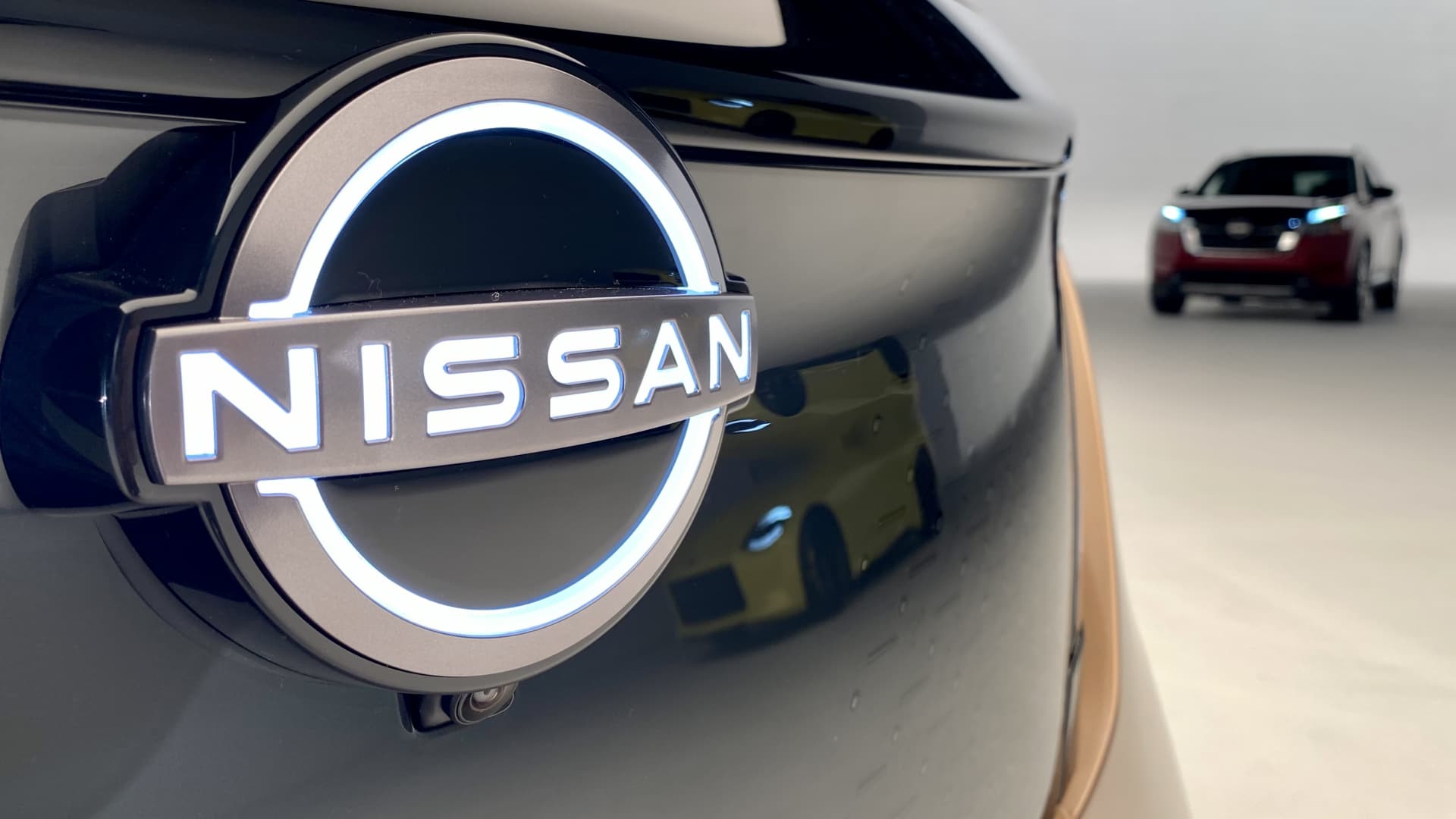
Nissan’s logo is illuminated on a prototype of its new all-electric Ariya crossover. Nissan’s Z Proto performance car is reflected in the vehicle’s grille, while a redesigned Nissan Pathfinder SUV sits in the background.
Michael Wayland / CNBC
Nissan Motor plans to introduce a new type of hybrid to the U.S. market that drives like an all-electric vehicle but is powered — not driven — by a traditional gas-powered engine.
The new Nissan “e-Power” is called a series hybrid. It uses the engine as a generator to power the vehicle’s electric motors that then propel the vehicle. It operates like emerging extended-range electric vehicles, or EREVs, but has a smaller battery and doesn’t require a plug.
It’s also different from a traditional hybrid, such as the Toyota Prius, because the gas engine in those vehicles is used to propel the vehicle. The series hybrid’s engine just keeps the battery charged to power the electric motors in the vehicles.
The e-Power hybrid system for Nissan is planned to launch domestically later this year in a new version of its popular Rogue compact SUV.
Timing for such a vehicle could be ideal for Nissan with climbing gas prices, slower-than-planned adoption of EVs and an expected surge in hybrid sales amid new entries, according to officials.
After losing billions of dollars on EVs, automakers such as Nissan are turning to hybrid vehicles to meet customer expectations for fuel economy and to help with driving performance.
S&P Global Mobility expects hybrids in the U.S. this year to increase to 18.4% of new vehicle sales, up from 12.6% last year and 7.3% in 2023. It’s forecasting pure EVs, meanwhile, will be 7.1% of new vehicle sales, down from 8% last year.
“This is a unique powertrain for the for the U.S.,” Kurt Rosolowsky, Nissan North America vehicle evaluation and test engineer, said during a media briefing. “This is an electrically driven vehicle, as far as what is powering the wheels, but it doesn’t have a plug, and you fill it up with gas like you do with a normal car.”
Series hybrids
Nissan and other automakers have used series hybrids elsewhere, particularly in Asia, but companies have been reluctant to bring the vehicles to the U.S. because of consumer expectations for driving dynamics and power.
To address those concerns, Nissan said it has developed a more powerful 1.5-liter, three-cylinder turbocharged engine specifically for the e-Power system, in addition to new packaging and other upgrades, to appease American buyers.
“The turbo is only there to serve efficiency at higher speeds for the gas engine to deliver energy,” Rosolowsky said.
The e-Power for the U.S. market is Nissan’s third generation of the series hybrid since it debuted in Japan in 2016. Since then, Nissan said it has sold more than 1.6 million vehicles globally with e-Power in nearly 70 countries.
“I think it’s going to be a really good system. I think it’s going to be very popular for Nissan in the new Rogue when it arrives later this year,” said Sam Abuelsamid, vice president of market research at communications and consulting firm Telemetry.
Abuelsamid said the only real drawback to the series hybrid is that it’s less efficient at higher speeds, which Nissan is trying to overcome with the new engine as well as battery size.
Driving e-Power
Driving a European version of the Nissan Rogue Sport sold with the ePower system around suburban Detroit, the vehicle’s driving dynamics — specifically fast acceleration and regenerative braking — are formidable.
They come with the familiar sound of an engine revving but without the shifting or sputtering of transmission gears and far less noise, vibration and harshness, or NVH, as the industry commonly refers to it.
“The driving experience really is what makes it different with those fewer components. You have less noise and less vibration,” Rosolowsky said.
Nissan e-Power logo
Courtesy Nissan
Unlike traditional gas-powered vehicles, the e-Power system also does not require a traditional transmission to shift gears or a driveshaft that transfers torque from the transmission to the differential, powering the wheels.
While the Rogue Sport is a smaller vehicle and only forward-wheel-drive, it’s easy to see how the system will translate to a larger vehicle with all-wheel-drive, which the new Rogue with e-Power will be.
The lack of a plug, some engine noise and slight vibration also might be more familiar for drivers who have been reluctant to adopt all-electric vehicles.
While Nissan is not releasing specifics such as pricing or fuel economy for the upcoming Rogue with e-Power, the Rogue Sport was achieving more than 40 miles per gallon during heavy city driving, according to the vehicle’s MPG system.
The current Nissan Rogue, depending on the model, can achieve more than 30 MPG, according to U.S. Department of Energy and the U.S. Environmental Protection Agency.
Nissan’s vehicles historically been less fuel efficient than those from its larger Japanese rivals. Honda Motor and Toyota Motor, the latter of which pioneered traditional hybrids with the Prius and continues to dominate the sector in the U.S.
Nissan declined to discuss the possibility of expanding the e-Power system to other vehicles in the U.S., but confirmed the new system is modular and capable of working with many different engines.
“If we were to expand this to other vehicles, you can theoretically bolt this onto another gasoline engine of a different size and have more options for an e-Power system,” Rosolowsky said.

A mini burger, mini fries and mini beer, Clinton Hall’s “Teeny Weeny Mini Meal”, is pictured next to a regular-sized combo on Dec. 8, 2025 in New York City. Approximately one in eight American adults are currently taking drugs from the class of GLP-1 agonists that are now popular for weight loss, according to a November poll by the non-profit health policy tracker KFF. Some in the restaurant industry are taking note.
Angela Weiss | AFP | Getty Images
The cost of GLP-1 drugs is falling, and pill versions are hitting the U.S. market. For restaurant chains and snacking giants, higher adoption of weight loss and diabetes treatments poses a threat to their sales — or an opportunity.
GLP-1 drugs slow digestion, suppress users’ appetites and increase satiety. For many restaurants and packaged food manufacturers, those reactions will likely mean weaker sales. Adults who use GLP-1s consume 21% fewer calories and spend nearly a third less on grocery bills on average, according to KPMG. JPMorgan estimates the growing use of the medications could wipe out $30 billion to $55 billion in annual sales for the food and beverage industry as soon as 2030.
About one in every eight U.S. adults is currently taking a GLP-1 drug like Ozempic or Zepbound, according to the KFF Health Tracking Poll conducted from Oct. 27 to Nov. 2. That number doesn’t include consumers who have discontinued their use of the drugs; 18% of respondents said that they have taken a GLP-1 medication at some point.
Those numbers are expected to keep climbing, especially after Novo Nordisk launched its Wegovy pill in January and Eli Lilly prepares to roll out its own oral drug this year. By 2030, more than 30 million Americans could be on a GLP-1 treatment, up from 10 million in 2026, based on J.P. Morgan estimates.
Michael Siluk | UCG | Universal Images Group | Getty Images
But the shift also presents an opportunity for restaurants and food and beverage companies.
With new protein- and fiber-rich options, many businesses are hoping to win over GLP-1 consumers and mollify investors’ concerns about how the treatments will affect their bottom lines.
“Whether it is labeling as GLP-1 friendly, decreasing the serving size, emphasizing protein content, or even when you shift over to the beverage world, because hydration is certainly a concern, there are a number of players that are starting to react to this,” said Don K. Johnson, principal of strategy and execution for EY-Parthenon.
Skipping snacks and breakfast
About half of GLP-1 users report consuming fewer calories while taking the medications, according to UBS Evidence Lab. But the effects aren’t even across the industry, and “certain categories are more impacted than others,” Johnson said.
Snacking, once one of the fastest-growing grocery segments, has taken the biggest hit. About 70% of GLP-1 users who report consuming fewer calories said that they are snacking less, according to a survey conducted by EY-Parthenon last spring.
“I think it is about the specific type of snack, but I do think they’re also snacking less … Having said that, we do see that there is a shift to healthier foods, and that certainly will include healthier snacking,” Johnson said.
Think more yogurt, nuts or fruit, and fewer chips or pretzels.
Since GLP-1 drugs lead patients to lower their caloric intake, every calorie consumed means more. Protein intake is more important to prevent muscle loss. So, too, is fiber to support gut health and digestion. And staying hydrated helps mitigate some of the drugs’ side effects, like nausea and headaches.
The effects of eating less extend to restaurants. About 60% of those respondents to the EY-Parthenon survey said that they are dining out less frequently.
The shift could also hit full-service restaurants where diners order a drink with their meals. Roughly 45% of survey respondents who are eating and drinking less said that they are drinking less alcohol.
Surveys conducted by Bernstein indicate that the frequency of restaurant visits among GLP-1 users can fall by as much as 45%, depending on the category of food and the nature of the occasion, analyst Danilo Gargiulo of Bernstein wrote in a research note published on Tuesday.
The pullback in restaurant visits isn’t spread evenly across times of day, according to Dana Baggett, executive director of restaurant client strategy at RRD, which works with more than 200 restaurant brands.
Lunch, so far, hasn’t been impacted, she said. But breakfast has taken a hit, particularly from high-income GLP-1 users, who represent a bigger percentage of current patients, she said. In practice, that means fewer sugary coffee drinks and doughnuts, although options like Starbucks‘ protein cold foam could encourage those consumers to return.
A commercial for GLP-1 drugs during the Super Bowl LX broadcast on television screens at a bar in Los Angeles, California, US, on Sunday, Feb. 8, 2026.
Jill Connelly | Bloomberg | Getty Images
Dinner, especially at fast-food restaurants, has taken the brunt of the damage so far.
Dinner traffic has fallen 6% among consumers who have been taking the medication regularly, according to Baggett; in other words, overall restaurant sales during dinner hours have declined about 0.4% due to GLP-1 use, she said. But as the number of consumers who use the drug consistently grows, so too will the pressure on restaurant traffic.
And snacking isn’t confined to grocery store aisles. For limited-service restaurants, like McDonald’s or Taco Bell, snacking accounts for 12% of spending, according to Bank of America Global Research.
Even so, threats to those large restaurants chains may only be gradual, which gives them time to adapt.
“I think there shouldn’t be this panic out there in the marketplace, but this is a trend that’s not going away,” Baggett said. “This is an amazing opportunity for brands to start repositioning themselves and focusing on what consumers want: less sugar, higher protein and that focus on fiber.”
How Big Food is evolving
If recent earnings conference calls are any example, restaurant and food executives also think that it isn’t time to panic just yet. For some companies, the trend offers a chance to reach new customers through healthier options.
“I think there are more opportunities than threats, but there are both,” PepsiCo CEO Ramon Laguarta told Wall Street analysts on the company’s earnings conference call in early February.
In recent months, Pepsi has released protein-packed Doritos, relaunched Gatorade and unveiled fiber-rich varieties of SunChips and Smartfood popcorn. Those moves are part of the company’s broader strategy to modernize its portfolio and boost sales by appealing to health-conscious consumers, but they also align with Laguarta’s assumption that GLP-1 medications will be adopted more broadly.
Domino’s Pizza CEO Russell Weiner sounded unshaken when he told analysts last month that the pizza chain hasn’t seen GLP-1 drugs affect its sales yet.
“Dinner, for us, is a sharing occasion, so perhaps that’s why we’re not seeing any impact, but we’re going to continue to watch it,” he said. “But if there needs to be menu innovation around that, we will do that.”
RRD’s Baggett told CNBC that she thinks portions and snack sizing will be key for restaurants to attract consumers who are on GLP-1 treatments.
When asked about the drugs on McDonald’s earnings conference call last month, CEO Chris Kempczinski touted the burger chain’s existing protein options. But he added that the preferences of GLP-1 users are also being considered as the chain creates new menu items.
“We’re also seeing changes around maybe less snacking, changes in some of the beverages that they drink, less sugary drinks, and so all of those things are factoring into some of what we’re out there experimenting with and testing with,” he said.
Other restaurant chains have already launched options that appeal to diners on GLP-1 drugs, even if the medications weren’t the key impetus. For example, Chipotle launched grab-and-go protein cups in December, aiming to cash in on the protein and snacking crazes as its restaurant sales struggled.
And Olive Garden, owned by Darden Restaurants, released a Lighter Portions menu last year, downsizing a handful of its classic entrees at a lower price. Darden CEO Rick Cardenas said that the chain introduced the new menu to give all of its customers more options.
“It just so happens to benefit the consumers that might want smaller portions that are on GLP-1 medications, and we have a lot of options like that in all of our menus,” Cardenas said on the company’s earnings conference call in December.
Marketing to GLP-1 users
Other companies have explicitly appealed to GLP-1 users, particularly when it comes to innovation.
In 2024, Nestle led the pack when it launched Virtual Pursuit, a frozen-food brand targeting GLP-1 users. While the packaging initially didn’t call out that it was “GLP-1 friendly,” the food company updated it later to include it prominently, boosting sales.
“It’s a big initiative for Nestle,” Nestle USA CEO Marty Thompson told CNBC at a media event earlier in March. “There will be those things that are designed for GLP-1, and there will be those things that will be sort of a companion to GLP-1, clearly calling out protein and fiber, but not necessarily designed portion-size wise or whatever for GLP-1.”
Nestle’s focus will extend beyond food, too. Thompson said that the company plans to expand into beverages and listed protein shakes as one potential way to appeal to GLP-1 customers.
Even food companies without much exposure to GLP-1 users are broadening their portfolios to reach them.
Close-up view of Dippin’ Dots ice cream cup in a person’s hand, Santa Cruz, California, June 22, 2024.
Smith Collection | Gado | Archive Photos | Getty Images
For example, Dippin’ Dots and Icee owner J&J Snack Foods makes most of its sales in stadiums, theme parks and malls. Because of its “experiential” focus, CEO Dan Fachner told CNBC that he thinks that J&J is more insulated from the effect of GLP-1 drugs compared with its snacking peers.
“I still think that in most cases, even people on GLP-1 drugs will still use those occasions for snacking,” he said.
Even still, more than a year ago, Fachner presented employees with a challenge for the company’s grocery business, which accounts for 13.5% of annual sales.
“Take the core products — pretzels and churros and Icees and Dippin’ Dots and frozen novelties — tell me how we can make them more GLP-1 friendly as it continues to grow,” he said.
This year, J&J has a number of new products hitting the freezer aisle. Protein has been added to its soft pretzels, now available in a smaller portion size. And Luigi’s Italian Ice, traditionally sold in a cup, will come in a “mini pop size,” with a formula that includes more antioxidants or helps hydration, according to Fachner. If the new products succeed in grocery stores, then J&J plans to take them to the company’s food service customers, as well.
J&J’s new products also have the benefit of appealing to a wider audience than just consumers who are on GLP-1 medication. For example, Fachner expects the new Luigi’s mini pops will appeal to health-conscious moms as a snack for their kids.
Uptake could change strategies
For restaurants and food suppliers, current data on the eating and drinking habits of GLP-1 users are informing their efforts to appeal to those consumers. But that behavior can still fluctuate.
About 5% of users lapse in taking the medications, due to cost, side effects or hitting their weight goal. After quitting, they tend to maintain the same eating habits for a couple of months before eventually returning to a higher caloric intake.
“I think that we don’t spend enough time talking about the fact that there may be sort of a cycle of behaviors — people going on and off of the drugs — that will have sort of an interesting impact on manufacturers of food because there’s no ‘before’ and ‘after,'” EY’s Johnson said. “It’s a process.”
And a whole new group of consumers could soon be taking daily pill versions of GLP-1 medications. It’s too soon to tell if oral GLP-1 drugs will result in more consistent usage or higher quit rates and to know who exactly is trying the pill version over the injectable.
“I don’t have a crystal ball, but my guess is from our survey that the folks using the oral version of the drug will be a new set of people, because one of the barriers to trial was — as can be expected — a lot of people don’t like to take shots of injections,” Johnson said.
There is one prediction that is widely accepted: the pill version will mean much higher adoption of GLP-1 drugs.
Business
Has oil crisis Trumped US? Inside the war-time paradox of fighting Iran and funding its crude – The Times of India

The United States is fighting Iran on the battlefield, and turning to its oil to keep the global economy afloat. As war in the Middle East chokes supplies through the Strait of Hormuz and sends prices soaring, the Donald Trump administration has begun easing restrictions on Iranian crude, allowing allies to buy the very resource that funds Tehran. For a president who came to power vowing to avoid “stupid” wars, the moment is especially fraught, a conflict he helped set in motion now risks slipping beyond his control, both on the battlefield and in its economic fallout.The move lays bare a stark war-time paradox — in trying to weaken Iran, Washington is being forced to rely on it.Though the move has been framed as “very temporary”, Mike Waltz, speaking at a CNN town hall, defended it as necessary to counter Iran’s strategy of driving up global energy prices.Even the administration’s messaging has been mixed — de-escalation in rhetoric, escalation in action. Trump said he was considering “winding down” military operations in the Middle East, even as the United States deployed three more amphibious assault ships and roughly 2,500 additional Marines to the region. Moreover, it attacked Iran’s nuclear facility Natanz again, even as Tehran has clearly warned against any attacks on its energy infrastructure, else bear oil shocks. Then what explains this sanctions shift?
World’s energy lifeline hit
Three weeks into the war with Iran, the United States is confronting a supply disruption of a scale few policymakers had anticipated. The near-total shutdown of the Strait of Hormuz has choked one of the world’s most critical oil arteries, sending shockwaves through global markets.The crisis has been compounded by direct attacks on critical energy infrastructure across the region. Strikes on Iran’s South Pars gasfield, part of the world’s largest natural gas reserve, were followed by missile attacks on Qatar’s Ras Laffan LNG facilities, causing extensive damage to one of the world’s biggest gas export hubs. Additional targets have included refineries in Saudi Arabia, Kuwait, and the UAE, raising fears of a broader energy war. With some of these facilities expected to take three to five years to fully repair, the disruption is no longer temporary — it threatens to lock in a prolonged global supply crunch. Brent crude, the international benchmark, has surged to around $106 per barrel, up sharply from roughly $70 before the conflict, underscoring how rapidly the crisis has escalated and how tightly global prices are tied to Middle East stability. Inside the administration of Donald Trump, officials are scrambling for solutions that can meaningfully ease supply pressures. A newly announced pause in sanctions applies only to Iranian oil already loaded on ships and is set to expire by April 19, limiting its immediate impact. Crucially, the move does not increase actual production, a central factor behind soaring prices, and much of Iran’s oil was already finding its way to buyers despite sanctions. That reality mirrors earlier steps, including a temporary pause on restrictions on some Russian shipments, which critics said offered only modest relief while exposing the limits of Washington’s options.
Policy levers pulled with little effect
Washington has already deployed nearly every conventional mechanism to cushion the blow. Hundreds of millions of barrels have been released from strategic reserves, sanctions on Russian oil have been partially eased, and domestic crude flows have been accelerated in an effort to boost supply. Yet these measures have barely dented rising prices. Global benchmarks continue to surge, and US consumers are feeling the impact at the pump. Officials privately acknowledge that the tools at their disposal are either insufficient in scale or too slow to counter the immediacy of the crisis, exposing the limits of state intervention in a tightly wound global oil market. The strain is also evident in Washington’s shifting diplomatic posture. After initially insisting the US did not need Nato’s help to secure the Strait of Hormuz, Donald Trump publicly urged allies to “step up” and help reopen the vital route. The appeal has met a muted response, with many countries reluctant to be drawn into a conflict they did not start, further complicating efforts to stabilize the situation and underlining the limits of US leverage even among its partners.Trump has criticized Nato countries as “cowards” for refusing to assist while insisting the campaign is unfolding according to plan, even declaring the battle “militarily won.” Yet those claims sit uneasily against the reality of a defiant Iran continuing to choke off Gulf energy flows and launch missile strikes across the region, underscoring the widening gap between rhetoric and conditions on the ground.
Finally, turning to enemy’s oil
With options dwindling, the administration has turned to a controversial stopgap: allowing allies to purchase Iranian oil already at sea. The move is designed to inject roughly 140 million barrels into a market starved of supply, offering short-term relief even as the broader conflict rages on. Officials argue that this oil would have likely been sold regardless, particularly to countries willing to bypass sanctions. Redirecting those flows to US allies, they contend, helps stabilize markets without fundamentally altering the pressure campaign against Tehran. Still, the decision lays bare an uncomfortable truth, that immediate economic needs are forcing Washington into choices that cut against its own strategic posture.
But is it enough to solve the energy crisis?
Even with Iranian barrels entering the market, the relief is expected to be fleeting. The additional supply amounts to barely a day and a half of global consumption, underscoring how limited the impact will be if disruptions persist. Energy experts warn that without a reopening of key shipping routes, the imbalance between supply and demand will continue to widen. That leaves the administration facing a stark choice: find a way to restore passage through the Strait of Hormuz or brace for prolonged economic fallout. For now, officials appear to be managing rather than resolving the crisis, navigating a war where the battlefield extends far beyond missiles and troops, deep into the fragile mechanics of the global economy.
Will the war end?
Beyond the immediate energy crisis, the conflict is pushing Donald Trump toward a deeper strategic crossroads. Analysts say the administration now faces a narrowing set of choices under what it has called Operation Epic Fury, with no clear indication of which path it is prepared to take, Reuters reported. One option is escalation — intensifying the offensive, potentially targeting critical infrastructure such as Iran’s oil hub at Kharg Island or expanding the US military footprint along Iran’s coast to neutralize missile threats. But such a move risks drawing Washington into a prolonged conflict, one that could face significant resistance from an American public wary of another long war in the Middle East. The alternative is to claim victory and scale back operations. Yet that, too, carries risks. It could leave Gulf allies exposed to a weakened but still defiant Iran, capable of disrupting shipping lanes and projecting power across the region. With diplomacy stalled and neither side showing signs of backing down, the administration is left navigating a conflict where every option deepens the very uncertainty it is trying to contain.


Arne Slot: Liverpool’s defeat to Brighton ‘hurts a lot’

Men’s March Madness live tracker: Updates on Saturday’s games

Dua Lipa pouts with director pal after locking major deal

-
 Business1 week ago
US issues 30-day waiver for Russian oil shipments stranded at sea | The Express Tribune
-

 Fashion1 week ago
Chinese firm to invest $15.34 million in garment factory at BEPZA
-

 Tech1 week ago
Tips and Advice for Buying Used or Refurbished Electronics
-
 Fashion1 week ago
US unemployment rate 4.4% in Feb 2026, LFPR 62%: BLS
-

 Sports1 week ago
Bilas’ All-America teams: My top 20 men’s college basketball players of 2025-26
-
 Business1 week ago
Oil holds above $100 as tensions escalates between Iran, US and Israel – SUCH TV
-
 Business1 week ago
UAE savings strategies 2026 explained: Best apps, tools, budget rules and smart money hacks to beat rising cost of living in emirates – The Times of India
-
 Entertainment6 days ago
Strategic oil stocks to be released ‘immediately’ in Asia and Oceania: IEA