

Business
Data centres to be expanded across UK as concerns mount

 Getty Images
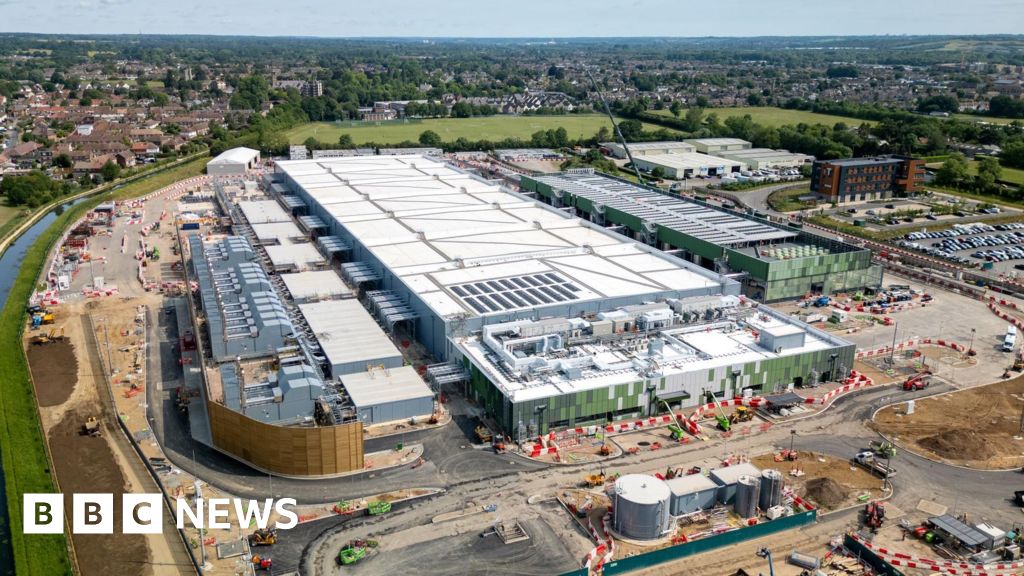
The number of data centres in the UK is set to increase by almost a fifth, according to figures shared with BBC News.
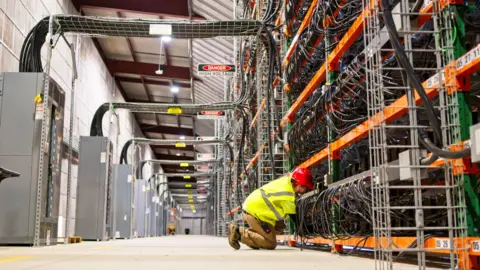
Data centres are giant warehouses full of powerful computers used to run digital services from movie streaming to online banking – there are currently an estimated 477 of them in the UK.
Construction researchers Barbour have analysed planning documents and say that number is set to jump by almost 100, as the growth in artificial intelligence (AI) increases the need for processing power.
The majority are due to be built in the next five years.
However, there are concerns about the huge amount of energy and water the new data centres will consume.
Some experts have warned it could drive up prices paid by consumers.
More than half of the new data centres would be in London and neighbouring counties.
Many are privately funded by US tech giants such as Google and Microsoft and major investment firms.
A further nine are planned in Wales, one in Scotland, five in Greater Manchester and a handful in other parts of the UK, the data shows.
While the new data centres are mostly due for completion by 2030, the biggest single one planned would come later – a £10-billion AI data centre in Blyth, near Newcastle, for the American private investment and wealth management company Blackstone Group.
It would involve building 10 giant buildings covering 540,000 square meters – the size of several large shopping centres – on the site of a former Blyth Power Station.
Works are set to begin in 2031 and last for more than three years.
Microsoft is planning four new data centres in the UK at a total cost of £330 million, with an estimated completion between 2027 and 2029 – two in the Leeds area, one near Newport in Wales, and a five-storey site in Acton, north west London.
And Google is building two data centres, totalling £450m, spread over 400,000 sq m in north east London in the Lee Valley water system.
By some analyses, the UK is already the third-largest nation for data centres behind the US and Germany.
The government has made clear it believes data centres are central to the UK’s economic future – designating them critical national infrastructure.
But there are concerns about their impact, including the potential knock-on effect on people’s energy bills.
It is not known what the energy consumption of the new centres will be as this data is not included in the planning applications, but US data suggests they are can be considerably more powerful than older ones.
Dr Sasha Luccioni, AI and climate lead at machine learning firm Hugging Face, explains that in the US “average citizens in places like Ohio are seeing their monthly bills go up by $20 (£15) because of data centres”.
She said the timeline for the new data centres in the UK was “aggressive” and called for “mechanisms for companies to pay the price for extra energy to power data centres – not consumers”.
According to the National System Operator, NESO, the projected growth of data centres in Great Britain could “add up to 71 TWh of electricity demand” in the next 25 years, which it says redoubles the need for clean power – such as offshore wind.
‘Fixated with sustainability’
There are also growing concerns about the environmental impact of these enormous buildings.
Many existing data centre plants require large quantities of water to prevent them from overheating – and most current owners do not share data about their water consumption.
Stephen Hone, chief executive of industry body the Data Centre Alliance, says “ensuring there is enough water and electricity powering data centres isn’t something the industry can solve on its own”.
But he insisted “data centres are fixated with becoming as sustainable as possible”, such as through dry-cooling methods.
Such promises of future solutions have failed to appease some.
In Potters Bar, Hertfordshire, residents are objecting to the construction of a £3.8bn cloud and AI centre on greenbelt land, describing the area as the “lungs” of their home.
And in Dublin there is currently a moratorium on the building of any new data centres because of the strain existing ones have placed on Ireland’s national electricity provider.
In 2023 they accounted for one fifth of the country’s energy demand.

 Getty Images
Last month, Anglian Water objected to plans for a 435 acre data centre site in North Lincolnshire. The developer says it aims to deploy “closed loop” cooling systems which would not place a strain on the water supply.
The planning documents suggest that 28 of the new data centres would be likely to be serviced by troubled Thames Water, including 14 more in Slough, which has already been described as having Europe’s largest cluster of the buildings.
The BBC understands Thames Water was talking to the government earlier this year about the challenge of water demand in relation to data centres and how it can be mitigated.
Water UK, the trade body for all water firms, said it “desperately” wants to supply the centres but “planning hurdles” need to be cleared more quickly.
Ten new reservoirs are being built in Lincolnshire, the West Midlands and south-east England.
A spokesperson for the UK Government said data centres were “essential” and an AI Energy Council had been established to make sure supply can meet demand, alongside £104bn in water infrastructure investment.
Additional reporting by Tommy Lumby

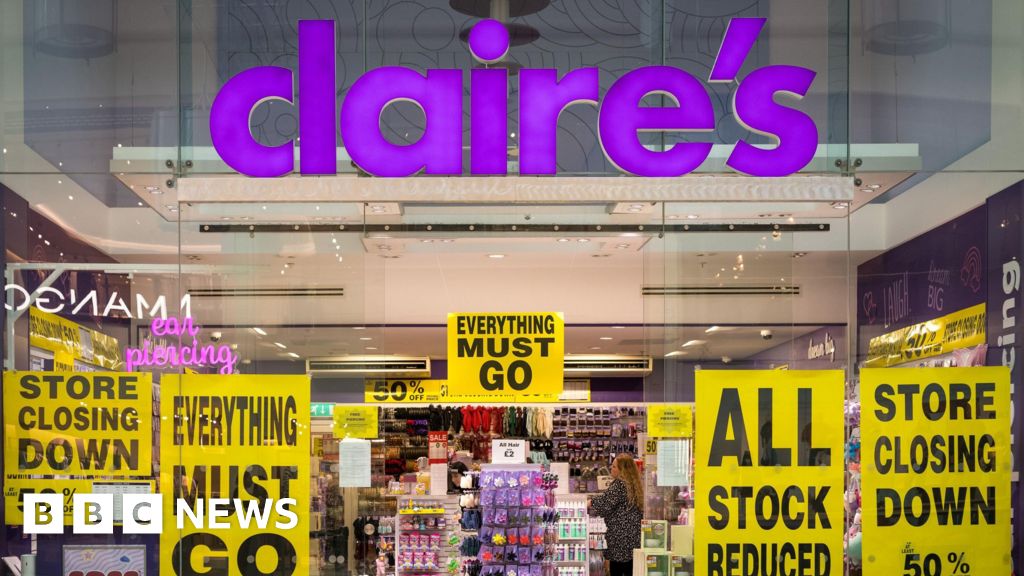
All of the chain’s standalone stores have stopped trading in the UK and Ireland.
Source link

A pedestrian walks by a Domino’s Pizza on Dec. 9, 2025 in San Francisco, California.
Justin Sullivan | Getty Images
Domino’s Pizza stock fell 10% in morning trading on Monday after it reported weaker-than-expected U.S. same-store sales growth.
The chain’s domestic same-store sales rose just 0.9%, lower than the 2.3% bump expected by Wall Street analysts, based on StreetAccount estimates.
“We’re not happy with it,” CEO Russell Weiner told CNBC.
The pizza chain also lowered its full-year U.S. same-store sales forecast to low-single digit growth, down from its prior projection that U.S. same-store sales will increase 3%.
Weiner said he expects more fast-food chains to report similar headwinds from winter weather and weak consumer sentiment, which took a dive in March due to spiking fuel prices caused by the U.S.-Israeli war with Iran.
“One of the bad things about reporting first is you don’t get to hear about anybody else,” Weiner said.
Domino’s kicked off the earnings season for restaurant chains. Starbucks is on deck after the bell on Tuesday, and Chipotle Mexican Grill and Pizza Hut owner Yum Brands are expected to share their results on Wednesday. Rival Papa John’s will report its earnings next Thursday.
During the quarter, Domino’s also faced stiffer competition from rival pizza chains. Papa John’s and Pizza Hut both matched Domino’s $9.99 “Best Deal Ever” with promotions at the same price point. And Little Caesars undercut Domino’s $6.99 Mix & Match deal with a $5.99 version.
“People are seeing what we’re doing, and they’re sick of losing share, and they’re coming at it,” Weiner said, adding that he still expects Papa John’s and Pizza Hut to report same-store sales declines for the quarter despite the new promotions.
Looking ahead, Weiner expressed confidence that Domino’s will prove itself in the long run.
“Domino’s has got a bigger advertising budget than our second two competitors combined,” he said. “And those competitors are both going up for sale, so we know things aren’t good there right now.”
Yum announced in November that it was exploring strategic options for Pizza Hut, which could include a sale. And Papa John’s is reportedly in talks with Qatari-backed Irth Capital to go private. Both chains have also announced plans to close hundreds of restaurants this year, which could further boost Domino’s dominant position in the pizza category.
And if either Pizza Hut or Papa John’s goes private, Weiner said he expects that a new owner would shutter even more locations — a win for Domino’s.
Shares of Domino’s have lost nearly a third of their value over the last year. The company’s market cap has fallen to roughly $11.2 billion.

United Airlines CEO Scott Kirby (L) and American Airlines CEO Robert Isom listen as U.S. Transportation Secretary Sean Duffy speaks to reporters outside the White House on October 30, 2025 in Washington, D.C.
Kevin Dietsch | Getty Images
United Airlines CEO Scott Kirby confirmed Monday that he contacted American Airlines about a potential merger, a possibility American rejected.
“I approached American about exploring a combination because I thought we could do something incredible for customers together,” Kirby said in a statement. He said he shared his “big, bold vision” because he was confident it could win regulatory approval.
American rejected the idea and its CEO, Robert Isom, last week said such a merger would be bad for customers and “anticompetitive.”
Kirby had floated the idea to the Trump administration earlier this year, according to people familiar with the matter who weren’t authorized to discuss the private conversation, in hopes that the combination would mean a big global airline to compete with foreign rivals
American declined to comment on Kirby’s Monday statement.
“I was hoping to pitch that story to American, but they declined to engage and instead responded by publicly closing the door,” Kirby said in his statement Monday. “And without a willing partner, something this big simply can’t get done.”
He said that “American’s public comments make it clear that a merger like this is off the table for the foreseeable future” but outlined his vision for a combined airline.
Kirby reiterated that the country has deficit with foreign airlines that fly more than half of the long-haul seats into the U.S., with most of the customers being Americans.
“The combined scale of United and American would be a better way to compete with foreign carriers,” he said.
President Donald Trump said he was against the idea of a combination last week.
“I don’t like having them merge,” he told CNBC’s “Squawk Box” on Tuesday morning. He said he would, however, like someone to buy struggling discount carrier Spirit but he also suggested that the federal government could “help that one out.”
Spirit and the Trump administration are in advanced talks for a rescue package.


Melania Trump says ABC should ‘take a stand’ on late-night host Kimmel

A Brain Implant for Depression Is About to Be Tested in Humans

UN proliferation meeting begins amid ‘looming’ risk of nuclear arms race

-

 Sports1 week ago
NCAA men’s gymnastics championship: All-time winners list
-

 Sports1 week ago
WWE WrestleMania 42 Night 2: Live match results and analysis
-

 Politics6 days ago
UK’s Starmer seeks to deflect blame over Mandelson appointment
-

 Fashion1 week ago
UK’s Sosandar returns to profitability amid robust FY26 performance
-

 Entertainment7 days ago
Lee Anderson, Zarah Sultana kicked out of UK Parliament for calling PM ‘liar’
-
 Business7 days ago
How Trump’s psychedelics executive order could unlock stalled cannabis reform
-
 Business1 week ago
No fuel shortage: Govt assures 100% domestic LPG, PNG, CNG supply amid Hormuz energy crunch – The Times of India
-

 Sports1 week ago
Quetta Gladiators opt to bowl after winning toss against Peshawar Zalmi in PSL 11 clash