

Business
Gatwick airport second runway approved by transport secretary

Katy AustinTransport correspondent and
Jamie WhiteheadBBC News
 PA Media
Transport Secretary Heidi Alexander has approved plans for a second runway at London Gatwick Airport, as the government looks for economic growth opportunities.
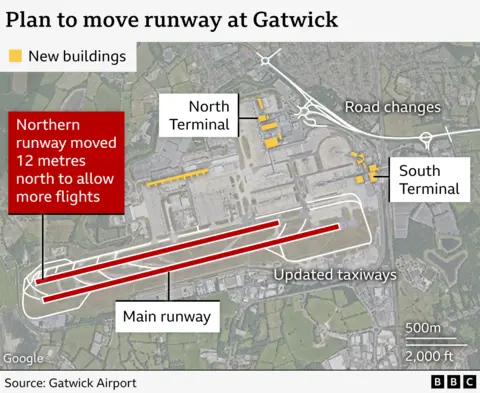
The £2.2bn privately-financed project involves in effect moving the current Northern Runway 12 metres to bring it into regular use, as well as other developments, including extending the size of terminals.
The airport says its plans will bring jobs and boost the local economy. But there has long been opposition from campaigners and groups worried about the impact on the surrounding area.
Gatwick currently handles about 280,000 flights a year. It says the plan would enable that number to rise to around 389,000 by the late 2030s.
A government source has described the plans as a “no-brainer for growth,” adding that “it is possible that planes could be taking off from a new full runway at Gatwick before the next general election.”
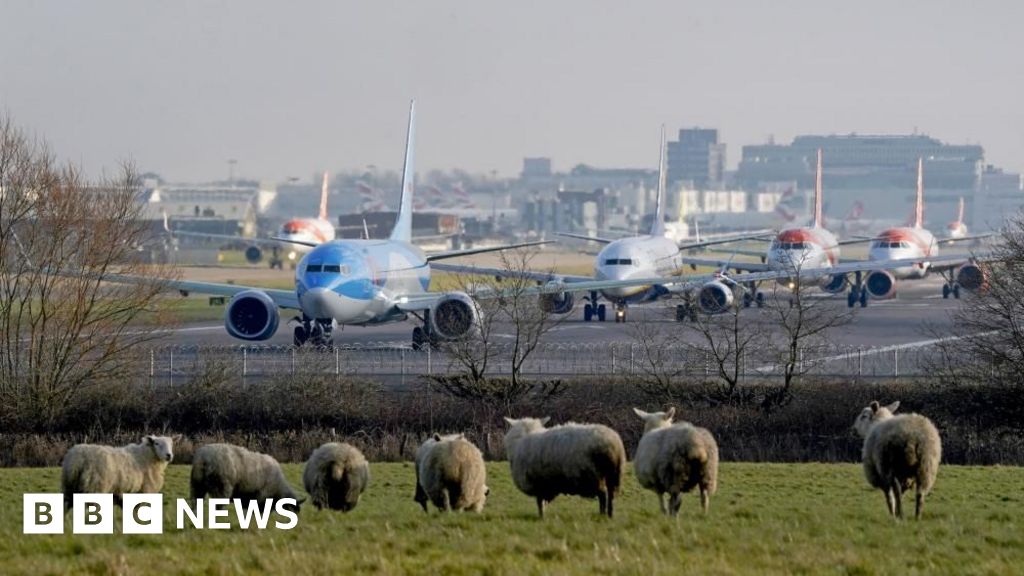
London Gatwick, in West Sussex, is currently Europe’s busiest single-runway airport with more than 40 million passengers using it every year.
The plans approved by Ms Alexander would include adding 40,000 more flights before the second runway opens, and 70,000 more – almost 190 a day – once it is fully up and running.
The airport says that passenger numbers could rise to up to 80 million.
Currently, the Northern Runway is currently only used for taxiing or as a back up.
The second runway would be used for short haul flights, with capacity also freed up for more long-haul services from the main runway.

The decision to approve the expansion plan had been expected in February, but at the time, the transport secretary only said she was “minded to grant consent” for the Northern Runway planning application.
It emerged planning inspectors had expressed concerns over the effect the proposals would have on several aspects on the area surrounding the airport, including traffic and noise.
In April, Gatwick Airport agreed to stricter noise controls, an enhanced insulation scheme for nearby residents, and having 54% of air passengers using public transport before the Northern Runway opened.
To achieve this target, the airport said, third parties – including the Department for Transport – would need to “support delivery of the necessary conditions and improvements required to meet this target,” giving the example of reinstating the full Gatwick Express rail service.
Before the Covid-19 pandemic, the Gatwick Express ran a service of four trains per hour non-stop between the airport and London Victoria, this was reduced to two trains per hour from 2022.
Gatwick Airport also proposed a cars-on-the-road limit if the 54% target could not be met before the first use of the Northern Runway to address possible road congestion concerns.
It added that if neither the target nor the cars-on-the road limit could be met, the runway plans would be delayed until the required £350m of road improvements had been completed.
“This would make sure any additional road traffic flows can be accommodated and any congestion avoided,” the airport said.
“This government has taken unprecedented steps to get this done, navigating a needlessly complex planning system, which our reforms will simplify in future,” the government source said.
“Any airport expansion must be delivered in line with our legally binding climate change commitments and meet strict environmental requirements.”
Chris Curtis, who chairs the Labour Party’s growth group, welcomed the approval but said “radical planning reform” was needed to enable future projects to be completed more swiftly.
Shadow transport secretary Richard Holden welcomed the decision as “a vital step towards driving economic growth”.
But he said approval should have been made months ago and accused Labour of creating “uncertainty for businesses and local communities”.
But there is strong opposition to any expansion, particularly from climate campaigners.
Green Party leader Zack Polanski said approval of the expansion plan was a “disaster for the climate crisis”.
Hannah Lawrence, spokesperson for Stay Grounded, said “We need an immediate end to airport expansion and money put into improving sustainable transport such as trains.”
In February, Greenpeace UK policy director Douglas Parr said the extension would not drive economic growth. “The only thing it’s set to boost is air pollution, noise, and climate emissions,” he added.
Alex Chapman, senior economist at left-of-centre think tank New Economics Foundation, also argued the move would not create new jobs, but would just shift them from other parts of the country.
“People are already perfectly able to catch cheap flights on holiday or travel for business,” he added.
Unite the Union general secretary Sharon Graham backed Gatwick having a second runway, but warned it would need “to come with guarantees of well paid, unionised jobs and proper facilities for workers”.

Sally Pavey, chair of Communities Against Gatwick Noise Emissions (CAGNE), said she was worried about “uncontrollable noise, ramifications on the roads, decline in air quality… and climate change”.
“We can’t keep ignoring climate change and it would be wrong to allow a new ‘bucket and spade’ runway, as we put it, at the expense of residents and the economy,” she said.
The group would take legal action through a judicial review if the expansion goes ahead, she added.
Gatwick’s is the latest in a string of airport expansion approvals, most recently Luton’s in June.
The government has also expressed support for a third runway at the country’s biggest airport, Heathrow, but that would be a much more complex, costly and controversial project.
Trump said on Saturday that an agreement would include the reopening of the Strait of Hormuz, without giving further details.
Source link
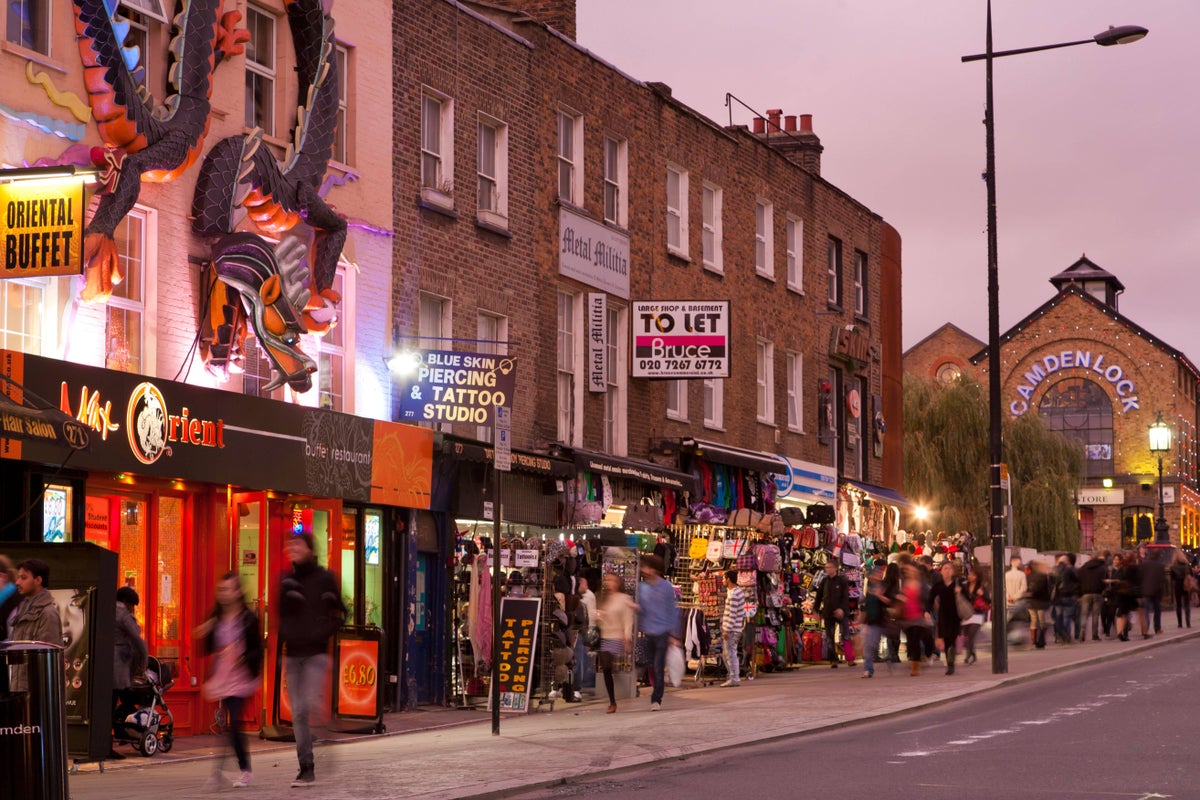
UK high streets and shopping destinations are showing signs of recovery as more than 13 retail stores opened each week over the past year, according to new figures.
However, England and Wales have still seen more than 6,000 retail premises vanish from local communities over the past five years.
Analysis of Valuation Office Agency data by tax firm Ryan, found that there were 507,810 retail premises across England and Wales at the end of 2025.
It said the figures showed that a recent contraction across the sector has appeared to stabilise, with a 723 net increase in the number of retail stores compared with a year earlier.
Property numbers increased across every region of England and Wales, with the exception of the North West, which saw a decline of 41.
It suggests that parts of the sector are now beginning to rebalance following significant structural contraction seen since the pandemic.
The creation of new retail units also comes as many retail real estate firms, such as Hammerson, have turned empty large units, often former department stores, into a greater number of smaller units.
Other retail groups, such as John Lewis, have moved away from ambitions to transform some retail property for other uses such as rental accommodation.
Nevertheless, the retail sector is still facing pressure from higher business rates for many firms, increased labour costs and concerns over consumer sentiment.
The data also shows that there has also been significant decline over the past few years, with a net reduction of 6,045 retail properties since the end of 2020.
London recorded the largest five-year regional reduction, with 1,266 retail premises disappearing over the period, followed by the South East (-1,191), North West (-719) and North East (-672).
The figures show retail premises which have permanently disappeared from communities altogether, having either been demolished or converted for alternative use.
The figures come as Ryan’s 2026 annual business rates review highlighted that the retail sector saw a 9.3% increase in rateable values at the 2026 business rates revaluation despite the major shift in the retail landscape since the pandemic.
Alex Probyn, practice leader for Europe and Asia-Pacific property tax at Ryan, said: “The pandemic accelerated structural changes that were already emerging across the retail sector, including changing consumer behaviour, hybrid working patterns and a reduced reliance on traditional retail floorspace in many locations.
“Many locations were arguably over-retailed before Covid and high streets have evolved towards more mixed-use environments, with retail space being rebalanced alongside growing demand for residential, leisure, hospitality and service-led uses.
“The revaluation outcome does suggest a large proportion of retail premises have seen bigger increases in their assessments than underlying market conditions and rental evidence would have led occupiers to expect.
“Retailers should therefore carefully review and, where appropriate, challenge their assessments.”

Indians sharply cut back on overseas travel spending in March, with remittances for foreign trips dropping by more than $212 million from the previous month, according to Reserve Bank of India data. The fall in outbound travel expenditure came amid rising oil prices linked to the Middle East conflict and persistent pressure on rupee, even as travel remained the single largest component of outward remittances under the Liberalised Remittance Scheme (LRS).In March, travel-related remittances fell to $1.09 billion from $1.3 billion in February and $1.65 billion in January. The decline came at a time when the West Asia conflict pushed oil prices higher and weakened rupee to record lows. Amid the situation, Prime Minister Narendra Modi urged citizens to cut down on foreign travel and adopt measures such as carpooling. Lower overseas travel spending could reduce foreign exchange outflows and help ease pressure on rupee.According to the RBI’s data on outward remittances by resident individuals, travel continued to account for the largest share of money sent abroad under the LRS in March. Total remittances during the month stood at $2.59 billion.The RBI tracks overseas spending across categories including travel, studies abroad, maintenance of close relatives, overseas investments, and property purchases. Under the LRS framework, resident individuals, including minors, can remit up to $250,000 in a financial year for permitted current or capital account transactions.Within the travel segment, the biggest component remained the ‘other travel’ category, which covers holiday spending and international credit card settlements. Indians spent $623.05 million under this category in March, accounting for nearly 57 per cent of total travel-related remittances during the month.Expenditure linked to education travel, including hostel and fee payments, stood at $450.16 million. Business travel, pilgrimage, and overseas medical treatment together accounted for $21.39 million.The data also showed a rise in remittances meant for the maintenance of close relatives abroad. Such transfers increased to $389.78 million in March from $266.18 million in February.At the same time, spending under the ‘studies abroad’ category declined. This category includes payments made for educational services accessed remotely without travelling overseas, such as correspondence courses. Remittances under this head stood at $151.71 million in March, compared to $175.68 million in February and $267.42 million in January.For the financial year 2024-25, Indians remitted a total of $29.56 billion under the LRS. Travel made up the largest portion of this amount at $16.96 billion.The RBI figures further showed that investments by Indians in overseas equity and debt instruments rose significantly to $440.22 million in March from $265.99 million in February.Meanwhile, outward remittances for the purchase of immovable property overseas declined to $38.68 million in March, down from $51.36 million a month earlier.


Net employment in Australia drops by 18,600 MoM in April: ABS

Zayn Malik thanks fans after ‘epic’ Konnakol Tour opening night

Travis Head and wife Jessica suffer online abuse after Kohli spat

-

 Entertainment1 week ago
Where Pete Davidson, Elsie Hewitt stand after breakup: Details revealed
-

 Politics1 week ago
Rising diesel costs from Iran war strain US school budgets
-

 Tech1 week ago
Why Is Your Grill So Dumb? The Best Grills Set Temp Like an Oven
-

 Tech1 week ago
This Solar-Powered Smart Sprinkler Keeps My Lawn Watered Without Any Power Cables
-

 Fashion6 days ago
Nigeria Kwara Garment Factory, KWS Garment Production Village ink pact
-

 Sports1 week ago
Pakistan steady after Das ton | The Express Tribune
-

 Entertainment1 week ago
Princess of Wales praised as ‘step ahead’ of royal family
-

 Fashion7 days ago
India’s Pearl Global’s FY26 revenue crosses $521 mn milestone