

Politics
China’s new K visa beckons foreign tech talent as US hikes H-1B fee

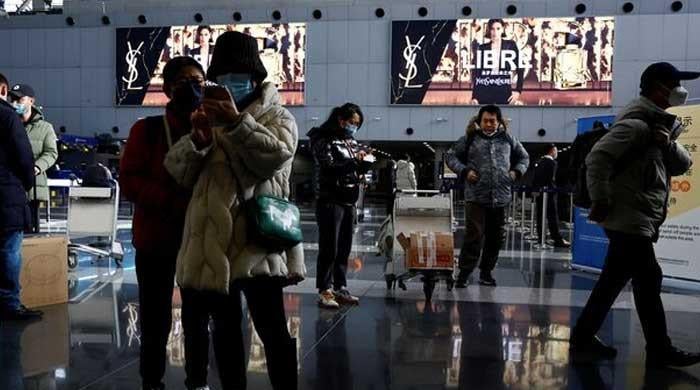
BEIJING: China’s new visa programme aimed at attracting foreign tech talent kicks off this week, a move seen boosting Beijing’s fortunes in its geopolitical rivalry with Washington, as a new US visa policy prompts would-be applicants to scramble for alternatives.
While China has no shortage of skilled local engineers, the programme is part of an effort by Beijing to portray itself as a country welcoming foreign investment and talent, as rising trade tensions due to US tariffs cloud the country’s economic outlook.
China has taken a series of measures to boost foreign investment and travel, opening more sectors to overseas investors and offering visa waivers for citizens from most European countries, Japan and South Korea, among others.
“The symbolism is powerful: while the US raises barriers, China is lowering them,” said Iowa-based immigration attorney Matt Mauntel-Medici, referring to China’s new visa category, called the K visa, which launches on Wednesday.
Perfect timing
The K visa, announced in August, targets young foreign science, technology, engineering and mathematics (STEM) graduates and promises to allow entry, residence and employment without a job offer, which could appeal to foreign workers looking for alternatives to US job opportunities.
Earlier this month, the Trump administration said it would ask companies to pay $100,000 per year for H-1B worker visas, widely used by tech companies to hire skilled foreign workers.
“The US has definitely shot itself in the foot on H-1Bs, and the timing is exquisite for China’s K visa,” said Michael Feller, chief strategist at Geopolitical Strategy.
Other countries including South Korea, Germany and New Zealand are also loosening visa rules to attract skilled migrants.
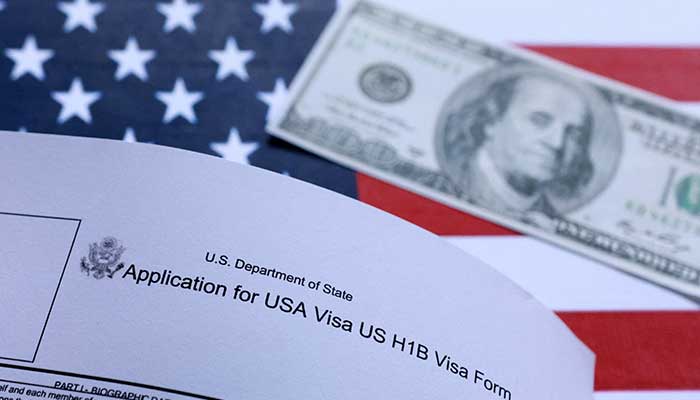
Immigration experts say the main attraction of the K visa is no requirement of a sponsoring employer, which has been regarded as one of the biggest hurdles for those seeking H-1B visas.
The H-1B visa requires employer sponsorship and is subject to a lottery system, with only 85,000 slots available annually. The new $100,000 fee could further deter first-time applicants.
“It’s an appealing alternative for Indian STEM professionals seeking flexible, streamlined visa options,” said Bikash Kali Das, an Indian student at Sichuan University.
India was by far the largest beneficiary of H-1B visas last year, accounting for 71% of approved beneficiaries.
Language issues, unanswered questions
Despite its promise, the K visa faces hurdles. Chinese government guidelines mention vague “age, educational background and work experience” requirements.
There are also no details on financial incentives, employment facilitation, permanent residency, or family sponsorship. Unlike the US, China does not offer citizenship to foreigners except in rare cases.
China’s State Council did not respond to a request for comment asking for more details on the logistics and underlying strategy of the K visa.
Language is another barrier: most Chinese tech firms operate in Mandarin, limiting opportunities for non-Chinese speakers.
Political tensions between Delhi and Beijing could also become a factor that could limit the number of Indian K visa applicants China is willing to accept, experts said.
“China will need to ensure Indian citizens feel welcome and can do meaningful work without Mandarin,” said Feller.
Alternative for whom?
China’s talent recruitment has traditionally focused on China-born scientists abroad and overseas Chinese.
Recent efforts include home-purchase subsidies and signing bonuses of up to ¥5 million ($702,200). These have drawn back US-based Chinese STEM talent, especially amid Washington’s growing scrutiny on ties to China.
“The recruitment effort targeting Indian tech talent in China is growing but remains moderate compared to the more intensive, well-established, and well-funded initiatives aimed at repatriating Chinese STEM talent,” said Sichuan University’s Das.
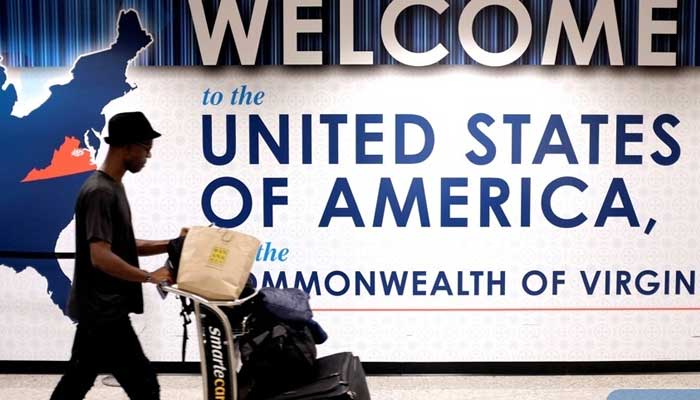
A Chinese STEM graduate who recently got a job offer from a Silicon Valley-based tech company was also sceptical about the K visa’s prospects.
“Asian countries like China don’t rely on immigration and local Chinese governments have many ways to attract domestic talent,” he said, declining to be named for privacy reasons.
The US has over 51 million immigrants — 15% of its population — compared to just one million foreigners in China, less than 1% of its population.
While China is unlikely to significantly alter its immigration policy to allow in millions of foreign workers, analysts say the K visa could still boost Beijing’s fortunes in its geopolitical rivalry with Washington.
“If China can attract even a sliver of global tech talent, it will be more competitive in cutting-edge technology,” Feller said.
- Eight crew members and three passengers were onboard.
- Plane was chartered for fisheries surveillance operations.
- Debris found around Mount Bulusaraung amid heavy fog.
Indonesian authorities said on Sunday they had located the wreckage of a fisheries surveillance plane that went missing in South Sulawesi province near a fog-covered mountain, but were still searching for the 11 people on board.
The ATR 42-500 turboprop owned by aviation group Indonesia Air Transport lost contact with air traffic control on Saturday at about 1:30pm local time (0530 GMT) around the Maros region in South Sulawesi.
There were eight crew members and three passengers on board the plane, which was chartered by Indonesia’s Marine Affairs and Fisheries Ministry to conduct air surveillance on fisheries. The passengers were ministry staff members.
The head of South Sulawesi’s rescue agency, Muhammad Arif Anwar, said on local television that after finding the wreckage, the rescuers would deploy 1,200 personnel to search for the missing passengers and crew.
“Our priority is to search for the victims, and we hope that there are some that we can evacuate safely,” he said.
The aircraft had been heading to Makassar, the capital of South Sulawesi, after departing from Yogyakarta province, before contact was lost.
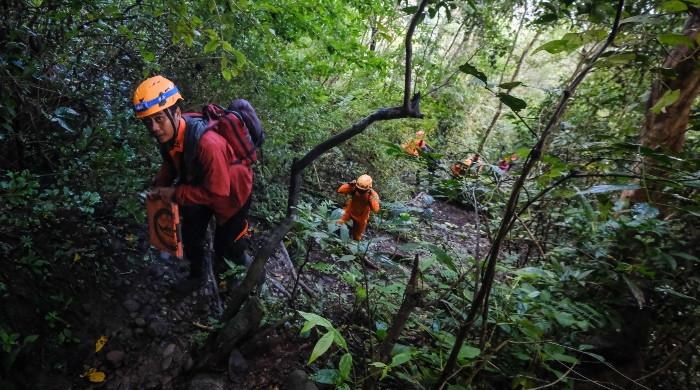
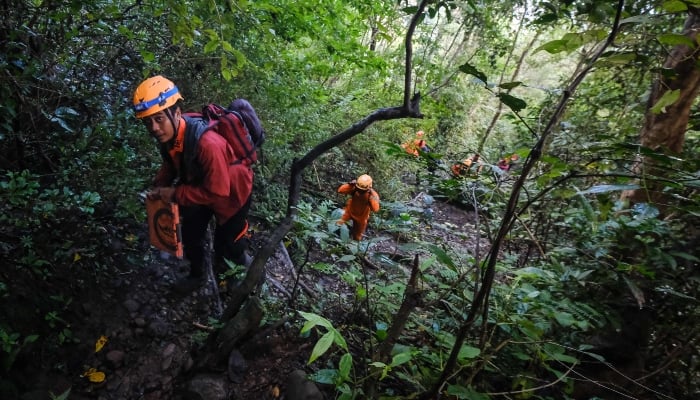
On Sunday morning, local rescuers found the wreckage in different locations around Mount Bulusaraung in the Maros region, said Andi Sultan, an official at South Sulawesi’s rescue agency. The mountain is roughly 1,500 km (930 miles) northeast of the sprawling island nation’s capital, Jakarta.
“Our helicopter crews have seen the debris of the plane’s window at 7:46am,” Sultan told reporters.
“And around 7:49am, we discovered large parts of the aircraft, suspected to be the fuselage of the plane,” he said, adding the tail of the plane was also seen at the bottom of the mountain slope.
Rescuers have been deployed to the locations where the wreckage was discovered, Sultan said, adding the search was hampered by thick fog and mountainous terrain.
In video footage shared by the rescue agency, a window of the plane was found scattered on the mountain with thick fog and strong wind around it.
Sultan said Indonesia’s National Transportation Safety Committee would lead an investigation into the crash. The cause remains unclear, and experts say most accidents are caused by a combination of factors.
The ATR 42‑500, manufactured by Franco-Italian planemaker ATR, is a regional turboprop aircraft capable of carrying between 42 and 50 passengers.
Flight tracking website Flightradar24 said on X that the plane was flying over the ocean at a low altitude so its tracking coverage was limited, and the last signal was received at 0420 GMT about 20 km northeast of Makassar airport.
- Cairo “studying” request for Sisi to join board, says FM.
- Canadian PM intends to accept Trump’s invitation: aide.
- Argentine president says it will be an ‘honour’ to join initiative.
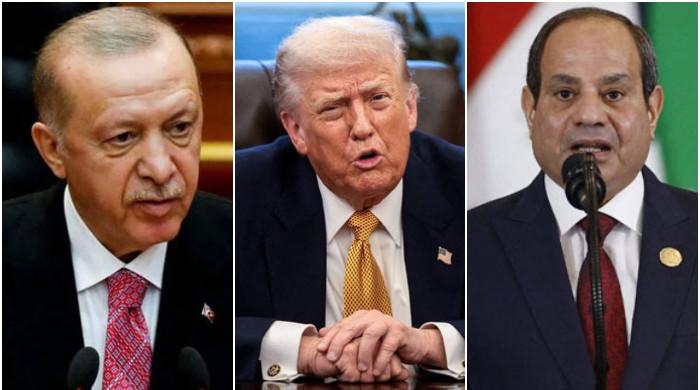
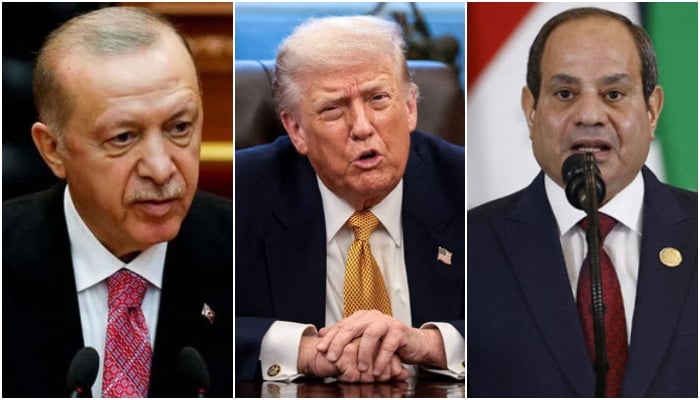
WASHINGTON: US President Donald Trump’s so-called “Board of Peace” for postwar Gaza began to take shape Saturday, with the leaders of Egypt, Turkey, Argentina and Canada asked to join.
The announcements from those leaders came after the US president named his Secretary of State Marco Rubio, former British prime minister Tony Blair, and senior negotiators Jared Kushner and Steve Witkoff to the panel.
Trump had already declared himself the chair of the body, as he promotes a controversial vision of economic development in the Palestinian territory, which lies in rubble after two-plus years of relentless Israeli bombardment.
The moves came after a Palestinian committee of technocrats meant to govern Gaza held its first meeting in Cairo which was attended by Kushner, Trump’s son-in-law who has partnered with Witkoff for months on the issue.
In Canada, a senior aide to Prime Minister Mark Carney said he intended to accept Trump’s invitation, while in Turkey, a spokesman for President Recep Tayyip Erdogan said he had been asked to become a “founding member” of the board.
Egypt’s Foreign Minister Badr Abdelatty said Cairo was “studying” a request for President Abdel Fattah al-Sisi to join.
Sharing an image of the invitation letter, Argentine President Javier Milei wrote on X that it would be “an honour” to participate in the initiative.
In a statement sent to AFP, Blair said: “I thank President Trump for his leadership in establishing the Board of Peace and am honoured to be appointed to its Executive Board.”
Blair is a controversial figure in the Middle East because of his role in the 2003 invasion of Iraq. Trump himself said last year that he wanted to make sure Blair was an “acceptable choice to everybody.”
Blair spent years focused on the Israeli-Palestinian issue as representative of the “Middle East Quartet” – the United Nations, European Union, United States and Russia – after leaving Downing Street in 2007.
The White House said the Board of Peace will take on issues such as “governance capacity-building, regional relations, reconstruction, investment attraction, large-scale funding and capital mobilisation.”
The other members of the board so far are World Bank President Ajay Banga, an Indian-born American businessman; billionaire US financier Marc Rowan; and Robert Gabriel, a loyal Trump aide who serves on the US National Security Council.
Trump has created a second “Gaza executive board” that appears designed to have a more advisory role.
It was not immediately clear which world leaders were asked to be on each board.
The White House, which said Friday that additional members would be named to both entities, did not immediately reply to a request for comment.
Israel strikes
Washington has said the Gaza plan had gone on to a second phase – from implementing the ceasefire to disarming Hamas, whose October 2023 attack on Israel prompted the massive Israeli offensive.
On Friday, Trump named US Major General Jasper Jeffers to head the International Stabilization Force, which will be tasked with providing security in Gaza and training a new police force to succeed Hamas.
Jeffers, from special operations in US Central Command, in late 2024 was put in charge of monitoring a ceasefire between Lebanon and Israel, which has continued periodic strikes aimed at Hezbollah.
Gaza native and former Palestinian Authority deputy minister Ali Shaath was earlier tapped to head the governing committee.
Trump, a real estate developer, has previously mused about turning devastated Gaza into a Riviera-style area of resorts, although he has backed away from calls to forcibly displace the population.
- Private carrier admits misjudgement, planning gaps.
- Regulator orders IndiGo to relieve senior office bearers.
- Operational meltdown linked to new policy of pilot rest.
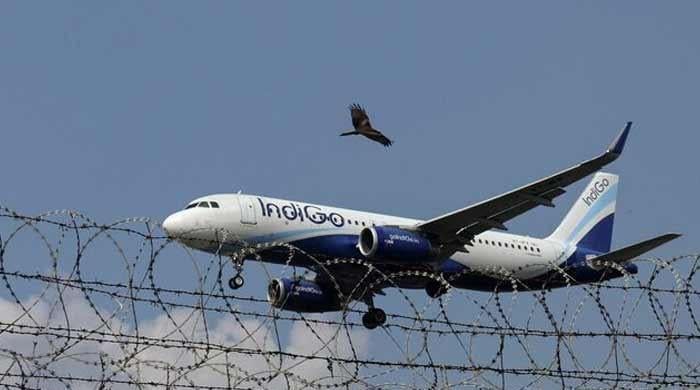
India’s civil aviation regulator on Saturday imposed a fine of $2.45 million on IndiGo, the country’s biggest airline, for poor roster planning that led to large-scale flight cancellations in December.
Airports across India were thrown into disarray late last year, with the private carrier admitting “misjudgement and planning gaps” in adapting to a new policy of pilot rest.
Over 4,000 mostly domestic flights were either cancelled or delayed for over a week across the country, stranding hundreds of thousands of passengers.
The operational meltdown came even though IndiGo had two years to prepare for the new rules aimed at giving pilots more rest periods in between flights to enhance passenger safety.
The Directorate General of Civil Aviation (DGCA) said it was levying the penalty for several lapses, including “failure to strike (a) balance between commercial imperatives and crew members’ ability to work effectively”.
The regulator ordered IndiGo to relieve its senior vice president of its operations control centre of his responsibilities, according to a statement released on Saturday.
It also issued warnings to senior officials at the company, including CEO Pieter Elbers “for inadequate overall oversight of flight operations and crisis management”.
There was no immediate response from IndiGo to the fine.
IndiGo, which commands 60% of India’s domestic market, operates more than 2,000 flights a day.
The crisis was one of the biggest challenges faced by the no-frills airline that has built its reputation on punctuality.
India is one of the world’s fastest growing aviation markets. In November 2024, IndiGo reached a daily level of 500,000 passengers for the first time.


UK’s Sosandar Q3 FY26 revenue rises 10% to $18.09 mn

Indonesian authorities find wreckage of missing surveillance plane with 11 on board

Trump vows to protect Army-Navy game from ‘Big TV Money’ interference with executive order

-

 Tech5 days ago
New Proposed Legislation Would Let Self-Driving Cars Operate in New York State
-

 Sports1 week ago
Clock is ticking for Frank at Spurs, with dwindling evidence he deserves extra time
-
Sports1 week ago
Commanders go young, promote David Blough to be offensive coordinator
-

 Entertainment5 days ago
X (formerly Twitter) recovers after brief global outage affects thousands
-

 Fashion1 week ago
South India cotton yarn gains but market unease over US tariff fears
-
 Fashion1 week ago
China’s central bank conducts $157-bn outright reverse repo operation
-
 Business1 week ago
SoftBank reduces Ola Electric stake to 13.5% from 15.6% – The Times of India
-

 Sports1 week ago
US figure skating power couple makes history with record breaking seventh national championship