

Business
Are ‘tech dense’ farms the future of farming?

David SilverbergTechnology Reporter
 Getty Images
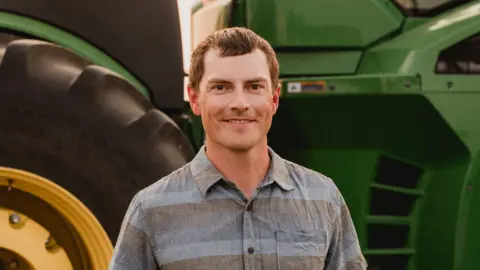
Jake Leguee is a third-generation farmer in Saskatchewan, Canada.
Since his grandfather bought the 17,000 acres in 1956, the Leguee family has grown canola, wheat, flax and green lentils.
As a child, he watched his father and grandfather spending hours riding their tractor to sow seeds and spray crops. Sweat would coat their shirts after those long, hot days.
“It was a lot less efficient back then,” says Leguee. “Today, technology has vastly improved the job that we do.”
To keep his farm competitive, Leguee has made several innovations, particularly when it comes to crop spraying.
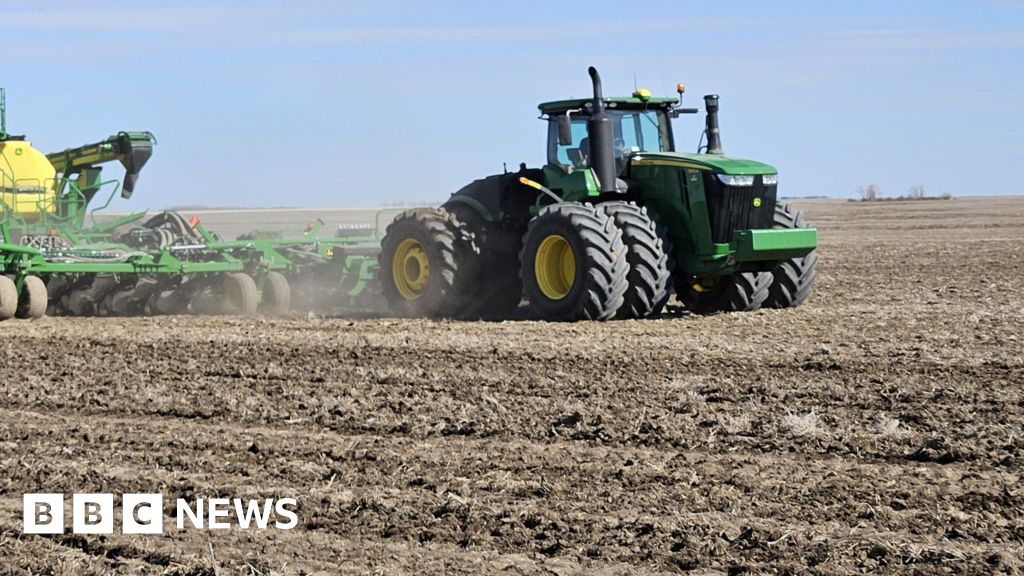
With software and remote cameras attached to his John Deere tractor, he can kill the weeds much more efficiently, a practice every farmer has to do before planting seeds.
“It can look down and spray a nozzle when the sensors pick a weed, while we’re going around 15 miles an hour,” Leguee says.
He adds that he saves on pesticide spray since the nozzles only turn on when weeds are detected, as opposed to the kind of blanket spraying he used to do.
The return-on-investment for adding these new layers to his farm operations are often high, Leguee adds.
“There are low-cost solutions that won’t be as expensive as new spraying tech, and they could be an app to help you better keep your records, for example,” he says.

 Jake Leguee
It’s a lesson that farmers across North America are taking on board.
A 2024 McKinsey survey found that 57% of North American farmers are likely to try new yield-increasing technologies in the next two years.
Another report, from 2022, by the US Department of Agriculture said that while the number of farms in the country is shrinking, the farms that remain are becoming “tech dense”.
Norah Lake, the owner and farmer at Vermont’s Sweetland Farms, says to get a successful harvest, “there’s a lot of looking forward and then backwards and then forwards and then backwards in crop farming”.
She once used Microsoft Excel to plug in the figures for, say, their yields from a recent harvest, or a given year, and see how they compare to years prior.
“I’d want to know that if we planted 100 bed feet of broccoli, what did we actually produce?” she says.
More recently, Lake, who grows vegetables such as asparagus, tomatoes and zucchini, as well as pastured meat, has been using software and an app from a company called Tend.
She wanted to digitise and streamline those laborious tasks into a piece of tech that she can view on her cellphone or computer.
Now she can input those harvest numbers into Tend, and the software can give her details, and advice, on how to manage her crop best for the coming harvest.
“We can use Tend to calculate the quantity of seed that we need to order based on the row feet of a particular crop that we want to harvest,” she says.
 Syngenta Group
There’s no shortage of tech for farmers to choose from.
Sygenta, the argri-tech giant based in Switzerland, offers farmers the software Cropwise, which uses AI and satellite imagery to guide farmers on what to do next with their crops, or alerts them to emergencies.
“It can tell the farmer that you need to visit the southeast corner of your field because something is not right about that section, such as a pest outbreak,” says Feroz Sheikh, chief information office of Syngenta Group. “And the system also has 20 years of our weather pattern data fed into a machine learning model, so we know exactly what kind of conditions lead to what outcome.”
With that data, farmers can cover their crops before, say, an incoming snap frost that could kill a large portion of their acreage.
In Germany, Jean-Pascal Lutze founded NoMaze to give farmers a deeper understanding of how different crops will perform under climate conditions.
Its software is rolling out this year. “We did field tests in a variety of environments and then created simulations through our computer model to give clients better insight into, say, how much water to use, how to get the maximum yield,” he explains.
 Getty Images
The impact of these technologies might be felt by the consumer, says Heather Darby, an agronomist and soil specialist at the University of Vermont.
Bringing more food to market could translate to lower prices at the register, she says.
“When farmers get help to avoid crop failures, that could lead to a more controlled farm environment and a reliable and secure food system,” says Darby.
Back in Saskatchewan, Darby notes younger farmers are turning to technology while older tillers might resist major change.
He says that farmers need to be open to change.
“After all, when you think about it, some of these farms are multi-million-dollar businesses that are supporting multiple families. We need to embrace technology that works for us.”
“I heard someone say once: ‘If you treat farming as a business, it’s a great way of life, but if you treat your farming as a way of life, it’s a horrible business.'”
Business
Spirit starts monthslong process of dismantling airline after biggest collapse in a generation

Spirit Airlines‘ more than three-decade run ended over the weekend, but on Tuesday it was just starting the monthslong process of dismantling the company after the biggest U.S. airline collapse in a generation.
Spirit and its stakeholders were in bankruptcy court in White Plains, New York, to start that process, which will take months. The hearing included discussions about airport landing fees, aircraft and staffing.
The carrier filed a cumulative wind-down budget of around $217 million, though that number could change.
The budget went out to February 2028. It included more than $52 million in employee costs through July and another more than $52 million for aircraft-related expenses.
The airline had 59 Airbus A320s in service and 63 in storage, as well as 37 of the larger A321s in service, and 13 of them in storage, according to aviation data firm Cirium. More than three-quarters of its fleet was leased.
Spirit shut down operations after years of struggles, most recently from heavy debt loads and a surge in costs.
Spirit’s lawyer, Marshall Huebner of Davis Polk, told a bankruptcy court on Tuesday that the jump in jet fuel prices following the U.S.-Israel attacks on Iran in February left the carrier with no choice but to shut down. That added $100 million in incremental costs for Spirit in March and April, he said.
U.S. bankruptcy court in White Plains, N.Y.
Leslie Josephs/CNBC
Talks for a potential government bailout in the form of a $500 million loan that could have given the government an up to 90% stake in Spirit fell apart late last week, and the carrier officially shut down at 3 a.m. ET on Saturday.
Spirit passengers scrambled to rebook reservations. American Airlines, JetBlue Airways, Southwest Airlines, United Airlines and others said they have flown tens of thousands of Spirit customers who were stranded by the collapse.
Spirit had flown about 50,000 people in the day leading up to its closure. The airline said about 17,000 direct and indirect employees lost their jobs.
“The closing of Spirit Airlines is a sad and unfortunate event that adversely affects many parties, and that’s particularly true for the thousands of folks who are Spirit employees and families who depend on them,” the presiding judge, Sean Lane, said at Tuesday’s hearing.
“The stress level for these employees and affinities is very high, and they likely have many questions,” he continued. “Hopefully there’ll be some information discussed today to provide some answers to some of those questions, or provides information about where to get those answers. Bankruptcy can be a very difficult process, and today is a sad example of that.”
Under the changed system customers collect points rather than reward coupons, with £1 spent equalling one point.
Source link

There have been extra jitters in UK government debt markets ahead of Thursday’s local and national elections.
Source link


Longtime entertainment publicist was 82
Spirit starts monthslong process of dismantling airline after biggest collapse in a generation

AS-level Business Studies paper allegedly leaked online

-

 Tech1 week ago
A Brain Implant for Depression Is About to Be Tested in Humans
-

 Sports1 week ago
Pro wrestling star Steph De Lander reveals how colleague’s advice helped lead her to title triumph at ACW
-

 Tech1 week ago
Almost 90% of women leave tech industry within 10 years | Computer Weekly
-
 Business1 week ago
‘I had £20,000 stolen and had to fight a 13-month fraud reporting rule to get it back’
-

 Entertainment1 week ago
Norway joins Type 26 Frigate Programme to boost NATO naval power
-

 Entertainment1 week ago
Melania Trump says ABC should ‘take a stand’ on late-night host Kimmel
-

 Tech1 week ago
This Ambitious Laptop Doesn’t Leave Much Room for Your Hands
-
 Business6 days ago
PSX plunges over 4,800 points | The Express Tribune