

Business
Asian stocks today: Markets mixed as AI rally loses steam, oil prices and inflation worries weigh on sentiment – The Times of India

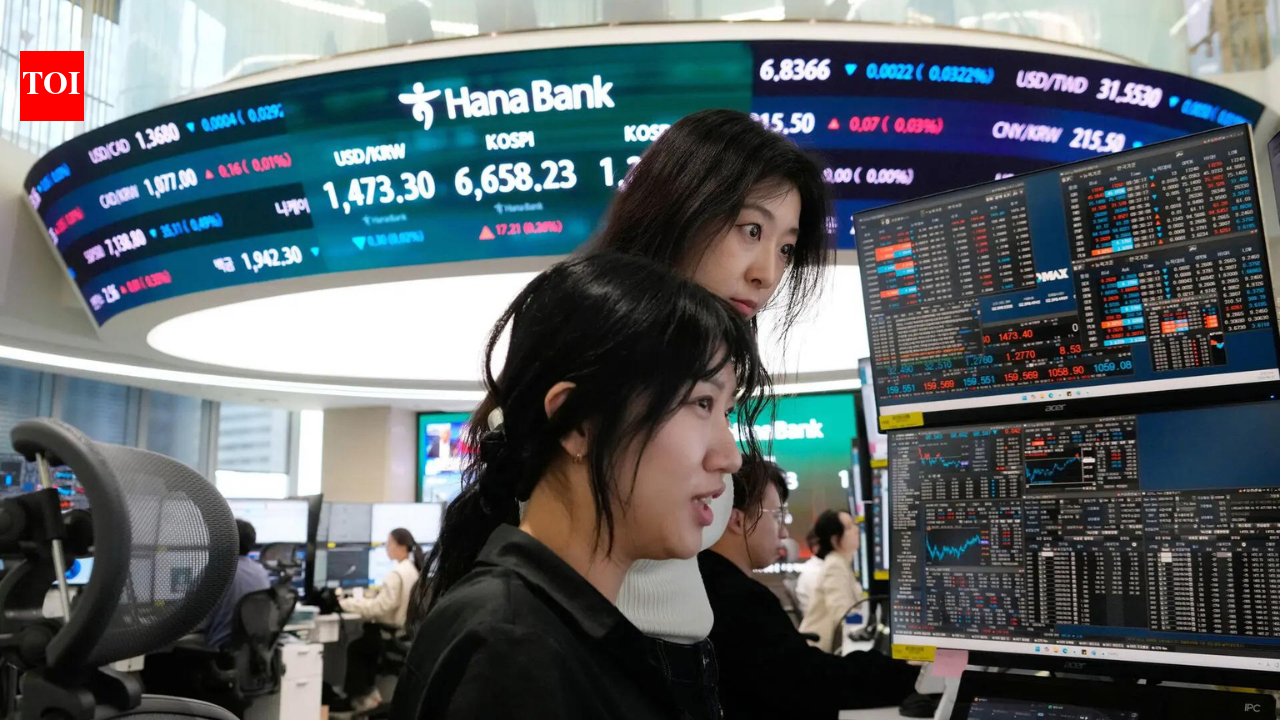
Asian markets traded mixed on Wednesday as fading momentum in artificial intelligence-linked stocks, elevated oil prices and concerns over persistent inflation kept investors cautious.Japan’s Nikkei 225 edged up less than 0.1% to 62,774.94, while South Korea’s Kospi gained 0.9% to 7,708.05 after recovering some recent losses.Australia’s S&P/ASX 200 slipped 0.3% to 8,645.80.Hong Kong’s Hang Seng Index fell 0.4% to 26,246.29, while China’s Shanghai Composite was little changed, down less than 0.1% at 4,213.86.As per Reuters, MSCI’s broadest index of Asia-Pacific shares outside Japan fell 0.6% for a second straight session, as markets reacted to stalled US-Iran talks and hotter-than-expected US inflation data.
AI stocks under pressure
South Korean markets remained volatile after a recent AI-driven rally pushed stocks to record highs. Korean shares had earlier dropped as much as 3.2% before recovering.Shares of Samsung Electronics plunged 5.7% after the company failed to reach a wage agreement with its labour union, raising the possibility of a strike involving more than 50,000 workers that could affect chip production.On Wall Street, major US indices ended lower overnight, with technology stocks leading declines.The S&P 500 slipped 0.2% from its record high, while the Nasdaq Composite fell 0.7%, AP reported. Intel dropped 6.8% after a strong rally earlier this year, while Micron Technology lost 3.6%.“Corporate earnings and AI momentum are acting as the market’s primary shock absorbers, but the road is getting significantly rougher,” Tim Waterer, chief market analyst at KCM Trade, told AP.“With oil prices becoming entrenched at elevated levels and a diplomatic breakthrough between the US and Iran remaining elusive, the easy bullish narrative is becoming much harder to maintain.”
Oil prices remain elevated amid Iran tensions
Oil prices eased slightly on Wednesday but remained near multi-month highs due to ongoing tensions in the Middle East and continued disruptions around the Strait of Hormuz.Benchmark US crude fell 58 cents to $101.60 a barrel, while Brent crude slipped 66 cents to $107.11.Oil has largely remained above $100 per barrel since US and Israeli strikes on Iran earlier this year and Tehran’s effective closure of the Strait of Hormuz disrupted global supply flows.The fragile ceasefire between the US and Iran has also failed to reassure investors, with US President Donald Trump saying on Tuesday that he does not believe China’s help is necessary to end the conflict ahead of his meeting with Chinese President Xi Jinping later this week.“We’ve seen this movie before, and we know it doesn’t end with a breakthrough agreement that resets the US-China relationship,” Phillip Wool of Rayliant Investment Research told Reuters.
Inflation fears dampen rate cut hopes
Investors also reacted to stronger-than-expected US inflation data, which reinforced expectations that the Federal Reserve may keep interest rates elevated for longer.“A hotter-than-expected inflation report and persistent geopolitical tensions reminded investors that sticky prices and elevated energy costs are not going away anytime soon,” IG analyst Tony Sycamore told Reuters.Markets have largely ruled out any Federal Reserve rate cuts this year, while expectations for a rate hike by December have risen sharply, according to CME FedWatch data.US Treasury yields remained elevated, with the benchmark 10-year Treasury yield holding near 4.47%, its highest level since July.In currency markets, the US dollar strengthened slightly against the Japanese yen to 157.77, while gold edged 0.1% higher and bitcoin slipped marginally.





SBP says IMF Executive Board has also approved disbursement of second tranche of SDR 154 million under RSF
The government wants to accelerate economic growth to lower rising poverty and unemployment, but the IMF was of the view that Pakistan has not yet reached a stage where it can afford sustainably higher economic growth. PHOTO: Reuters
The State Bank of Pakistan (SBP) said on Wednesday it had received about $1.3 billion from the International Monetary Fund (IMF) under its Extended Fund Facility (EFF) and Resilience and Sustainability Facility (RSF) programmes, in a post on X.
The post read that, “The IMF Executive Board completed third review under the Extended Fund Facility (EFF) in its meeting held on May 8, 2026, and approved the disbursement of SDR 760 million for Pakistan”.
“Furthermore, the IMF Executive Board has also approved the disbursement of the second tranche of SDR 154 million under the RSF,” it added.
#SBP has received about US$1.3 billion under the IMF’s EFF and RSF programs
The IMF Executive Board completed third review under the Extended Fund Facility (EFF) in its meeting held on 08 May 2026, and approved disbursement of SDR 760 million for Pakistan. Furthermore, the IMF…
— SBP (@StateBank_Pak) May 13, 2026
“Accordingly, SBP has received SDR 914 million (equivalent to about US$ 1.3 billion) under the EFF and RSF in value May 12, 2026, from the IMF,” SBP added in a statement.
The central bank said that “the amount would be reflected in SBP’s foreign exchange reserves for the week ending on May 15, 2026”.
Read: Petroleum levy jumps 45% to Rs1.2tr
On Friday, the executive board of the IMF approved $1.2 billion worth of loan tranches after Pakistan accepted a dozen new conditions and assured it would stick to the pre-war programme targets to stay on the course of stabilisation.
With the fresh approval, Pakistan has so far received a $4.5 billion loan from the IMF against two separate debt packages totaling $8.4 billion. Pakistan has access to another $1 billion under the Extended Fund Facility and $200 million under the Resilience and Sustainability Facility.
The money would be disbursed early next week, which will take the central bank’s reserves to over $17 billion, said government officials.
However, the government had to stick to the old fiscal and monetary targets and gave a commitment to stay on the path of stabilisation despite strong voices against these policies that have caused higher unemployment, higher poverty, and higher income inequality.

Two ads promoting British beef and milk have been banned after television presenter and environmental campaigner Chris Packham complained that they misled consumers about the products’ carbon footprints.
Both ads for the Agriculture and Horticulture Development Board’s (AHDB) Let’s Eat Balanced campaign used the carbon footprint of British beef and milk to promote the products, firstly stating: “British beef not only tastes great, but has a carbon footprint that’s half the global average*.”
The asterisk linked to text that stated: “Full lifecycle emissions of CO2 eq (carbon dioxide equivalent) per kg of beef.”
The ad for milk stated: “British milk not only tastes good, but is also produced to world-class standards, and has a carbon footprint a third lower than the global average.”
Packham complained to the Advertising Standards Authority (ASA) that the ads, and specifically the carbon footprint claims, were misleading as they did not reflect the full environmental impact of British meat and dairy.
The AHDB said the ads’ mention of carbon emissions would be understood in relation to the environmental impact of beef and milk that occurred between the “cradle-to-retail” stages.
But the ASA said the average consumer “being reasonably well-informed, observant and circumspect” would understand the claims to apply beyond the retail stage and include actions such as cooking and wastage.
The ASA said: “While we acknowledged the potential difficulties in producing post-retail emissions data, the claims in the ads suggested those emissions were included and we therefore expected the evidence provided to also include them.
“We therefore concluded that the evidence presented was insufficient to support the full life-cycle claims in the ads, which was how the average consumer was likely to interpret them.
“We reminded AHDB that environmental claims should be based on the full life cycle unless the ad stated otherwise.”
AHDB’s director of communications and market development, Will Jackson, said: “Let’s Eat Balanced is doing what it was designed to do, providing clear, factual, evidence-led information about British food, nutrition and farming standards.
“Since the investigation began, we have conducted independent consumer research which found that the majority of respondents interpreted these adverts as relating to the production phase only, from farm to retail.
“This research provides important insight into consumer understanding and supports our belief that consumers were not misled by the information we shared in these two specific adverts.”

BENGALURU: India’s Gen Z workforce is embracing what experts describe as “portfolio careers” – balancing multiple professional identities and income streams simultaneously. New research from LinkedIn shows that 75% of Gen Z entrepreneurs in India now manage multiple income streams, significantly higher than the 62% among Gen X entrepreneurs. The findings point to a growing preference among younger professionals for flexibility, autonomy and diversified sources of income. “We’re also seeing the rise of the ‘portfolio era’, with more professionals creating multiple income streams and redefining what a career can look like. This shift is making entrepreneurship more accessible than ever before,” said LinkedIn India country manager Kumaresh Pattabiraman.Rather than depending on a single full-time role, many professionals are simultaneously building businesses, freelancing, consulting, creating online content and monetising specialised skills through digital platforms. The trend comes amid a broader rise in entrepreneurial activity in India. LinkedIn recorded a 104% year-on-year increase in members adding “Founder” to their profiles – the highest growth among all global markets.AI is also emerging as a major enabler of this shift. The report found that 85% of Gen Z entrepreneurs consider AI and digital tools important to their business operations.


US Treasury’s Bessent, China’s He hold talks in South Korea ahead of Trump-Xi summit

India’s apparel sourcing window reopens—for now
Asian stocks today: Markets mixed as AI rally loses steam, oil prices and inflation worries weigh on sentiment – The Times of India

-

 Tech1 week ago
DHS Demanded Google Surrender Data on Canadian’s Activity, Location Over Anti-ICE Posts
-

 Tech5 days ago
A new frontier: Identity stack evolves for agentic systems | Computer Weekly
-
 Business1 week ago
Heineken plans huge investment in hundreds of UK pubs ahead of World Cup
-

 Tech5 days ago
‘Orbs,’ ‘Saucers,’ and ‘Flashes’ on the Moon: Pentagon Drops New UFO Files
-

 Tech5 days ago
What Microsoft Executives Really Thought About OpenAI in 2018
-

 Tech5 days ago
Nick Bostrom Has a Plan for Humanity’s ‘Big Retirement’
-
 Business1 week ago
India among most resilient large EMs, better placed for future global shocks; policy reforms & strong buffers help: Moody’s – The Times of India
-

 Fashion5 days ago
New orders in German manufacturing up 5% MoM in Mar 2026: Destatis