

Business
Budget 2026: Why standard deduction should be hiked under the new income tax regime – explained – The Times of India

Budget 2026 income tax expectations: Standard deduction is seen as a much needed relief for taxpayers – it’s a simple, straightforward deduction from your gross income – a fixed amount that allows salaried taxpayers and pensioners to reduce their tax outgo.With the Union Budget 2026 set to be presented by Finance Minister Nirmala Sitharaman on February 1, taxpayers are wondering if this relief will see a hike, especially in the new income tax regime.The standard deduction limit varies depending on the tax regime that salaried taxpayers opt for: under the old income tax regime it has stayed at Rs 50,000 for several years, and under the new income tax regime it was hiked to Rs 75,000 in 2024. As the government pushes for the adoption of the new income tax regime, any major changes including those in standard deduction limits, are expected only in that regime.Over the last few years, several income tax slab and rate changes have been introduced in the new regime to make it more attractive for salaried individuals. Last year, FM Sitharaman made income up to Rs 12 lakh tax free (Rs 12.75 lakh for salaried taxpayers who get the benefit of Rs 75,000 standard deduction). As per government data, for FY 2023-24, 72% of taxpayers had opted for the new regime – a figure that will likely go up after last year’s tax relief under the new regime.
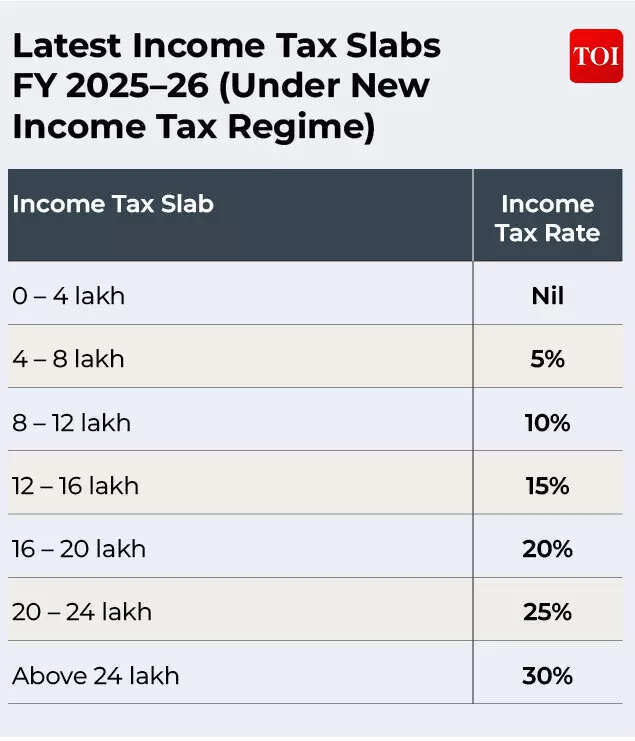
Latest Income Tax Slabs FY 2025–26 (Under New Income Tax Regime)
So, should the standard deduction limit be raised from Rs 75,000? Most tax experts surveyed by Times of India Online are of the view that a hike in standard deduction under the new income tax regime should be considered by the government.
Why Standard Deduction Should Be Hiked
The case for a hike in standard deduction limits is simple: the new income tax regime does not offer benefits of most deductions and exemptions that are available under the old income tax regime. Hiking this limit will push more people to opt to the clutter-free new income tax regime. Some experts also advocate linking standard deduction limits to inflation, hence ensuring that the limit is in line with the rising cost of living.Preeti Sharma, Partner – Tax and Regulatory Services at BDO India tells TOI, “Under the new tax regime, salaried taxpayers currently enjoy a standard deduction of Rs 75,000, raised from Rs 50,000 in Budget 2025. This increase has provided some relief, especially since most exemptions and deductions are not available under the new tax regime. However, rising inflation and higher day-to-day expenses have reduced the disposable income of salaried households. A further increase in the standard deduction would help employees manage these rising costs.”Radhika Viswanathan, Executive Director at Deloitte India sees a case for standard deduction to be hiked to as much as Rs 1.25 lakh!“There is a strong case for further enhancing the standard deduction under the new tax regime since no other major deductions or exemptions are available to the salaried class. While the current limit stands at Rs 75,000, the government could consider increasing it to Rs 1 lakh to 1.25 lakh. An increase would provide meaningful relief, support middle-class taxpayers, and preserve the simplicity of the regime without reintroducing multiple deduction-linked compliances,” she tells TOI.
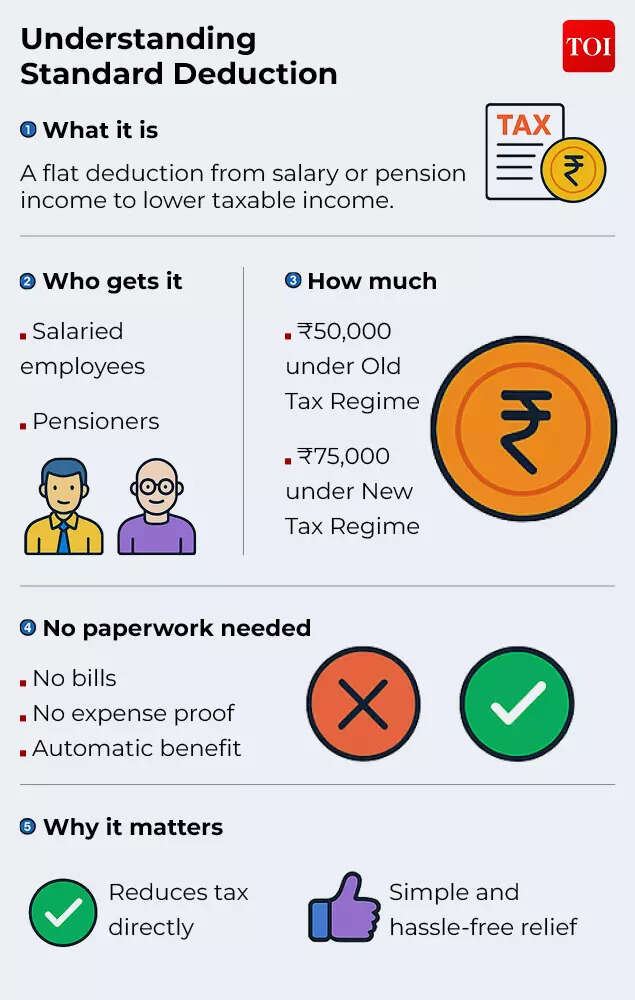
What is Standard Deduction?
Chander Talreja, Partner, Vialto Partners makes an important point: introduction of new labour codes may reduce take home pay, and an increase in standard deduction may help offset that.“This Budget will focus on how to further accelerate adoption of the new personal tax regime by the taxpayers. On the one hand, the scope for further rationalization of tax slabs or the introduction of reduced tax rates and additional rebates is limited, as these were revised last year only. On the other hand, introducing new deductions or exemptions under the new personal tax regime may not be feasible, given that the regime is designed to operate without such provisions, and any deviation could dilute its core objective,” he says.According to Talreja, this effectively leaves the government with one viable option – enhancement of the standard deduction. The existing limit is Rs 75,000 under the new personal tax regime which may be increased by at least Rs 15,000 to address rising cost-of-living pressures.“Moreover, the said increase in standard deduction may also be crucial with the introduction of the new Labour Codes. With the definition of “Wages” the contribution towards provident fund may go up which may consequently reduce the take-home pay for individuals. Some relief in the form of increased standard deduction may help to offset this impact,” he says.Tanu Gupta, Partner at Mainstay Tax Advisors LLP also finds merit in increasing the standard deduction limit. “In last year’s Budget, the government revised the income tax slabs under the new tax regime and enhanced the rebate under Section 87A, effectively providing tax relief for income up to Rs 12 lakh (Rs 12.75 lakh for salaried taxpayers). The objective was to increase disposable income, thereby boosting consumption. This was further supplemented during the year by reductions in GST on several items,” she tells TOI.However, the standard deduction, which was increased from Rs 50,000 to Rs 75,000 in Union Budget 2024 under the new tax regime, has since remained unchanged, she says. “There is merit in automatically adjusting this limit each year for inflation, in a manner similar to the government’s periodic revision of Dearness Allowance for its employees.Given the limited number of exemptions and deductions available under the new tax regime, such simplicity – combined with automatic inflation adjustment – would make the regime even more straightforward and taxpayer-friendly,” she adds.Parizad Sirwalla, Partner and Head, Global Mobility Services, Tax at KPMG in India is also of the view that since salaried taxpayers do not have any avenue to claim deduction for increased cost of living / other expenses (unlike a person earning business income) there is an ongoing expectation that the standard deduction is enhanced periodically keeping in mind the rate of inflation prevailing in the economy.
Why the government may not hike standard deduction limit
However, some experts note that the government will have limited fiscal room to hike standard deduction after last year’s tax slab changes under the new income tax regime and sweeping GST rate cuts. There is also the rationale that the government may await data on how many taxpayers opt for the new tax regime as per FY 2025-26 slabs before looking to incentivise it further.Richa Sawhney, Partner, Tax at Grant Thornton Bharat explains that salaried taxpayers often feel that they end up paying more taxes than taxpayers with business income, due to limited avenues of deductions available from salary income.

Why Standard Deduction Should Be Hiked & Why It May Not Be
Standard deduction is one of the limited deductions available to salaried taxpayers, which aims to compensate them for employment‑related expenses, without requiring proof of claim. “Salaried taxpayers do feel that the current limit of Rs 75,000 is inadequate and a hike is surely on their budget wishlist . However, considering that the standard deduction was enhanced last year, increasing it further this year may not be feasible for the government. More-so, when the softening of gross non corporate tax collections is evident post the slab rate reforms carried out last year,” she says.Surabhi Marwah, Tax Partner, EY India also says that a further hike in the standard deduction appears unlikely in the near term. “In Budget 2024, the government increased the standard deduction under the new tax regime to Rs 75,000 for salaried taxpayers, while the old regime continues to offer Rs 50,000. This differential already provides a clear incentive for taxpayers to shift to the new regime,” she tells TOI.“With the Income-tax Act 2025 focusing on structural simplification, the priority now seems to be on wider adoption of the revised framework rather than introducing additional reliefs,” she adds.




Mumbai: Warburg Pincus-backed housing finance company Truhome Finance ( formerly Shriram Housing) has filed draft papers with capital markets regulator SEBI to raise Rs 3,000 crore through an initial public offering.The IPO will comprise a fresh issue of equity shares of face value Rs 10 aggregating up to Rs 1,500 crore and an offer for sale of equity shares of face value Rs 10 aggregating up to Rs 1,500 crore, according to the draft red herring prospectus filed with SEBI. The offer for sale will be undertaken by promoter selling shareholder Mango Crest Investment, which plans to offload shares worth up to Rs 1,500 crore.Truhome Finance plans to use the net proceeds from the fresh issue to augment its capital base to support future capital requirements, including onward lending and general corporate purposes. The funds will also help the company comply with RBI’s capital adequacy norms as its business expands.The company said the proceeds are expected to be deployed over the financial years ending March 31, 2027 and March 31, 2028.JM Financial, IIFL Capital Services, Jefferies India and Kotak Mahindra Capital Company are the book running lead managers to the issue.Warburg Pincus completed its acquisition of Shriram Housing Finance (SHFL) from Shriram Finance and other sellers in December 2024 for approximately Rs 4,630 crore, marking a strategic shift in India’s housing finance sector.
Business
Ticketmaster parent Live Nation reaches settlement with Department of Justice over antitrust concerns

Signs are seen at the Live Nation NYC headquarters on May 23, 2024 in New York City.
Michael M. Santiago | Getty Images
Live Nation Entertainment has reached a settlement with the Department of Justice over antitrust concerns surrounding its Ticketmaster platform, a senior DOJ official said Monday.
The settlement would see Ticketmaster unwind some of its exclusivity agreements with musical artists and open up the ticketing industry to greater competition. It still needs approval by more than 20 states that had filed suit and by the court.
As part of the settlement, Ticketmaster will offer a standalone third-party ticketing system for other companies like SeatGeek to use its technology. Live Nation has also agreed to divest at least 13 of its amphitheaters and will no longer be able to require artists to use other Live Nation products tied to its venues. It has also agreed to pay roughly $280 million in civil penalties.
Shares of Live Nation rose 5% in morning trading. Live Nation and Ticketmaster did not immediately respond to requests for comment.
Ticketmaster has long faced criticism that its dominance in the live events and ticketing space pushes up prices for consumers. The company has come under heightened scrutiny in recent years from fans who argue that it’s become harder and pricier to snag coveted event tickets.
In 2022, the backlash boiled over when the rollout of tickets for Taylor Swift’s Eras Tour was mishandled, leading to a probe of the company. And in 2024, the DOJ — along with more than two dozen states — sued to break up Live Nation and Ticketmaster, which merged in 2010.
In September, Live Nation was separately sued by the Federal Trade Commission over what the agency called “illegal” ticket resale tactics. The FTC said Ticketmaster controls roughly 80% of major concert venues’ ticketing.
In a Monday statement, New York Attorney General Letitia James said her office would continue to fight against Live Nation’s alleged monopoly even after its agreement with the DOJ.
“The settlement recently announced with the U.S. Department of Justice fails to address the monopoly at the center of this case, and would benefit Live Nation at the expense of consumers. We cannot agree to it,” said James, who is joined by the attorneys general of more than 20 other states.

The conflict in the Middle East could raise the cost of petrol, household energy bills and even food.
Source link


Adidas salutes USMNT’s 1994 World Cup run with denim jersey

Oil surges past $100 a barrel as stocks tumble amid US-Israeli aggression against Iran
Espresso Machines Are Like Guitars: The Rich Don’t Win

-

 Sports3 days ago
Pakistan set for FIH Pro League debut | The Express Tribune
-

 Politics2 days ago
India let Iran warship dock the day US sank another off Sri Lanka, say officials
-

 Sports1 week ago
College basketball star suspended by team for spitting toward opposing fan
-

 Entertainment1 week ago
Al Jazeera broadcast interrupted by emergency missile alert in Qatar
-

 Entertainment2 days ago
Harry Styles kicks off new era with ‘One Night Only’ comeback show
-
 Business3 days ago
Home heating oil: ‘Most of my pension has gone on home heating oil’
-
 Business1 week ago
Labour parliamentarians urge UK Government to oppose Rosebank oil field
-

 Sports1 week ago
Michigan loses L.J. Cason for rest of season with torn ACL