

Business
Business news live – Pound climbs against the dollar, FTSE 100 hits new record high


House prices on the rise again – but one property type is bucking the trend
Nationwide data shows prices are up 0.5 per cent month to month, keeping annual prices rising at 2.2 per cent.
But the statistics show there are major differences in price changes between the north and south of the UK, as well as in the property type.
Semi-detached properties rose 3.4 per cent over the last 12 months, while detached (2.5 per cent) and terraced (2.4 per cent) saw slightly slower price rises. The cost of flats continues to decline, seeing average prices fall by 0.3 per cent.
Karl Matchett1 October 2025 16:00
Business and Money live – 1 October
Morning all, new economic data this week continues to paint a general picture of slow, perhaps grudging, growth in multiple areas – but not manufacturing.
We saw in GDP data that it had been hit in the second quarter and more numbers today back that up.
Karl Matchett1 October 2025 10:50
Manufacturing falls in ‘worrying news’ for industry
The latest data on UK manufacturing PMI from S&P shows a September slowdown, hot on the heels of ONS’ data showing the sector fell in the second three months of the year.
Rob Dobson, director at S&P Global Market Intelligence, said: “The final Manufacturing PMI results provide further worrying news for the health of UK industry.”
Commenting on what it might mean going forward, Mike Thornton, head of industrials at RSM UK, said: “The latest fall in manufacturing activity in September was another blow for the sector, showing a continued downward trend rather than a seasonal dip in August.
“The output index has dropped to 45.7, the lowest level since March, signalling a sharp slowdown in production levels as weak demand, falling new orders and subdued export activity continue to weigh heavily on the sector.
“This sustained contraction suggests manufacturers are scaling back operations to mitigate deteriorating market conditions, with little sign of a rebound in the short term. Businesses should therefore expect a stagnant outlook for the remainder of the year.”
Karl Matchett1 October 2025 10:58
UK business confidence plunges to lowest level on record
Business confidence slumped to its lowest level on record last month amid concerns over soaring costs, according to a new survey of company bosses.
Data from the Institute of Directors (IoD) showed that firms said higher labour costs has been the biggest contributor to growing pessimism about the economy.
The industry group’s monthly economic confidence index, which measures business leader optimism about the prospects of the UK economy, posted a minus 74 reading for September.
It marked a significant decline from minus 61 and struck the lowest level since the index was launched more than nine years ago.
Karl Matchett1 October 2025 11:02
Pound strengthens against the dollar after government shutdown
The US government is now in shutdown, with the two parties not managing to agree a funding plan.
While stock markets have generally not reacted too much to this outcome – futures show the S&P 500 down about 0.5 per cent – the dollar has weakened further.
That means you are right now getting more for your money if you are heading to the US.
£1 is now $1.3465, up almost 0.2 per cent today.
It was slightly higher earlier and we can expect a little more movement across the day.
At the start of the year it was $1.2521 – it’s up more than 7.3 per cent since then.
Karl Matchett1 October 2025 11:20
FTSE 100 surges to new record high
The City is cheering new FTSE 100 highs today, as the benchmark index topped 9,400 points for the first time ever.
After rising 0.7 per cent this morning, it’s currently around 9,414 points.
The highest risers include pharma trio AstraZeneca (up 6.1%), Hikma (3.6%) and GSK (2.5%).
“AstraZeneca, Hikma and GSK rallied after Donald Trump announced plans to launch a government-run website for consumers to buy drugs directly from manufacturers. It looks like investors are regaining confidence in the pharma sector following recent uncertainty around pricing and tariffs. More clarity on both points is helping to regain investors’ interest,” explained Russ Mould, investment director at AJ Bell.
Karl Matchett1 October 2025 11:40
Greggs sales growth cools after July heatwave deters consumers
Greggs has revealed its sales rose in recent months but blamed unusually hot July weather and a tough consumer backdrop for a slowdown in growth.
The high street bakery chain, with 2,675 shops in the UK, has continued to expand its sprawling estate across the country.
It reported a 6.1% increase in sales over the third quarter of 2025, compared with the same period a year ago.
On a like-for-like basis, which strips out the impact of new shop openings, sales growth across company-managed shops slowed to 1.5% year on year.
Karl Matchett1 October 2025 12:00
Key deadline approaching if you have a side hustle
Another reminder that 5 October is fast approaching – and that’s the deadline to register for self assessment if you have a side hustle and your income from it is beyond £1000.
To put that in perspective if you’re on Vinted, eBay and anywhere else – that’s only an average of £20 a week means you surpass that threshold.
Kate Steere, money expert at Finder, said: “Side hustles are becoming increasingly popular as household budgets are squeezed by inflation, but many people don’t realise they could be liable for tax even if they’re earning a relatively small amount on the side each month. All it takes is earning more than £80 a month, and you’ve exceeded the £1,000 yearly limit.
“If you’re in this boat, while you don’t need to submit your tax return until the end of January, you do need to register for Self Assessment before 5 October.
“Miss this, and you could face a failure-to-notify penalty. While you’re at it, why not give your future self a break by opening a dedicated business account? Separating your personal finances from your side hustle income will make the whole process that much smoother when it comes to filing your tax return.”
Karl Matchett1 October 2025 12:20
Young adults turn to TikTok more than uni for financial information
Credit card firm Aqua have released results of a survey of 500 young adults (18-24 year olds) and, while a small sample size, the results are eye opening.
The top financial lessons they wish they’d known earlier are ‘how to invest’ (21%), ‘how to budget’ (19%) and detail around what credit scores mean (18%).
Perhaps more notable is where they are going for this.
18-24-year-olds are more likely to turn to TikTok (22.2%) than to their university (15.8%) for financial guidance, reads the report.
Good that they are going out and trying to find the information, of course, but be wary on social media – there’s a lot of misinformed or outright incorrect stuff on there.
Always ensure you’re using reputable accounts, persons or companies if that’s where you go for info.
Aqua’s Sharvan Selvam said: “These results show that many young people feel underprepared when it comes to managing their money, especially around credit and budgeting. It’s worrying to see such high levels of stress around finances at such a formative stage in life, and it highlights the need for more practical, accessible guidance.”
Karl Matchett1 October 2025 12:40
Royal Mail to take over thousands of UK convenience stores
International Distribution Services (IDS), the firm which owns the postal service, has concluded a purchase of 49 per cent of shares in parcel company Collect+, with part of the deal meaning about 8,000 stores will now be branded Royal Mail.
It means high street stores will sell postage over the counter and customers can pay bills in person rather than only online.
The deal, which is worth £43.9m, will also see self-service kiosks installed in some shops next year, extended opening hours including weekends and evenings – plus retaining the normal operations of Collect+, which include sending and returning parcels from other carriers.
Karl Matchett1 October 2025 13:00
Business
NaBFID signs pact with PDCOR to expand advisory support for state projects – The Times of India

The National Bank for Financing Infrastructure and Development (NaBFID) has signed a Memorandum of Agreement with Projects Development Company of Rajasthan Limited (PDCOR) to strengthen advisory services for state and city-level infrastructure projects.The agreement will also allow both institutions to jointly explore financing and transaction advisory opportunities, including transaction structuring, commercial and technical due diligence, and support for financial closure of projects undertaken by state governments and urban local bodies across India, according to PTI.“This collaboration seeks to enhance access to long-term institutional finance for State Governments and Urban Local Bodies, while strengthening the infrastructure advisory and financing ecosystem,” Rajkiran Rai G., Managing Director of NaBFID, said.He added that the partnership would help both institutions jointly pursue project advisory opportunities, develop replicable financing frameworks, accelerate financial closures and mobilise capital across the infrastructure value chain.Monika Kalia, DMD-CFO, NaBFID, said the tie-up would leverage the strengths of both organisations to provide much-needed advisory support to states and urban local bodies for impactful urban infrastructure projects.Dileep Chingapurath, Chief Executive Officer, PDCOR, said the agreement would address the long-felt need for end-to-end professional support to structure and mobilise sustainable financing solutions, particularly for state governments and their agencies.“Through this collaboration, both institutions aim to enhance the quality of project preparation, mobilise institutional capital more effectively and accelerate the implementation of sustainable infrastructure projects across states and municipalities,” he said.NaBFID is a Development Financial Institution focused on long-term infrastructure financing, while PDCOR is an undertaking of the Government of Rajasthan.
Business
Explained: On way to 4th largest, how India slipped to 6th rank & what it means for 3rd largest economy dream – The Times of India
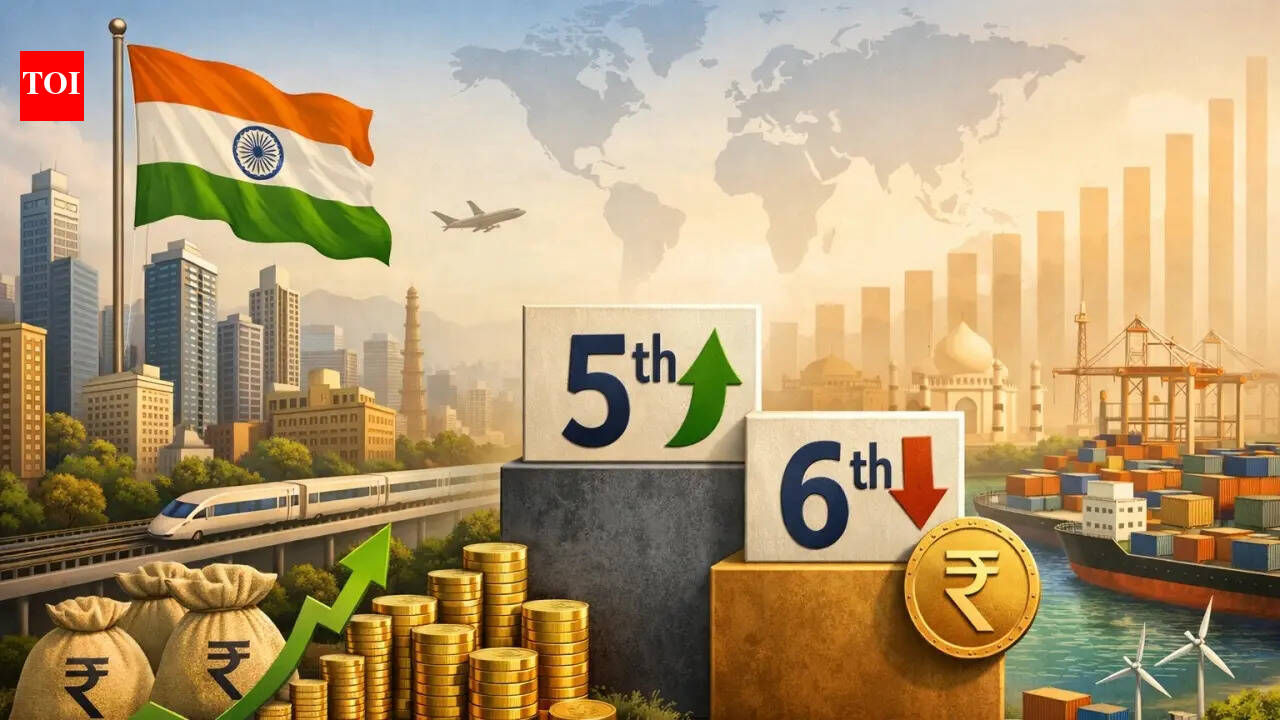
In April 2025 when the International Monetary Fund (IMF) released its World Economic Outlook, India was seen overtaking Japan to become the world’s fourth largest economy by the end of 2025-26. One year later, India has slipped to the sixth position on the largest economies rankings, with the United Kingdom reclaiming its spot as the fifth largest economy.In fact, IMF’s latest World Economic Outlook (April 2026) sees India sitting at the sixth spot this financial year too. This projection comes even as India has grown better than expected in FY26 and is seen retaining its tag of being the world’s fastest growing major economy.What has led to the sudden fall? Why has India dropped to the sixth position, falling behind the UK, instead of overtaking Japan to become the fourth largest economy? And what does this setback mean for its dream of becoming the third largest economy by the end of this decade? We decode:
Data drive: India projected as 4th largest, but fell to 6th spot
First let’s look at some IMF data to see which way the Indian economy was headed in April 2025, and what the April 2026 outlook data suggestsAs per April 2025 estimates of IMF, India’s economy would have been at $4601.225 billion at the end of FY 2025-26, overtaking Japan which was estimated at $4373.091 billion. The UK at the 6th spot was projected to have a nominal GDP of $4040.844 billion.However, as per the April 2026 estimates, India’s economy had a nominal GDP of $4,153 billion at the end of FY 2025-26, with the UK overtaking it with $4,265 billion GDP. Japan’s GDP is seen at $4,379 billion.As the above estimates show, India’s GDP estimates have seen a drop over one year, while UK’s nominal GDP has grown better than expected. Japan has been steady.So, what went wrong? Blame the rupee and GDP data itself!
Rupee Depreciation Blow & New GDP Series
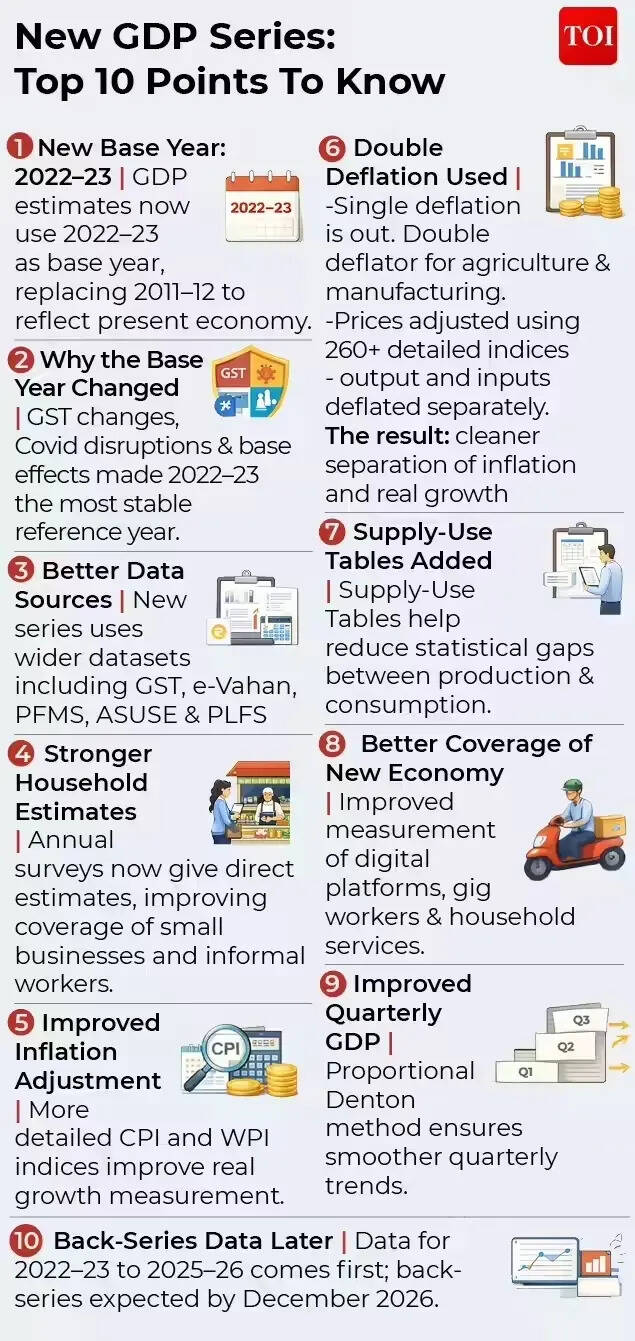
The first thing to understand is that IMF’s data on the size of a country’s nominal GDP is in dollar terms. Hence, with global rankings based on dollar‑denominated GDP, they are highly sensitive to exchange rate movements. The biggest party pooper for India’s dream of becoming the fourth largest has been the rupee’s slide. The Indian currency has depreciated more than expected over the last year, dropping from 84.57 versus the US dollar in 2024 to 88.48 in 2025, as per IMF data. The IMF estimates see it at 92.59 this year.Several factors have contributed to the rupee’s decline, including capital outflows, uncertainty related to India-US trade deal up until February, and the recent Middle East conflict which has raised crude oil prices and India’s import bill. Also, the RBI while actively managing volatility in the forex market, is not targeting any particular level of the rupee.Arun Singh, Chief Economist, Dun & Bradstreet India says that India’s recent slip to sixth place in global GDP rankings does not reflect a weakening of the economy, but is largely the result of currency conversion effects and a one‑time statistical revision.The rupee’s depreciation from 2024 to 2026, has mechanically compressed India’s GDP in dollar terms, effectively halving apparent growth despite strong domestic expansion, says Arun Singh.According to Ranen Banerjee, Partner and Leader, Economic Advisory Services, PwC India, GDP in US dollar terms would shave off with rupee depreciation. “We have had almost 7-8% depreciation over the last few months owing to the conflict and portfolio outflows. Thus, in effect in US dollar terms, it is close to shaving out almost a year’s nominal GDP,” he tells TOI.And it’s not just about the Indian economy. The United Kingdom which has overtaken India to bag the 5th spot again also has economic factors working in its favour. UK’s GDP growth at 0.5% has recently beaten forecasts of 0.1% by a wide margin. Not only that, its currency – pound – has actually appreciated against the US dollar.The second factor that has impacted the rankings is India’s adoption of a new base year for its latest GDP series. As per the new data, which also makes use of a more refined methodology, the size of India’s nominal GDP in rupee terms has gone down. Sample this: As per the older base year of 2011-12, India’s GDP at the end of 2025-26 would have been Rs 35,713,886 crore. But under the new series, it is estimated to be Rs 34,547,157 crore. The new calculation methodology and base year revision presents a more accurate picture of the size of the Indian economy.Hence the currency effect has been compounded by a one‑time downward revision following India’s shift to a new GDP base year, which has lowered reported nominal levels without affecting real activity.
Does India’s drop to 6th indicate fundamental weakness?
Experts are confident that India’s growth story is intact and fundamentally strong, a fact that is reflected in projections of it continuing to be the world’s fastest growing major economy. They see technical factors behind the current slip, rather than any deterioration in economic fundamentals.It’s also interesting to note that while India will be the sixth largest economy in FY27, in the upcoming financial year, it is likely to overtake both the UK, and Japan to bag the fourth spot.Arun Singh of Dun & Bradstreet India explains this resilience with numbers:IMF World Economic Outlook (April 2026) data show that India’s GDP at current prices in domestic currency rose strongly from ₹318 trillion in 2024 to ₹346.5 trillion in 2025 and further to ₹384.5 trillion in 2026, translating into robust nominal growth of about 8.9% in 2024–25 and nearly 11% in 2025–26, among the fastest globally. In contrast, other large economies recorded more moderate domestic nominal growth – around 5% in the US, roughly 4% in China, 3–5% in the UK, 3–3.5% in Germany, and lower or volatile growth in Japan – underscoring India’s strong underlying momentum. In times of global economic turmoil, while GDP growth is expected to take some hit, most agencies and experts have pegged India’s growth to be strong. Incidentally, the IMF has even marginally raised its GDP growth forecast for FY27 to 6.5% despite the ongoing Middle East conflict.
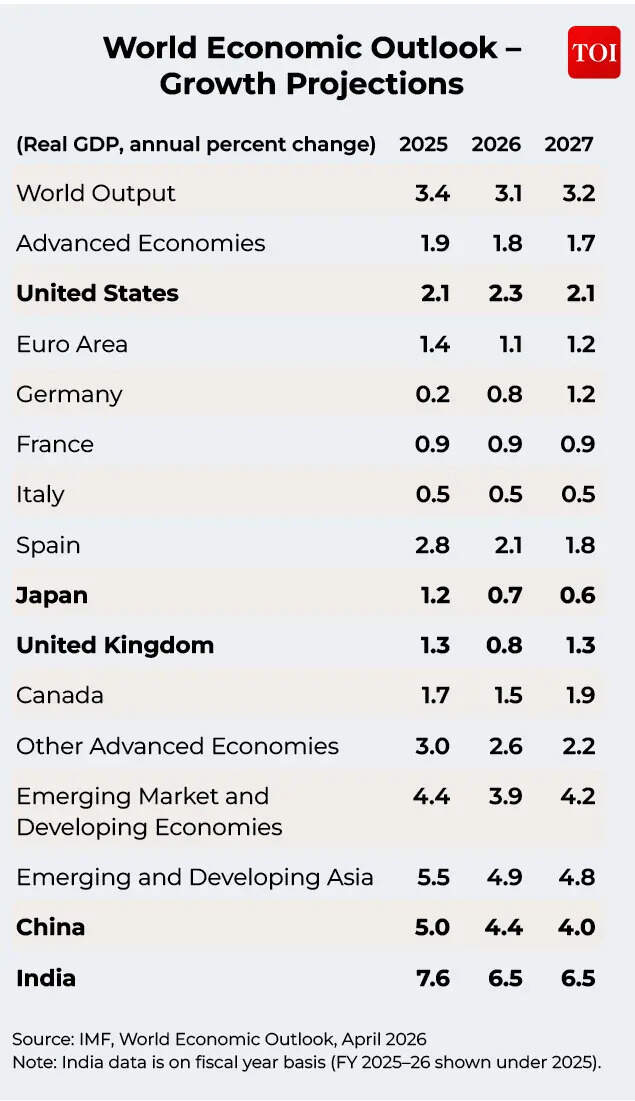
“In India, growth for 2025 is revised upward by 1.0 percentage point relative to October, to 7.6 percent, reflecting the better-than-expected outturn in the second and third quarters of the fiscal year and sustained strong momentum in the fourth quarter,” IMF said in its latest outlook. “For 2026, growth is revised upward moderately by 0.3 percentage point (0.1 percentage point relative to January) to 6.5 percent, led by positive contributions from the carryover of the strong 2025 outturn and the decline in additional US tariffs on Indian goods from 50 to 10 percent, which outweigh the adverse impact of the Middle East conflict. Growth is projected to stay at 6.5 percent in 2027,” it added.
Will India become 3rd largest anytime soon?
The rupee depreciation and the nominal GDP revision has also pushed back India’s dream of becoming the third largest economy by the end of this decade. In the October 2025 estimates, IMF had said that India will overtake Germany to become third largest by FY30. However, the April 2026 projections see it reaching the third rank only by FY 2030-31.Experts point to the rupee’s depreciation versus the dollar to note that the road ahead is likely to be uncertain. Madan Sabnavis, Chief economist, Bank of Baroda is confident that India will continue to do well in the coming years.“We will definitely improve in terms of GDP growth which will be higher than that of other countries especially UK and Japan which are just above us. However, the rupee value will finally determine how India gets placed on the global scale,” he told TOI.Ranen Banerjee of PwC India sees rupee beginning to get support with the conflict containment, relatively lower oil prices and portfolio flow reversals with valuations getting attractive in recent times. “Thus, we should not be experiencing any further sharp depreciation of the rupee in the immediate term provided the conflict does not escalate and oil prices relatively softening from their highs and come down to a range of $85-90 a barrel,” he says.For Arun Singh of Dun & Bradstreet, looking ahead, India’s relative position in US dollar‑based GDP rankings will remain highly sensitive to currency movements rather than domestic growth dynamics. “Continued global dollar strength or capital‑flow volatility may cause periodic slippage in rankings despite robust fundamentals. Sustaining external macro stability and limiting undue rupee volatility will be crucial for India’s strong growth performance to translate more fully into higher global economic rankings,” Arun Singh told TOI.The Indian economy, largely driven by domestic fundamentals, is not immune to external shocks. High US tariffs of 50% from August 2025 to early February, and the ongoing US-Iran war have spelt back-to-back shocks for the economy. Even as experts stress on the resilience of the growth story, the vulnerability to higher crude oil prices, and other global supply chain disruptions is a reality. In such a scenario, India may well have to contend with fluctuating world rankings, while banking on its strong GDP growth to tide over disruptions.

new video loaded: Why Your Paycheck Feels Smaller
By Ben Casselman, Nour Idriss, Sutton Raphael and Stephanie Swart
April 18, 2026


Ariana Grande teases new era after ‘Eternal Sunshine’ with cryptic video

I don’t regret gifting Nobel prize to Trump: Venezuela’s Machado
NaBFID signs pact with PDCOR to expand advisory support for state projects – The Times of India

-

 Politics1 week ago
Indian airlines hit hardest after Dubai limits foreign flights until May 31
-

 Entertainment6 days ago
Palace left in shock as Prince William cancels grand ceremony
-

 Sports5 days ago
The case for Man United’s Fernandes as Premier League’s best
-

 Politics1 week ago
Chinese, Taiwanese will unite, Xi tells Taiwan opposition leader
-

 Entertainment1 week ago
Dua Lipa hits major career high ahead of wedding with Callum Turner
-
 Business1 week ago
The FAA wants gamers to apply for air traffic control jobs
-
 Business5 days ago
UK could adopt EU single market rules under new legislation
-

 Sports1 week ago
Lamar Jackson hits back at critics with faithful message on social media