

Sports
California school board votes to ban trans athletes from girls’ sports amid state’s lawsuit with Trump


NEWYou can now listen to Fox News articles!
A school board in California voted to defy state policy and ban trans athletes from girls’ sports Tuesday.
The Kern County Board of Education approved a resolution to comply with the federal definition of Title IX.
The vote comes amid a feud and lawsuit between the state and President Donald Trump‘s administration over the issue of males competing in girls’ sports. Now, at least one school board has opted to side with Trump over the state authorities that have rigorously committed to keeping males in girls’ sports this year.
CLICK HERE FOR MORE SPORTS COVERAGE ON FOXNEWS.COM
Trump signed an executive order to ban males from girls’ and women’s sports nationally back in February, but California was one of the first states to publicly defy the order. The defiance enabled multiple incidents of trans athletes competing in high school girls’ basketball, cross-country and track and field in 2025, as California schools were made to continue following the state law that has protected trans inclusion in sports dating back to 2014.
The issue came to a head during the spring high school track and field postseason, when transgender athlete AB Hernandez of Jurupa Valley High School made a run for two girls’ state titles.
In May, three of the state’s esteemed Christian high schools sent a letter to the California Interscholastic Federation (CIF) challenging its longstanding policy that allows biological males in girls’ sports. Many residents, girls’ athletes and even entire educational institutions protested the trans athlete’s inclusion.
Earlier that month, JSerra Catholic High School, Orange Lutheran High School and Crean Lutheran High School sent a joint letter to the CIF on Thursday.
“CIF’s Gender Identity Policy also fosters an environment that is increasingly hostile to religious member schools. CIF’s expectation that all faith-based schools facilitate the CIF Gender Identity Policy puts religious schools in the untenable position of adhering to the tenets of their faith in their classrooms and communities but practicing something contrary to their faith on their athletic fields,” the letter read.
Now, the Kern County Board of Education is the first public school board to stand up to the state and side with Trump over the issue.
Maine, which is engulfed in a similar lawsuit with Trump over the same issue, also saw two of its public school boards pass resolutions in April to locally ban trans athletes from competing in girls’ sports.
Trump’s Department of Justice is now suing both states, seeking injunctions on the policies that continue to enable males to compete in girls’ sports and use girls’ locker rooms.
California’s policies “eviscerate equal athletic opportunities for girls … they also require girls to share intimate spaces, such as locker rooms, with boys, causing a hostile educational environment that denies girls educational opportunities,” the lawsuit against California argues.
“The results of these illegal policies are stark: girls are displaced from podiums, denied awards, and miss out on critical visibility for college scholarships and recognition.”
California Democrat Gov. Gavin Newsom has said that the California Department of Education and CIF were following laws enacted in 2013.
“I struggled with the issue of fairness when it came to sports,” Newsom said in response to the lawsuit at a July event. “And we tried to figure that out a couple of years ago, and we were unsuccessful, and we struggled with that recently.
“And my position is that I don’t think it’s fair, but I also think it’s demeaning to talk down to people, and to belittle the trans community. And I don’t like the way the right wing talks about the trans community. These people just want to survive.”
Newsom previously garnered mixed responses within his party when he said he believed males competing in girls’ sports is “deeply unfair” in a March episode of his podcast. Still, he has declined to commit to or even support the idea of banning males from girls’ sports.
Newsom is not named as a defendant in the DOJ lawsuit.
A bipartisan survey by the Public Policy Institute of California found the majority of California residents oppose biological male trans athletes competing in women’s sports.
That figure included more than 70% of the state’s school parents.
CLICK HERE TO GET THE FOX NEWS APP
“Most Californians support requiring transgender athletes to compete on teams matching the sex they were assigned at birth,” the poll stated.
“Solid majorities of adults (65%) and likely voters (64%) support requiring that transgender athletes compete on teams that match the sex they were assigned at birth, not the gender they identify with. An overwhelming majority of public school parents (71%) support such a requirement.”
Follow Fox News Digital’s sports coverage on X, and subscribe to the Fox News Sports Huddle newsletter.







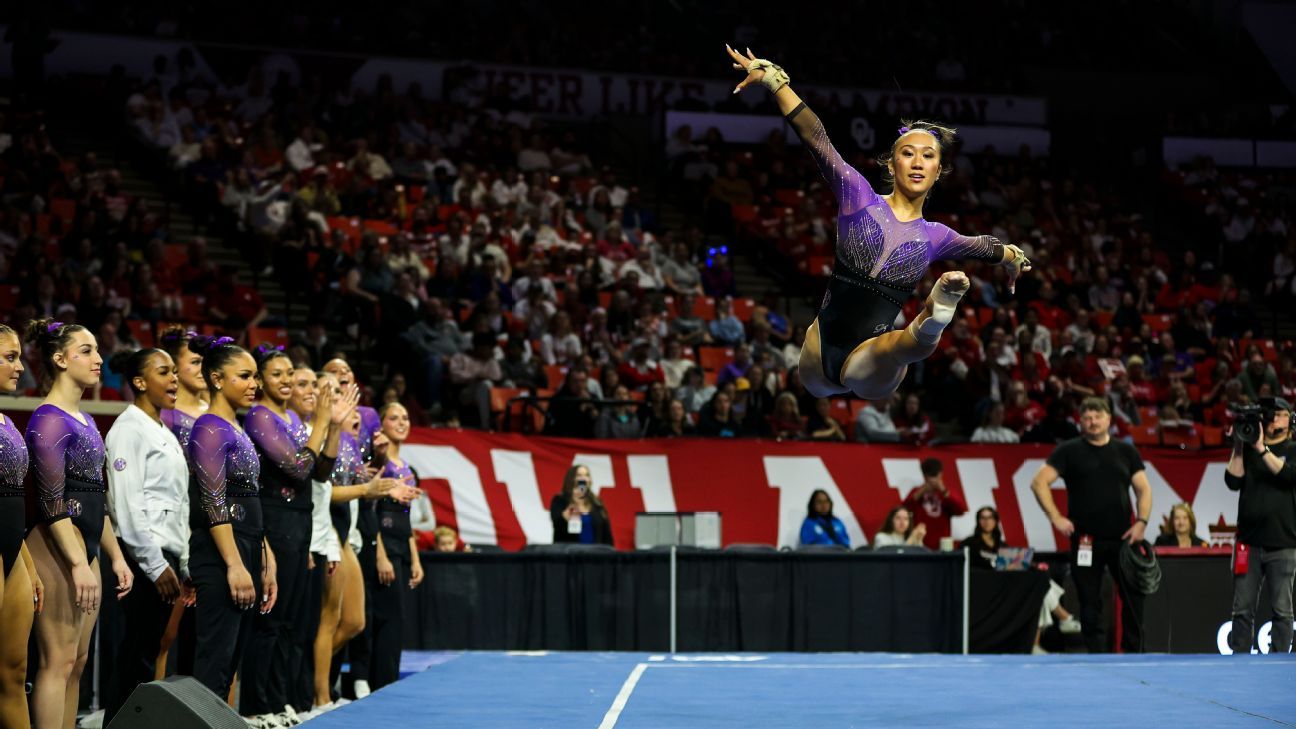
FORT WORTH, Texas — The first semifinal session of the NCAA gymnastics championships included LSU, Florida, Georgia and Stanford — with Florida and LSU advancing to Saturday’s final (4 p.m. ET; ABC).
Next up, Oklahoma, UCLA, Arkansas and Minnesota will compete in Semifinal II, beginning at 9 pm ET (ESPN2). Once again, the top two teams will move on.
Individual event titles and an all-around winner will also be awarded today — but not until both semifinal sessions are complete.
Who will make it to the next round? Will an upset surprise us all? We’ll have you covered with all the action here.

New Jersey Gov. Mikie Sherrill on Wednesday joined U.S. Senator Chuck Schumer in calling on FIFA to contribute toward World Cup transit security costs.
MetLife Stadium will host eight World Cup games, including the tournament final. The Athletic reported earlier this week that NJ Transit is considering charging $100 for train tickets to shuttle fans between New York Penn Station and the stadium. Standard fare is $12.90.
Parking will be restricted at the Meadowlands stadium complex compared to NFL games — making public transport one of the only options to attend World Cup matches, which get underway June 11.
“We inherited an agreement where FIFA is providing $0 for transportation to the World Cup,” Sherrill said on X. “And while NJ TRANSIT is stuck with a $48 million bill to safely get fans to and from games, FIFA is making $11 billion. I’m not going to stick New Jersey commuters with that tab for years to come.
“FIFA should pay for the rides. But if they don’t — I’m not going to let New Jersey get taken for one.”
Speaking on WNYC on Wednesday, Sherrill said she would approve the fare increase if FIFA doesn’t step in.
“I will, if that’s what it takes, because I’m not putting this on the back of New Jerseyans,” she said.
On Wednesday, NJ Transit’s board of directors unanimously approved a resolution to set transport prices to “cover any and all costs” to transport fans and comply with Sherrill’s directive.
NJ Transit CEO Kris Kolluri on Wednesday said he supported Sherrill’s plea to FIFA and confirmed that commuters would not pay extra costs, according to NJ.com.
“The governor said whatever the fare will be, it will not be cross subsidized by our regular commuters. I’d think every NJ Transit customer would stand behind that,” Kolluri told NJ.com. “It will cost us $48 million. We will charge FIFA fans for those tickets, and it will not be subsidized by our commuters.”
Schumer on Monday said FIFA should be helping pay for World Cup transit security costs.
“FIFA is set to reap nearly $11 billion from this summer’s World Cup, yet New York area commuters and residents are being handed the bill,” Schumer wrote on X. “The least FIFA can do is ensure New York residents can go to the stadium without being gouged at the turnstile. I am demanding FIFA step up.”
We inherited an agreement where FIFA is providing $0 for transportation to the World Cup.
And while NJ TRANSIT is stuck with a $48 million bill to safely get fans to and from games, FIFA is making $11 billion.
I’m not going to stick New Jersey commuters with that tab for years… pic.twitter.com/pugU8davkW
— Governor Mikie Sherrill (@GovSherrillNJ) April 15, 2026
Earlier this month, New Jersey’s host travel committee released a detailed plan for transport and parking during the matches, outlining a park-and-ride plan with specific parking lots and shuttle buses that will run to and from the stadium.
“While rideshare and limited premium parking options will be available, the FIFA World Cup at NYNJ Stadium will be a public transportation first event, largely relying on NJ Transit rail and Host Committee bus shuttles,” Natalie Hamilton, a host committee spokesperson, told NJ.com.
“We are strongly encouraging all ticket holders to utilize expanded NJ Transit rail service and the Host Committee’s Stadium Shuttle.”
A FIFA spokesperson insisted the host city had previously agreed to provide free or at-cost transportation to fans at all matches.
“We are quite surprised by the NJ governor’s approach on fan transportation,” FIFA said in a statement Wednesday.
“The original FIFA World Cup 2026 host city agreements signed in 2018 required free transportation for fans to all matches. Recognizing the financial strain this placed on the host cities, back in 2023 FIFA adjusted the host agreement requirements across all host cities as follows: All match ticket holders and accredited individuals shall be able to access transport [public or additionally planned transport] at cost to allow travel to stadiums on match days.
“Moreover, FIFA has worked for years with host cities on their transportation and mobility plans, including advocating for millions of dollars in federal funding to support host cities for transportation.
“The FIFA World Cup will bring millions of fans to North America along with the related economic impact. Many of these fans will travel to NYNJ to enjoy the eight matches scheduled, including the FIFA World Cup final.
“FIFA is not aware of any other major event previously held at NYNJ Stadium, including other major sports, global concert tours, etc, where organizers were required to pay for fan transportation.”
During the last World Cup in Qatar in 2022, ticket holders enjoyed free transport on the city’s Metro system, funded by the country’s government.
UEFA bore the cost of ticket holders using German public transport in host cities on match days during Euro 2024.
Kansas City, where England’s training camp will be based, will offer free bus travel for fans from the airport close to the Fan Festival in the city center, and daily, weekly and tournament passes for unlimited regional travel costing $5.25 and $50, respectively.
Ticket holders will also be able to use a Stadium Direct service, which connects four park and ride locations as well as the Fan Festival to the Arrowhead Stadium for $15 per person, the host city committee said.
Meanwhile, a spokesperson for the Southeastern Pennsylvania Transportation Authority (SEPTA) said that there will be no fare increases connected to the staging of World Cup matches in Philadelphia.
The spokesperson said most if not all of the added operating costs of running the services during the World Cup would be covered by a recently awarded federal grant.
Information from Press Association and The Associated Press was used in this report.

NEWYou can now listen to Fox News articles!
The Baltimore Orioles fell victim to an accidental challenge.
In the second inning of the Orioles’ 8-5 loss to the Arizona Diamondbacks on Wednesday, third baseman Coby Mayo was forced to challenge a pitch he didn’t want to.
Mayo took a 3-0 pitch from Diamondbacks starter Eduardo Rodríguez on the outside and began walking toward first base, thinking he had a walk. Instead home plate umpire John Tumpane called it a strike.
CLICK HERE FOR MORE SPORTS COVERAGE ON FOXNEWS.COM
Baltimore Orioles’ Coby Mayo talks with umpire John Tumpane during the second inning against the Arizona Diamondbacks in Baltimore, Maryland. April 15, 2026. (Stephanie Scarbrough/AP Photo)
Mayo expressed his displeasure with the call and raised his right hand toward his helmet, but did not tap his head, as he did not want to challenge the pitch. Tumpane thought he did indeed challenge the pitch and initiated a review.
The call was confirmed to be a strike as Mayo argued he did not challenge the call. The Orioles ended up losing the challenge, one of their two on the day. A replay confirmed that Mayo never actually touched his head.
ASTROS’ $54M PITCHER BLAMES ARM FATIGUE ON STRUGGLE TO ADJUST TO AMERICAN LIFESTYLE

Baltimore Orioles’ Coby Mayo celebrates hitting a double during the second inning against the Arizona Diamondbacks in Baltimore, Maryland. April 15, 2026. (Stephanie Scarbrough/AP Photo)
Mayo, however, still had a successful at-bat. On the ensuing 3-1 pitch, Mayo ripped a 91-mph fastball down the left-field line for a double and ended up scoring the game’s first run.
Mayo’s unintentional challenge is one of a few that have occurred so far this season. Last week, Pittsburgh Pirates infielder Nick Gonzales challenged a pitch but immediately tried to reverse his decision, as the team only had one challenge left.
CLICK HERE TO DOWNLOAD THE FOX NEWS APP

Baltimore Orioles’ Coby Mayo celebrates with Blaze Alexander after scoring on an RBI hit by Sam Huff during the second inning against the Arizona Diamondbacks in Baltimore, Maryland. April 15, 2026. (Stephanie Scarbrough/AP Photo)
Gonzales ended up winning the challenge, and the Pirates retained their last challenge.
Mayo and the Orioles (9-9) will hope they don’t have any more ABS snafus when they play the Cleveland Guardians (10-9) on Thursday at 6:10 p.m. ET.
Follow Fox News Digital’s sports coverage on X, and subscribe to the Fox News Sports Huddle newsletter.


2026 NCAA gymnastics championships: Live updates from semifinals

Netflix co-founder Reed Hastings to step down as chairman

N.J. governor: FIFA should pay extra train costs to MetLife for World Cup

-

 Entertainment1 week ago
Queen Elizabeth II emotional message for Archie, Lilibet sparks speculation
-

 Tech1 week ago
Azure customers up in arms over ‘full’ UK South region | Computer Weekly
-

 Tech1 week ago
As the Strait of Hormuz Reopens, Global Shipping Will Take Months to Recover
-

 Fashion1 week ago
CII submits 20-pt agenda to Indian govt to back firms hit by Iran war
-

 Tech1 week ago
This AI Button Wearable From Ex-Apple Engineers Looks Like an iPod Shuffle
-

 Politics7 days ago
Indian airlines hit hardest after Dubai limits foreign flights until May 31
-

 Entertainment4 days ago
Palace left in shock as Prince William cancels grand ceremony
-

 Politics6 days ago
Chinese, Taiwanese will unite, Xi tells Taiwan opposition leader