

Business
Casino Math Can Power Your Portfolio: How Investors Can Win The Risk–Reward Game


Last Updated:
Winning more trades doesn’t mean winning more money. Alok Jain says long-term success comes from casino math—small losses, big winners
Casino Math
Investors often fixate on being “right” in the stock market by chasing the highest possible number of winning trades. But according to Alok Jain, founder of Weekend Investing, true long-term success in the markets comes from a counterintuitive principle: casino math. Addressing investors, Jain said the same probability-driven logic that enables casinos to earn billions can also help individuals build stronger and more profitable portfolios.
To explain the idea, Jain began with how casinos operate despite occasionally paying out massive jackpots. “A 25-year-old software engineer wins $39 million after betting just $100. Someone else wins $3 million on a $3 bet. Yet casinos continue to thrive because they focus on managing risk and reward—not on win rates,” he said.
In a typical setup, a casino might allow players to win seven out of 10 games. Even with that apparent disadvantage, the casino still profits because its losses are small while its gains are large. For instance, if the casino wins three rounds earning ₹100 each (₹300 total) but loses seven rounds losing ₹30 per round (₹210), it still makes a profit of ₹90. “The math defies intuition,” Jain explained, “but this is the essence of risk–reward.”
He then translated this concept into personal investing using a comparison between two investors—Ram and Sham. Ram wins 75% of his trades but settles for small gains while suffering large losses. Sham, in contrast, wins only 25% of his trades, but his winners are large and his losses are tightly controlled. At the end of the year, Ram ends up with just a 5% return, while Sham earns 13%. “The investor with more losing trades actually makes more money. That’s the power of reward overpowering risk,” Jain noted.
Jain said many investors behave like Ram because of loss aversion, a behavioural bias where losses hurt far more than equivalent gains feel good. This leads people to hold on to losing stocks in the hope of recovery, while booking profits too early on winning positions. “We deceive ourselves,” he said. “A stock falling from ₹100 to ₹60 is treated as temporary. Investors convince themselves it will bounce back, even as the damage keeps increasing.”
The impact of deep losses can be severe, Jain warned. A 50% fall requires a 100% gain just to recover. Falling another 30–40% pushes investors into an almost unrecoverable “ditch.” The core principle, he stressed, is simple: cut losses early and let winners run.
Jain also shared real data from a 242-trade systematic momentum strategy. Even though losing trades were higher than winning ones (52% losers versus 48% winners), the average winning trade delivered 25% returns, while average losses were capped at 9%. A handful of multi-bagger stocks—posting gains of 144%, 219% and even 298%—accounted for most of the portfolio’s overall performance. “Just like the Pareto principle, 20% of trades generate 80% of the returns,” he said.
The central takeaway, Jain emphasized, is that a high win rate does not guarantee profitability—risk–reward discipline does. “Don’t cling to losing stocks. Don’t fear rising stocks. Use stop-losses, churn smartly and allow the math to work in your favour,” he advised.
He urged investors to introspect on their behavioural biases and adopt systematic investing approaches that prioritise survival, consistency and large winners—rather than chasing bragging rights based on hit rates alone.

Aparna Deb is a Subeditor and writes for the business vertical of News18.com. She has a nose for news that matters. She is inquisitive and curious about things. Among other things, financial markets, economy, a…Read More
Aparna Deb is a Subeditor and writes for the business vertical of News18.com. She has a nose for news that matters. She is inquisitive and curious about things. Among other things, financial markets, economy, a… Read More
November 30, 2025, 10:58 IST
Read More





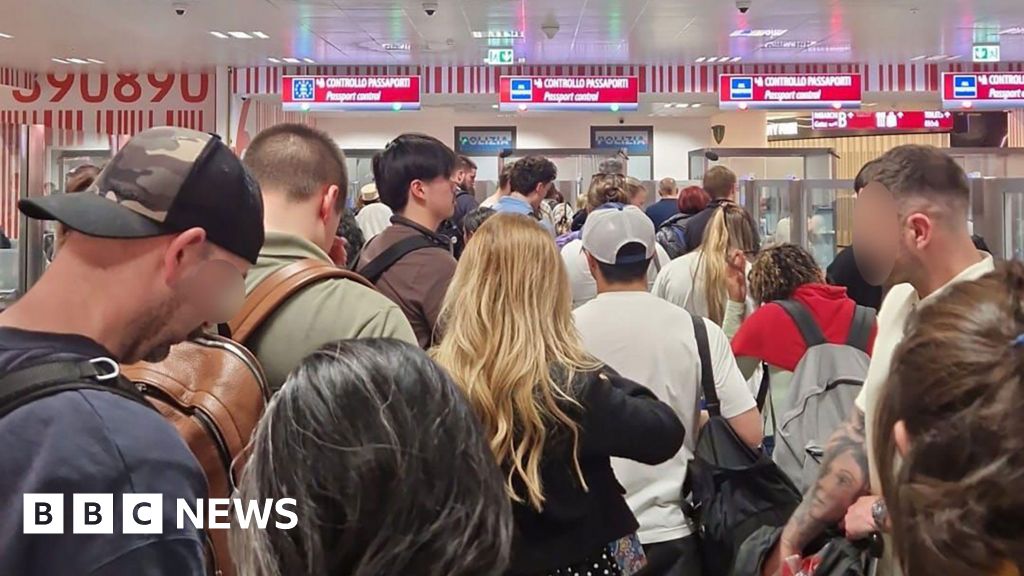
New European border rules have caused delays at airports across the continent, affecting flights.
Source link

A view shows a second-generation R1S at electric auto maker Rivian’s manufacturing facility in Normal, Illinois, on June 21, 2024.
Joel Angel Juarez | Reuters
A tornado damaged part of Rivian Automotive‘s factory in central Illinois over the weekend, according to a message sent to employees Sunday night by CEO RJ Scaringe that was viewed by CNBC.
The tornado touched down on the plant, Scarigne said. That area was being used for parts storage and logistics for Rivian’s upcoming R2, which is a crucial product for the company that’s expected to be on sale this spring.
Scaringe said operations in the damaged area are expected to resume this week, while other major portions of the plant, such as its assembly lines, are operating as planned. No injuries have been reported as a result of the incident, according to a company spokeswoman.
“While Building 2 has sustained damage and is closed for the time being as we complete our assessments, I am incredibly relieved to share that there were no injuries at our plant,” Scaringe said in his message to employees.
Scaringe said the company would “share more information as it becomes available, but for now, our priority is ensuring our Normal [Illinois] team is safe and supported.”
Apparent photos posted online of the aftermath, which was first reported by TechCrunch, showed damage to the roof and at least one wall of the recently constructed building.
The National Weather Service reports the factory was hit amid a “significant tornado outbreak” that occurred Friday across the upper Midwest. Confirmed tornadoes near the factory Friday night were classified as EF1, with estimated peak winds of 100 mph, according to NWS.

Businesses can apply online through a portal for refunds expected to total $160bn.
Source link


King Charles’ wardrobe reveals obsession with bespoke suits

UK’s Starmer admits should never have named Mandelson as US envoy
Ryanair flight from Milan to Manchester leaves passengers behind due to border delays

-

 Fashion4 days ago
France’s LVMH Q1 revenue falls 6%, shows resilience amid Iran war
-

 Sports1 week ago
The case for Man United’s Fernandes as Premier League’s best
-

 Entertainment1 week ago
Palace left in shock as Prince William cancels grand ceremony
-
 Business1 week ago
UK could adopt EU single market rules under new legislation
-

 Entertainment5 days ago
Is Claude down? Here’s why users are seeing errors
-

 Fashion1 week ago
Energy emerges as biggest cost driver in textile margins
-
 Business1 week ago
Delta Air Lines unveils first new Delta One suite in premium cabin arms race
-

 Tech1 week ago
A Lot of Shops Won’t Fix Electric Bikes. Here’s Why