

Business
China takes ‘high stakes’ tech race up a notch with US as economic imbalances worsen | The Express Tribune

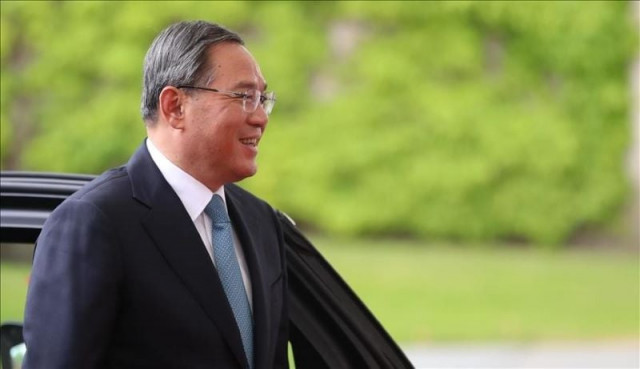
Premier Li Qiang said ‘multilateralism, free trade are under severe threat’, 7% increases in the defence budget, R&D
Chinese Prime Minister Li Qiang. PHOTO: ANADOLU
China on Thursday vowed to deepen investment in high-tech industries and scientific innovation, framing them as essential to bolstering national security and self-reliance amid rising geopolitical tensions and an intensifying rivalry with the US.
At the opening of the annual parliament meeting, Premier Li Qiang praised China’s ability to withstand US President Donald Trump’s tariff hikes, but said “multilateralism and free trade are under severe threat” and announced 7% increases in the defence budget and in research and development.
Li acknowledged an “acute” imbalance between strong supply and weak demand, subdued market expectations, and ongoing risks from a persistent property-sector downturn and high local government debt.
These challenges have pushed Beijing to set a slightly lower growth target of 4.5%–5% for this year, down from last year’s 5%, which was met largely through a one‑fifth surge in its trade surplus to a record $1.2 trillion.
China’s 15th five-year plan, as widely expected, pledged investments in innovation and industrial upgrading, as well as a “notable” – but unspecified – increase in household consumption as a share of economic output.
The combination of a lower growth target and higher outlays on research and strategic industries underscores Beijing’s bet that technological upgrading- not consumption – will drive its next phase of development despite growing structural pressures.
Last year’s trade punches with the Trump administration, which briefly escalated to embargo-like conditions of triple-digit tariffs, also showed the importance of its supply chain dominance as leverage.
“China’s government remains laser-focused on spurring technological breakthroughs and high-tech investment,” said Fred Neumann, chief Asia economist at HSBC. “In part, this is motivated by competition with the United States for control over the technologies of the future.”
“Many international observers may be left disappointed, therefore, by slower progress in rebalancing the economy away from investment towards consumption.”
China invests 20 percentage points of GDP more than the global average, while its households spend roughly 20 points less – a state-controlled, debt-driven development model that creates industrial overcapacity and fuels trade tensions abroad and deflationary pressures at home.
“The rebalancing challenge that China faces, and that will take years to achieve, is implicitly acknowledged by a weaker growth target for the coming year,” Neumann added.
The five-year plan aims to raise the value-added of “core digital economy industries” to 12.5% of GDP and roll out new policies for an integrated national data market and establish a system for AI security risk prevention.
These goals reflect President Xi Jinping’s vision of developing “new productive forces” to escape the middle-income trap, counter the demographic downturn, and enhance national security by insulating China from US export controls.
China pledged support for “breakthrough” developments across a range of industries, from farm seeds and biomedicine to areas at the cutting-edge of science, such as machine-brain interfaces. State-owned enterprises were urged to create demand for made-in-China technology like semiconductors and drones.
But the five-year plan also lists new ambitions in areas China already dominates. While accounting for 85% of the electric vehicle charging stations in the world, China aims to double their number within three years.
In AI, Beijing promised to build out “hyper-scale” computing clusters supported by cheap and abundant electricity.
“Beijing is trying to manage a ‘controlled glide’ in growth while building a new economy based on technology rather than property,” said Andy Ji, Asian FX & rates analyst at ITC Markets.
“It is a high-stakes rebalancing where the government is betting the house on AI and advanced manufacturing.”
Steady stimulus plans
Economists say a lower growth target allows Beijing to experiment with adjustments to industrial overcapacity, which could lead to some factory closures and job losses, but cautioned that this did not mean a departure from its production-focused growth model.
The US Supreme Court’s decision to strike down some of Trump’s tariffs and expectations that a meeting between the two countries’ presidents later in March could stabilise relations in the short term, bode well for such adjustments.
“The bigger context here is the China-US competition, but this year is the trade truce,” said Dan Wang, China director at Eurasia Group.
“It seems that China is taking advantage of this year to do some structural reform, which is the right direction for the economy in the long term, but it also means in the short term, the job market pressure is way higher.”
In terms of stimulus, China plans a budget deficit of 4.0% of GDP and has set special debt issuance quotas at 1.3 trillion yuan ($188.5 billion) for the central government and 4.4 trillion yuan for local authorities – all unchanged from last year.
China pledged to raise minimum monthly pensions by 20 yuan per person and basic medical insurance subsidies for rural, non-working people by 24 yuan – marginal, rather than structural, moves. It said it wants to increase education spending, subsidise childcare and reform public hospitals, acknowledging the demographic downturn.
Yuan Yuwei, fund manager at Trinity Synergy Investment, warned that China’s growth and policy aims for this year, prepared at the end of 2025, do not take into account the US-Israeli attacks in Iran.
“That’s very negative to China, which counts the Strait of Hormuz as a crucial trade route,” said Yuan.
($1 = 6.8969 Chinese yuan renminbi)








New European border rules have caused delays at airports across the continent, affecting flights.
Source link

A view shows a second-generation R1S at electric auto maker Rivian’s manufacturing facility in Normal, Illinois, on June 21, 2024.
Joel Angel Juarez | Reuters
A tornado damaged part of Rivian Automotive‘s factory in central Illinois over the weekend, according to a message sent to employees Sunday night by CEO RJ Scaringe that was viewed by CNBC.
The tornado touched down on the plant, Scarigne said. That area was being used for parts storage and logistics for Rivian’s upcoming R2, which is a crucial product for the company that’s expected to be on sale this spring.
Scaringe said operations in the damaged area are expected to resume this week, while other major portions of the plant, such as its assembly lines, are operating as planned. No injuries have been reported as a result of the incident, according to a company spokeswoman.
“While Building 2 has sustained damage and is closed for the time being as we complete our assessments, I am incredibly relieved to share that there were no injuries at our plant,” Scaringe said in his message to employees.
Scaringe said the company would “share more information as it becomes available, but for now, our priority is ensuring our Normal [Illinois] team is safe and supported.”
Apparent photos posted online of the aftermath, which was first reported by TechCrunch, showed damage to the roof and at least one wall of the recently constructed building.
The National Weather Service reports the factory was hit amid a “significant tornado outbreak” that occurred Friday across the upper Midwest. Confirmed tornadoes near the factory Friday night were classified as EF1, with estimated peak winds of 100 mph, according to NWS.
Businesses can apply online through a portal for refunds expected to total $160bn.
Source link


‘It’s his superpower’: Inside Fernando Mendoza’s extraordinary rise to No. 1

King Charles’ wardrobe reveals obsession with bespoke suits

UK’s Starmer admits should never have named Mandelson as US envoy

-

 Fashion4 days ago
France’s LVMH Q1 revenue falls 6%, shows resilience amid Iran war
-

 Sports1 week ago
The case for Man United’s Fernandes as Premier League’s best
-

 Entertainment1 week ago
Palace left in shock as Prince William cancels grand ceremony
-
 Business1 week ago
UK could adopt EU single market rules under new legislation
-

 Entertainment5 days ago
Is Claude down? Here’s why users are seeing errors
-

 Fashion1 week ago
Energy emerges as biggest cost driver in textile margins
-

 Tech1 week ago
A Lot of Shops Won’t Fix Electric Bikes. Here’s Why
-
 Business1 week ago
Delta Air Lines unveils first new Delta One suite in premium cabin arms race