

Tech
Cisco, USGA set to drive golf into the AI era | Computer Weekly


The United States Golf Association (USGA) has renewed its partnership with Cisco to deploy artificial intelligence (AI-)ready infrastructure and advanced solutions that help ensure its network can support complex and dynamic environments.
The USGA is a non-profit mission-based golf organisation which aims to “unify the golf community through handicapping nonprofit association and grassroots programmes”. Stated missions include showcasing talent through: the US Open, US Women’s Open Presented by Ally and 13 other national championships and its museum; providing “unbiased global governance” with The R&A through the playing, equipment and Amateur Status rules; and advancing issues important to golf’s future, with a focus on driving sustainability, accessibility and inclusion.
The USGA also manages day-to-day operations for the US National Development Programme, the US’s first unified pathway for American talent; and the World Golf Hall of Fame, preserving and celebrating the legacies of the game’s greatest figures.
Cisco has served as the official technology partner of the USGA since 2018, offering its AI networking, cyber security and observability solutions to strengthen the USGA’s year-round operations as well as its marquee events, including the US Open and US Women’s Open.
Through its renewed partnership with Cisco, the USGA will look to collaborate to deploy AI-ready infrastructure and advanced solutions that help ensure its network can support current and future device loads, socially those from emerging AI applications. The world of golf has rapidly adopted AI-driven connected intelligence platforms to gain required real-time insights and intelligence that can support current and future device loads.
The two companies said that their extended and enhanced partnership is designed to pioneer a new chapter of innovation and technology for the USGA and its championships, setting the stage for the next decade and beyond.
Cisco believes that AI is unlocking new experiences across industries and that such technology will help the USGA continue to innovate and evolve its foundation by helping USGA officials monitor the health of venue infrastructure and networking equipment, as well as crowd management, identifying issues before they occur to ensure “seamless” event operations.
In the near term, USGA is also helping to make the game’s official rules more accessible to everyday golfers through an AI-powered experience that provides clear, timely answers to rules questions. Cisco AI Defense – built to provide protection for enterprise AI – is being deployed to secure the integrity and security of the underlying AI. It also offers visibility into AI usage, validating models for risk and integrity and safeguarding applications at runtime against emerging AI-specific threats.
Cisco’s technology will see initial use in connecting and protecting the forthcoming championships at Riviera Country Club (US Women’s Open Presented by Ally) from 4-7 June 2026, and the US Open at Shinnecock Hills Golf Club (US Open).
Both championships will bring a range of connectivity including Cisco Wi-Fi 7 access points and Cisco switching architecture, delivering wireless comms to more than 240,000 expected fans, media and operators across the championship weeks.
Cisco networking technology will also be deployed to deliver operational simplicity and prepare to defend against AI-powered threats, alongside physical security and secure firewall solutions that ensure the integrity of the entire digital ecosystem. This includes critical functions such as broadcast, scoring and on-site amenities.
Meraki cameras will operate to offer enhanced security to monitor crowd flow and provide data-driven insights that improve event management. Customised dashboards from Splunk Enterprise and Splunk Cloud Platform will offer end-to-end monitoring and analytics, giving event operators real-time insight into network health and performance.
USGA chief commercial officer Jon Podany said: “Cisco has been an essential partner in helping the USGA build a technology foundation worthy of the world’s greatest golf championships. This extended partnership ensures we’re not just ready for today’s demands, but well-positioned to push the boundaries of what’s possible at our championships and beyond to meet the changing needs of our fans and customers.”
As it was announced the new partnership, Cisco stressed that it had “a deep commitment” to growing the game of golf, shown through various ongoing initiatives, including Cisco’s support of the USGA’s Pathways Internship Program, designed to introduce college and graduate students to careers in the golf and sports industry. In addition, Cisco will continue to deploy Networking Academy Dream Teams at key championship events, creating opportunities for aspiring technology leaders to foster skill building and career development in a real-world environment.
“We’re proud to partner with the USGA as it enters a new era of AI-driven innovation,” said Rob McQueen, vice-president of global sponsorships at Cisco. “As AI becomes foundational to the future of golf, Cisco’s leadership in networking, security and digital infrastructure will help the USGA deliver smarter, more connected and more immersive experiences for fans around the world.”
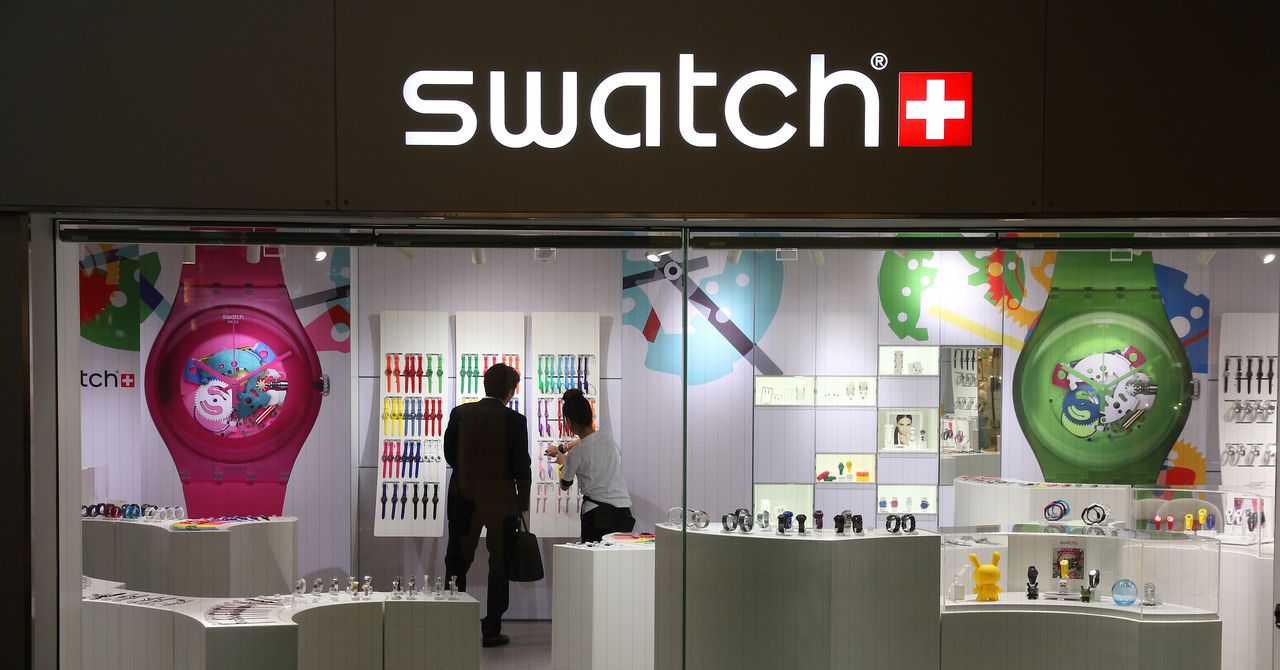
Laden with iconic Royal Oak design cues, most notably the octagonal case, eight-screw bezel, and Petite Tapisserie-patterned dial, the strapless design heavily references 1979’s Royal Oak Pocket Watch reference 5691. Inside is an entirely new hand-wound version of Swatch’s Sistem51 caliber, a movement that is completely machine assembled. Swatch has 15 active patents on this new iteration and has also squeezed in an impressive 90-hour power reserve. There’s even an antimagnetic Nivachron balance spring that was, incidentally, codeveloped with Audemars Piguet.
Swatch’s 1986 POP line, whose watch heads could be physically ejected from their frames and clipped elsewhere, has been plundered here to create a design that allows the Royal Pops to ping out of their bioceramic holder clips, too.
Why There’s No Wristwatch
The simple logic of the pocket watch design authorized by Audemars Piguet, which, unlike Omega, is not part of the Swatch Group, is that it doesn’t upset its existing high-net-worth customer base. Royal Oak owners will no doubt be breathing sighs of relief now that it’s confirmed a version of their coveted pieces won’t be coming to market for a mere few hundred bucks.
However, this doesn’t mean that AP would have been financially hit had it delivered what the public so clearly wanted. Omega, which was also concerned for its sales when shown the original MoonSwatch internal prototypes, enjoyed a sizable 50 percent bump in sales following the release of its budget cousin.
The Royal Pop pocket watch, cleverly, is a sidestep designed to generate as much hype as possible yet be as safe as can be for AP’s brand. The Royal Oak design language is unmistakable, but the wrist is off-limits. With Swatch, Audemars built something real for its aspirational fans; it just didn’t build them what they wanted.
What does Swatch get out of this? Valuable PR as well, but far more importantly, the potential of a much-needed sales hit. In 2025, the group posted a 6.75 percent drop in sales and a staggering 55.6 percent decline in operating profit, primarily attributed to a sharp drop in demand for its watches in China, Hong Kong, and Macau. Swatch Group shareholders are not happy.
How China Will Come to the Rescue
Here is where the story gets interesting for reasons neither Swatch nor AP planned. As Swatch resurrected its POP design, allowing the Royal Pop to be removed from its housing, within hours of the Royal Pop announcement, third-party strap brands seized on this prospect, looking to quickly fashion adaptations that convert the timepiece from pocket to wristwatch. As Royal Pops were designed to snap in and out of lanyards and desk stands, they should just as easily clip into bracelets and straps made specifically to receive them.
The market recognized in real time that the pocket watch from Swatch and AP tantalizingly contained all that was structurally needed to deliver the very wristwatch that the AI concepts had promised. All that was required now was something to connect the case to a wrist.

The Competition and Markets Authority (CMA) has formally launched its investigation into Microsoft’s business software to look at whether the provider of office productivity and database software should be categorised with strategic market status (SMS).
The CMA will be looking at whether Microsoft is making it difficult to integrate its products with that of other providers, which limits the ability of UK customers to gain access to the best products at the most competitive prices. The investigation will also consider Microsoft product bundling, a practice which can lead to Microsoft’s own products working more seamlessly together than if certain products are replaced by best-in-class third-party alternatives to solve specific business challenges.
The Windows software ecosystem is what has made Microsoft the dominate company that it is today and, as it builds out more and more artificial intelligence (AI) capabilities, there is a very real risk that new entrants and alternative AI engines may be unable to compete.
This is another aspect of the CMA investigation, where the regulator will assess how AI competitors are able to integrate with Microsoft’s business software, giving customers access to AI software across suppliers to best suit their needs. Another area of investigation is default settings in software, which can prevent customers from switching to alternative business software providers.
The CMA’s investigation will examine whether Microsoft has SMS in business software and consider whether it can use that position to limit customer choice. An SMS designation would enable it to consider whether to intervene on a key concern from its cloud market investigation – particularly Microsoft’s use of software licensing, which was found to be reducing competition in cloud services.
The CMA has been investigating concerns that Microsoft uses its dominant position in software (such as Windows Server and SQL Server) to limit competition in the cloud market by making it more expensive or difficult to host these products on rival platforms such as AWS or Google Cloud.
In March, the CMA announced that following engagement with Amazon Web Services (AWS) and Microsoft, the two companies agreed to make changes to cloud egress fees and product interoperability. Microsoft and AWS had been the subject of the CMA’s “cloud services market investigation”, which concluded last July and could have seen both companies designated with SMS.
With the Microsoft business software investigation, the CMA said it wants UK customers to be able to access the best tools in the market, and mix and match software and AI services from a broad range of competing suppliers. It said the investigation will examine Microsoft’s provision of a range of business software products used by UK organisations, including productivity software, personal computer and server operating systems, database management systems and security software.
Last month, Microsoft 365 Commercial cloud reported a quarterly revenue increase of 19%, and its Productivity and Business Processes business posted revenue of $35bn, an increase of 17% over the same period last year. Although there are commercial and open source alternatives to the Microsoft office productivity suite, it remains the de facto standard thanks, in part, to the dominance of the Windows operating system on business PCs.
Sarah Cardell, chief executive at the CMA, said: “Business software is a cornerstone of how the UK economy functions, from small businesses to major public services and infrastructure. Our aim is to understand how these markets are developing, Microsoft’s position within them and to consider what, if any, targeted action may be needed to ensure UK organisations can benefit from choice, innovation and competitive prices.”
The CMA’s nine-month investigation will include responses from customers, rivals and challenger technology, along with evidence submitted by Microsoft. It aims to reach a decision by February 2027.
Cardell has previously stated that an SMS designation would enable the CMA to address issues concerning Microsoft’s licensing practices in the cloud and ensure a level playing field as AI becomes embedded into business software. The CMA hopes the investigation will encourage a competitive and resilient business software market for UK businesses and the public sector.

InstaFarm’s patented 4-by-4-inch compostable trays come pre-filled with about a half-inch of soil (“sourced from Amish Country in Pennsylvania,” according to InstaFarm) and organic, non-GMO seeds, with the nutritional info for the final-product microgreens listed on top. They come in over a dozen varieties of nine-packs for $23, including individual cultivars, smoothie- and salad-specific blends, and even plain trays for growing your own greens or garden starts. It is worth noting that the trays are easily saturated paperboard designed for one-time use.
For comparison, Vego’s hydroponic microgreens planter, which I used last year, is just $60 for two units, while Gardyn’s is $100. Neither produces a volume of greens anywhere close to the InstaFarm, but again, $500 can buy a lot of store-bought microgreens.
InstaFarm has an app, but it doesn’t add much to the experience, other than the ability to activate night mode (which then turns off the light for up to 10 hours). More helpful is the button on the top of the unit that comes with a sticker describing how many presses are required for any function you’d need.
Every 90 minutes, a metal nozzle arm pops out and moves along each shelf, sensing each tray and its plants’ height, humidity, and temperature. Once the nozzle is done sensing, it dispenses an appropriate blast of water, much like the spray heads in the produce section of the grocery store. If you have cats, they may be very interested the first time they hear the nozzle whirring and moving slowly over the shelves. (The first quick, unexpected spray was an entertaining event in my house.) Sometimes, this sensing was more accurate in theory than in practice—for some reason, the sensor consistently overshot the watering volume for the red beet greens (but only the beet greens), causing the tray to overflow daily.
After a few weeks, I noticed the nozzle making a slight mechanical noise once it finished its rounds, as it slowly retracted back to its resting position. It wasn’t loud—it reminded me of the sound the bullwheel makes at the top of a ski lift—but because the InstaFarm was sitting on my dining room table, it was noticeable. And I should also note it was on my dining room table because, despite the website’s claims the unit can fit under most kitchen cabinets, it was just slightly too tall for mine. This made it difficult to site, as it does take up an approximate 6-by-18-inch footprint. Given how easy it is to clip the greens off for salads, smoothies, and other meals, its most natural habitat is probably the kitchen, so you may want to measure more than once to make sure it will fit your space.
Greens Aplenty
Photograph: Kat Merck
Just as the directions claimed would happen, I had lush, usable microgreens in about five days. For my first growing round (I’ve now been through four), I was overly excited and placed a tray on every slot. Unless you have a large family that eats microgreens for every meal, I don’t recommend this. I tried gamely to use them all, but after the traumatic experience of putting a tray’s worth of radish microgreens in a strawberry smoothie (so spicy, so radishy), I decided to share some of my first-grown trays with friends.


Here’s how Marco Rubio avoids Chinese sanctions to reach Beijing

GFS 2026: Bio-based materials have arrived. Can fashion scale them?

Jersey Election 2026: Cost of living concern in St Helier Central

-

 Tech6 days ago
A new frontier: Identity stack evolves for agentic systems | Computer Weekly
-

 Tech6 days ago
‘Orbs,’ ‘Saucers,’ and ‘Flashes’ on the Moon: Pentagon Drops New UFO Files
-

 Fashion6 days ago
New orders in German manufacturing up 5% MoM in Mar 2026: Destatis
-

 Tech6 days ago
Nick Bostrom Has a Plan for Humanity’s ‘Big Retirement’
-

 Sports6 days ago
Shaheen Afridi achieves landmark feat during opening Test against Bangladesh
-

 Entertainment6 days ago
Rihanna embraces new tattoo given by children
-

 Tech7 days ago
What Microsoft Executives Really Thought About OpenAI in 2018
-

 Tech6 days ago
Immersive narratives: how VR transforms industries through storytelling | Computer Weekly