

Business
Disney launches its Adventure cruise ship — a new foothold in Southeast Asia


Disney’s cruise line is going big in Asia.
This month, the company’s eighth and largest ship, the Disney Adventure, will embark on its maiden voyage, carrying passengers on three- and four-night journeys at sea from its berth in Singapore.
The vessel accommodates a whopping 6,700 passengers, around two-thirds more capacity than Disney’s Wish class ships, which are the Disney Wish, the Disney Treasure and the Disney Destiny. The Adventure can also carry around 2,500 crew members, about 1,000 more than on the Wish class ships.
“It takes a village to be able to support the type of service that we’re known for,” Joe Schott, president of Disney Signature Experiences, told CNBC.
The Disney Adventure sets sail at a time of rapid expansion for Disney’s cruise line. It is one of six vessels set to join the fleet by 2031. It’s also emblematic of the company’s global aspirations, which coincides with a sharp decline in international visitors venturing to the United States.
Mickey and Minnie Mouse pose in front of the Disney Adventure.
Disney
While tourism grew worldwide last year, the United States was the only major destination to see a drop in foreign visitors, according to the World Travel & Tourism Council. Overall, international travel to the U.S. fell 6%, the organization found. That decline continued into 2026, as January’s numbers were down 4.8% compared with the same month a year prior.
Travel bans, visa fees and invasive searches at ports of entry are all contributing to international travelers leaving the United States off their travel itineraries, according to the WTTC. Trade frictions, geopolitical unease and safety concerns have also contributed to the drop in demand for travel stateside, travel experts told CNBC.
Still, Disney’s domestic theme parks drive around two-thirds of revenue in its experiences division, which includes parks, cruises, resorts and consumer products. International destinations account for around one-fifth of revenue.
Expanding its fleet to new ports allows Disney to entice guests that may not have otherwise been able to venture to its theme parks or get on board one of its cruise ships. And Asia is a rapidly growing market.
A whole new market
Disney is no stranger to the Asian market. It already has a strong footprint of theme parks and resorts in Tokyo, Hong Kong and Shanghai.
“We have a really strong presence already up in the the northern part of Asia,” Schott said. “But, I think as you think about the southeast part of Asia, we don’t really have a physical presence. So, this is a great way to really be able to connect a whole lot of people that haven’t had the opportunity to do a physical Disney experience before.”
The cruise industry, in particular, in Asia has been in a state of rapid growth in the wake of the pandemic. In 2024, the region accounted for 2.6 million cruise passengers, a 13% increase from the previous year, according to data from the Cruise Lines International Association.
“Prior to 2024 we were really seeing a rise in the disposable income and the income levels of Southeast Asian travelers,” said Dulani Porter, executive vice president and partner at Spark, a creative agency that works with hospitality and tourism brands. “And so it was a very, very important market for any international tourism organization.”
That’s where the Disney Adventure comes in.
Initially destined to be a floating casino, the ship went up for sale part way through its construction when its parent company, Genting Hong Kong, went bankrupt in 2022. Disney swooped in and bought it.
“I think this was a great opportunity, because if we hadn’t acquired the ship the way we did, we wouldn’t be going into this market as soon as we are,” said Bruce Vaughn, president and chief creative officer of Walt Disney Imagineering. “And that’s a great thing.”
Previously, all of Disney’s cruise ships have left from domestic ports in Florida before traveling to international destinations. In the case of the Adventure, the ship is the destination. Stationed in Singapore, the vessel will voyage entirely at sea, with no port calls.
And Disney says demand is already there. Disney’s cruises are already 80% booked for fiscal 2026, Schott said.
A ‘brand ambassador’
The Disney Adventure’s size isn’t the only thing that sets it apart from the rest of the fleet. The ship has been tailored for consumers in Asia.
“Since the ship is going to be dedicated to Singapore and that market, we also wanted to make sure that we address what we thought would be unique to them,” said Vaughn.
This came in the form of selecting franchises and characters that are popular in the region, designing entertainment and relaxation areas catered to local tastes and providing a diverse selection of menus across its restaurants.
“We’re looking forward to servicing a brand-new audience,” Schott said. “In that respect, the ship is a brand ambassador.”
Guests on board the Adventure will be immersed in Disney’s more than 100 years of storytelling with character meet-and-greets as well as themed shopping and entertainment areas.
Situated in the middle of the ship is a deck designed to look like a street from San Fransokyo, the fictional city in “Big Hero 6.” The area is home to arcade games inspired by the movie, a replica of the Lucky Cat Cafe owned and operated by Aunt Cass as well as four movie theaters and dedicated tween and teen spaces.
A view of San Fransokyo street aboard the Disney Adventure.
Disney
The street also features the first-ever Duffy and Friends store at sea and a National Geographic shop. Disney executives told CNBC that these brands are incredibly popular with consumers in the region.
Duffy the Disney Bear is a character that was developed initially for a merchandise line at Walt Disney World’s Disney Springs, but gained attention when it was brought to Tokyo a few years later. In the last two decades, Duffy has been joined by seven other stuffed animal friends and has become one of the bestselling merchandise lines for the company.
In 2023, Disney reported the character generated $500 million in sales annually.
Disney characters in traditional Han costumes perform on the stage during a special edition of “Enjoying the Moon with Duffy and Friends” event celebrating the Mid-Autumn Festival at the Shanghai Disney Resort on September 17, 2024 in Shanghai, China.
Vcg | Visual China Group | Getty Images
In designing the Disney Adventure, the company was also conscious of local traditions. For many in Asia, vacations aren’t just for a nuclear family, but for extended family and even large groups of friends.
“I think one of the biggest distinctions that I’m seeing with South Asian cultures [is] travel really is about spending more time together,” Porter said. “Not to generalize, but North American cruisers will choose cruising because the kids can go do their thing and the parents can go do their thing, all contained into a ship.
“For Asian travelers, that is a very meaningful time spent together, where the grandparents and the kids and the parents and the grandparents, everybody is really trying to maximize all of that time together,” she said.
Both Vaughn and Schott detailed layers of experiences available to cruise guests that cater to different age ranges, both kids and kids at heart.
There’s Marvel Landing on the upper deck of the ship that features a rollercoaster, a spinning attraction and car-chase ride all inspired by The Avengers. In the same area is a sundeck, infinity pool and a bar.
Wayfinder Bay is an open-air area with amphitheater-like seating that doubles as a performance venue. And there’s D Lounge, which features a number of private karaoke rooms.
“We’ve had to think about that quite extensively in our parks in the region … multigenerational travel is just part of the formula,” said Schott.
Also part of the formula is Disney’s dining experience.
Aboard the Disney Adventure, guests will have an eclectic selection of food and beverages to try, with an emphasis on flavors that are popular in the region.
The Disney Adventure will have burgers and classic American fare at Stitch’s Ohana Grill, bubble teas at the Ursula-inspired Bewitching Boba and Brews, as well as pitas and kebabs at the Ms. Marvel-inspired Cosmic Kebabs.
There will also be Indian cuisine at Mowgli’s Eatery and Polynesian-inspired fare at Gramma Tala’s Kitchen.
Rotational dining is also featured on the cruise ship, a staple of Disney’s service.
While passengers have the option to grab quick-service meals and snacks throughout the ship, several of its restaurants are included in a prescheduled dining plan. Guests have reservations for each of these themed restaurants and rotate through them during their cruise.
Disney rotates the restaurant staff, too, to follow each group of passengers to their scheduled restaurant. As a result, guests have the same servers, busboys and restaurant managers throughout their trip, and the waitstaff gets to know the guests — and their preferences.
“I think at the end of the day, this entry into the market needs to be a really strong one for us,” Schott said. “So we’re looking forward to really being able to deliver the Disney-level of service at an extraordinary level.”






Business
Middle East heat may ripple across India’s energy supply chain, flags Goldman Sachs – The Times of India
As tensions continue to heat up in the Middle East, concerns are raising about disruptions to one of the world’s most critical energy shipping routes, the Strait of Hormuz. Any disruption could significantly affect major oil-importing countries such as India, as the narrow Strait of Hormuz is central to global energy trade. The strait sees almost 20 million barrels of oil passing through each day, or about a fifth of the world’s consumption, pass through the route. The waterway also carries roughly 19% of global liquefied natural gas (LNG) shipments, making it a crucial corridor for energy-importing economies.A recent report by Goldman Sachs has flagged early signs of stress in the region. The report warned that tanker traffic through the Strait of Hormuz has already begun showing signs of disruption, with shipping firms, oil producers and insurers adopting a cautious approach following reports of damaged vessels in nearby waters.According to the firm, financial markets have already begun factoring in the geopolitical risk. Oil prices currently carry an estimated risk premium of $18-per-barrel, reflecting the potential market impact if energy flows through the Strait of Hormuz were disrupted for about a month.
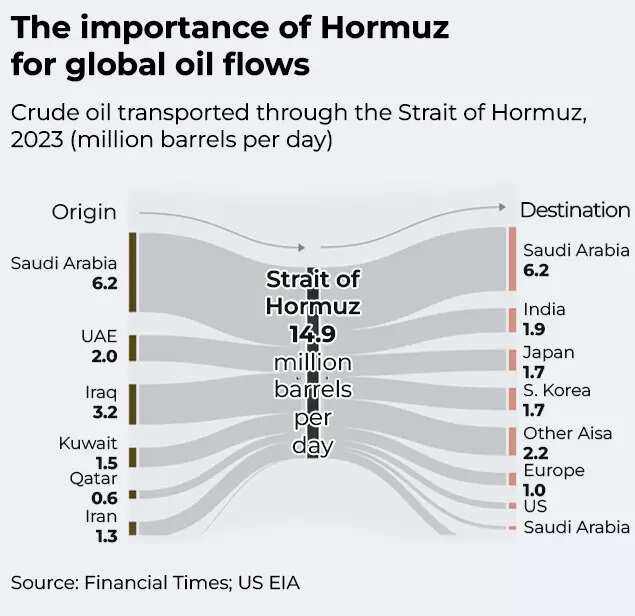
Even is the oil facilities are not directly damaged, a shutdown of the shipping route could expose a significant portion of global supply. The report estimates that in an event of full closure, about 16 million barrels per day of oil flows could be affected, despite the availability of some pipeline routes designed to bypass the strait.And the risks are not limited to crude oil shipments with almost 80 million tonnes of LNG exports annually, much of it from Qatar, moving through the passage. Any prolonged disruption could tighten gas supply globally and potentially drive European benchmark gas prices back to levels seen during the 2022 energy crisis.
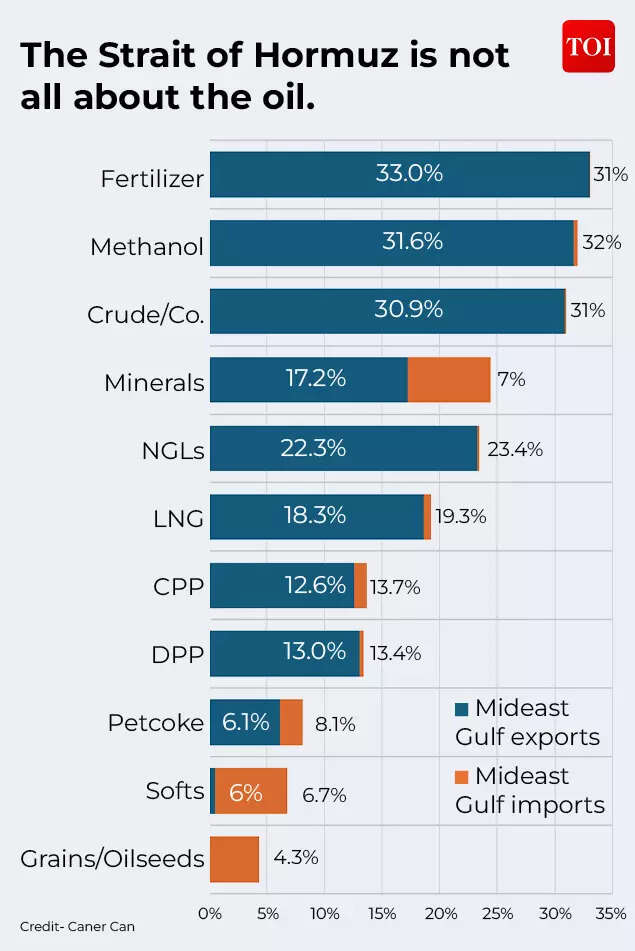
Asian economies stand among the most exposed to such disruptions. Major importers such as China, India, Japan and South Korea depend heavily on oil and LNG shipments that transit through the strategic corridor.While global oil inventories and spare production capacity could help cushion short-term shocks, the report warned that sustained disruption to Gulf shipping routes could trigger sharp volatility in global energy markets and push prices higher across oil, gas and refined fuel products.Market participants and governments are closely watching tanker traffic in the Strait of Hormuz, along with diplomatic and military developments involving the United States, Iran and Gulf nations, to assess whether the current disruptions remain temporary or escalate into a broader energy supply shock.

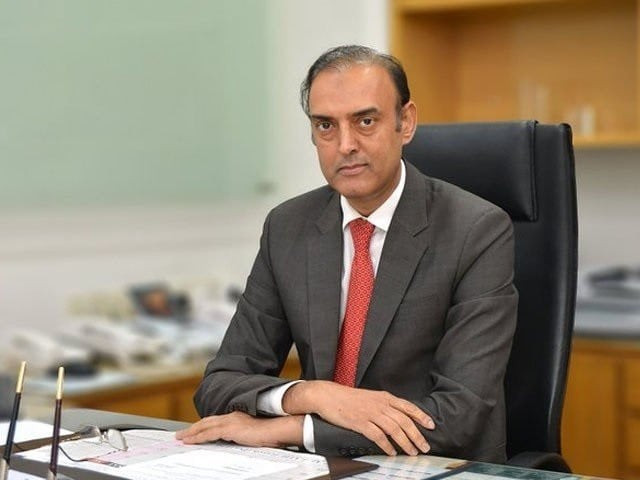
KARACHI: The Pakistan Stock Exchange rallied on Thursday after Saudi Arabia assured Pakistan of facilitating crude oil shipments through the Red Sea port of Yanbu Port, easing concerns over potential fuel supply disruptions.
The benchmark KSE-100 Index climbed sharply during the trading session, rising 4,439.93 points (2.85%) to reach an intraday high of 160,217.14 points.
Market Recovery
Analysts attributed the market rebound to renewed institutional buying and improving investor sentiment after Saudi assurances on oil supplies.
Market expert Ahsan Mehanti, CEO of Arif Habib Commodities, said easing fuel supply concerns played a key role in the recovery.
He added that rising global crude prices, expectations of a new International Monetary Fund loan tranche for Pakistan, and positive economic indicators also boosted investor confidence.
Alternative Oil Route
Pakistan sought an alternative supply route after Iran announced the closure of the Strait of Hormuz, a crucial global oil transit corridor.
Federal Petroleum Minister Ali Pervaiz Malik held talks with Nawaf bin Said Al-Malki, requesting Saudi support for uninterrupted energy supplies.
Saudi authorities reportedly assured Pakistan that oil shipments could be routed through Yanbu, and one crude vessel has already been prepared for dispatch.
Global Oil Market Impact
Oil prices continued to rise amid tensions in the Middle East conflict involving Iran, Israel and the United States.
Brent crude: up 3.26% to $83.99 per barrel
West Texas Intermediate (WTI): up 3.70% to $77.42 per barrel
Energy markets remain volatile as shipping disruptions threaten supply through the Strait of Hormuz, a route that handles nearly 20% of global oil trade.
Analysts say the Saudi assurance helped calm fears about Pakistan’s energy supply chain, contributing to the strong recovery at the PSX.
Business
Asian stocks today: Markets inch higher mirroring Wall Street gains; Kospi jumps 10%, Nikkei up 1,400 points – The Times of India
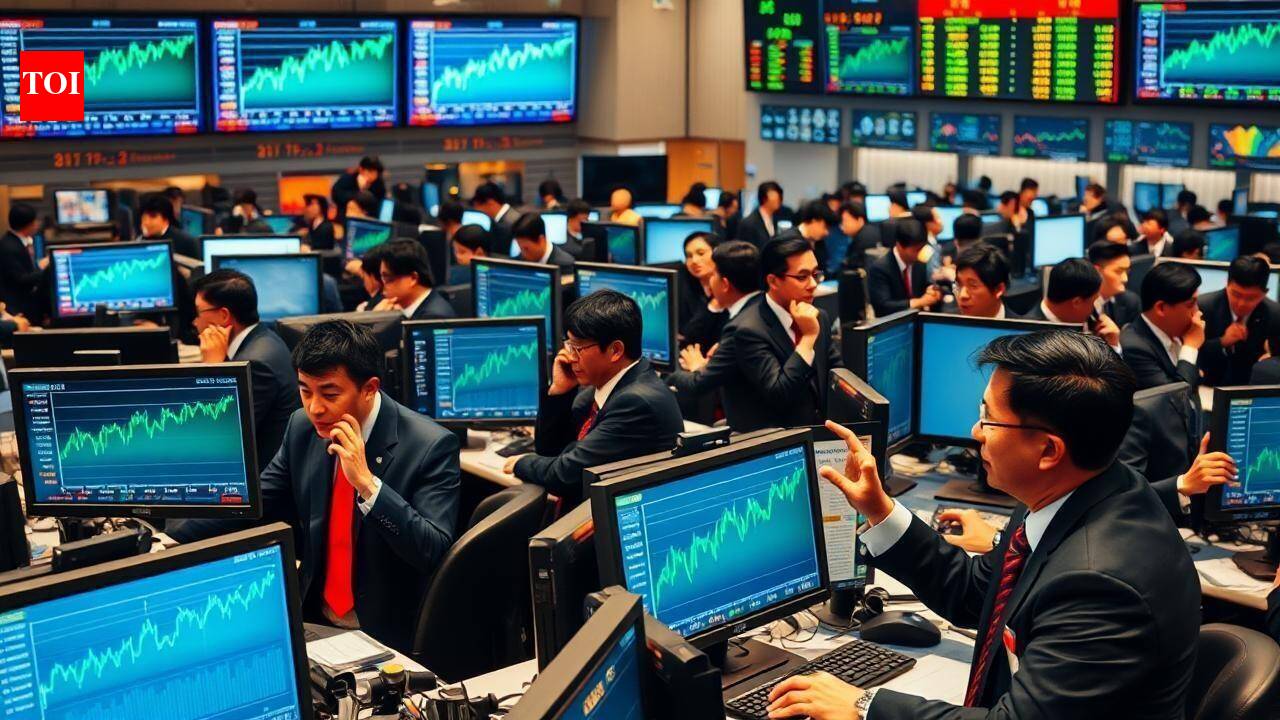
Asian stocks inched higher on Thursday, after days of trading in red amid ongoing Middle East tensions. This comes as equities were lifted by a rebound on Wall Street as oil prices paused their recent spike and economic updates painted a more positive picture of the American economy. In South Korea, Kospi hit a pause on its downward rally to add a whopping 10% or 513 points, to reach 5,606. Japan’s Nikkei 225 also climbed 2.7% to 55,713. Hong Kong’s HSI also traded in green, rising 353 points to 25,603 as of 9:10 am. Shanghai and Shenzhen added 0.9% and 1.7% respectively. Gains elsewhere in the region were more modest. Australia’s S&P/ASX 200 added 0.3% to 8,927.20, while New Zealand’s benchmark index moved 0.9% higher. In contrast, US futures indicated a subdued start ahead. Futures linked to the Dow Jones Industrial Average were almost unchanged, while S&P 500 futures ticked up 0.2%. The S&P 500 advanced 0.8% on Wednesday, clawing back much of the decline seen since the onset of the Iran conflict. The Dow Jones Industrial Average rose 0.5%, and the Nasdaq Composite outperformed with a 1.3% gain. Globally, market sentiment has remained sensitive to developments in the Middle East, with oil price swings continuing to steer trading direction. Crude prices eased during Wednesday’s session. Brent crude briefly moved above $84 a barrel before settling at $81.40, roughly matching the previous day’s level. US benchmark crude edged up 0.1% to finish at $74.66 per barrel. By early Thursday, however, oil was on the rise again. Brent crude climbed 2.4% to $83.32 per barrel, while U.S. benchmark crude jumped 2.5% to $76.53 per barrel.

Middle East heat may ripple across India’s energy supply chain, flags Goldman Sachs – The Times of India

Princess Beatrice ‘marital woes’: Edoardo issues surprise update

LaLiga side Celta Vigo put out plea to Madonna to find 1990 jersey

India Us Trade Deal: Fresh look at India-US trade deal? May be ‘rebalanced’ if circumstances change, says Piyush Goyal – The Times of India

What are Iran’s ballistic missile capabilities?

Attock Cement’s acquisition approved | The Express Tribune

-
Business6 days ago
India Us Trade Deal: Fresh look at India-US trade deal? May be ‘rebalanced’ if circumstances change, says Piyush Goyal – The Times of India
-
 Politics1 week ago
What are Iran’s ballistic missile capabilities?
-
Business7 days ago
Attock Cement’s acquisition approved | The Express Tribune
-
 Business1 week ago
Households set for lower energy bills amid price cap shake-up
-
 Politics1 week ago
US arrests ex-Air Force pilot for ‘training’ Chinese military
-

 Fashion7 days ago
Policy easing drives Argentina’s garment import surge in 2025
-

 Sports6 days ago
LPGA legend shares her feelings about US women’s Olympic wins: ‘Gets me really emotional’
-

 Fashion6 days ago
Texwin Spinning showcasing premium cotton yarn range at VIATT 2026