Growing up in the suburban town of Spring, Texas, just outside of Houston, Erik Ballesteros couldn’t help but be drawn in by the possibilities for humans in space.
It was the early 2000s, and NASA’s space shuttle program was the main transport for astronauts to the International Space Station (ISS). Ballesteros’ hometown was less than an hour from Johnson Space Center (JSC), where NASA’s mission control center and astronaut training facility are based. And as often as they could, he and his family would drive to JSC to check out the center’s public exhibits and presentations on human space exploration.
For Ballesteros, the highlight of these visits was always the tram tour, which brings visitors to JSC’s Astronaut Training Facility. There, the public can watch astronauts test out spaceflight prototypes and practice various operations in preparation for living and working on the International Space Station.
“It was a really inspiring place to be, and sometimes we would meet astronauts when they were doing signings,” he recalls. “I’d always see the gates where the astronauts would go back into the training facility, and I would think: One day I’ll be on the other side of that gate.”
Today, Ballesteros is a PhD student in mechanical engineering at MIT, and has already made good on his childhood goal. Before coming to MIT, he interned on multiple projects at JSC, working in the training facility to help test new spacesuit materials, portable life support systems, and a propulsion system for a prototype Mars rocket. He also helped train astronauts to operate the ISS’ emergency response systems.
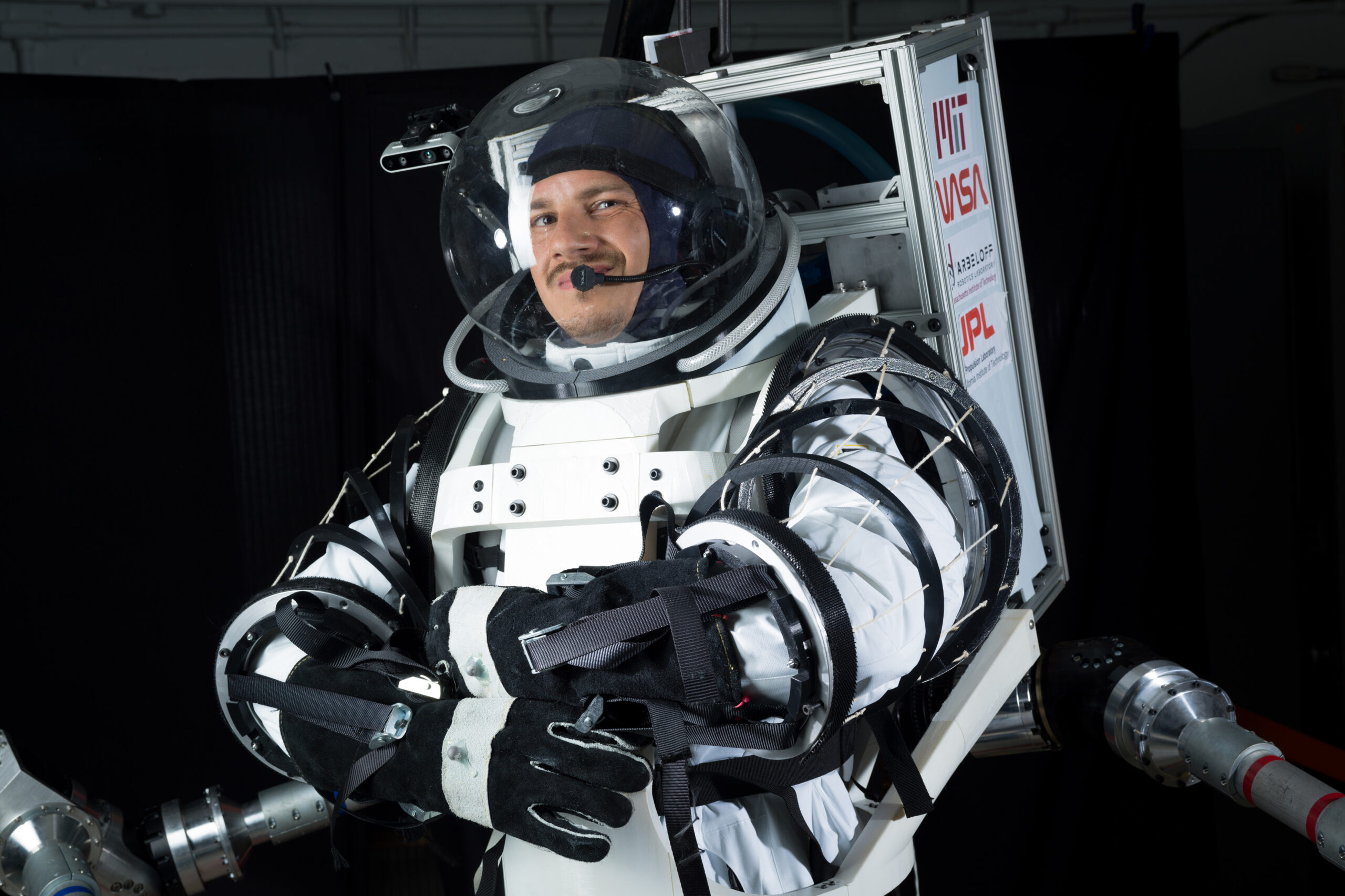
Those early experiences steered him to MIT, where he hopes to make a more direct impact on human spaceflight. He and his advisor, Harry Asada, are building a system that will quite literally provide helping hands to future astronauts. The system, dubbed SuperLimbs, consists of a pair of wearable robotic arms that extend out from a backpack, similar to the fictional Inspector Gadget, or Doctor Octopus (“Doc Ock,” to comic book fans). Ballesteros and Asada are designing the robotic arms to be strong enough to lift an astronaut back up if they fall. The arms could also crab-walk around a spacecraft’s exterior as an astronaut inspects or makes repairs.
Ballesteros is collaborating with engineers at the NASA Jet Propulsion Laboratory to refine the design, which he plans to introduce to astronauts at JSC in the next year or two, for practical testing and user feedback. He says his time at MIT has helped him make connections across academia and in industry that have fueled his life and work.
“Success isn’t built by the actions of one, but rather it’s built on the shoulders of many,” Ballesteros says. “Connections — ones that you not just have, but maintain — are so vital to being able to open new doors and keep great ones open.”
Getting a jumpstart
Ballesteros didn’t always seek out those connections. As a kid, he counted down the minutes until the end of school, when he could go home to play video games and watch movies, “Star Wars” being a favorite. He also loved to create and had a talent for cosplay, tailoring intricate, life-like costumes inspired by cartoon and movie characters.
In high school, he took an introductory class in engineering that challenged students to build robots from kits, that they would then pit against each other, BattleBots-style. Ballesteros built a robotic ball that moved by shifting an internal weight, similar to Star Wars’ fictional, sphere-shaped BB-8.
“It was a good introduction, and I remember thinking, this engineering thing could be fun,” he says.
After graduating high school, Ballesteros attended the University of Texas at Austin, where he pursued a bachelor’s degree in aerospace engineering. What would typically be a four-year degree stretched into an eight-year period during which Ballesteros combined college with multiple work experiences, taking on internships at NASA and elsewhere.
In 2013, he interned at Lockheed Martin, where he contributed to various aspects of jet engine development. That experience unlocked a number of other aerospace opportunities. After a stint at NASA’s Kennedy Space Center, he went on to Johnson Space Center, where, as part of a co-op program called Pathways, he returned every spring or summer over the next five years, to intern in various departments across the center.
While the time at JSC gave him a huge amount of practical engineering experience, Ballesteros still wasn’t sure if it was the right fit. Along with his childhood fascination with astronauts and space, he had always loved cinema and the special effects that forged them. In 2018, he took a year off from the NASA Pathways program to intern at Disney, where he spent the spring semester working as a safety engineer, performing safety checks on Disney rides and attractions.
During this time, he got to know a few people in Imagineering — the research and development group that creates, designs, and builds rides, theme parks, and attractions. That summer, the group took him on as an intern, and he worked on the animatronics for upcoming rides, which involved translating certain scenes in a Disney movie into practical, safe, and functional scenes in an attraction.
“In animation, a lot of things they do are fantastical, and it was our job to find a way to make them real,” says Ballesteros, who loved every moment of the experience and hoped to be hired as an Imagineer after the internship came to an end. But he had one year left in his undergraduate degree and had to move on.
After graduating from UT Austin in December 2019, Ballesteros accepted a position at NASA’s Jet Propulsion Laboratory in Pasadena, California. He started at JPL in February of 2020, working on some last adjustments to the Mars Perseverance rover. After a few months during which JPL shifted to remote work during the Covid pandemic, Ballesteros was assigned to a project to develop a self-diagnosing spacecraft monitoring system. While working with that team, he met an engineer who was a former lecturer at MIT. As a practical suggestion, she nudged Ballesteros to consider pursuing a master’s degree, to add more value to his CV.
“She opened up the idea of going to grad school, which I hadn’t ever considered,” he says.
Full circle
In 2021, Ballesteros arrived at MIT to begin a master’s program in mechanical engineering. In interviewing with potential advisors, he immediately hit it off with Harry Asada, the Ford Professor of Enginering and director of the d’Arbeloff Laboratory for Information Systems and Technology. Years ago, Asada had pitched JPL an idea for wearable robotic arms to aid astronauts, which they quickly turned down. But Asada held onto the idea, and proposed that Ballesteros take it on as a feasibility study for his master’s thesis.
The project would require bringing a seemingly sci-fi idea into practical, functional form, for use by astronauts in future space missions. For Ballesteros, it was the perfect challenge. SuperLimbs became the focus of his master’s degree, which he earned in 2023. His initial plan was to return to industry, degree in hand. But he chose to stay at MIT to pursue a PhD, so that he could continue his work with SuperLimbs in an environment where he felt free to explore and try new things.
“MIT is like nerd Hogwarts,” he says. “One of the dreams I had as a kid was about the first day of school, and being able to build and be creative, and it was the happiest day of my life. And at MIT, I felt like that dream became reality.”
Ballesteros and Asada are now further developing SuperLimbs. The team recently re-pitched the idea to engineers at JPL, who reconsidered, and have since struck up a partnership to help test and refine the robot. In the next year or two, Ballesteros hopes to bring a fully functional, wearable design to Johnson Space Center, where astronauts can test it out in space-simulated settings.
In addition to his formal graduate work, Ballesteros has found a way to have a bit of Imagineer-like fun. He is a member of the MIT Robotics Team, which designs, builds, and runs robots in various competitions and challenges. Within this club, Ballesteros has formed a sub-club of sorts, called the Droid Builders, that aim to build animatronic droids from popular movies and franchises.
“I thought I could use what I learned from Imagineering and teach undergrads how to build robots from the ground up,” he says. “Now we’re building a full-scale WALL-E that could be fully autonomous. It’s cool to see everything come full circle.”
Now, there’s another class of high-end gaming laptop that focuses more on performance than being thin or portable. The Lenovo Legion 7i Gen 10 is one of my favorites in this class, featuring a beautiful white chassis and glossy OLED display. Unlike some OLED displays, the Legion 7i’s screen can be cranked up to over 1,000 nits of brightness. The result is some really splendid HDR performance that brings games to life. HDR is a powerful way of improving the visuals of your games without a performance cost. The Legion 7i Gen 10 is one of the very best in this regard.
It’s still fairly thin at 0.7 inches thick too, while a lot of the ports are found on the back. It’s the definition of a “clean” gaming laptop. It’s no slouch when it comes to performance either, offering either the RTX 5070 Ti or RTX 5080 for graphics.
Cheap Gaming Laptops That Are Worth It
No gaming laptops worth buying are actually cheap. High-refresh rate displays and discrete graphics will always make them more expensive than standard laptops. But as you get closer to $1,000, there is one laptop I always come back to: the Lenovo LOQ 15. Pronounced “Lock,” this Lenovo subbrand is known for cutting the fluff and focusing on giving gamers the performance they need at an affordable price. No laptop does that better than the LOQ 15. Many laptop manufacturers sell their RTX 5060 configurations for hundreds of dollars more. In reality, if you’re shopping around $1,000, there’s no reason to not buy the LOQ 15. Just do it.
If you do want to save some extra cash, there is another option that is cheaper than the LOQ 15 with a few compromises in key areas. The Acer Nitro V 16 is that laptop, which comes with an RTX 5050. This was as affordable as $600 at one point last year—before prices on laptops have risen due to the ongoing memory shortage—but it remains the only laptop cheaper than the Lenovo LOQ 15 that’s actually worth it. It’s fairly powerful for the RTX 5050, and while the screen is pretty shoddy, it’s not a bad-looking laptop. The one big caveat is that the 135-watt power supply it comes with doesn’t deliver quite enough power to keep it charged in Performance mode. Read more about this issue in my review, as it’s important to know about if you’re planning to buy it.
There are other cheap gaming laptops out there I’ve tested, such as the MSI Cyborg A15, but either the Acer Nitro V 16 or Lenovo LOQ 15 are better, cheaper options. You will also find lots of gaming laptops under $1,000 that use older graphics cards, such as the RTX 4050 or 3050. In general, I’d recommend staying away from these. They’re only one or two generations back, but remember: Nvidia only releases new laptop graphics cards every couple of years. So, an RTX 4050 laptop may be well over two years old already, and an RTX 3050 is over five years old. Not only do you get worse graphics performance, these laptops are much more likely to need to be replaced sooner.
Experimental Stuff
One of the exciting things about the world of gaming laptops right now is the experimentation. While clamshell gaming laptops with a conventional Nvidia GPU are the most standard way to go, there’s a few different ways to take your PC games on the go that stretch the boundaries. You might consider a gaming handheld, for example, like the Steam Deck or Xbox Ally X. These handhelds have their fans, and while you can’t also do your homework on these devices, they’re great on couches, trains, and planes.
The Sans Institute, one of the world’s pre-eminent cyber security certification and training bodies, is to play a key role in the annual Nato Cooperative Cyber Defence Centre of Excellence (CCDCOE) Locked Shields exercise, held in Tallinn, Estonia, through the provision of a fully functional power generation system that participating teams will attempt to defend during the game.
This year marks the 16th running of the Locked Shields live fire security defence exercise, which unites blue teams from across Nato’s 32 member states, as well as other allies and observers.
This year, however, Sans has been entrusted with the task of building a genuine, operational cyber range, as opposed to creating a simulation. It is using real industrial control systems (ICSs) and physical equipment that 16 teams of defenders will have to protect while under live cyber attack, with the decisions they make having an immediate physical impact on a national-scale power grid.
Nato and Sans said the aim of the game is to close the gap between sandboxed, classroom-based cyber security training and real-world operational readiness, which, amid the cyber dimension to the energy crisis precipitated by the war in Iran and spillover from the ongoing war in Ukraine, has never been more important.
“We are putting teams in an environment where cyber decisions directly impact physical operations,” said Felix Schallock, who leads the initiative at the Sans Institute. “If you lose visibility, if you lose control, the power generation can be affected. That’s the reality operators face every day. That’s what we’re training for.”
Nato CCDCOE director Tõnis Saar added: “Locked Shields is a technically advanced exercise that challenges participants to defend the critical infrastructure systems modern societies depend on. As much of this critical infrastructure is owned and operated by the private sector, strong public-private collaboration is essential. Industry partners such as Sans Institute play a vital role in making the exercise as realistic and impactful as possible.”
Hybrid architecture
The Sans Institute’s cyber range comprises close to 70 physical ICS devices, with programmable logic controllers (PLCs), human-machine interfaces (HMIs), operator and engineering workstations, 100 virtual machines (VMs) and interconnected systems within the wider CCDCOE environment, all supported by live network infrastructure, the whole forming a hybrid information and operational technology (IT/OT) architecture.
During the exercise, blue teamers will be set the task of defending the “energy provider” while coming under sustained attack from opposing red teams.
The goal is to effectively demonstrate how maintaining a reliable generation system isn’t some metric on a scorecard, but rather the core mission, so success will entail more than just spotting and arresting threats – it will also demand operational discipline, maintaining uninterrupted power generation, preserving comms between IT and OT networks, guaranteeing visibility and control of ICS technology, and avoiding any destabilising disruptions.
The people defending our critical infrastructure deserve training that takes the threat as seriously as they do James Lyne, Sans Institute
Actions will be visible, rippling through the systems in real time, so participants won’t just see alerts, they will see turbines being throttled, breakers being opened or closed, and generation capacity being affected. As such, failure will be immediate and visible – missteps will degrade system performance, disrupt or halt power generation, or simulate national-level consequences.
Tim Conway, Sans Institute fellow and ICS curriculum lead, explained: “We’re showing teams how to defend infrastructure that can’t simply be rebooted or patched on the fly. You have to think like an operator, not just a defender. That mindset shift is what makes this environment so powerful.”
Sans Institute CEO James Lyne expressed great pride in what the Sans team has built for Locked Shields this year. “The scenarios these critical initiatives prepare for are playing out in the world – national espionage, cyber integrated to kinetic attacks and warfare, and retaliation attacks,” he said.
“Throw in AI or machine speed attackers and the need for defenders to adapt, and you have the most disruptive period in cyber security in 20 years. We are privileged to help our allies be ready and continuously improving to secure the future. The people defending our critical infrastructure deserve training that takes the threat as seriously as they do,” he added.
Schallock said the exercise was about preparing teams for protecting the systems that matter most. “Cyber security training must reflect the environment defenders are protecting. We’re not just teaching cyber security, we’re showing how to defend a nation’s infrastructure when it counts.”
In mid-April, astronomy enthusiasts will be able to enjoy one of the classic celestial spectacles. The meteor shower known as the Lyrids will illuminate the sky, especially in the northern hemisphere, and anyone will be able to see it with the naked eye, weather permitting—if they know where to look.
The Lyrids began to appear as early as April 14, but their activity peaks between the night of April 21 and the early morning of April 22, according to NASA. During those hours, the shower will show 15 to 20 meteors per hour under dark skies.
The shower gets its name because the meteors appear to emerge from the constellation Lyra. Locating the radiant is simple if you use an astronomical mapping app: Just find Vega, the fifth brightest star in the sky, surpassed only by Sirius, Canopus, Alpha Centauri A, and Arcturus. Once you locate it, look around it; the luminous traces of the Lyrids will seem to be projected from that point due to a perspective effect. Keep in mind that it takes 20 to 30 minutes for the human eye to adjust to darkness.
The moon will be in early crescent phase during the peak, so its light will interfere very little. With a dark sky, meteors should stand out easily. The shower is usually visible from 10 pm to dawn, although early morning offers the best conditions. It is best to stay away from light pollution and, if possible, to observe from high ground. An outing to the mountains works well.
Each meteor shower has a different origin. In April, Earth crosses the cloud of fragments left by comet C/1861 G1 (Thatcher) in its orbit around the sun. This comet, discovered in 1861, takes about 415 years to complete its journey. The grains of ice and rock that it released centuries ago enter the atmosphere at high speed and produce the flashes we know as the Lyrids.
After the Lyrids, the calendar still holds several spectacles for those who follow the night sky. The Eta Aquarids will arrive in May with debris from Halley’s Comet. The Perseids will appear in August, the Orionids will return in October, and the year will close with the Leonids in November and the Geminids in December. The latter is considered the most intense and reliable shower on the calendar.
This story originally appeared on WIRED en Español and has been translated from Spanish.













 Fashion5 days ago
 Sports1 week ago
 Entertainment1 week ago

 Entertainment6 days ago
 Fashion1 week ago

 Fashion1 week ago