

Fashion
EU enforces new Waste Framework Directive to boost circular economy

The new directive aims to cut waste, reduce environmental damage, and strengthen the EU’s economic resilience by driving sustainable innovation and decreasing reliance on raw materials. It aligns with the EU’s Competitiveness Compass and Strategic Agenda for 2024–29, European Commission said in a press release.
The European Union’s revised Waste Framework Directive came into effect yesterday, establishing unified rules for EPR in textiles and setting binding targets to reduce food waste.
Aimed at cutting waste and boosting circularity, it requires Member States to set up EPR schemes, reduce food waste by up to 30 per cent by 2030, and promote eco-modulated fees, and sustainable design.
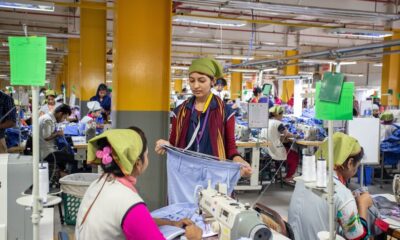
The EU’s textile and clothing industry remains an economic powerhouse, generating €170 billion (~$198.9 billion) in 2023 and employing 1.3 million people across nearly 197,000 companies. Yet, it is also one of the most resource-intensive sectors, ranking third in water and land use impact and fifth in raw material use and greenhouse gas emissions. In 2019 alone, the EU generated 12.6 million tonnes of textile waste, with only one-fifth separately collected for reuse or recycling.
To address these challenges, the revised directive introduces two major sets of measures to promote circularity and competitiveness:
- Under mandatory EPR schemes, each Member State must establish a system requiring producers of textiles and footwear to pay fees for every product placed on the market. These funds will finance collection, reuse, recycling, and disposal operations. The fees will also support consumer awareness campaigns and R&D in sustainable design and waste prevention. EPR fees will vary according to sustainability criteria under the Eco-design for Sustainable Products Regulation (ESPR)—a principle known as eco-modulation. Producers will pay less for durable, recyclable, and eco-friendly products, incentivising circular design.
- The directive also sets new rules for managing used textiles, ensuring that all separately collected textiles are classified as waste to prevent false reuse labelling and illegal exports. Unsorted textile waste will fall under the Waste Shipment Regulation.
Member States have 20 months to transpose the directive into national law and 30 months to set up their textile and footwear EPR schemes. Competent authorities must be designated by January 17, 2026, and updated food waste prevention plans finalised by October 17, 2027.
Fibre2Fashion News Desk (SG)








Published
January 16, 2026
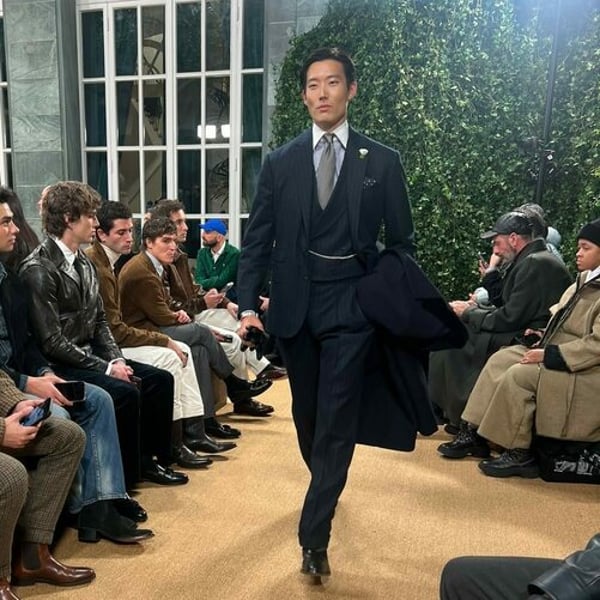
The house of Ralph Lauren very rarely stages menswear runway shows in Milan, which is a pity as its catwalk display this Friday was the coolest and cleverest display of menswear classicism we’ve seen in many moons.
The smoothest of shows too. Presented with polish inside Ralph Lauren’s European headquarters, a geometric Rationalist era jewel of a building. Guests- from Tom Hiddleston and Colman Domingo to Nick Jonas- imbibing biscuity champagne as they took their places on leather bench seats.
Opening with a score of looks from Polo, a rich selection of kicky, preppy ideas: red flannel shirts with turkey prints; Navajo graphic wool sweaters; snow crystal pattern cardigans; and even a brown three-piece Prince of Wales suit. All anchored by Alpine hiking boots or hyped-up L.L. Bean style waders; or accessorised by Black Watch tartan carpet bags.
Plenty of Western looks, from urban cowboy brown suede fringed jackets, worn by a model with an acoustic guitar on his back, to lace ties, rancher hats, and riding boots. Very Yellowstone in Lombardy.

Backed up by a great soundtrack- where Nina Simone’s Sinnerman followed Texas Sun by Khruangbin and Leon Bridges. Ideal for some bold and colourful motor-bike jackets that read: Ralph Lauren Racing.
As day shifted to evening, Scottish baronial chic made an appearance: from Clan Stewart red plaid tuxedos worn under a Count Dracula cape to a great black Grenadier guards military tunic worn with a black silk stock– un petit merci to Dior. Albeit seen on models sporting New York Yankees baseball caps.
“We had so many looks and ideas in this collection that it just seemed right to stage a show this week in Milan,” explained Andrew Lauren, sitting among the movie stars in the villa’s covered courtyard.

All worn by a highly diverse cast, from all the world’s continents. And, one could not help noticing that when he came to the two chalk stripe impeccable bankers, these were worn by a South and an East Asian.
Though there was clearly no deliberate political message, the very heterogeneousness of the cast was a reminder of how Ralph has always celebrated the diversity of America. Which, at a moment when ICE are clearly racially profiling citizens in the United States, made this show feel very powerful.
This is the melting pot America that Europeans love. Not the white supremacism currently being rammed down people’s throats.
Copyright © 2026 FashionNetwork.com All rights reserved.
They predict that the labour market will keep weakening, but also anticipate a boost to the economy from a significant cooling of inflation and further rate cuts from the Bank of England (BoE).
Goldman Sachs Research expects ‘another mixed year’ for the UK economy, which is expected to grow at 1.4 per cent in 2026—up from around 1 per cent in 2025.
It expects the unemployment rate to rise to 5.3 per cent by March, and then stabilising.
Consumption is expected to grow at 1.3 per cent in 2026 versus 0.7 per cent in 2025.
The fiscal position looks less vulnerable than some other European nations.
The UK labour market weakened significantly in 2025 as slow economic growth and the increase in national insurance contributions weighed on employment. A recent rise in layoffs points to ‘further labour market softening ahead’, according to Moberly and Stehn.
Goldman Sachs Research expects the unemployment rate to rise to 5.3 per cent by March. But as growth picks up towards potential, it sees the unemployment rate stabilising for the remainder of this year, the report says.
Given rising slack in the job market, lower headline inflation, and a smaller increase in the national living wage, the company’s economists expect wage growth to normalise this year. Private sector regular pay growth slowed to 3.8 per cent from around 6 per cent over the last 12 months, and the team forecasts further cooling to 3.1 per cent by the end of 2026.
Consumer spending in the UK is low, and the household savings rate is elevated. “Real disposable income growth is likely to remain weak in coming quarters given wage growth moderation, elevated mortgage rates, and a larger fiscal drag on household incomes,” Moberly and Stehn write.
The team’s models suggest that the savings rate will likely decline this year as interest rates fall and consumption catches up with recent increases in real inflation-adjusted incomes.
Consumption is expected to grow at 1.3 per cent in 2026 versus 0.7 per cent last year.
The team anticipates further progress on inflation in the coming months given unwinding base effects. Goldman Sachs Research projects headline inflation to decelerate to 2.1 per cent in the second quarter this year.
The fiscal trajectory, political risk, and efforts to boost economic growth are likely to be key areas of focus this year, according to the company.
“Our analysis suggests that the UK’s fiscal position looks less vulnerable than some other European countries, notably France,” Moberly and Stehn add.
Fibre2Fashion News Desk (DS)
Published
January 16, 2026
What an honour for Italy at Pitti Uomo 109! For the first time, Canadian clothing brand Kanuk is stepping beyond Québec to reach the rest of the world. President Elisa Dahan confirmed as much to FashionNetwork.com. “Yes, it’s true. If we exclude an episode in the United States a few years ago, this is the first time we are presenting ourselves outside our province. I mean truly outside Québec: we had never really begun to develop beyond Québec towards a global dimension- not even in the rest of Canada. And since we are a fashion brand rooted in outerwear, of course we’re starting with Italy.”
Kanuk, a play on the slang nickname for Canadians (Canucks), has the snowy owl as its emblem. “We chose it because it never migrates; it always stays in Québec, no matter the temperature. It feels tailor-made for the philosophy of comfortable, welcoming Canadian country living,” Dahan points out. “A bit like us so far: we were founded in 1974 in a small workshop in Montréal with the mission of creating outerwear suited to Québec’s particular climate and lifestyle, and today we offer a total look.”
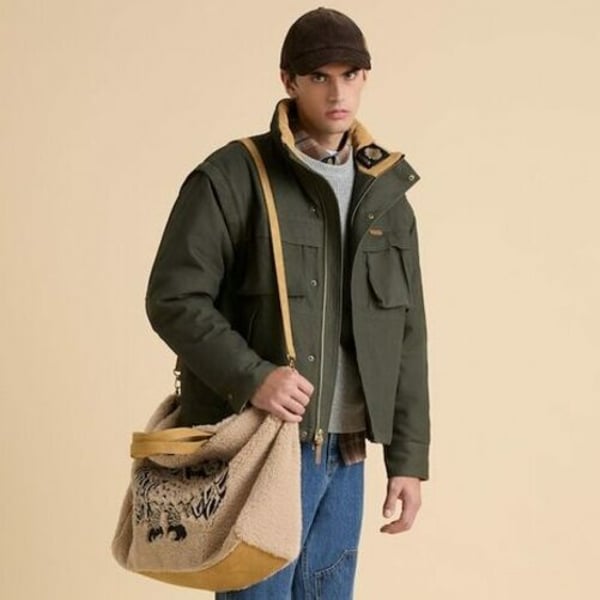
With a lifestyle focus, Kanuk is inspired by the spirit of rural Canadian life- farm-to-table family traditions, a distinctive generational heritage, and outdoor pursuits- while applying uncompromising artisanal standards to production. In the Autumn/Winter 2026/27 Heritage Collection, featuring 30 men’s and 30 women’s styles in a range of colours, the brand expands its ready-to-wear with new jumpers, knit sets, wool pieces, corduroy outerwear, and increased use of Kanuk’s signature sherpa, designed to complement its parkas. The colour palette reflects the season’s defining landscapes: warm earth tones, leafy greens, deep browns, and the muted golds of Canada’s transforming trees.

With two mono-brand stores, one in Montréal and the second just opened in Québec City- “attracting strong tourist traffic,” according to the president- Kanuk sees e-commerce “performing very well and accounting for about a third of the business; but don’t forget that right now we are only distributed in about 30 major stores in Québec. The sky is the limit for what we can achieve from now on,” she smiles.
Elisa Dahan is very confident that Kanuk’s products will be highly appreciated in Europe, “because in Europe the weather starts one way during the day and can shift in the evening and at night- sometimes in the opposite direction- so you need functional versatility, style and lasting durability in what you wear: precisely Kanuk’s attributes, with its timeless pieces and 3-in-1 models with removable layers,” she says.

Kanuk is not only apparel but also accessories, including gloves, scarves, and a super-plush bag, once again featuring the snowy owl. These designs are intended especially for cold climates. Across both the product range and the Canadian brand’s revenue- which rose by double digits last fiscal year- menswear and womenswear are split evenly, 50/50. Accessories account for 10% of turnover.
After Pitti Uomo 109, where she forged many connections with buyers, agents, and distributors, Elisa Dahan aims over the next two to three years to expand the brand into a strong network of quality retailers across Europe. “I’m not interested in quantity; ours is a beautiful brand with a lot of potential, but it needs to be surrounded by the right brands; for me, location is the most important factor to get right, and the business results will follow,” says the Kanuk president, who is also open to launching pop-ups or temporary stores in winter resorts as well as summer destinations, in Italy and beyond.
This article is an automatic translation.
Click here to read the original article.
Copyright © 2026 FashionNetwork.com All rights reserved.


This Jackery Power Station Can Save You in an Emergency, and It’s on Sale for $199

Princess Kate starts driving herself to events, ditches drivers

Trump threatens tariffs on nations opposing Greenland takeover

-

 Tech4 days ago
New Proposed Legislation Would Let Self-Driving Cars Operate in New York State
-
 Sports6 days ago
Clock is ticking for Frank at Spurs, with dwindling evidence he deserves extra time
-
 Business1 week ago
Trump moves to ban home purchases by institutional investors
-
Sports7 days ago
Commanders go young, promote David Blough to be offensive coordinator
-
 Fashion6 days ago
South India cotton yarn gains but market unease over US tariff fears
-

 Fashion6 days ago
China’s central bank conducts $157-bn outright reverse repo operation
-

 Entertainment3 days ago
X (formerly Twitter) recovers after brief global outage affects thousands
-
 Business7 days ago
SoftBank reduces Ola Electric stake to 13.5% from 15.6% – The Times of India