

Business
EU to suspend approval of US tariffs deal

Jonathan Josephs,Business reporterand
Nick Edser,Business reporter
 Bloomberg via Getty Images
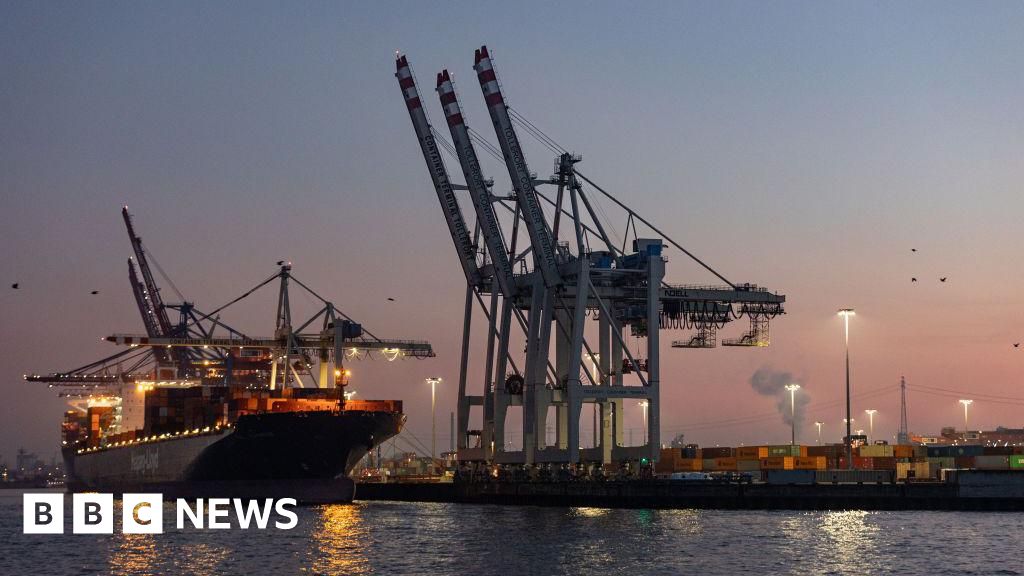
The European Parliament is planning to suspend approval of the US tariffs deal agreed in July, according to sources close to its international trade committee.
The suspension is set to be announced in Strasbourg, France on Wednesday.
The move would mark another escalation in tensions between the US and Europe, as Donald Trump ratchets up his efforts to acquire Greenland, threatening new tariffs over the issue on the weekend.
The stand-off has rattled financial markets, reviving talk of a trade war and the possibility of retaliation against the US for its trade measures.
Shares on both sides of the Atlantic were lower on Tuesday, with European stock markets seeing a second day of losses. In the US, the Dow Jones was down 1.3% in midday trading, while the S&P 500 dropped 1.5% and the Nasdaq was 1.7% lower.
On the currency markets, the US dollar also fell sharply. The euro climbed 0.7% against the dollar to $1.1731 while the pound rose by 0.2% to $1.346.
Borrowing costs also rippled higher around the world, as the biggest sell-off of long-term government debt in months drove up yields on 30-year bonds in markets including the US, UK and Germany.
Trade tensions between the US and Europe had eased since the two sides struck a deal at Trump’s Turnberry golf course in Scotland in July.
That agreement set US levies on European goods at 15%, down from the 30% Trump had initially threatened as part of his “Liberation Day” wave of tariffs in April. In exchange, Europe had agreed to invest in the US and make changes at on the continent expected to boost US exports.
The deal still needs approval from the European Parliament to become official.
But on Saturday, within hours of Trump’s threat of US tariffs over Greenland, Manfred Weber, an influential German member of European Parliament, said “approval is not possible at this stage”.
The EU had put on hold plans to retaliate against the US tariffs with its own package targeting €93bn ($109bn, £81bn) worth of American goods while the two sides finalised the details.
But that reprieve ends on 6 February, meaning EU levies will come into force on 7 February unless the bloc moves for an extension or approves the new deal.
French Prime Minister Emmanuel Macron was among those urging the EU to consider its retaliatory options, including the anti-coercion instrument, nicknamed a “trade bazooka”.
Washington’s “endless accumulation” of new tariffs is “fundamentally unacceptable, even more so when they are used as leverage against territorial sovereignty,” he said in a speech at the World Economic Forum in Davos.
American response
Also speaking in Davos, US Treasury Secretary Scott Bessent reiterated his warning to European leaders against retaliation, urging them to “have an open mind”.
“I tell everyone, sit back. Take a deep breath. Do not retaliate. The president will be here tomorrow, and he will get his message across,” he said.
Commerce Secretary Howard Lutnick and US Trade Representative Jamieson Greer warned that the US would not let retaliation go without response.
“What I’ve found is that when countries follow my advice, they tend to do okay. When they don’t, crazy things happen,” Greer said, in remarks reported by the Agence France-Presse.
The US has previously expressed impatience with European progress toward approval of the deal amid ongoing disagreements over tech and metals tariffs.
The US and the 27-nation European Union are each others’ single biggest trade partners, with more than €1.6tn ($1.9tn, £1.4tn) in goods and services exchanged in 2024, according to European figures. That represents nearly a third of all global trade.
When Trump started announcing tariffs last year, it prompted threats of retaliation from many political leaders, including in Europe.
In the end, however, many, opted to negotiate instead.
Only China and Canada stuck by their threats to hit American goods with tariffs, with Canada quietly withdrawing most of those measures in September, concerned they were damaging the Canadian economy.
In a speech in Davos on Tuesday, Canadian Prime Minister Mark Carney urged “middle powers” to unite to push back against the might-makes-right world of great power rivalry that he warned was emerging.
“When we only negotiate bilaterally with a hegemon, we negotiate from weakness. We accept what is offered. We compete with each other to be the most accommodating,” he warned. “This is not sovereignty. It is the performance of sovereignty while accepting subordination.”
Looming in the background of the trade tensions is a pending Supreme Court decision over whether many of the tariffs Trump announced last year are legal.
Business
Crude oil surpasses $100: WTI up 30%, brent crude reaches $118; what it means? – The Times of India

Oil markets skyrocketed beyond the $100 mark on Monday as Middle East conflict continues to intensify, fueling fears about energy supplies disruption and shipping routes across the region. Brent crude, the global benchmark, climbed past $118 a barrel. US benchmark West Texas Intermediate followed a similar trajectory as the light, sweet crude grade jumped 30% higher than its previous close of $90.90 on Friday.At 0230 GMT, WTI crude climbed 30.04% to $118.21 per barrel before paring some of its gains, while Brent crude was trading 27.54% higher at $118.22.The latest spike came after an already volatile week for oil markets. Last week, US crude prices had surged 36% while Brent rose 28%, as the conflict, now entering its tenth day, began drawing in regions central to the production and transportation of oil and gas from the Persian Gulf.Roughly 15 million barrels of crude oil move through the Strait of Hormuz every day, accounting for about one-fifth of global oil supply, according to independent research firm Rystad Energy. However, the threat of Iranian missile and drone attacks has nearly halted tanker traffic through the narrow waterway. The strait, bordered to the north by Iran, is a critical route for shipments from Saudi Arabia, Kuwait, Iraq, Qatar, Bahrain, the United Arab Emirates and Iran.Export constraints have begun to affect production levels in the region. Iraq, Kuwait and the UAE have reduced oil output as storage facilities fill up due to limited export capacity. At the same time, strikes targeting energy infrastructure have intensified supply concerns, with Iran, Israel and the United States attacking oil and gas facilities since the conflict began.The last time Brent and US crude futures traded near the current levels was in 2022, following Russia’s invasion of Ukraine.Natural gas prices have also moved higher during the conflict, although the gains have been more modest compared to oil. Late Sunday, natural gas was trading at around $3.33 per 1,000 cubic feet, about 4.6% above its Friday closing price of $3.19, after rising roughly 11% during the previous week.Oil’s rise has also begun to show up in fuel prices. In the United States, the average price for a gallon of regular gasoline reached $3.45 on Sunday, about 47 cents higher than a week earlier, according to the AAA motor club. Diesel prices climbed to roughly $4.60 per gallon, up around 83 cents over the same period.Meanwhile, crude oil is also a key ingredient in many everyday consumer goods, including detergents, biscuits, toothpaste, paints and packaging materials. Petroleum-based derivatives are widely used in products such as soaps, shampoos, creams, hair oils, as well as in plastic bottles and tubes. In India, these inputs account for over 25% of production costs for FMCG companies and nearly 40% for paint manufacturers. As a result, if crude oil prices continue to rise, the cost of these daily-use products could increase further.Some analysts and investors have further cautioned that if oil prices remain above $100 a barrel for a prolonged period, the global economy could struggle to absorb the impact.
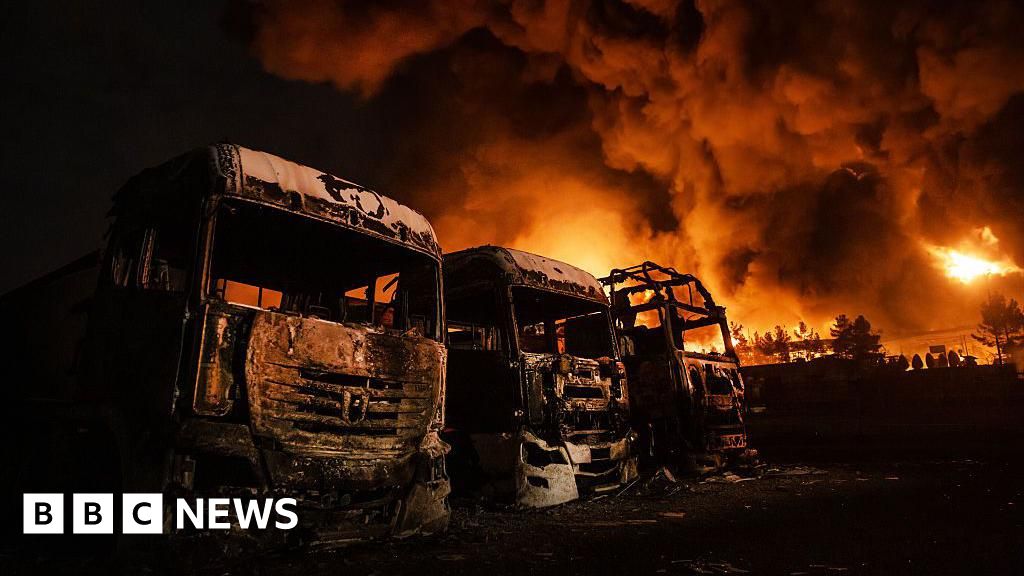
Major disruption to energy supplies threatens to push up prices for consumers and businesses around the world.
Source link
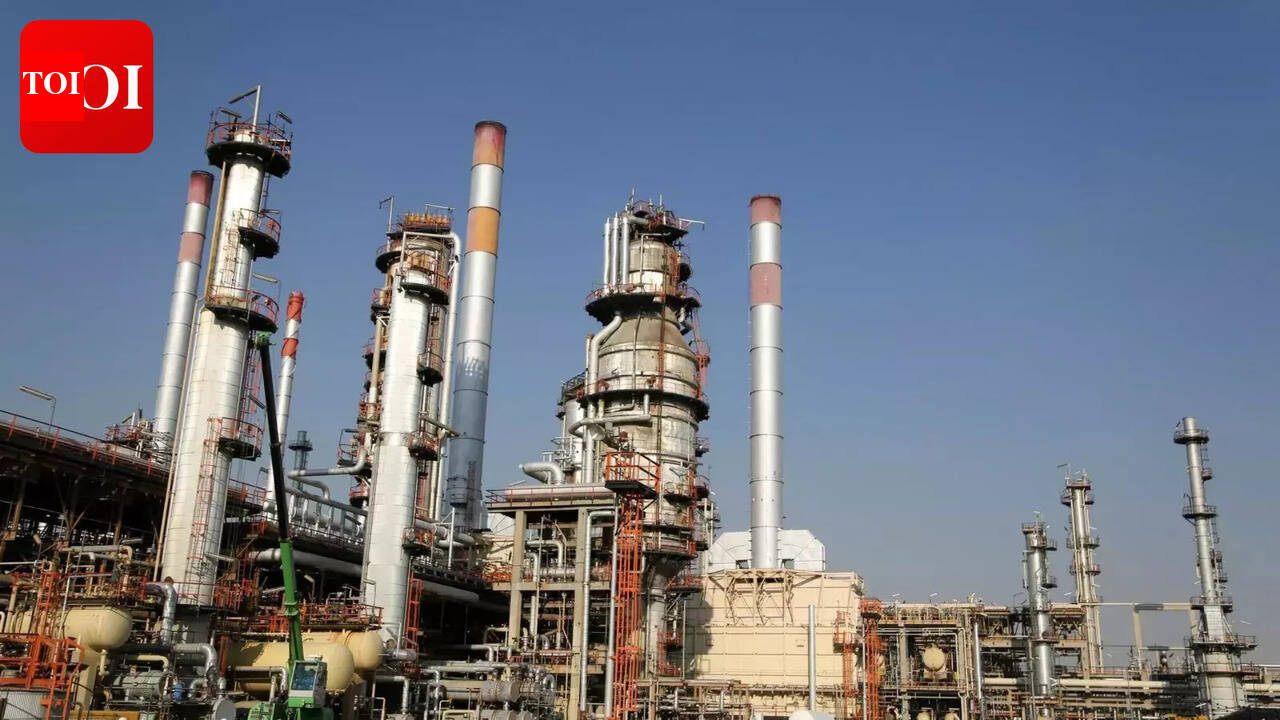
Saudi Aramco jumped the most since April 2023 on Sunday as the Iran war entered its second week, prompting supply disruptions that may send oil prices higher when global markets reopen. Shares of the state-backed oil giant climbed as much as 4.9% in Riyadh before paring gains to close up 4.1%, on the first day of trading for the stock since Brent crude prices topped $90 a barrel on Friday.Brent may climb further after UAE and Kuwait started reducing oil production amid a near-closure of Strait of Hormuz waterway, adding to interruptions affecting worldwide energy supply and exports. “For Aramco, we believe that the gain in oil prices would offset a decline in exports,” said Junaid Ansari, head of research and strategy at Kamco Investment Co. “We also believe that Aramco should be able to re-route a bulk of its shipments to the Red Sea. It’s just about logistics and handling the excess capacity.” Aramco has been redirecting oil cargoes to Red Sea facilities on Saudi Arabia’s west coast to avoid the Strait of Hormuz.


India–Canada CEPA: Closing Canada’s preference gap before compliance
Crude oil surpasses $100: WTI up 30%, brent crude reaches $118; what it means? – The Times of India

10 Ships Attacked in Strait of Hormuz as Mojtaba Khamenei Named Iran’s Supreme Leader

-

 Politics2 days ago
India let Iran warship dock the day US sank another off Sri Lanka, say officials
-

 Politics1 week ago
Iran launches retaliation against Israel, launches ballistic missiles
-

 Entertainment1 week ago
Al Jazeera broadcast interrupted by emergency missile alert in Qatar
-

 Sports2 days ago
Pakistan set for FIH Pro League debut | The Express Tribune
-

 Sports1 week ago
College basketball star suspended by team for spitting toward opposing fan
-
 Fashion1 week ago
India’s real GDP estimated to grow 7.6% in FY26 under new base FY23
-

 Sports1 week ago
Transfer rumors, news: Man City, Man United in for Anderson
-

 Entertainment2 days ago
Harry Styles kicks off new era with ‘One Night Only’ comeback show