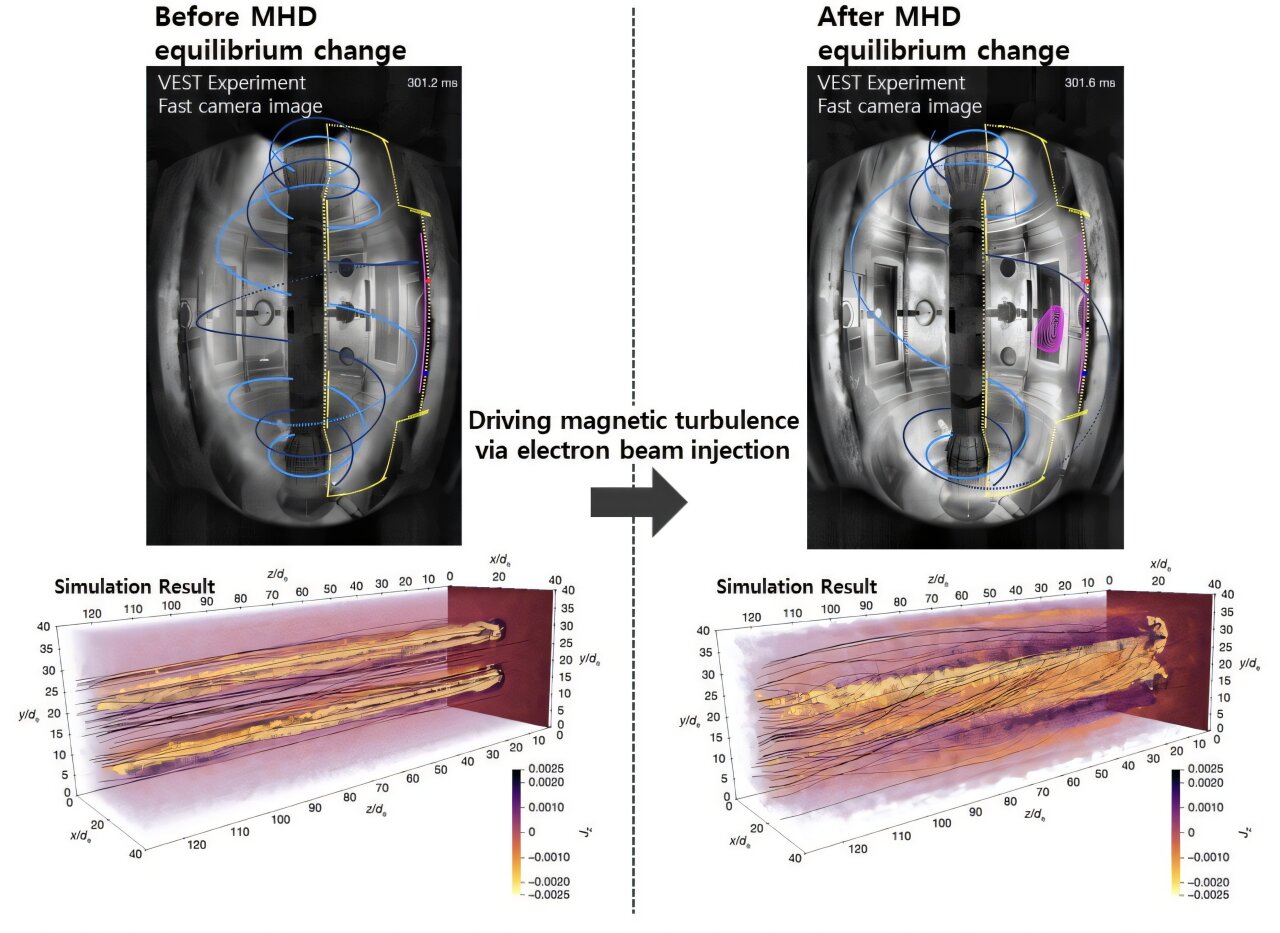
Prior to the equilibrium change, intense microscale magnetic turbulence is generated by electron beams injected into the two flux ropes. This turbulence induces three-dimensional magnetic reconnection. After the equilibrium change, the VEST device shows newly formed plasma (magenta) resulting from the reconnection of the two flux ropes, while the original flux ropes remain. In the simulation, the two flux ropes are observed to have merged into a single structure. Credit: Nature
Microscopic turbulence in plasma can trigger macroscopic structural changes. In complex physical systems, such cross-scale interactions—between different spatial and temporal scales—are known as multiscale coupling. To the best of their knowledge, Prof. Yong-Seok Hwang’s team, together with the Asia Pacific Center for Theoretical Physics, has now experimentally proven this phenomenon for the first time.
The breakthrough resolves a long-standing puzzle in plasma physics, with implications for both fusion energy development and the study of astrophysical plasmas.
Seoul National University College of Engineering announced that a joint research team led by Prof. Yong-Seok Hwang from the Department of Nuclear Engineering, in collaboration with the Asia Pacific Center for Theoretical Physics (APCTP), has experimentally demonstrated the phenomenon of multiscale coupling in plasma—a long-standing puzzle in plasma physics—through the integration of fusion experiments and astrophysical plasma theory.
Initiated under the proposal of Prof. Hwang, who holds appointments in the Department of Nuclear Engineering and the Department of Energy Systems Engineering, the study was conducted solely by three Korean researchers.
The team included Dr. Jong Yoon Park, BK Assistant Professor at SNU and first author of the paper, and Dr. Young Dae Yoon, theoretical physicist at APCTP and corresponding author. This achievement, accomplished entirely by domestic researchers, is recognized as a milestone that significantly elevates Korea’s standing in global plasma science and technology research.
For plasma physicists, plasma—often called the “fourth state of matter,” distinct from solids, liquids, and gases—presents the formidable challenge of explaining how microscopic instabilities can drive macroscopic structural changes. The problem of multiscale coupling has therefore remained one of the most fundamental and long-standing issues in the field.
Plasma, however, is not only the essential medium for nuclear fusion reactions but also the predominant state of matter in the universe. Accordingly, understanding multiscale coupling in plasma has long been considered critical for both advancing fusion energy technology and unraveling the origins of the universe.
The team of Dr. Park and Dr. Yoon analyzed experimental data obtained from SNU’s fusion device and verified their findings through particle simulations using the KAIROS supercomputer at the Korea Institute of Fusion Energy. Their results proved that when microscopic magnetic turbulence is triggered, magnetic reconnection occurs effectively, inducing macroscopic structural changes within plasma.
The joint research team demonstrated for the first time that microscopic magnetic turbulence, deliberately induced by a strong electron beam, can increase plasma resistivity, thereby driving magnetic reconnection and ultimately producing large-scale structural changes—a direct experimental realization and proof of multiscale dynamics in plasma.
The study is particularly significant as an interdisciplinary achievement, combining experimental operations of Seoul National University’s fusion device with theoretical simulations conducted at APCTP.
This achievement also reflects the sustained efforts of Seoul National University and APCTP to provide early-career researchers with opportunities at an international level and to foster interdisciplinary collaboration. It stands as a representative case of advancing the global competitiveness of domestic researchers and nurturing future leaders in science and technology.
Dr. Jong Yoon Park, BK Assistant Professor at SNU, noted, “This outcome was only possible through countless discussions and debates between experts in fusion and theoretical physics, who started from different interests but ultimately arrived at common ground.
It is particularly meaningful in that it offers new clues to understanding the onset of magnetic reconnection, a process that plays a key role in cosmic phenomena such as solar flares and geomagnetic storms.”
Dr. Young Dae Yoon of APCTP added, “We hope this research will not only expand the framework of interpretation in plasma physics but also serve as a foundation for the development of new fusion technologies.”
More information:
Jong Yoon Park et al, Kinetic turbulence drives MHD equilibrium change via 3D reconnection, Nature (2025). DOI: 10.1038/s41586-025-09345-9
Citation:
First experimental proof of multiscale coupling in plasma has implications for fusion energy (2025, September 21)
retrieved 21 September 2025
from https://techxplore.com/news/2025-09-experimental-proof-multiscale-coupling-plasma.html
This document is subject to copyright. Apart from any fair dealing for the purpose of private study or research, no
part may be reproduced without the written permission. The content is provided for information purposes only.
I always tell people that the best thing I’ve ever tested for my job here on the WIRED Reviews team is my automatic litter box from Litter-Robot. I recommend every cat owner invest in an automatic litter box. If they can swing it, the Litter-Robot is the best one to invest in. You’ll be able to say goodbye to the days of scooping and smells while this nifty machine does the grunt work for you.
Litter-Robot is the OG automatic litter box, and the name itself has become synonymous with the concept. And that’s not by accident, as the brand makes incredibly well-made, ergonomic products to help the lives of pet parents everywhere. Along with their famous automatic litter boxes, they also make a super sleek automatic pet feeder that I’ve also tested (and loved). These gadgets are an investment, and can be pricey, but we here at WIRED love the brand so much that we’ve rounded up some of the best Litter-Robot promo codes, coupons, and deals to make these life-changing pet machines more affordable. Because your pet (and you) deserve it.
Get $150 Off Litter-Robot Bundles This Month: No Promo Code Needed
One of the best ways to save big without needing a Litter-Robot promo code is to buy in a bundle. Litter-Robot has several bundles that give you all the essentials you’ll need to get started using your automatic litter box, like a litter trapping mat, replacement waste bags, odor eliminators, litter, and more. A bundle is a great way to save money on the purchases you’ll already have to make, without needing a Litter-Robot coupon. You can get $150 off several different bundles, including Litter-Robot 4 models, as well as the newly released Litter-Robot 5 and Litter-Robot EVO models.
Get the Best Deals on the Litter-Robot 4
I’ve tested well over a dozen models of automatic litter boxes from different brands, including several models from Litter-Robot. The one I keep coming back to is my personal favorite, the Litter-Robot 4. Even though the 5 is the newest model (I’ve tested it and I’m in the process of writing the review now), I just can’t quit you, Litter-Robot 4! I still think it’s one of the best automatic litter boxes you can buy: it has a user-friendly, intuitive connected app that isn’t overcrowded or confusing, the drawer is easy to pull out to remove waste, it has buttons on the top to manually change, and it doesn’t take up a large footprint on the floor. Plus, with a variety of discounted bundles to choose from, you won’t even need a Litter-Robot promo code.
Litter-Robot 5 Pro Insights Bundle Discount: $150 Off
As previously mentioned, I just tested the Litter-Robot 5 Pro, part of Litter-Robot’s recently released line of brand new models. I was seriously impressed with this model, which looks super similar to the Litter-Robot 4, but has a built-in camera to see what’s going on inside and outside of the box. The newest model isn’t cheap, but right now, the Litter-Robot 5 Pro Insights Bundle is only $999 ($152 off). This bundle includes the newest Litter-Robot 5 Pro with built-in camera, plus a litter tracking mat and waste drawer liners to get you started. And as an added bonus, Litter-Robot has a 90-day in-home trial, one-year warranty, and free shipping to the lower 48.
Take $50 Off the Litter-Robot EVO Starter Bundle
The Litter-Robot EVO is another newly released model from Litter-Robot, but this one is a more pared-down, basic version that’s streamlined and compact. I personally love the simpler models (hence my paragraph-long love letter to the Litter-Robot 4 above). If you’re someone who doesn’t need to watch a camera feed of your cat peeing and pooing, the EVO is a more affordable, basic option that gets the job done efficiently. Right now, the Litter-Robot EVO Starter Bundle is $782 ($50 off), and has everything you need to get settled with your new auto box, including waste drawer liners, a litter trap mat, a bag of litter, and odor traps to keep things smelling fresh.
Save 35% on Cat Essentials With a Litter-Robot Discount Code
If you live in a big city like me, there’s nothing worse than carrying heavy litter down icy streets or in hot, packed subway cars. Autoshipping my (often heavy) cat essentials has been a game-changer. If you choose autoship, you’ll save 35% on cat essentials like litter, waste drawer liners, odor traps, filters, and more with this Litter-Robot discount code.
{Get 35% Off Litter-Robot Accessories
I love my Litter-Robot 4, but I highly encourage everyone to spring for the Litter-Robot-branded accessories to accompany the device. This automatic litter box works excellently as is, but things like a ramp for senior cats, filter replacements, and odor traps will keep the device running like new for longer. Keep your investment in tip-top shape for way less with discounted accessories and bundles, for up to 35% off.
If your TV isn’t as smart as you hoped, or you just hate its built-in interface for some reason, there are a variety of other options for dedicated streaming. For households that watch a lot of shows and movies on Prime Video or use Alexa for their smart home management, we recommend checking out the Fire TV Stick 4K Max. The latest generation is currently marked down to just $35 for the Amazon Big Spring Sale, a $25 discount from its usual price.
Amazon
Fire TV Stick 4K Max (2nd Generation)
While the Fire TV Stick is a good choice for Prime Video, it plays well with basically all of the major streaming services you’d expect, including Netflix, Disney+, and HBO Max. The previous generation had just 8 GB of storage, but the new model’s upgraded 16 GB means you won’t have to choose which apps to keep and which to delete. If you have a compatible controller and an Xbox Game Pass subscription, you can even stream games directly to the Fire TV Stick right from the cloud. With some help from Wi-Fi 6E, apps will download faster and stream at higher quality with less buffering, as long as your router supports it.
One of the standout features is the Fire TV Stick’s integration with Alexa smart home systems. While watching your shows, you can easily pull up a picture-in-picture of any security feeds, and there are options to control other smart devices, like lights, right from your television. The remote even doubles as an Alexa with its built-in microphone, letting you find shows or ask questions without getting off the couch. With a built-in gallery mode, the TV can slowly rotate through photos and paintings like a screensaver, and you can ask the remote to quickly find out what you’re looking at.
“Opportunities like this in tech don’t come up that frequently,” Azzurri Group digital and technology director Jim Hingston says of US-themed restaurant chain Dave’s Hot Chicken.
“You look at the power of the brand, the demand for it, the opportunity we have – my challenge is how do I make tech really a catalyst for the growth and allow us to roll out stores in new markets and territories.”
Hingston chatted to Computer Weekly in the build-up to his appearance on a panel at Retail Technology Show 2026, where he intends to join a discussion on the changing face of digital and tech in hospitality.
Dave’s Hot Chicken, which Azzurri won the UK and Irelandmaster franchise rights for in 2024 and has franchise rights for in 10 other countries, has been a growth driver for Azzurri, which recorded flat revenue figures of £303.1m for the year to 30 June 2025.
Azzurri’s franchise agreement is to roll out a minimum of 180 Dave’s Hot Chicken restaurants across Europe, with around 14 expected to be in the UK and Ireland by the end of 2026.
Avoiding retail legacy tech entanglement
Hingston says the brand, which is essentially a startup in terms of its European status, gives his group’s tech team a chance to pull new growth levers and avoid getting in a legacy tech tangle often associated with more established businesses.
“It’s never totally greenfield, there are always a few shrubs and weeds you’ve got to get through, but it’s such a great opportunity,” Hingston says of the brand and its modern tech stack.
Work done with Dave’s could then provide a tech blueprint for its group stablemates such as ASK and Zizzi, which, like any restaurant chains, require continual upgrading and reinforcement from a tech and digital perspective. “If I have tech and I’ve proved I can scale it, [the question becomes about] applying it back into the rest of the group,” Hingston adds.
Whether the opportunity for modern tech development and transformational change ultimately sits with Azzurri remains to be seen, however, after Bloomberg reported on 12 March that the restaurant group was considering the sale of Dave’s.
Either way, the internal positivity about the brand and the seemingly external interest in it highlights the potential for the business as it continues to grow out from its Los Angeles roots.
“In Dave’s, we have a great opportunity of a new, successful, high-volume quick service business where you can use tech to give you a real advantage, where you can grow a business a lot quicker,” Hingston says.
How might that tech or digital capability present itself? First – and an area Azzurri is particularly excited about – is in dynamic pricing.
As reported, the group incubated and spun out Openr, a tech and data platform that enables speedier menu changes and price elasticity. That now-standalone tech business, which was the brainchild of Hingston’s former boss Joel Robinson, who continues to run the operation, is still used by Azzurri Group.
Travel and retail have done [price optimisation] for years, but you can’t do it if it takes you six weeks to update a price or you have set systems Jim Hingston, Dave’s Hot Chicken
Being able to change pricing per location, time of day or based on special events is seen as a key way tech can be a business driver. Think special offers at typically quieter times of the day to draw customers in, or more premium prices in line with demand – there are so many ways this technique can be business positive, Hingston says.
Legacy tech issues, he adds, mean it can take six months to conduct a menu change, or six weeks to update pricing in the hospitality space. “Retail peers look at me as if I’m on a different planet,” he says. “As an operator, we’re looking at pricing optimisation. Travel and retail have done it for years, but you can’t do price optimisation if it takes you six weeks to update a price or you have set systems.”
The ideal tech infrastructure Hingston and his team – which comprises around 25 roles and includes a relatively new in-house engineering team – are keen to implement, starting with Dave’s, is a headless digital architecture. They want to build a “tech ecosystem” around some of those principles of price optimisation.
Openr is being already being used by the group via partnerships with aggregator platforms Deliveroo, JustEat and UberEats.
Making physical stores an ‘event’ for digital natives
Elsewhere from a tech perspective, Hingston envisages opportunities for Dave’s to create interactive experiences for its restaurant customers via the digital screens deployed at venues.
The screens it has installed in its flagship London Shaftsbury Avenue site replicate the nearby Piccadilly Circus billboards. The tech boss, who joined from Gym Group in 2024, describes the need to bring excitement to life in store “so it feels like an event”.
This is an area of particular focus for Dave’s, which has a core influencer-led, digital native and social media-loving Gen Z audience. In terms of capturing their hearts and minds, one mooted idea is to use the digital billboards in restaurants – already in place to facilitate the Openr-enabled dynamic pricing – to gamify the customer experience (CX). Trison, which provides the screens, can enable loyalty app-linkups that permit users to control some of the content on display.
“That’s expensive tech but we’re seeing the cost come down and there are so many fun things you can do with an in-store experience when you have a digitally native audience,” Hingston says.
Around 10-15% of in-restaurant interactions at Azzurri Group are conducted via the order-and-pay system facilitated on smartphones, but generally speaking Hingston believes the best tech in hospitality and the wider retail landscape is hidden. The tech that powers operations rather than any shiny hardware and software that can bring friction to the CX is most crucial, he acknowledges.
For example, Wi-Fi usage in Dave’s is considerably higher than that encountered in the more family-oriented and traditional ASK branches, according to the digital boss. That shows the importance of network infrastructure in modern hospitality.
AI a useful tool, but cannot replace creativity
On the artificial intelligence (AI) revolution sweeping across retail and consumer-facing industries, Hingston is keen for his peers and the leadership team to experiment to see what business benefits may arise from it.
“I’m in the background making it safe – you must make sure you have good guardrails in place and know the limitations,” he says.
I think about the craft of software development; there is part of it which is artistry and deeply creative, and AI isn’t going to be able replace that Jim Hingston, Dave’s Hot Chicken
Hingston is cautious about overuse and over reliance on AI, though: “I think about the craft of software development; there is part of it which is artistry and deeply creative, and AI isn’t going to be able replace that – we need to temper things a little bit. But what’s great now is that, because the cost to entry is often a lot lower, I’m innovating quicker.
“Tech has a reputation of burning through cash, late deliveries and projects that are never ending – now you can break things down more easily. My team remind me we’re probably doing treble the amount we were as tech department.”
At Azzurri Group, there are six major tech programmes under way, Hingston says – “some deeply transformational”, adding: “Normally you do one or two of those a year. The team’s not much bigger and we’re spending less.”
It appears there are opportunities galore at Azzurri, and in particular at Dave’s Hot Chicken. Whether it remains a part of the group or not in the months to come remains to be seen – clearly, there’s plenty for the hospitality tech panel at Retail Technology Show to discuss at London’s Excel on 22 April.
























 Politics7 days ago
 Entertainment7 days ago
 Sports7 days ago
 Tech7 days ago


 Fashion7 days ago