

Business
FTSE 100 held back by hefty Rightmove and IAG falls

The FTSE 100 ended a losing week on a sour note, knocked by further heavy selling of US technology names and double-digit losses for blue chips Rightmove and IAG.
The FTSE 100 index closed down 53.21 points, or 0.6%, at 9,682.57.
The FTSE 250 ended 131.64 points lower, or 0.6%, at 21,773.39, and the AIM All-Share fell 3.66 points, 0.5%, at 749.47.
For the week, the FTSE 100 fell 0.4%, the FTSE 250 shed 1.8% and the AIM All-Share slid 2.7%.
London’s falls were reflected elsewhere in Europe and across the pond on Wall Street.
In European equities on Friday, the CAC 40 in Paris closed down 0.2%, while the DAX 40 in Frankfurt ended 0.7% lower.
In New York, the Dow Jones Industrial Average was down 0.6% at around the time of the London close.
The S&P 500 index was 1.1% lower, while the Nasdaq Composite declined 1.9%.
Joshua Mahony at Scope Markets said the broader market has been led lower by a pullback in “mega-cap tech, with semiconductors particularly under pressure”.
But “with earnings continuing to support the AI narrative and corporate profitability holding firm, many will question whether this week’s weakness represents a dip-buying opportunity rather than the start of a broader reversal”, he suggested.
Mark Haefele, chief investment officer at UBS Global Wealth Management, said that “bouts of volatility should not come as a surprise,” especially “after a strong run over the past several months”.
“While political uncertainty and shifting investor sentiment could inject further volatility into the market, we continue to believe that the fundamentals supporting the rally remain intact,” he added.
Mr Haefele argued that high stock valuations “do not necessarily signal an imminent correction”, and that the tech sector’s core metrics remain “robust”.
Goldman Sachs on Friday raised its 12-month prediction for the FTSE 100 and other European stock indices, to reflect increased earnings growth forecasts for 2025 and 2026.
Goldman now expects the London’s blue-chip index to surpass 10,000 within the next six months and hit 10,200 in 12 months, up from a prior target of 9,600.
In London, Rightmove plunged 12% as it warned operating profit growth could slow as it announced plans to ramp up investment on artificial intelligence capabilities.
The Milton Keynes-based online property portal said that between 2026 and 2028 it will accelerate investment in consumer innovation, AI-powered operations and research and development for new growth.
Russ Mould, investment director at AJ Bell, said: “Investing for future growth is not a bad thing but the scale of the market’s negative reaction implies real scepticism about its decision to put so much money into AI.”
Rightmove introduced guidance for 2026 of revenue growth of 8% to 10% and underlying operating profit growth of 3% to 5%, reflecting the increased investment.
Analysts at Citi said: “The updated guidance for FY26 onwards infers low/mid single digit downgrades to consensus underlying operating profit.”
Meanwhile, British Airways owner IAG nosed 12% as it reported “softness” in US travel and weaker prices in the European market.
“As expected the North Atlantic market saw some softness in US point-of-sale economy leisure and unit prices across our airlines were lower in the European market due to a combination of high growth by British Airways and more competitive markets elsewhere,” the airline said in a statement.
Sterling was quoted at 1.3166 dollars at the time of the London equities close on Friday, higher compared with 1.3106 dollars on Thursday.
The euro stood at 1.1582 dollars, up against 1.1536 dollars. Against the yen, the dollar was trading slightly lower at 153.07 yen, compared with 153.12 yen.
The yield on the US 10-year Treasury was at 4.07%, narrowed from 4.09% on Thursday. The yield on the US 30-year Treasury was quoted flat at 4.68%.
Ahead of the budget, Chancellor Rachel Reeves has submitted her likely tax-raising plans to the UK’s Office for Budget Responsibility, so that the independent fiscal watchdog can tell her how they may impact economic forecasts.
The Times reported the Government is considering increasing the basic, higher and additional rates of income tax by two percentage points, to 22%, 42% and 47%, while cutting the rate of national insurance paid by basic-rate taxpayers from 8% to 6%.
On the FTSE 250, ITV jumped 17% after confirming it is in the early stages of talks to sell its media and entertainment arm to Comcast Corp-owned Sky in a deal worth £1.6 billion.
The London-based television broadcaster and content producer said there can be no certainty that a deal will be struck.
Oxford Nanopore firmed 4.7% as it set out upbeat guidance for the full-year.
The Oxford-based specialist in DNA and RNA sequencing technologies said 2025 constant currency revenue growth is to be at the top end of its stated 20% to 23% range.
“All other financial metrics tracking in line with expectations,” it added, in a brief update.
Brent oil was quoted higher at 63.51 dollars a barrel at the time of the London equities close on Friday, from 63.25 dollars late on Thursday.
Gold traded higher at 4,012.24 dollars an ounce against 3,977.52 dollars.
The biggest risers on the FTSE 100 were Hikma Pharmaceuticals, up 60.0 pence at 1,582.0p, Coca-Cola Europacific Partners, up 240.0p at 6,950.0p, WPP, up 8.8p at 279.1p, Diageo, up 46.5p at 1,726.5p and Intercontinental Hotels Group, up 220.0p at 9,738.0p.
The biggest fallers on the FTSE 100 were Rightmove, down 81.8p at 573.6p, IAG, down 47.9p at 366.2p, Auto Trader, down 47.4p at 751.2p, Relx, down 122.0p at 3,194.0p and Experian, down 111.0p at 3,405.0p.
Next week’s global economic calendar sees UK jobs, earnings and GDP data, a slew of data in China, including retail sales and industrial production, and eurozone industrial production figures.
Monday’s UK corporate calendar has full-year results from sports nutrition brand Applied Nutrition. Later in the week trading updates are due from insurer Aviva and aerospace and defence firm Rolls-Royce.
Contributed by Alliance News
Business
Noida International Airport inauguration: Delhi-NCR gets new airport – all you need to know – The Times of India

NEW DELHI: Prime Minister Narendra Modi on Saturday inaugurated Phase I of the Noida International Airport at Jewar in Uttar Pradesh, marking a significant milestone in India’s expanding aviation infrastructure.PM Modi was accompanied by Uttar Pradesh chief minister Yogi Adityanath and Governor Anandiben Patel.
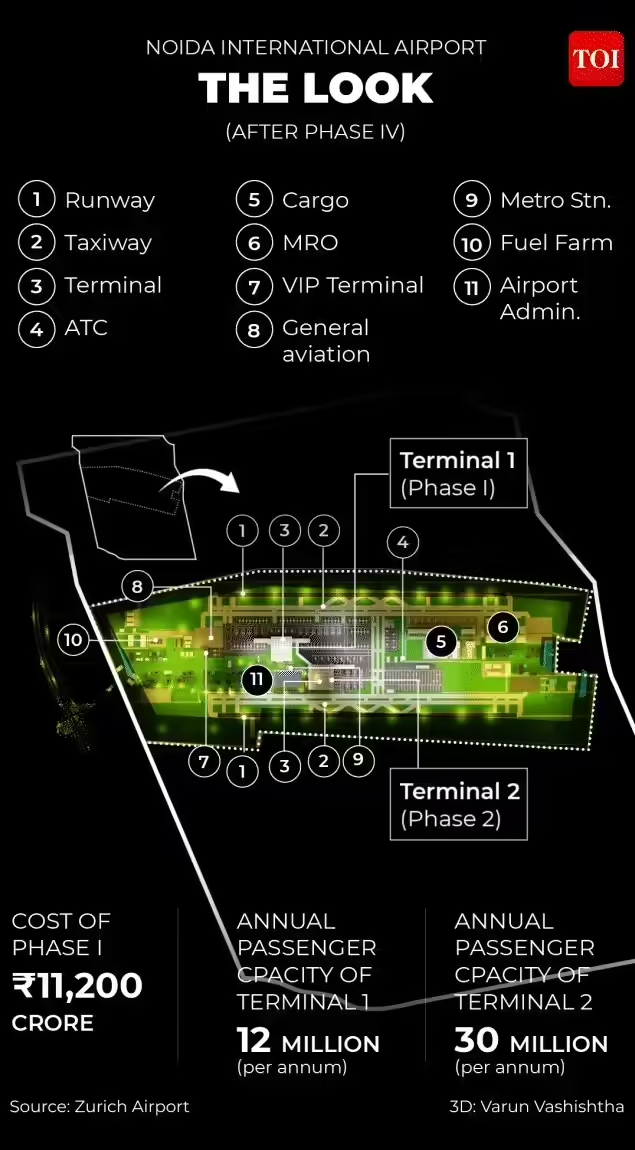
Developed at an investment of around Rs 11,200 crore under a Public–Private Partnership (PPP) model, the project is expected to enhance both regional and international connectivity for the National Capital Region (NCR).The airport is being positioned as a key addition to India’s aviation network, aimed at easing pressure on existing infrastructure while supporting the country’s ambition of becoming a global aviation hub.
Second international gateway for Delhi NCR
Noida International Airport has been developed as the second international gateway for Delhi NCR, complementing the existing Indira Gandhi International Airport, which currently handles the majority of the region’s air traffic.
.
With rising passenger demand and capacity constraints at IGI Airport, the new facility is expected to play a crucial role in distributing traffic more efficiently.Together, the two airports will function as an integrated aviation system, helping reduce congestion, improve connectivity, and enhance the region’s standing among leading global aviation hubs.
Phase I capacity and future expansion plans
Phase I of the airport is designed to handle 12 million passengers per annum (MPPA), providing immediate relief to the region’s growing air travel demand.The project has been planned with scalability in mind, with provisions to expand capacity to 70 million passengers annually in subsequent phases. This long-term vision reflects the government’s strategy to future-proof infrastructure and accommodate sustained growth in air travel.
Modern infrastructure and all-weather operations
The airport features a 3,900-metre runway capable of handling wide-body aircraft, making it suitable for both domestic and international long-haul operations.
.
Equipped with advanced navigation systems such as the Instrument Landing System (ILS) and modern airfield lighting, the facility is designed to support efficient, all-weather, round-the-clock operations. These features ensure operational reliability even under challenging weather conditions.
Cargo hub and logistics ecosystem
In addition to passenger services, the airport includes a comprehensive cargo ecosystem aimed at strengthening logistics and trade.The Multi-Modal Cargo Hub comprises an Integrated Cargo Terminal and dedicated logistics zones, with an initial handling capacity of over 2.5 lakh metric tonnes annually. This capacity is expected to expand significantly to around 18 lakh metric tonnes in the future, positioning the airport as a major cargo and logistics centre in North India.
Dedicated MRO facility to enhance efficiency
A key component of the airport’s infrastructure is a 40-acre Maintenance, Repair and Overhaul (MRO) facility.This dedicated facility is expected to improve operational efficiency by enabling airlines to service and maintain aircraft locally, reducing turnaround times and operational costs. It also strengthens India’s capabilities in aviation maintenance services.
Sustainability and future-ready design
Noida International Airport has been designed as a sustainable and future-ready infrastructure project, with a focus on achieving net-zero emissions.The project incorporates energy-efficient systems and environmentally responsible practices, aligning with India’s broader climate goals. The airport’s development reflects a growing emphasis on green infrastructure in large-scale projects.
Architecture inspired by Indian heritage
Blending modern infrastructure with cultural aesthetics, the airport’s architectural design draws inspiration from traditional Indian elements such as ghats and havelis.This approach aims to create a distinctive identity for the airport while offering passengers a sense of place rooted in Indian heritage.
Strategic location and multi-modal connectivity
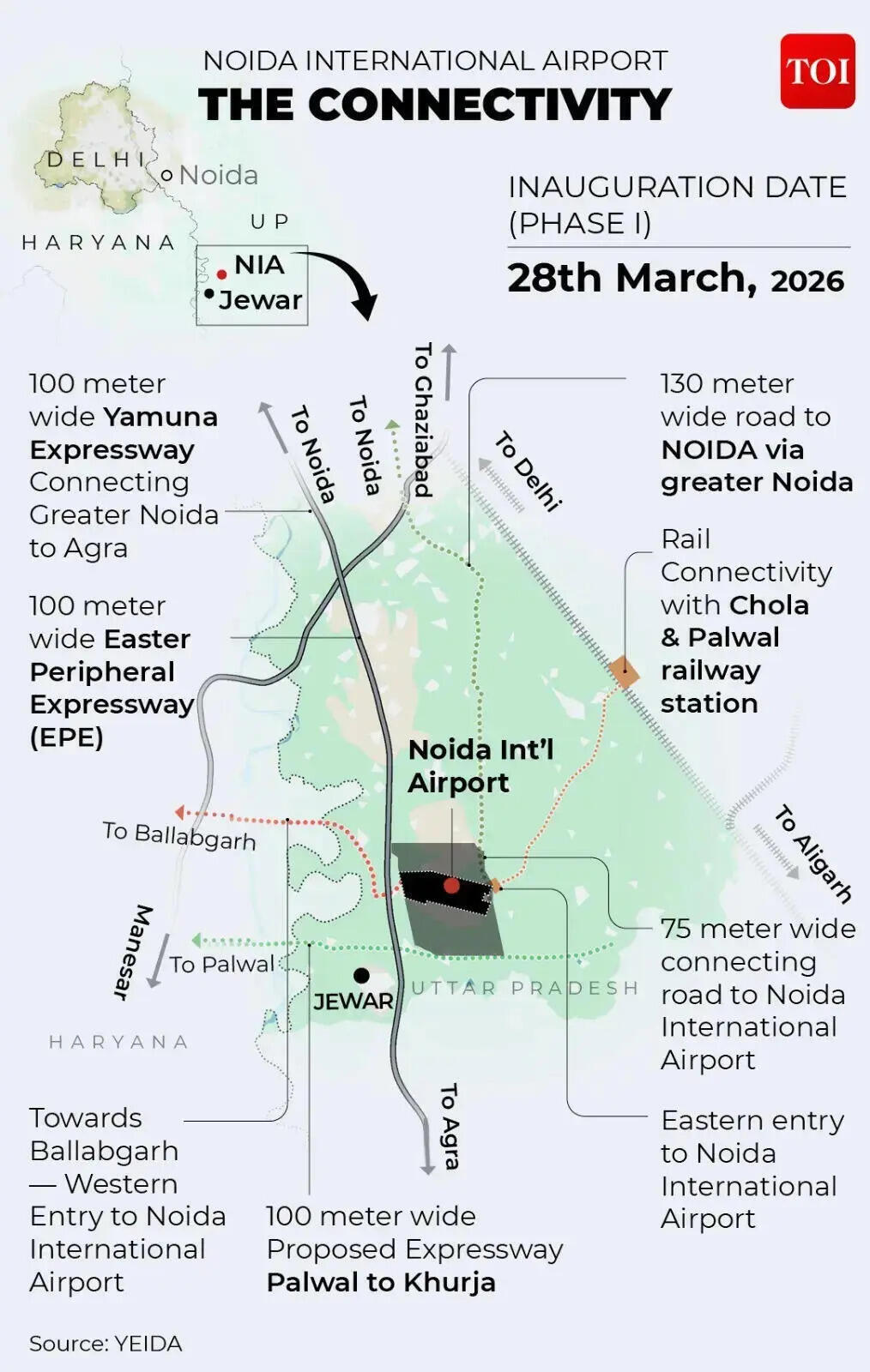
Strategically located along the Yamuna Expressway in Gautam Buddha Nagar district, the airport is planned as a multi-modal transport hub.It will feature seamless integration with road, rail, metro and regional transit systems, ensuring smooth connectivity for passengers and cargo. This connectivity is expected to significantly improve accessibility for travellers across Delhi NCR and neighbouring regions.
Boost to India’s aviation ambitions
The inauguration of Phase I of Noida International Airport is being seen as a major step in strengthening India’s aviation ecosystem.By expanding capacity, improving connectivity, and integrating modern infrastructure with sustainability, the project is expected to play a key role in positioning Delhi NCR as a major global aviation hub while supporting economic growth and regional development
Business
Iran permits 2 Pakistani cargo ships to pass through Strait of Hormuz | The Express Tribune

Iran has permitted two Pakistani cargo ships to transit through the Strait of Hormuz, sources in the Ministry of Maritime Affairs confirmed on Saturday.
The vessels, Multan and P-Akili, which were previously held after Iranian forces took control of the strait — a key global oil supply route — have now crossed and are en route to Karachi. They are expected to dock at Karachi port on March 31, a source familiar with the matter said.
Multan is a general cargo ship, while P-Akili is carrying over 80 million litres of crude oil. Sources added that Iranian authorities not only allowed the vessels to pass but also provided an escort until they cleared the strait’s flashpoint line.
Read: Global poll says Iran war leaves US increasingly isolated internationally
This move comes amid ongoing mediation efforts by Islamabad, in coordination with Turkiye and Egypt, to curb the escalating conflict in the Middle East.
It is the second time Tehran has permitted a Pakistani ship to pass through the Strait of Hormuz since the conflict began on February 28. Previously, a Pakistani oil tanker transited the strait on March 16.
The Middle East region remains on high alert following the joint US-Israel offensive on Iran that began on February 28, which has resulted in over 1,900 deaths, including then-Supreme Leader Ali Khamenei.
Tehran has retaliated with drone and missile strikes targeting Israel, Jordan, Iraq, and Gulf countries hosting US military assets, causing casualties, infrastructure damage, and disruption to global markets and aviation.

Butter, chocolate, coffee and milk have all seen prices rocket. Tracing back through the story of one particular supermarket staple begins to explain why
Source link


Transfer rumors, news: Salah eyes Roma after Liverpool exit

NHL playoff watch: Guide to all 15 games on Showdown Saturday

I Tested Garmin Watches for a Decade While Hiking, Biking, and Climbing. Here’s What You Should Buy

-
 Business1 week ago
Flipkart group CFO to leave co amid IPO plans – The Times of India
-
 Business1 week ago
Video: The Effects of High Oil Prices
-

 Fashion1 week ago
China’s textile & apparel exports surge 17% to $50 bn in Jan-Feb 2026
-

 Sports1 week ago
Rating Adidas’ 2026 World Cup away shirts: Argentina, Spain, Mexico and more
-

 Sports1 week ago
American Conference Commissioner Tim Pernetti thanks Trump for Army-Navy game executive order
-
Tech1 week ago
The Corsair 4000D RS PC Case Keeps Your System Cool
-

 Tech1 week ago
Gamers Hate Nvidia’s DLSS 5. Developers Aren’t Crazy About It, Either
-

 Tech1 week ago
‘Uncanny Valley’: Nvidia’s ‘Super Bowl of AI,’ Tesla Disappoints, and Meta’s VR Metaverse ‘Shutdown’