

Business
FTSE eases on weak US data as Ukraine peace summit looms

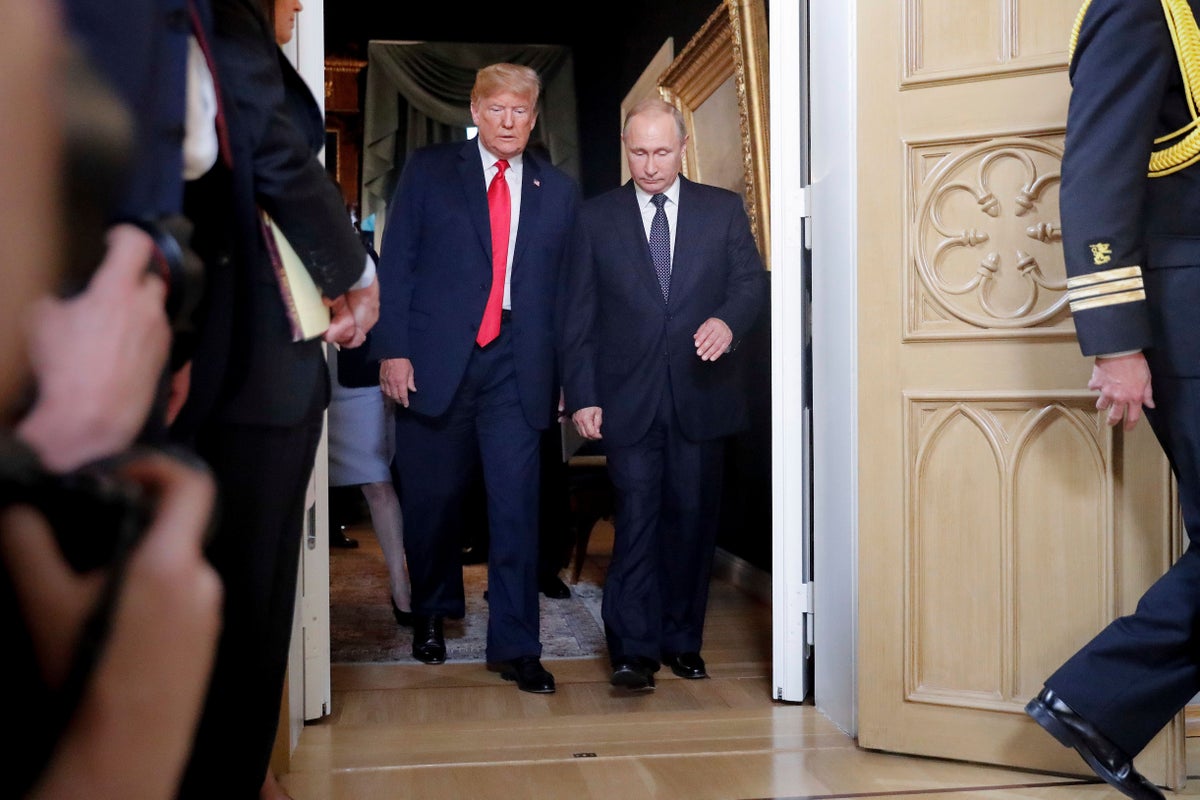
The FTSE 100 fell back after hitting a new all-time high to close lower on Friday amid caution ahead of the US-Russia peace summit, hints of more tariffs and weak US consumer sentiment.
The index closed down 38.34 points, 0.4%, at 9,138.90. It had earlier reached an all-time intra-day high of 9,222.07.
The FTSE 250 ended down 43.43 points, 0.2%, at 21,758.24, and the AIM All-Share finished 0.86 of a point higher, 0.1%, at 759.80.
For the week, the FTSE 100 rose 0.5%, the FTSE 250 fell 0.9% and the AIM-All Share declined 0.3%.
In Europe, the Cac 40 in Paris rose 0.7%, while the Dax 40 in Frankfurt closed down slightly.
US President Donald Trump and Russian counterpart Vladimir Putin will meet later on Friday in Alaska in a summit that could prove decisive for the future of Ukraine.
Mr Putin will step on to western soil for the first time since he ordered the invasion of Ukraine in February 2022.
Mr Trump extended the invitation at the Russian leader’s suggestion, but the US president has since warned that the meeting could be over within minutes if Mr Putin does not compromise.
Speaking to reporters aboard Air Force One en route to Anchorage, the US leader sounded a more positive note, saying: “There’s a good respect level on both sides and I think something’s going to come out of it.”
“Investors will be watching closely for signs a credible peace deal is in the offing and any outcomes could set the mood music for next week,” said AJ Bell investment director Russ Mould.
Mr Trump also said he will be setting new tariffs on steel, semiconductors and computer chips from next week, but declined to say what rate would apply, according to AFP.
The US president said he would keep the new levies “lower at the beginning” to give companies “a chance to come in and build” in the US.
“And if they don’t build here, they have to pay a very high tariff, which doesn’t work. So they’ll come and build,” he said.
In New York, the Dow Jones Industrial Average was up 0.1%, the S&P 500 was 0.2% lower, and the Nasdaq Composite dropped 0.4%.
Figures showed US retail sales growth decelerated in July, although the number was in line with hopes.
The US Census Bureau said retail sales grew 0.5% monthly in July from June, when they had grown 0.9%, which revised up from 0.6%.
But separate data from the University of Michigan showed the preliminary August sentiment index fell to 58.6 from 61.7 a month earlier. FX Street consensus had forecast an improvement to 62.0.
The report showed US consumers are scaling back spending plans amid concerns about inflation and weakening job prospects.
The pound climbed to 1.3566 dollars late on Friday afternoon in London, compared with 1.3541 at the equities close on Thursday.
The yield on the US 10-year Treasury was at 4.31%, widened from 4.28%. The yield on the US 30-year Treasury was 4.90%, up from 4.87%.
On the FTSE 100, mining stocks rose despite weak data from China.
Anglo American rose 2.1%, Glencore climbed 1.8% and Antofagasta 1.2% on hopes the soft figures will spark action from Chinese authorities.
“Chinese economic activity slowed across the board in July, with retail sales, fixed asset investment, and value added of industry growth all reaching the lowest levels of the year,” ING said.
“After a strong start, several months of cooling momentum suggest that the economy may need further policy support,” the broker added.
Asia-focused bank Standard Chartered slumped 7.2% after a US politician asked the country’s attorney general to investigate the bank.
Republican Elise Stefanik, in a post on X, said she has asked Pam Bondi to investigate the bank for “illicit payments to known terrorists”.
Ms Stefanik shared a letter on X in which she alleged Standard Chartered had made 9.6 billion dollars from such payments.
“China has been using Standard Chartered to purchase sanctioned Iranian oil,” she claimed.
On a quiet day for company news, Associated British Foods ended up 0.2% after confirming the acquisition of Hovis Group from private equity firm Endless.
AB Foods plans to combine Hovis with its existing Allied Bakeries division to create a “profitable UK bread business that is sustainable over the long term”.
Allied Bakeries owns the bread brands Kingsmill, Allinson’s and Sunblest. It also produces own-label bakery ranges for major UK supermarkets.
Clive Black, retail analyst at Shore Capital, said the deal shows AB Foods has been true to its word and taken “demonstrable action to deal with persistent problem children”.
He said AB Foods and Endless need to overcome any UK antitrust concerns, but he believes there is “ample” choice for bread shoppers after any Hovis/Kingsmill alliance, providing a “firm basis” for regulatory approval.
On the FTSE 250, Bytes Technology Group jumped 8.4% after launching a share buyback programme worth up to £25 million.
A barrel of Brent fell to 66.33 dollars late on Friday afternoon from 66.80 on Thursday. Gold rose to 3,343.39 dollars an ounce against 3,339.74.
The biggest risers on the FTSE 100 were Anglo American, up 47.0p at 2,170.0p, BP, up 7.3p at 421.4p, Glencore, up 5.2p at 299.7p, Games Workshop, up 200.0p at 15,680.0p and Antofagasta, up 26.0p at 2,122.0p.
The biggest fallers were Standard Chartered, down 101.5p at 1,305.5p, Rolls-Royce, down 27.5p at 1,074.0p , 3i Group, down 96.0p at 3,971.0p, Airtel Africa, down 4.0p at 216.2p and Rightmove, down 13.8p at 761.0p.
Contributed by Alliance News
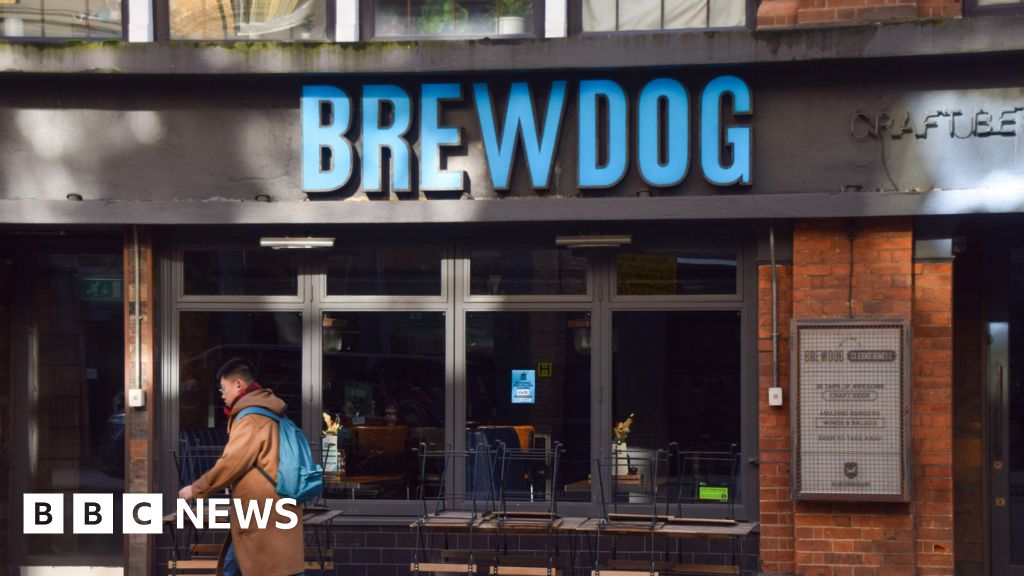
Beverage and cannabis company Tilray acquires the brewery, the brand and 11 bars after Brewdog went into administration.
Source link
Gas prices have leapt at the fastest pace since the outbreak of war in Ukraine, after Qatar halted production of liquified natural gas after attacks by Iran.
Oil prices also soared and global financial markets reeled from the fallout of an intensifying conflict between Iran and US-Israeli forces.
European whole gas prices soared by 52% on Monday, marking the sharpest rise since prices were pushed dramatically higher by the Russian invasion of Ukraine in March 2022.
The surge came after Qatar’s state-backed energy company QatarEnergy said it “ceased production” because of attacks on its facilities.
Qatari ministers had said earlier on Monday that an Iranian drone had attacked one of the company’s production facilities.
Qatar is a major producer of LNG, cooled gas which can be transported via ships, responsible for about a fifth of global supplies.
On Monday in London, the price of natural gas for delivery in April was up by about 43% to 115p per therm.
In the UK, gas prices are a key driver for the cost of domestic energy bills, indicating that a sustained spike could affect households in the coming months.
Neil Wilson, Saxo UK investor strategist, said: “Qatar is a top three LNG exporter, controlling roughly a quarter of expected supply over the next decade.
“Looks like Iran’s tactic is to pressure Gulf states so they in turn pressure the US and Israel to back off.
“I am much more concerned about European natural gas prices than oil prices, in terms of seeing a repeat of the 2022 European energy crisis.”
Global financial markets faltered after intense strikes across the Middle East and attacks on ships drove fears of energy supply disruption.
London’s FTSE 100 was weaker as trading was knocked by the growing conflict between Iran and US-Israeli forces.
The blue chip share index shed 130 points, closing 1.2% lower at 10,780.11.
Other European indexes suffered bigger drops with France’s Cac 40 down about 2.2% and Germany’s Dax tumbling 2.4% on Monday.
But it was a more tentative start to trading over on Wall Street with the S&P 500 relatively flat, and Dow Jones dipping by about 0.1% by the time European markets had closed.
Israel launched strikes on Lebanon’s capital Beirut on Monday after missiles were fired by militant group Hezbollah.
The latest strikes came after the US and Israel hit targets across Iran on Sunday as part of an intensifying military campaign which followed the killing of Supreme Leader Ayatollah Ali Khamenei.
Oil supplies could be affected by the conflict after Iran reportedly warned tankers on the strait of Hormuz that no ships would be allowed to pass through.
UK Maritime Trade Operations Centre officials said that two vessels have been struck near to the key trade artery.
The Strait of Hormuz is used by tankers carrying about one fifth of the world’s oil supplies and seaborne gas.
On Monday, the price of Brent crude oil soared by as much as 13%, rising above 82 dollars a barrel, before paring back.
It was 8.4% higher at 79.2 dollars a barrel shortly before 2pm, before easing slightly to be 5.5% higher at 76.9 dollars a barrel by early evening.
Nevertheless, City analysts have said the markets have been relatively contained so far in reaction to the conflict.
Chris Beauchamp, chief market analyst at IG, said: “While we have seen a significant surge in oil prices since markets opened last night, the gains appear contained for now as we wait to see if shipping through Hormuz can continue at lower levels or will be blocked entirely.
“Oil and gas infrastructure in the region has not yet been extensively targeted, keeping oil well south of the 100 dollar barrel range that many expected as a result of the weekend.”
Meanwhile, the pound dipped in value against the US dollar to its weakest level since December.
The fall is partly linked to the strength of the dollar, with investors pouring funds into the US “safe haven” currency.
The pound was down about 0.8% at 1.338 versus the dollar during the day, before parring back some losses to be down around 0.3% at 1.34 against the dollar by early evening.
London stocks were broadly weaker, with travel stocks among those dropping particularly sharply.
Cruise giant Carnival slid by 8%, while airline firm IAG, the parent firm of British Airways, dipped by 7.6%.
Rival Wizz Air, which typically runs flights to Dubai and Abu Dhabi, was also down 7.3% in early trading on Monday, while travel-focused retail groups SSP and WH Smith were also firmly lower.
However, defence stocks were among the gainers, with BAE Systems lifting by 7.4% to 2,268p.
Elsewhere, oil and energy stocks were also stronger – Shell and BP rose by 4.5% and 3.5% respectively as prices lift.
International stock markets also opened weaker after the start of trading, with the Nikkei 225 in Tokyo falling by 1.5% after Asian markets opened.
Business
Oil prices spike! Will petrol, diesel rates be hiked in India as crude nears $80 mark on Middle East tensions? – The Times of India
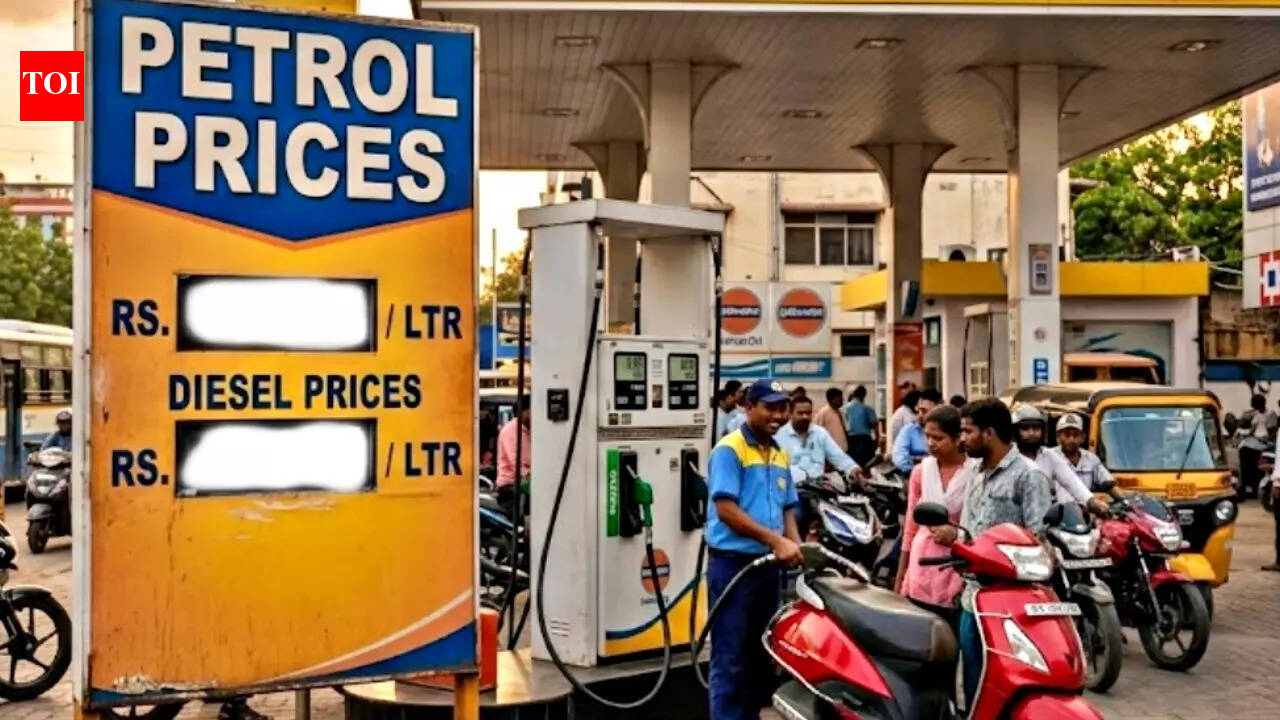
Internationally, oil prices have risen by around 9-10% following Israel-US strikes on Iran, and amid the rising tensions in the Middle East are likely to remain elevated. Does that mean that petrol and diesel prices in India will go up?Brent crude, the international benchmark, moved close to $80 per barrel, while US crude futures advanced 8.6 per cent to $72.79, compared with roughly $67 on Friday.
India, which meets about 88% of its crude oil demand through imports before refining it into fuels such as petrol and diesel, faces a higher import burden when global prices rise, along with possible inflationary effects.
Middle East tensions : Will petrol, diesel prices go up?
Despite the sharp increase in global oil prices, retail petrol and diesel prices in India are not expected to be revised upward in the immediate future, according to a PTI report.According to sources quoted in the report, the government is maintaining a calibrated approach that allows oil marketing companies to improve margins during periods of lower international prices while protecting consumers when global rates increase.Also Read | Middle East oil shock risks: How much do China, India, Japan depend on Middle Eastern crude, gas?Pump prices for petrol and diesel have remained unchanged since April 2022. During this period, state-run retailers including Indian Oil Corporation, Bharat Petroleum Corporation Ltd and Hindustan Petroleum Corporation Ltd have absorbed losses when crude prices were elevated and benefited when prices declined.As a result, domestic fuel prices have stayed steady even when global fuel rates climbed due to higher crude costs. Likewise, when international fuel prices softened in line with lower crude, retail rates in India did not see a reduction.Sources added that the government intends to continue shielding consumers under this policy framework, unless crude prices witness an exceptionally sharp surge.With assembly elections approaching in key states such as West Bengal, Tamil Nadu and Assam, the government is keen to avoid developments that could provide political ammunition to the opposition, the report said.
India assesses oil security
Amid intensifying hostilities in the Middle East, Oil Minister Hardeep Singh Puri on Monday assessed the crude oil, LPG and petroleum products situation in a meeting with senior officials from his ministry and executives of public sector oil companies.
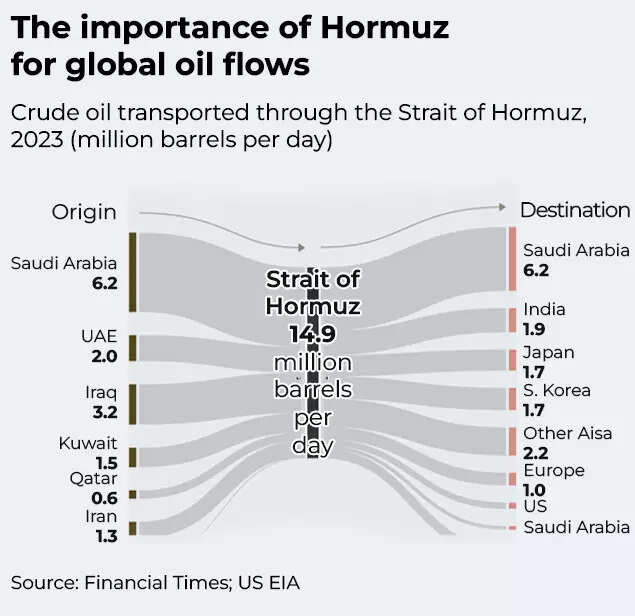
Importance of Hormuz for global oil flows
Much of India’s crude oil and gas supplies transit through the Strait of Hormuz, which Iranian authorities have threatened to close following US and Israeli strikes.“They have sufficient buffers to manage this kind of price spike,” a source with direct knowledge of the matter said, referring to oil companies. “We witnessed crude touching $119 per barrel in June 2022 after Russia’s invasion of Ukraine. That year their profits were modest, but in FY24 they recorded a record profit of Rs 81,000 crore.”Should interruptions continue, cargoes may need to be diverted around the Cape of Good Hope, resulting in longer transit durations and higher transportation expenses, along with increased freight and insurance costs.According to media accounts, the ongoing hostilities have in effect shut down the Strait of Hormuz, the vital artery for worldwide energy transportation. Nearly one-third of global seaborne crude oil exports and around 20 per cent of liquefied natural gas cargoes pass through this narrow channel.Also Read | 1970s-style oil shock loading? Crude may hit $100 if Strait of Hormuz shuts amid Middle East tensions – what it means


MLS Power Rankings: Miami surge after comeback win

Billie Eilish crawls into her past with Justin Bieber
Brewdog: Bars close and hundreds lose jobs as beer firm sold in £33m deal

-
 Business6 days ago
Households set for lower energy bills amid price cap shake-up
-

 Entertainment1 week ago
Talking minerals and megawatts
-
 Business6 days ago
Lucid widely misses earnings expectations, forecasts continued EV growth in 2026
-

 Entertainment1 week ago
Hailee Steinfeld shares big life update amid excitement for baby’s arrival
-
 Politics1 week ago
Supreme Court ruling angers Trump: Global tariffs to rise from 10% to 15%
-

 Sports1 week ago
South Africa thrash India by 76 runs in T20 World Cup Super 8 – SUCH TV
-
 Business1 week ago
Haryana Govt bars IDFC First Bank, AU Small Finance Bank over alleged Rs 590 crore fraud
-

 Sports7 days ago
Top 50 USMNT players of 2026, ranked by club form: USMNT Player Performance Index returns