

Business
Gap says it will launch checkout within Google’s Gemini, in an AI first from a major fashion company


Gap is partnering with Google’s Gemini to allow shoppers to check out directly within the AI platform, making it the first major fashion company to work directly with the tech company to fuel agentic commerce, CNBC has learned exclusively.
The partnership comes as more and more shoppers move away from traditional search and toward artificial intelligence platforms for product discovery, forcing retailers to rethink their approach to marketing to ensure they’re staying competitive and not missing out on customer demand.
“It’s not just keyword search anymore, right? It’s conversations, and so we need to be relevant to that,” Gap’s chief technology officer, Sven Gerjets, told CNBC in an interview. “Is it, you know, ‘I’m trying to figure out what to do for a wedding, what are the things I should be looking at?’ Or, ‘I’ve got a job interview, are there some styles I should wear?’ All of those things we need to become relevant to.”
When shoppers are hunting for a new pair of jeans or the perfect oversized hoodie on Gemini, and the platform thinks some of Gap’s products could be a fit, customers will be able to buy products from Gap’s house of brands directly within the platform without having to be redirected to the brand’s website.
The information about the product that is surfaced to shoppers won’t be crawled from Gap’s website but will be details the retailer provided to Gemini in advance so it can control for accuracy, continue to collect customer data and have better control over the customer experience.
If the shopper decides to buy the product, they’ll check out via Google Pay, and Gap will handle the shipping and any other logistics.
Gerjets said Gap is still testing the service’s capabilities but expects to deploy it to customers “imminently.”
Shoppers walk past a GAP fashion retail store on Oxford Street on October 30, 2025 in London, United Kingdom.
John Keeble | Getty Images News | Getty Images
In addition, a new AI-powered sizing tool dubbed Bold Metrics that Gap plans to integrate will help customers find the right size when shopping online and will also launch soon to shoppers.
Gap’s partnership with Gemini and its gains in customer-facing AI tools give it a competitive edge at a time when winning in specialty retail is harder than ever. The overall fashion market has been growing increasingly fragmented and more competitive.
As long as a retailer’s website has data that an AI platform can read, the company’s products will likely surface in chat results if the platform considers them a fit for a shopper’s inquiry, but there’s a lot of work that retailers need to do to ensure they’re showing up properly.
If a shopper is looking for a sundress on an AI platform, for example, and a company offers a relevant product, but the data isn’t readable by an LLM, the brand could miss out on the sale.
Most major companies are using and implementing AI in a variety of ways, but so far, none of Gap’s primary competitors have announced similar partnerships with Gemini.
Gap’s approach to agentic commerce is a first iteration that’s expected to evolve over time, Gerjets said.
For now, customers won’t be able to link loyalty accounts or spend points on the transaction, he said. That could create some friction for regular customers, but Gerjets said the option could be added down the line.
“We’ll continue to evolve the experience and bring the things forward that the customers want, so that is definitely the roadmap and the future,” said Gerjets. “It’s a very first experience in, I think, a journey that we’re all on to really nail what agentic commerce is for the customers.”
Retail’s AI wars
Gap’s partnership with Gemini comes after OpenAI made similar deals with companies such as Walmart and Etsy only to walk back plans to offer checkout directly within the app.
While the number of people using AI platforms for product discovery is growing, it’s still a small portion of overall shoppers, and the number of customers who will feel comfortable checking out directly within LLMs remains unclear.
Some shoppers may feel wary about putting their credit card information into the platform, while others may prefer to shop directly within a retailer’s app where their store credit card and loyalty points are stored.
Given how long shoppers have been interacting with Google and the fact that it already has customer payment information stored within its system, some shoppers could feel more comfortable using Gemini for checkout versus newer AI platforms such as OpenAI’s ChatGPT.
In some ways, Gemini’s platform is also more advanced. Google recently released new updates so real-time product data is available to users, preventing challenges such as out-of-stocks and pricing errors. Shoppers will also be able to add multiple items to their carts and connect loyalty memberships in some cases — two features OpenAI has yet to fully crack.
Gerjets said OpenAI and Gemini also have two different protocols for agentic commerce. The “Universal Commerce Protocol,” which Gap is using on Gemini, was designed for merchants to have better control over the overall shopping experience, whereas OpenAI’s “Agentic Commerce Protocol” was designed more for discovery, Gerjets said.
“This space is moving so quickly … We’re all evolving and learning together, and who knows what the space will look like in five years, who will be crowned the victor, or how fragmented the space will be?” Gerjets said. “For us, it’s important that we work with all of them, because we really want to meet our customers where they want to be.”
Correction: This story has been updated to correct that Gap plans to integrate an AI-powered sizing tool called Bold Metrics. A previous version misstated the relationship between Gap and the tool.










Olly Harrison, who farms in Tarbock, on Merseyside, said he bought his fertiliser for a good price last year and now believes – due to a wet and cold spring and limited growing days left, added with the costs of diesel for machinery – he may be better off not planting.
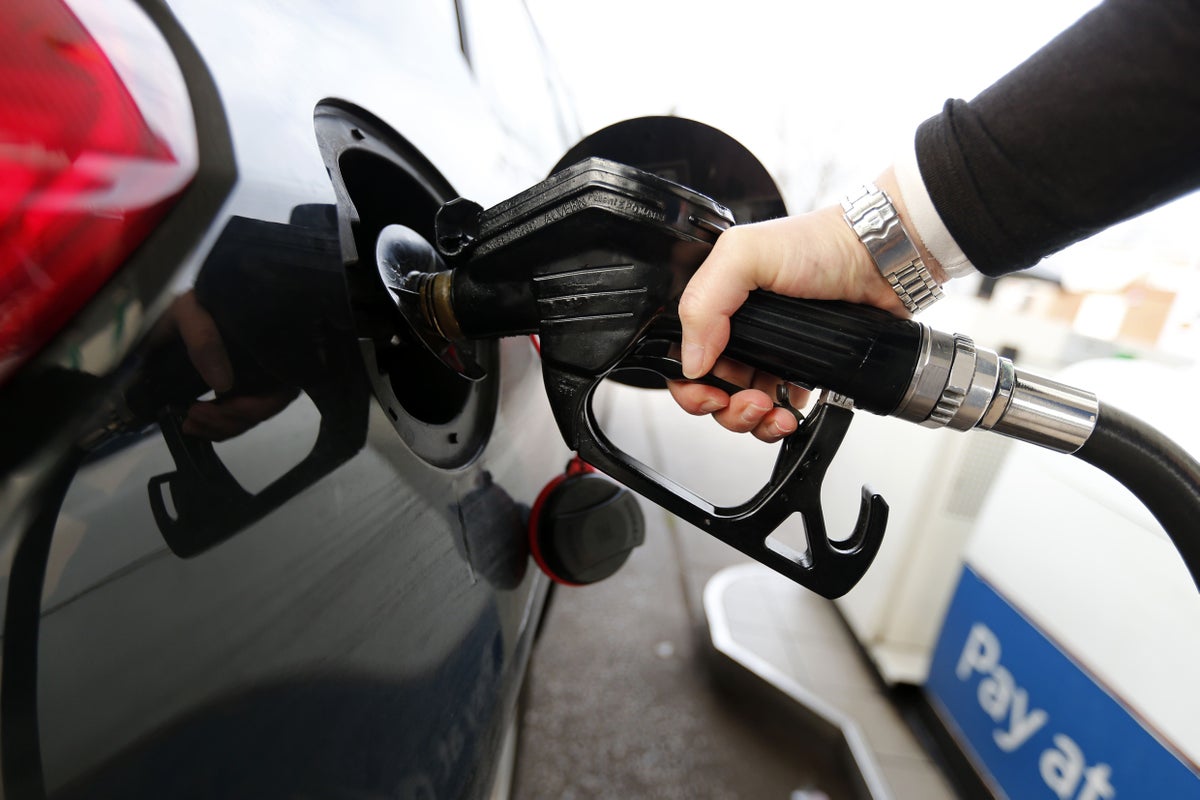
Diesel prices have reached their most expensive level since December 2022, new figures show, as the Iran oil crisis escalates.
The RAC said the average price of a litre of the fuel at UK forecourts on Monday was 181.2p.
That represents a 27% increase from 142.4p on February 28, the day the war in the Middle East began.
Average petrol prices have reached 152.0p per litre, a rise of 14% from 132.8p over the same period.
RAC head of policy Simon Williams said: “Compared to the start of the Iran conflict, it costs £10.55 more to fill up a typical family car that runs on petrol, and £21.35 more for a comparative diesel car.
“The financial strain on the eight in 10 motorists that tell us they depend on their cars continues to build, and at a particularly rapid rate for those who drive diesel vehicles.”
The 29.2p price difference between diesel and petrol is the largest since at least 2003.
UK oil refineries are more geared towards producing petrol than diesel, so the country’s supply of the latter is more reliant on imports.
Oil prices – which have a significant effect on the cost of wholesale fuel – have soared in response to Iran’s stranglehold on tankers passing through the Strait of Hormuz.
Latest DVLA figures show there were 16.2 million diesel vehicles licensed in the UK as of the end of September last year.
This included the vast majority of light goods vehicles, such as vans.
Steve Gooding, director of motoring research charity the RAC Foundation, described diesel as “the lifeblood of millions of small businesses” and warned that “white van man is bleeding cash just to stay on the road”.
He went on: “Whether you drive or not, soaring diesel prices will take money out of your pocket, either at the pump or in the bills you pay for everything from calling out the plumber to getting a home delivery.
“If oil prices remain at this level the impact on the forecourt could be felt for weeks, if not months.
“That’s bad news for everyone, not just drivers of the UK’s 4.6 million diesel vans, the majority of which will be used for work purposes.”
There are mounting calls for the Government to abandon the increase in fuel duty planned for September because of the rise in pump prices.
Chancellor Rachel Reeves announced in her November 2025 budget that the 5p-per-litre cut in fuel duty introduced by the Conservative government in March 2022 would only be extended until the end of August 2026, with rates then gradually returning to March 2022 levels over the next five years.
AA president Edmund King said: “Government can consider what they do with fuel duty in September but, frankly, that is five months away, and arguably industry needs help now.
“With higher pump prices, the Government has been gaining more in VAT, so there is some ‘free’ money in the system that could be used to help drivers out.”
Downing Street has insisted forecourts are “well-stocked nationally” amid reports of pumps running dry in some locations.
Asked whether the Government was planning for any shortages, the Prime Minister’s spokesman replied: “We’ll always plan for all eventualities.”
He added: “To be very clear, as the PM (Sir Keir Starmer) has said and as the Government have said, and indeed industry have said, fuel production and imports are continuing.
“The UK benefits from diverse and resilient supply.
“Petrol stations in the UK are well-stocked nationally and any suggestion otherwise is incorrect.”
Business
IIP data: Industrial output rises 5.2% in February, manufacturing leads recovery – The Times of India

India’s industrial production grew 5.2 per cent in February, driven largely by an improvement in manufacturing output, according to official data released on Monday.Factory output, measured by the Index of Industrial Production (IIP), had expanded 2.7 per cent in February 2025, as per the official statement.Data released by the National Statistics Office (NSO) also showed that industrial growth for January 2026 has been revised upward to 5.1 per cent from the earlier provisional estimate of 4.8 per cent.The manufacturing sector, which forms the bulk of the index, recorded a growth of 6 per cent in February 2026, compared with 2.8 per cent in the year-ago period, supporting the overall expansion.Mining output growth improved marginally to 3.1 per cent from 1.6 per cent a year earlier, while power generation rose 2.3 per cent against a 3.6 per cent increase in February 2025.According to the official data, the IIP index stood at 159.0 in February 2026 compared to 151.1 in the corresponding month last year.Within manufacturing, 14 out of 23 industry groups recorded positive growth. Key contributors included “manufacture of basic metals” (13.2 per cent), “manufacture of motor vehicles, trailers and semi-trailers” (14.9 per cent), and “manufacture of machinery and equipment n.e.c.” (10.2 per cent).In use-based classification, infrastructure and construction goods, intermediate goods and capital goods emerged as the top contributors to growth. Capital goods output rose 12.5 per cent, while infrastructure/construction goods grew 11.2 per cent and intermediate goods by 7.7 per cent.Consumer durables output expanded 7.3 per cent, whereas consumer non-durables contracted 0.6 per cent during the month.During the April-February period of FY26, industrial production growth remained flat at 4.1 per cent compared to the same period last year.


Roberto De Zerbi targeted by Tottenham to take job this season – sources
‘Fertiliser costs mean I’m better off not planting,’ says farmer

Trump’s tariffs had limited impact on US economy: Study

-

 Politics6 days ago
Afghanistan announces release of detained US citizen
-

 Sports6 days ago
Broadcast industry CEO says consolidation is ‘essential’ to compete for NFL soaring media rights prices
-

 Sports1 week ago
Men’s March Madness live tracker: Updates on Saturday’s games
-
 Business6 days ago
Property Play: Home flippers see smallest profits since the Great Recession, real estate data firm says
-

 Entertainment6 days ago
UN warns migratory freshwater fish numbers are spiralling
-

 Tech6 days ago
Can a Home Appliance Fix the Problem of Soft-Plastic Waste?
-

 Sports1 week ago
Arne Slot: Liverpool’s defeat to Brighton ‘hurts a lot’
-

 Fashion6 days ago
ICE cotton slips on weaker crude, profit booking