‘We want to ensure European sovereignty in energy supply,’ says Voltfang chief David Oudsandji.
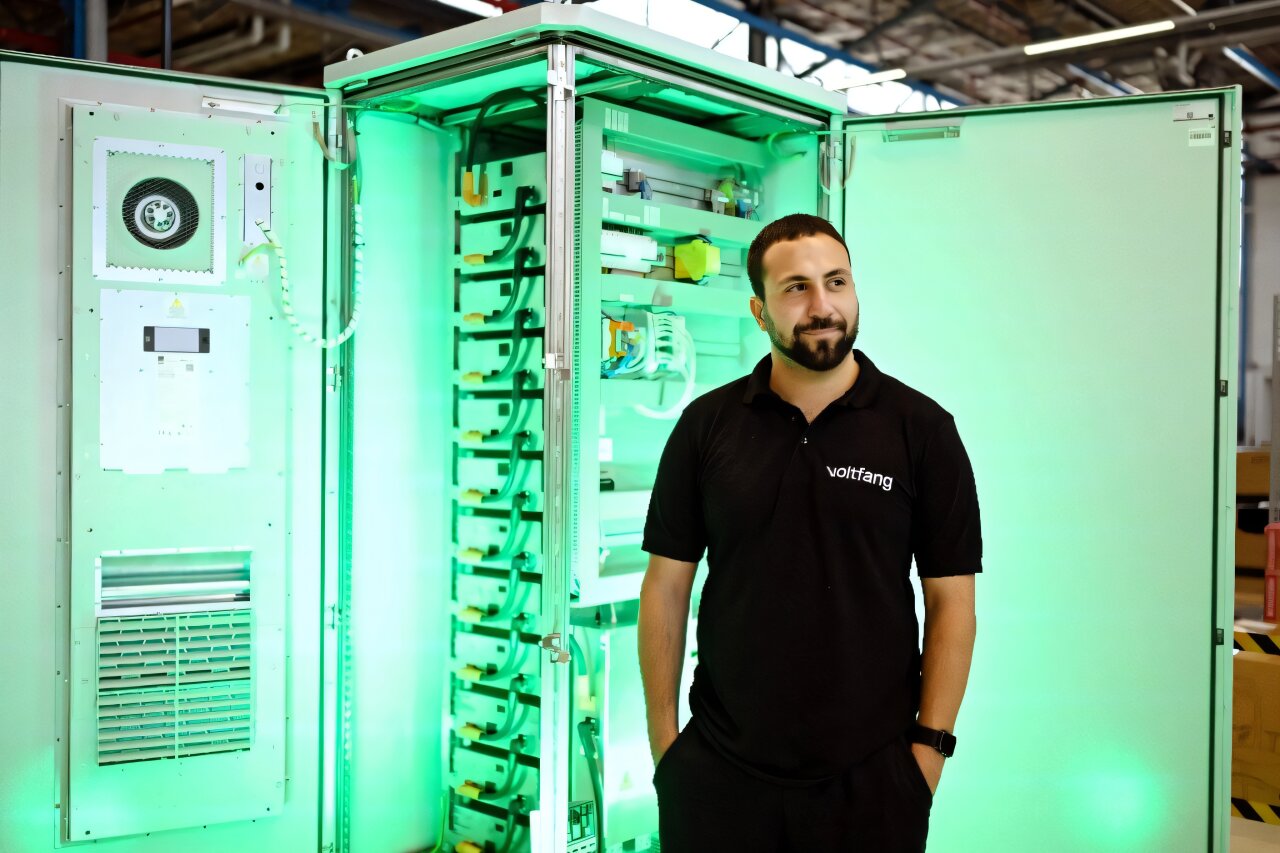
A German company is putting used electric vehicle batteries to new use by stacking them into fridge-size units that homes and businesses can use to store their excess solar and wind energy.
This week, the company Voltfang—which means “catching volts”—opened its first industrial site in Aachen, near the Belgian and Dutch borders.
With around 100 staff, Voltfang says it is the biggest facility of its kind in Europe in the budding sector of refurbishing lithium-ion batteries.
Its CEO David Oudsandji hopes it will help Europe’s biggest economy wean itself off fossil fuels and increasingly rely on climate-friendly renewables.
While wind turbines now dot Germany’s countryside and photovoltaic panels are found on many rooftops, he says the country still needs to build up battery storage capacity.
“We want to ensure European sovereignty in energy supply by enabling renewable energy production through storage,” Oudsandji, 29, told AFP.
“We can generate enormous amounts of electricity from solar and wind energy, then store it in a decentralized way all across Germany and distribute it,” he said.
“This means that the more renewable energy we use, the more storage capacity we deploy, the less we need fossil gas or oil.”
A wind turbine and a lignite-fired power plant near Neurath, western Germany.
Inside the site, technicians receive used EV batteries and test them to determine their remaining lifespans.
Those still found to be in good condition are reconditioned for their “second life” and fitted inside cabinets the size of large refrigerators—effectively huge power banks for excess electricity.
Among the first customers is the discount supermarket chain Aldi Nord, which wants to store power from its rooftop solar panels for later use.
Clean energy push
Voltfang, founded in 2020 by three university engineering students, aims to produce enough systems by 2030 to store a capacity of one gigawatt-hour (GWh) of electricity per year, enough for 300 homes.
It is one of many small steps meant to help Germany’s decades-old “Energiewende”, or energy transition.
Last year, renewables covered nearly 60% of electricity produced in Germany, and the target is 80% by 2030.
Voltfang is developing and manufacturing battery storage systems from reusable and surplus electric car batteries.
One problem for solar and wind is what to do on days when the sun doesn’t shine and the wind doesn’t blow.
Such “dark lulls”, most common in winter, have at times forced Germany to temporarily import power produced by French nuclear reactors or Polish coal plants.
To guarantee a secure supply, conservative Chancellor Friedrich Merz’s government plans to build around 20 new gas-fired power plants by 2030.
The Greens and environmental groups have denounced this as a step backward in German climate policy and fear the country will not meet its goal of carbon neutrality by 2045.
Circular economy
Europe’s battery sector is still nascent but expected to grow fast.
“In our opinion, small-scale distributed energy assets such as battery storage will play a major role to create efficient energy systems,” said Marc Sauthoff of the business consultancy Roland Berger.
The storage systems can power solar panels and heat pumps, or be used to feed electricity into the grid when needed.
The stationary storage market is growing exponentially in Germany: about six GWh of capacity were installed at end-2024, up from 2.5 GWh in 2022, he said.
Voltfang hopes to be profitable by next year, Oudsandji said, though he conceded there are hurdles.
For one thing, the supply of used EV batteries is still small, given that most vehicles have been on the road for only a few years.
Also, new batteries, produced mainly in China, are becoming more efficient and less expensive, making it harder to compete against them with refurbished models.
Oudsandji acknowledged that testing and refurbishing old batteries “is more complex” than simply buying new ones.
“But the big advantage is that it is more sustainable,” he said. “It is cheaper and allows us to create a circular economy, thus ensuring Europe’s independence in resource supply.”
Citation:
German firm gives ‘second life’ to used EV batteries (2025, August 21)
retrieved 21 August 2025
from https://techxplore.com/news/2025-08-german-firm-life-ev-batteries.html
This document is subject to copyright. Apart from any fair dealing for the purpose of private study or research, no
part may be reproduced without the written permission. The content is provided for information purposes only.
Google notes that Apple patched vulnerabilities used by Coruna in the latest versions of its mobile operating system, iOS 26, so its exploitation techniques are only confirmed to work against iOS 13 through 17.2.1. It targets vulnerabilities in Apple’s Webkit framework for browsers, so Safari users on those older versions of iOS would be vulnerable, but there’s no confirmed techniques in the toolkit for targeting Chrome users. Google also notes that Coruna checks if an iOS devices has Apple’s most stringent security setting, known as Lockdown Mode, enabled, and doesn’t attempt to hack it if so.
Despite those limitations, iVerify says Coruna likely infected tens of thousands of phones. The company consulted with a partner that has access to network traffic and counted visits to a command-and-control server for the cybercriminal version of Coruna infecting Chinese-language websites. The volume of those connections suggest, iVerify says, that roughly 42,000devices may have already been hacked with the toolkit in the for-profit campaign alone.
Just how many other victims Coruna may have hit, including Ukrainians who visited websites infected with the code by the suspected Russian espionage operation, remains unclear. Google declined to comment beyond its published report. Apple did not immediately provide comment on Google or iVerify’s findings.
In iVerify’s analysis of the cybercriminal version of Coruna—it didn’t have access to any of the earlier versions—the company found that the code appeared to have been altered to plant malware on target devices designed to drain cryptocurrency from crypto wallets as well as steal photos and, in some cases, emails. Those additions, however, were “poorly written” compared to the underlying Coruna toolkit, according to iVerify chief product officer Spencer Parker, which he found to be impressively polished and modular.
“My god, these things are very professionally written,” Parker says of the exploits included in Coruna, suggesting that the cruder malware was added by the cybercriminals who later obtained that code.
As for the clues that suggest Coruna’s origins as a US government toolkit, iVerify’s Cole notes that it’s possible that Coruna’s code overlap with the Operation Triangulation code that Russia pinned on US hackers could be based on Triangulation’s components being picked up and repurposed after they were discovered. But Cole argues that’s unlikely. Many components of Coruna have never been seen before, he points out, and the whole toolkit appears to have been created by a “single author,” as he puts it.
“The framework holds together very well,” says Cole, who previously worked at the NSA, but notes that he’s been out of the government for more than a decade and isn’t basing any findings on his own outdated knowledge of US hacking tools. “It looks like it was written as a whole. It doesn’t look like it was pieced together.”
If Coruna is, in fact, a US hacking toolkit gone rogue, just how it got into foreign and criminal hands remains a mystery. But Cole points to the industry of brokers that may pay tens of millions of dollars for zero-day hacking techniques that they can resell for espionage, cybercrime, or cyberwar. Notably, Peter Williams, an executive of US government contractor Trenchant, was sentenced this month to seven years in prison for selling hacking tools to the Russian zero-day broker Operation Zero from 2022 to 2025. Williams’ sentencing memo notes that Trenchant sold hacking tools to the US intelligence community as well as others in the “Five Eyes” group of English-speaking governments—the US, UK, Australia, Canada and New Zealand—though it’s not clear what specific tools he sold or what devices they targeted.
“These zero-day and exploit brokers tend to be unscrupulous,” says Cole. “They sell to the highest bidder and they double dip. Many don’t have exclusivity arrangements. That’s very likely what happened here.”
“One of these tools ended up in the hands of a non-Western exploit broker, and they sold it to whoever was willing to pay,” Cole concludes. “The genie is out of the bottle.”
Alongside its price-friendlyiPhone 17e and M4 iPad Air yesterday, Apple just announced a few updates to the MacBook Pro, MacBook Air, and its rarely-refreshed desktop display line.
The MacBook Air has now been updated to the latest M5 chip. It’s a fairly modest upgrade, but it brings it up to speed with Apple’s latest processor that debuted in the MacBook Pro last fall. There are no other major hardware changes—it now comes with 512 GB of starting storage with “faster SSD technology”—but you can still get the Air in either a 13- or 15-inch screen size.
This laptop also features Apple’s N1 wireless chip, which includes Wi-Fi 7 and Bluetooth 6 for the latest connectivity standards. It still comes with the standard 16 GB of RAM, and sadly, there’s a $100 price bump to account for the extra storage. It now starts at $1,099 for the 13-inch model and $1,299 for the 15-inch model. Apple says you can preorder it tomorrow, with sales kicking off on March 11.
More interestingly, Apple is expanding the M5 chip series with the M5 Pro and M5 Max, now available in the 14-inch and 16-inch MacBook Pro. Like previous generations of Apple silicon, the “Pro” and “Max” configurations add significantly improved multi-core CPU and graphics performance.
The new MacBook Air with M5.
Photograph: Courtesy of Apple
The M5 Pro and M5 Max can be configured with up to 18 CPU cores (12 performance cores and 6 “super” cores), up from 16 on the M4 Max. The M5 Pro can scale up to 20 GPU cores, while the M5 Max extends up to 40 GPU cores. Thanks to higher memory bandwidth, more efficient Neural Engine, and improved GPU architecture, Apple says the M5 Pro and M5 Max have “over 4X the peak CPU compute for AI” compared to the last generation and offer 20 percent better GPU performance.
The new MacBook Pros don’t include any other hardware changes; things have stayed largely the same since 2021—same port selection, Mini-LED display, speakers, and webcam. Even the claimed 24-hour battery life hasn’t changed from the M4 models, which came out in late 2024. Interestingly, as recently as last week, Bloomberg reported that Apple plans to launch a more significant update to the MacBook Pro later this fall, which will reportedly debut the M6 chip, an OLED touchscreen, and a thinner chassis.
Like the MacBook Air, all versions of the M5 Pro or M5 Max MacBook Pros come with twice the storage and a slightly higher starting price. Coming with 1 TB, the 14-inch M5 Pro now starts at $2,199, and the 16-inch model at $2,699. That’s $200 more than last year’s machines. Meanwhile, M5 Max prices start at $3,599.
“Increasingly, I’m coming back to running product and working with the vice president of tech on some artificial intelligence (AI) projects and getting very hands-on myself,” says Wolf & Badger CEO and co-founder George Graham.
“It’s intellectually challenging, stimulating and intriguing – and I want to learn more about it. I’m trying to get as much info as I can on what I consider to be the most interesting tech advancement of my professional work lifetime.”
Not the words of a head of engineering, CIO, or technology executive, but those of the CEO of the online marketplace, whose business world continues to be lit up by the opportunity to use AI across multiple operations.
And why not? In January 2026, Wolf & Badger released a performance update to mark 15 years of trading, reporting it had now surpassed $500m in cumulative sales since inception and achieved almost 40 million website visits in 2025 alone, while reinforcing its reputation as an ethical platform by securing B-Corp recertification.
Wolf & Badger partners with independent brands promising strong ethics, and effectively becomes their tech stack and online operations provider. It is the conduit for these brands to achieve the scale that few organisations of their size can achieve alone.
The business achieved annual sales of $100m (£75m) in 2024, with more than 2,000 brand partners now in place, helping the London-headquartered operation grow globally. And ongoing investment in “AI-driven discovery and on-site personalisation” is delivering a measurable impact, with the company talking about £3.2m of directly attributable incremental sales from recent AI initiatives.
“There’s tremendous opportunity to improve the efficiency and discovery on Wolf & Badger by better understanding our shoppers and our brands and the products they sell,” he says.
“There’s lots around AI on image recognition and product tagging to build out better information related to style or what event a product would be suitable for, and using that to surface more relevant products to the user at the right time – all with the end point of making life more exciting and creating inspirational shopping experiences.”
Are we all product managers now?
While the work on using AI to power the online experience is not uncommon in e-commerce today, Graham’s attitude as CEO of the marketplace is. He is a CEO getting his hands dirty with the tech, which is rare in retail.
“I have personally spent many hundreds of hours over the past three months getting my head around AI and the future of commerce – with agentic commerce in mind,” he explains.
I have personally spent many hundreds of hours over the past three months getting my head around AI and the future of commerce – with agentic commerce in mind George Graham, Wolf & Badger
“Claude Code has become my go-to app. I have built a fairly bespoke AI agent ‘chief of staff’ that is connected to my tools via MCPs [model context protocols] or APIs [application programming interfaces], with a bunch of bespoke skills and scripts that I have ended up building into that.”
Graham says the collective memory stack is getting more powerful by the day, and using it has improved his own working practices.
“I feel twice as efficient as I was six months ago. I have taken that time and – in the short term – continued reinvesting it in understanding AI.”
The AI assistant Graham has developed is being made accessible via Stack internally, and the wider team is getting set up on Claude Code themselves with access to their own version.
The CEO acknowledges he isn’t an engineer or coder, but as a teenager, he would make games in Basic (Beginner’s All-purpose Symbolic Instruction Code) and design websites with HTML. After studying business at university, he joined PwC as a strategy consultant. By the age of 23, he was starting Wolf & Badger and “had to figure out how to build a marketplace as there wasn’t really marketplace software out there”.
When development at Wolf & Badger was brought in-house – today, it has a vice-president of technology, around a dozen people in engineering and others in product management and design – Graham continued to play a part in building out features to support brand partners and customers.
“I have always found all that fascinating,” he explains.
“Over the years, I stepped away as we brought the experts in – but, increasingly, I’m coming back to running product and working with our vice-president of tech on some of the AI projects and getting very hands-on myself.”
Graham, who founded Wolf & Badger with his brother Henry in 2010, admits he doesn’t fully understand the finer nuances of coding and doesn’t have the experienced engineer’s eye. But with the new tech available, he suggests “anyone can be a product manager or software developer” now.
“I have been able to create prototypes – I have built things that assess brands coming on the platform and help the sustainability team with vetting,” he says.
The software his internal teams are now using is set up on GitHub, and built on Eversell MSL front-end, Superbase, and other apps. “Everything is hooked up in what I think is reasonably robust for internal use,” he adds.
He urges other leaders in retail and wider business not to be afraid, and to experiment with the tools now available. There’s a lot that can be built on just a small monthly tech subscription outlay, he notes.
The wider tech team at Wolf & Badger initially experimented with solutions such as Microsoft Copilot and then Cursor.
“Only in the past few months have our engineers found the quality is at a point where they can lean on it more to start actually writing code. We’re keeping clear of the vibe coding in key sensitive areas, of course, but we can experiment in lots of spaces.”
The tech exploration work Graham has taken on – and there is much more to come, he says – is to “ready ourselves for agentic commerce and make sure we’re ahead of the pack”.
Since the turn of the year, there have already been some noteworthy developments in agentic commerce that further underline it as a future direction of travel for e-commerce and, therefore, something e-commerce and retail leaders must better grasp an understanding of.
Agentic commerce and UCP
The new year started with JD Sports announcing it is enabling consumers to use AI platforms to search for and purchase products – all in a single click, without leaving the apps.
JD customers in the US can purchase directly through Copilot, and – in due course – this will be followed by the ability to do so via Google Gemini and ChatGPT. JD is leveraging the agentic commerce suite of tech players Commercetools and Stripe.
Jetan Chowk, JD’s chief technology and transformation officer, said the move was about meeting customers “where they are”. It came after OpenAI announced in September that US shoppers could buy from Etsy directly through ChatGPT.
It started with an “instant checkout” to support single-item purchases, but multi-item carts are now on their way to being a reality.
Then, at the January 2026 NRF Big Show in New York, where many from the retail technology community congregate every year, Google launched the Universal Commerce Protocol (UCP), an open standard for agentic commerce that aims to establish a common language for AI agents and systems to operate together across consumer surfaces, businesses and payment providers.
The work Stripe is doing with agentic commerce protocol and standardising the mechanism by which people can shop directly via the [AI] agents is super interesting George Graham, Wolf & Badger
This is a fast-moving space, but was co-developed with prominent retail industry players such as Shopify, Etsy, Wayfair, Target and Walmart, and endorsed by more than 20 others across the ecosystem, including payments companies Adyen, American Express, MasterCard and Visa.
Graham is in close conversations with Stripe and Google, attending their events and regularly tuning into their updates.
“The work Stripe is doing with agentic commerce protocol and standardising the mechanism by which people can shop directly via the agents is super interesting,” he says. “Google and Shopify UCP is a further move towards a standardisation of how this is going to work.”
Graham is confident there will be more consumer discovery conducted on Google’s AI-powered platforms, ChatGPT, Perplexity, and other similar spaces.
“We need to ensure we’re supporting the 2,000 brands we’re working with to appear in the right way on those channels and facilitate the tech that can support one- or zero-click checkout, where an agent has the ability to buy on a consumer’s behalf.”
He is confident that a platform such as Wolf & Badger can play a key role in the agentic space. Individual brands are typically going to struggle to really build out the right metadata and set up UCP to be recognised by the human in the loop or an AI agent.
Graham says: “If we can wrap together the best independent brands and collectively go to a shopping agent to ensure those brands appear in the right places, we’re well placed to capture some of that demand and drive it towards the individual brands we work with, rather than the resulting purchases ending up with the bigger homogenised brands in our space.”
He adds that Wolf & Badger’s presence harks back to the pre-digital days of boutique shopping in-store, but with the right technology investment and focus now, it can deliver this in a “scaled way” online and through its showrooms.
“Our editorial and marketing team still make the creative calls, but we’re able to drive it forward with some of these new bits of tech,” he says, adding that as Wolf & Badger extends its technological nous, it can enable its brands to focus on “the difficult part” of commerce – meaning the design and manufacturing of compelling garments and consumer products.
Rapidly evolving space
As for the immediate future at Wolf & Badger, the US expansion is a key focus – as are ventures across Europe and into the Middle East. An expanded brand partnerships function within the business is expected to support the onboarding of new designers from around the world.
But AI continues to be an area of significant exploration, with Graham confident that his experimentation and use of cost-effective tools are improving how the business operates.
“It’s a rapidly evolving space – everything is changing these days,” he says, adding that it’s getting increasingly difficult to understand what will come next due to the acceleration of technological capability.
“You just have to try to stay ahead,” he says. “We’re repositioning ourselves in making sure we are embracing AI in the way I think any forward-thinking growth company should, and recognising the power it can bring to enable us to do much more for our brands and shoppers.”























 Politics6 days ago

 Politics5 days ago
 Sports6 days ago

 Sports1 week ago
 Fashion5 days ago
 Fashion7 days ago