

Tech
I’m Not a Morning Person. These Sunrise Alarm Clocks Help Me Not Hate My Life

Comparing Our Favorite Sunrise Alarm Clocks
More Sunrise Alarm Clocks We’ve Tried
Photograph: Nena Farrell
Vivilumens Sunrise Alarm Clock for $41: This sunrise alarm works fine but seems better suited as a desk lamp than a true sunrise alarm. But it could be a fun pick if you live in a studio and need a device that can both work for your desk or your bedside alarm. It also has a USB-A charging port and can show time as 24 or 12 hour.
Philips SmartSleep Wake-Up Light (HF3520/60) for $149: This might sound similar to the lamp we recommend above, but it has a different shape and is missing the word “Sleep” from the name because it doesn’t offer a nighttime routine like our top pick. But it still works great as a morning sunrise lamp, and similar to the other Philips model, it’s easy to set up without any instructions on hand. It’s a good affordable model, but not as cheap as other options with similar offerings.
Lumie BodyClock Glow 150 for $139: This cute little clock worked fine, but our other picks are bigger and brighter. You could get the WiiM for the same price, or the Philips HF3520 for even cheaper.
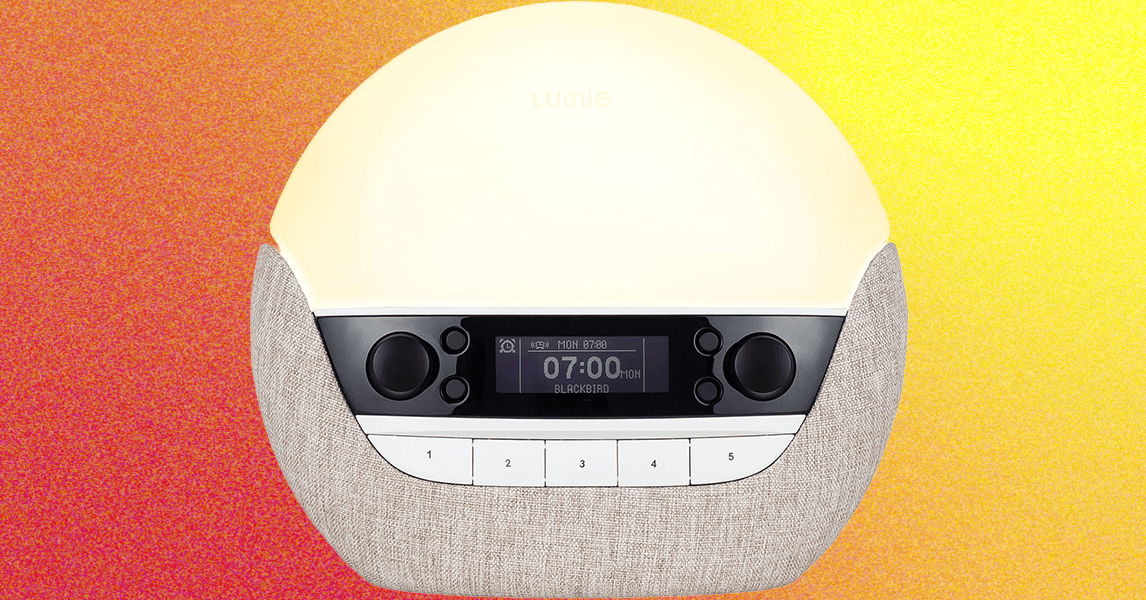
Lumie Bodyclock Luxe 700FM for $259: This is my true favorite sunrise alarm, with 27 sounds and two dials on the front to easily control both sound and brightness level. It’s a bigger, brighter sunrise clock that’s great for bigger bedrooms, too. It’s out of stock on Amazon right now and has limited stock on Lumie’s site, but should be back in stock this fall.
Hatch Restore 2 for $85: Hatch isn’t selling this model any longer, but you can find it refurbished on some third-party retailers and sites like Walmart and eBay. It’s a fine device that gives you the same app and sound offerings as the Hatch Restore 3, but the Restore 3 has much better controls. I recommend skipping this device for the newer model.
Philips SmartSleep Sleep and Wake-Up Light for $220: We previously recommended this sunrise lamp, formerly known as Somneo. Its name is nearly identical to our top pick, and it has the same shape. The Connected version had an app and extra capabilities similar to the WiiM, but it’s no longer available.
FAQ
How Do Sunrise Clocks Work?
Your body is built to wake naturally with the sunrise and feel sleepy as the sun sets. The light at both the beginning and end of the day is a warm, golden tone, unlike the midday bright, slightly blue sunlight that keeps you wide awake. A sunrise alarm clock mimics this transition from morning to bright daytime light, helping to signal your body to wake up (or fall asleep, if the clock also has a sunset option).
Each model we recommend offers a sunrise routine, meaning you choose a time to wake up and then the sunrise clock will start displaying a deep orange glow and transition to a bright light by the time your audio alarm is set for. Some offer customization, allowing you to choose how long you want that artificial sunrise to be, while others have set timers. Some also allow the reverse option with a sunset routine and can double as sound machines. Most of these plug into the wall like a classic alarm clock and stay put, though sometimes there’s a companion app or recharging capabilities (if it’s not mentioned, though, assume it doesn’t).
What Should You Look For in a Sunrise Alarm Clock?
There’s a lot of features to consider in a sunrise lamp, but which ones that you’ll like best vary by person.
If you struggle to fall asleep: splurge on a sunrise alarm with a nighttime or wind-down routine. These help build a routine for you to fall asleep to.
If you need a bedside lamp and sunrise clock: get a brighter sunrise clock that has easy controls to switch it on as a bedside lamp. Not all sunrise clocks have these, so check the details carefully (and reviews like ours)
If you want a specific bedside sound: check how many sounds are offered. Just about every sunrise clock has some sound machine features and options, but cheaper ones tend to only have a couple of sounds and might not have the sound you’re looking for.
If you want app control: some options in this guide don’t have a partner app or Wi-Fi capabilities, especially some of my favorites. An app doesn’t necessarily make it a better sunrise clock, but it can be convenient to use. If you prefer an app to set up your sunrise lamp, shop the Casper, Hatch, Loftie, and WiiM.
Do Sunrise Alarms Work for Heavy Sleepers?
Yes! I’m an especially heavy sleeper in the morning and these can still help me wake up. You might want to choose the most gradual increase of brightness on the sunrise lamp you choose, so that the slow brightening of the room can better slowly rouse you from that deep sleep.
What’s the Difference Between a Sunrise Clock and a SAD Lamp?
These two gadgets might look similar on the outside, but sunrise clocks and other wake-up style lights are for waking you up, while a SAD or seasonal affective disorder lamp is designed to simulate sunlight for you during the day. SAD lamps perform light therapy to help combat seasonal depression during darker times of the year, while sunrise alarms are just for making morning wake-up less rough. Both can help regulate your circadian rhythm, but in different ways. You could set a sunrise clock to stay on all day to help simulate sunlight, though these don’t promise the same benefits and you might not get the help you’re looking for.
How Does WIRED Choose Sunrise Clocks to Test?
We research all models in advance to see which ones are a fit for testing. We look to ensure they have wake-up features (some SAD lamps will look similar to a sunrise alarm, for example, but if there’s no gradual sunrise to wake up to they don’t qualify for testing with this guide) and look to test a variety of price points and additional features to see what’s really worth buying. We make an effort to select both more affordable options with less features and high-end options to compare and contrast against one another in our testing rounds.
How Does WIRED Test Sunrise Clocks?
I tested each recommended sunrise clock on my bedside in a room with blackout curtains to see how much it could really brighten a room over the course of its sunrise routine. I slept with each model for anywhere between one and seven nights, depending on its performance. I also tried out the various sound options each machine had to offer to both test the speakers and see how pleasant the sounds were to wake up or fall asleep to. If there was a nighttime routine option, I tested that too.
Power up with unlimited access to WIRED. Get best-in-class reporting and exclusive subscriber content that’s too important to ignore. Subscribe Today.









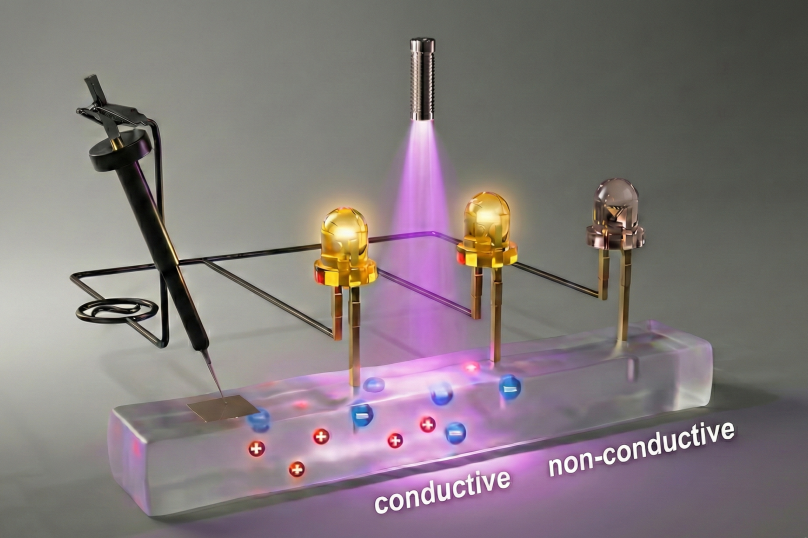
Consider the chief difference between living systems and electronics: The first is generally soft and squishy, while the latter is hard and rigid. Now, in work that could impact human-machine interfaces, biocompatible devices, soft robotics, and more, MIT engineers and colleagues have developed a soft, flexible gel that dramatically changes its conductivity upon the application of light.
Enter the growing field of ionotronics, which involves transferring data through ions, or charged molecules. Electronics does the same, with electrons. But while the latter is well established, ionotronics is still being developed, with one huge exception: living systems. The cells in our bodies communicate with a variety of ions, from potassium to sodium.
Ionotronics, in turn, can provide a bridge between electronics and biological tissues. Potential applications range from soft wearable technology to human-machine interfaces
“We’ve found a mechanism to dynamically control local ion population in a soft material,” says Thomas J. Wallin, the John F. Elliott Career Development Professor in MIT’s Department of Materials Science and Engineering and leader of the work. “That could allow a system that is self-adaptive to environmental stimuli, in this case light.” In other words, the system could automatically change in response to changes in light, which could allow complex signal processing in soft materials.
An open-access paper about the work was published online recently in Nature Communications.
A growing field
Although others have developed ionotronic materials with high conductivities that allow the quick movement of ions, those conductivities cannot be controlled. “What we’re doing is using light to switch a soft material from insulating to something that is 400 times more conductive,” says Xu Liu, first author of the paper and former MIT postdoc in materials science and engineering who is now an incoming assistant professor at King’s College London.
Key to the work is a class of materials known as photo-ion generators (PIGs). These can become some 1,000 times more conductive upon the application of light. The MIT team optimized a way to incorporate a PIG into polyurethane rubber by first dissolving a PIG powder into a solvent, and then using a swelling method to get it into the rubber.
Much potential
In the material reported in the current work, the change in conductivity is irreversible. But Liu is confident that future versions could switch back and forth between insulating and conducting states.
She notes that the current material was developed using only one kind of PIG, polymer (the polyurethane rubber), and solvent, but there are many other kinds of all three. So there is great potential for creating even better light-responsive soft materials.
Liu also notes the potential for developing soft materials that respond to other environmental stimuli, such as heat or magnetism. “We’re inspired to do more work in this field by changing the driving force from light to other forms of environmental stimuli,” she says.
“Our work has the potential to lead to the creation of a subfield that we call soft photo-ionotronics,” Liu continues. “We are also very excited about the opportunities from our work to create new soft machines impacting soft wearable technology, human-machine interfaces, robotics, biomedicine, and other fields.”
Additional authors of the paper are Steven M. Adelmund, Shahriar Safaee, and Wenyang Pan of Reality Labs at Meta.

A recent cosmological model combines two of the most eccentric ideas in contemporary physics to explain the nature of dark matter, the invisible substance that makes up about 85 percent of all matter in the universe. To understand it, it’s necessary to look beyond the Big Bang we all know and consider two concepts that rarely intersect: cyclic universes and primordial black holes.
A Different Kind of Multiverse
There are different versions of the “multiverse.” The most popular model—that of the Marvel Cinematic Universe—proposes that there are as many universes as there are possibilities and that these versions of reality are parallel. Physics proposes something more sober and mathematically consistent: the cosmic bounce.
In this model, the universe is not born from a singularity, but expands, contracts, and expands again in an endless cycle. Each “universe” is not parallel, but sequential—that is, one arises from the ashes of the previous one.
Is it possible for something to survive the end of its universe and endure into the next? According to a paper published in Physical Review D, yes. Author Enrique Gaztanaga, a research professor at the Institute of Space Sciences in Barcelona, shows that any structure larger than about 90 meters could pass through the final collapse of a universe and survive the rebound. These “relics” would not only persist, but could also seed the formation of giant, unexplained structures observed in the early stages of the present-day universe. Moreover, they could be the key to understanding dark matter.
For decades, the dominant explanation for dark matter has been that it is an unknown particle or particles. But after years of experiments without direct detections, physicists have begun to explore alternatives. One of them proposes that dark matter is not an exotic particle, but an abundant population of small black holes that we overlook.
The idea is appealing, but it has a serious problem. For these black holes to explain dark matter, they would have to exist from the earliest moments of the universe, long before the first stars could collapse. There are indications that these objects could exist, but a convincing physical mechanism to explain their origin is lacking.
A Universe Born With Black Holes
This is where Gaztanaga’s newly proposed model shines. If cosmic bouncing allows compact structures to survive the collapse of the previous universe, then the current universe would have already been born with pre-existing black holes. They would not have to have been generated by extreme fluctuations or finely tuned inflationary processes, but would simply have been there from the first instant.
The assumption has the potential to solve two riddles at once: the origin of black holes and the nature of dark matter. If this model is correct, dark matter would not be a mystery of the early universe but rather a legacy of a cosmos that predates our own.
“Much work remains to be done,” Gaztanaga, also a researcher at the Institute of Cosmology and Gravitation at the University of Portsmouth, said in an article for The Conversation. “These ideas must be tested against data—from gravitational-wave backgrounds to galaxy surveys and precision measurements of the cosmic microwave background.”
“But the possibility is profound,” he added. “The universe may not have begun once, but may have rebounded. And the dark structures shaping galaxies today could be relics from a time before the Big Bang.”
This story originally appeared in WIRED en Español and has been translated from Spanish.

The European online age verification app is ready.
The app works with passports or ID cards, is built to be “completely anonymous” for the people who use it, works on any device (smartphones, tablets, and PCs), and is open source. “Best of all, online platforms can easily rely on our age verification app, so there are no more excuses,” said European Commission president Ursula von der Leyen at a press conference on Wednesday. “Europe offers a free and easy-to-use solution that can protect our children from harmful and illegal content.”
High Expectations
“It is our duty to protect our children in the online world just as we do in the offline world. And to do that effectively, we need a harmonized European approach,” von der Leyen said at Wednesday’s press conference. “And one of the central issues is the question, how can we ensure a technical solution for age verification that is valid throughout Europe? Today, I can announce that we have the answer.”
This answer takes the form of an open source app that any private company can repurpose, as long as it complies with European privacy standards and offers the same technical solution throughout the European Union. The user downloads the app, agrees to the terms and conditions, sets up a pin or biometric access, and proves their age through an electronic identification system, or by showing a passport or ID card (in which case biometric verification is also provided). The app does not store your name, date of birth, ID number, or any other personal information, according to the European Commission—only the fact that you are over a certain age.
After that, when a person using the app wants to access a social network (minimum age: 13), pornographic site (minimum age: 18), or any other age-protected content, if they are logged in from a computer, they need only scan the QR code shown on the site they want to visit. If, on the other hand, the person logs in from a smartphone, the app sends the proof of age directly. The platform does not access the document with which the user proved it in the first place.
Adoption Event
The need to introduce a common system for the entire European Union has been discussed for some time, and according to commission technicians, the technical work is now complete. Of course, it will still be possible to circumvent the system—all it takes is for an adult to lend their phone to a younger friend—but the technological architecture exists, and it will be up to EU member states to decide whether to integrate it into national digital wallets or develop independent apps.
“No More Excuses”
For the app to really be effective, platforms must be obligated to verify the age of their users—that’s where things get tricky. The Digital Services Act, which went into effect in 2024, requires “very large online platforms”—those with more than 45 million monthly users in the European Union—to take concrete steps to mitigate systemic risks related to child protection, with heavy penalties for noncompliance.
“And that’s why Europe has the DSA: to call online platforms to their responsibilities. Because Europe will not tolerate platforms making money at the expense of our children,” European Commission executive vice president Henna Virkkunen told a press conference. She added that after an investigation into TikTok, the European institutions plan to take similar action against Facebook, Instagram, and Snapchat, as well as four porn sites. “Since the platforms do not have adequate age verification tools, we developed the solution ourselves,” he concluded. In short, as von der Leyen also remarked, “there are no more excuses.”
Bare Minimum
So far, this is the European framework that sets the general rules. On this basis, member states can consider more restrictive measures. Italy was among the first to discuss how to regulate the use of social media by minors but has so far not landed on anything concrete. Elsewhere in the EU, France’s Emmanuel Macron has been a trailblazer on the issue, pushing France to discuss a rule to ban social networks for minors under the age of 15 entirely. So far, this measure has received broad political support—but the outcome depends largely on compatibility with the Digital Services Act and the availability of effective age verification systems like the app the European Commission just released.
This article originally appeared on WIRED Italia and has been translated.


China’s industrial output grows 6.1% in Q1 2026

Italy’s apparel export-import plunge after positive trend in 2025

Top stocks to buy today: Stock recommendations for April 17, 2026 – check list – The Times of India

-

 Entertainment1 week ago
Queen Elizabeth II emotional message for Archie, Lilibet sparks speculation
-

 Tech1 week ago
Azure customers up in arms over ‘full’ UK South region | Computer Weekly
-

 Tech1 week ago
As the Strait of Hormuz Reopens, Global Shipping Will Take Months to Recover
-

 Fashion1 week ago
CII submits 20-pt agenda to Indian govt to back firms hit by Iran war
-

 Tech1 week ago
This AI Button Wearable From Ex-Apple Engineers Looks Like an iPod Shuffle
-

 Politics7 days ago
Indian airlines hit hardest after Dubai limits foreign flights until May 31
-
Uncategorized1 week ago
[CinePlex360] Please moderate: “Trump considers
-

 Entertainment4 days ago
Palace left in shock as Prince William cancels grand ceremony