Connect with us

Business

Gold prices rebound after three-day decline as global market strengthens | The Express Tribune

Published

on

Gold prices rebound after three-day decline as global market strengthens | The Express Tribune


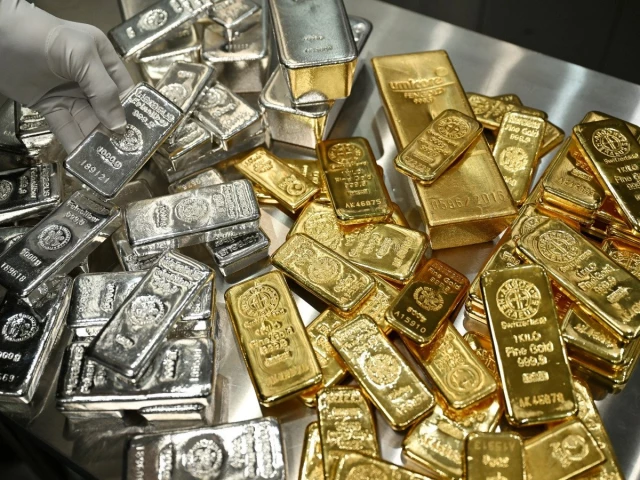
After three consecutive days of decline, gold prices rebounded on Friday in both international and local markets, driven by gains in the global bullion trade.

The increase in global rates translated directly into the domestic market. In local bullion markets, the price of gold per tola climbed by Rs 3000, reaching Rs 444,462. Similarly, the price of 10 grams of gold rose by Rs 2572, settling at Rs 381,064.

In the international market, spot gold rose 0.5% to $4226.99 per ounce as of 1208 GMT, although it remained on track for a marginal 0.1% weekly decline. The broader uptick pushed the international price up by $30, taking it to $4221 per ounce earlier in the day.

Read: Gold prices fall further in global, local markets

Silver also posted strong gains in the international market. It rose 1.9% to $58.20 an ounce, marking a weekly increase of 3.2% after hitting a record high of $58.98 on Wednesday.

Traders said the domestic market is closely tracking global movements, and volatility is likely to persist as investors respond to shifts in international demand, currency trends, and expectations for US monetary policy.



Source link

Continue Reading
Click to comment

Leave a Reply

Your email address will not be published. Required fields are marked *

Business

Water companies to face regular MOT-style checks in industry shake-up

Published

on

Water companies to face regular MOT-style checks in industry shake-up


Simon Jack,Business editorand

Jonah Fisher,Climate correspondent

Getty Images A young woman's hands cup water as it runs from a tap into a deep black sink.Getty Images

Inspections without notice, regular MOT-style checks and compulsory water efficiency labels on appliances are among the key measures in the government’s overhaul of the water industry.

The government is describing the measures as as the biggest overhaul of the water industry in England and Wales since privatisation.

Environment Secretary Emma Reynolds said there will be “nowhere to hide” for poor performing water companies.

The proposed changes come after widespread public anger at increasing numbers of pollution incidents, leaks and water outages that have affected thousands of customers across England and Wales in recent years.

Reynolds told the BBC: “We’ve had a system whereby water companies are marking their own homework.”

“This has been a whole system failure,” she said. “A failure of regulation, a failure of regulators, of the water companies themselves.”

The Water white paper promises to set up company-specific teams to monitor, supervise and support individual firms and their particular issues rather than rely on a “desk based, one size fits all” approach.

Smart meters and mandatory water efficiency labels on appliances including dishwashers and washing machines will also help households monitor their usage and costs, the government said.

It is also creating a chief engineer role at the regulator that will be set up to replace Ofwat.

Government officials have told the BBC that the establishment of a new regulator may take a year or more and water companies say it will take time for the benefits of new investments to be felt.

The government’s reforms come after a review by Sir John Cunliffe, who issued 88 recommendations to improve the industry.

However, he was asked not to consider whether to nationalise the sector, which was privatised in the late 1980s.

Campaigners said the proposed reforms did not go far enough.

River Action chief executive James Wallace said the measures showed the government “recognises the scale of the freshwater emergency, but lacks the urgency and bold reform to tackle it”.

The new regulator must be “truly independent” and properly funded, he warned, and said major gaps remain.

“None of these reforms will make a meaningful difference unless the failed privatised model is confronted head on. Pollution for profit is the root cause of this crisis,” Wallace said.

Surfers Against Sewage chief executive Giles Bristow said the government’s proposed changes were “frankly insulting” and fall short of much needed structural reform.

“The truth is glaringly obvious to everyone except this government. As long as the industry is structured to prioritise profit, the public will keep paying the price through soaring bills and polluted water,” he said.

Sir Dieter Helm, professor of economic policy at Oxford University, said the government had not wanted to explore that because its self-imposed spending rules have already been stretched to the limits.

“In addition to that, I think there’s a very sensible view around government that the government probably isn’t competent and capable to run these businesses,” he said.

“The government should think really quite carefully about this, because if they’re supervising the companies, and something goes wrong, Whose fault is it?”

Problems in the beleaguered sector have been thrown into focus recently after tens of thousands of South East Water customers were cut off for several days both before and after Christmas.

Mike Keil, chief executive of the Consumer Council for Water (CCW), said the “miserable disruption” underlined the importance of “meaningful change” in water regulation.

A new, powerful ombudsman service would also be welcome, Keil said, given CCW has had a 50% increase in customers asking for help with complaints relating to their water provider.

“One of our key asks of the Independent Water Commission was to make our existing voluntary ombudsman service mandatory, as this is vital to giving customers robust protection,” he said.

‘Proof in the river’

A man in a grey sweatshirt and khaki trousers kneels on a green riverbank next to a tree. He is using equipment from a yellow box to test the water.

Peter Devery testing the water of the River Pang

The River Pang in Berkshire is regarded by some as one of the inspirations for Kenneth Grahame’s Wind in the Willows classics. It’s environmental status has deteriorated from “good” in 2015 to “poor” now – with campaigners blaming regular sewage discharges.

On the banks of the Pang, Pete Devery from the Angling Trust told the BBC he was sceptical of the government’s plans.

“I won’t hold my breath” he said.

“The proof will be in the river. Do the rivers across the country improve? That’s the end result. Doesn’t matter what you call that regulator. It doesn’t matter how many regulators there are. If the difference isn’t made in the rivers, they will have failed.”

In 2024, water companies released raw sewage into England’s rivers and seas for a record 3.61 million hours, a slight increase on 2023.

Aging infrastructure, wetter winters and drier springs and farming runoff into rivers and lakes have all contributed to poor water service and quality.

Ofwat, is currently the water industry’s economic regulator for both England and Wales. In October 2025 the Welsh government said that when Ofwat is abolished it plans to form its own stand-alone economic regulator to replace it.

In 2025, water supply interruptions across England and Wales rose by 8% and pollution incidents by 27%, while customer satisfaction fell by 9%.

Average water bills rose by 26%, or £123 a year, from last April after years of below-inflation increases that some have blamed, along with high executive pay and shareholder dividends, on under-investment in the sector.

The sharp rise in bills is meant to address that under-investment by funding spending of £104 billion over the next five years – more than 40% of which is earmarked for new infrastructure.


Source link

Continue Reading

Business

Kodak Had The World’s First Digital Camera But Chose Films Over Future, Went Bankrupt

Published

on

Kodak Had The World’s First Digital Camera But Chose Films Over Future, Went Bankrupt


Last Updated:

Kodak, once a global photography giant, missed the digital revolution despite Steve Sasson’s invention, leading to bankruptcy in 2012 and a dramatic fall from dominance

In early 2000s, film sales collapsed, photo labs shut down and the iconic yellow Kodak box began disappearing from shelves. (News18 Hindi)

In early 2000s, film sales collapsed, photo labs shut down and the iconic yellow Kodak box began disappearing from shelves. (News18 Hindi)

If you grew up in the 1980s or 1990s, photography likely meant one thing – Kodak. From carefully loading film into cameras to waiting days for prints to arrive, the brand dominated how the world captured memories. Not just in India, but globally, Kodak was synonymous with photography.

Kodak was founded in 1888 by George Eastman, whose vision was to make photography accessible to everyone. His idea worked. With the slogan “You press the button, we do the rest”, Kodak turned a complex process into a household habit. The company’s business model was equally smart; cameras were sold cheaply, while profits flowed from film, chemicals and photo paper; the classic “razor and blade” strategy.

By the 1990s, Kodak controlled nearly 90% of the US film market, and the phrase “Kodak moment” had entered popular culture. The company had billions in cash, global dominance and a workforce running into thousands.

Then came the moment that could have changed everything. In 1975, a Kodak engineer named Steve Sasson invented the world’s first digital camera inside the company’s own lab. The prototype was bulky, wired and shot black-and-white images stored on a cassette tape, which could be viewed by connecting the device to a television. Primitive as it was, the invention was revolutionary. Sasson presented it to Kodak’s top management, expecting excitement. Instead, he was told to keep it quiet.

The reason was that digital photography did not need film. Executives feared that if the technology became mainstream, Kodak’s core business would collapse. They also believed consumers would always prefer physical photographs over images on a screen. The invention was shelved, and Kodak doubled down on film. In hindsight, rejecting digital photography was the company’s biggest mistake.

For nearly two decades, Kodak remained convinced that digital images would never match the quality or emotional value of film. While the company hesitated, rivals such as Sony, Canon and Nikon invested steadily in digital technology. By the late 1990s, digital cameras had entered the market, but Kodak was still reluctant to abandon its legacy business. Even when it launched digital products, it tried to replicate the look and feel of film, unable to accept that the era had changed.

The rise of the internet dealt the final blow. As personal computers and email became common in the early 2000s, people stopped printing photographs altogether. Images were stored, shared and viewed digitally. Film sales collapsed, photo labs shut down and the iconic yellow Kodak box began disappearing from shelves. Kodak attempted a late pivot, spending millions to enter the digital space, but by then the market was firmly controlled by competitors.

In 2012, Kodak filed for bankruptcy, stunning the global business community. Once valued in billions and employing over 1,40,000 people worldwide, the company was reduced to selling patents to survive. Thousands lost their jobs, and Kodak’s factories in New York fell silent. The empire had effectively ended.

Ironically, Kodak’s downfall unfolded even as small digital-first companies were thriving. Platforms like Instagram, with a fraction of Kodak’s resources, built massive valuations by understanding how people wanted to save and share memories in a digital age. Kodak, despite having the technology, the brand and the capital, failed to recognise that shift.

Today, Kodak still exists, but only as a shadow of its former self. It operates in areas such as printing, specialty chemicals and pharmaceuticals, and occasionally produces film for hobbyists. Steve Sasson, often mistakenly believed to have been fired, continued working at Kodak for 35 years and retired in 2009. He even helped develop the first DSLR camera in 1989, which Kodak again chose not to commercialise. Sasson was later honoured by the US President for his contribution to digital photography.

Click here to add News18 as your preferred news source on Google.

Follow News18 on Google. Join the fun, play games on News18. Stay updated with all the latest business news, including market trendsstock updatestax, IPO, banking finance, real estate, savings and investments. To Get in-depth analysis, expert opinions, and real-time updates. Also Download the News18 App to stay updated.
News business Kodak Had The World’s First Digital Camera But Chose Films Over Future, Went Bankrupt
Disclaimer: Comments reflect users’ views, not News18’s. Please keep discussions respectful and constructive. Abusive, defamatory, or illegal comments will be removed. News18 may disable any comment at its discretion. By posting, you agree to our Terms of Use and Privacy Policy.

Read More


Source link

Continue Reading

Business

244 Special Trains Carried Over 4.5 Lakh Devotees During Mauni Amavasya: Railway Ministry

Published

on

244 Special Trains Carried Over 4.5 Lakh Devotees During Mauni Amavasya: Railway Ministry


New Delhi: Indian Railways successfully managed rail traffic during the Mauni Amavasya period, operating 244 special trains across the country since January 3, ensuring smooth and convenient travel for devotees, according to an official statement issued by the Ministry of Railways on Monday. 

These trains, of which 31 were of Northern Railway (NR), 158 trains of North Central Railway (NCR), and 55 trains of North Eastern Railway (NER), served around 4.5 lakh passengers. The special services were planned to facilitate hassle-free journeys and safe travel during the festive period.

On January 18, Prayagraj witnessed the peak of festive travel with 40 special trains in operation, including 11 trains of NR, 22 trains of NCR, and seven trains of NER, carrying approximately 1 lakh passengers. Notably, all regular trains ran as scheduled, demonstrating effective planning and operational efficiency by Indian Railways, the statement explained.

Add Zee News as a Preferred Source


“The successful operation of these special trains reflects Indian Railways’ commitment to providing safe, convenient, and uninterrupted services to passengers during peak festive periods. The railways continue to leverage technology, resource planning, and coordination across zones to manage large-scale passenger movements efficiently,” the statement said.

Earlier, Indian Railways operated more than 43,000 special train trips in 2025 to ensure smooth travel and clear the rush during major religious festivals and peak holiday seasons.

During the year, Indian Railways undertook one of its largest special train operations for Maha Kumbh, operating 17,340 special train trips between January 13 and February 28, 2025, to facilitate the movement of a very large number of pilgrims. For Holi, 1,144 special train trips were operated between March 1 and March 22, 2025, nearly double the number run during Holi 2024, ensuring better availability and smoother festive travel.

The summer travel season of 2025, spanning April 1 to June 30, saw the operation of 12,417 Summer Special train trips, maintaining a high level of service during peak vacation months.

Special arrangements for Chhath Puja 2025 were further strengthened, with 12,383 special train trips operated between October 1 and November 30, 2025, marking a substantial increase over the previous year, according to official figures.


Source link

Continue Reading

Trending