

Tech
Got a Pixel 10? Google’s Android Phone Can Now Share Files With Apple’s AirDrop


The caveat is that the iPhone user will need to switch AirDrop into the “Everyone for 10 Minutes” mode instead of “Contacts Only” mode. Google says this isn’t some kind of workaround solution. It’s a direct, peer-to-peer connection; your data isn’t routed through a server, shared content isn’t logged, and no extra data is shared. Naturally, iPhone owners will be able to send data back to Pixel 10 phones as well.
Google has not worked with Apple on this cross-compatibility, as the company says it “welcomes the opportunity” to work with Apple so that this sharing function can work in the Contacts Only mode. “We accomplished this through our own implementation,” a Google spokesperson tells WIRED. “Our goal is to provide an easy and secure file-sharing experience for our users, regardless of who they are communicating with.”
In a security blog post, Google says the underlying strategy for what makes this new synergy between Quick Share and AirDrop work is the memory-safe Rust programming language. “These overlapping protections on both platforms work in concert with the secure connection to provide comprehensive safety for your data when you share or receive,” writes Dave Kleidermacher, vice president of Google’s platforms security and privacy.
Google tapped NetSPI, a third-party and independent penetration testing firm, to validate the security of the new sharing feature. The findings? The interoperability is “notably stronger” than other industry implementations. That’s pretty important, considering what happened the last time someone tried to improve cross-compatibility between iOS and Android without Apple: The startup Beeper tried to make texts from Android phones show up as blue bubbles on iPhones and caused all kinds of drama.
The number of people who can actually use this feature is limited because it’s only available on Google’s latest Pixel 10 smartphones, which just launched this past August. However, Google says it’s looking to expand the feature to more Android devices in the future.
This new feature in Quick Share is rolling out starting today to the Pixel 10 series, which includes the Google Pixel 10, Pixel 10 Pro, Pixel 10 Pro XL, and Pixel 10 Pro Fold. As it’s rolling out, you may not see it immediately on your device. To use it, all you need to do is select something to share, whether it’s a file, contact, or photo, choose Quick Share in the sharing menu, and make sure the iPhone owner has their AirDrop set to “Everyone for 10 Minutes Only.” The iPhone will be able to see the Pixel 10 device and can receive or send data.











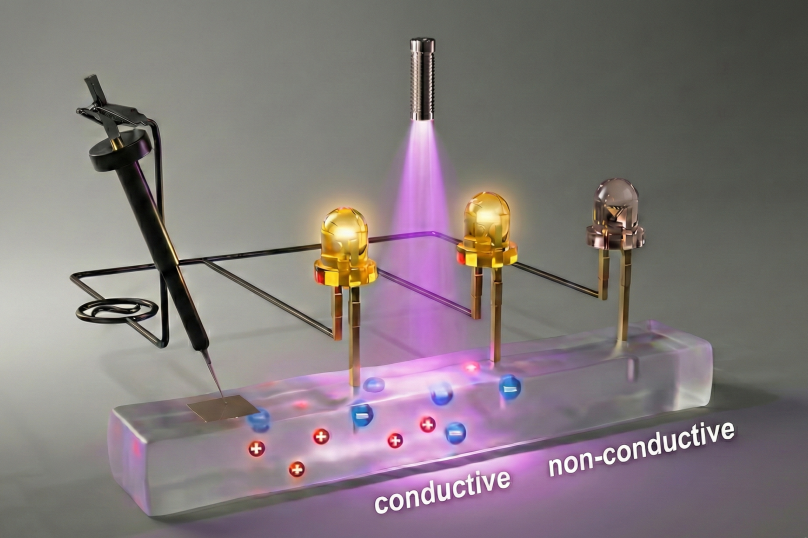
Consider the chief difference between living systems and electronics: The first is generally soft and squishy, while the latter is hard and rigid. Now, in work that could impact human-machine interfaces, biocompatible devices, soft robotics, and more, MIT engineers and colleagues have developed a soft, flexible gel that dramatically changes its conductivity upon the application of light.
Enter the growing field of ionotronics, which involves transferring data through ions, or charged molecules. Electronics does the same, with electrons. But while the latter is well established, ionotronics is still being developed, with one huge exception: living systems. The cells in our bodies communicate with a variety of ions, from potassium to sodium.
Ionotronics, in turn, can provide a bridge between electronics and biological tissues. Potential applications range from soft wearable technology to human-machine interfaces
“We’ve found a mechanism to dynamically control local ion population in a soft material,” says Thomas J. Wallin, the John F. Elliott Career Development Professor in MIT’s Department of Materials Science and Engineering and leader of the work. “That could allow a system that is self-adaptive to environmental stimuli, in this case light.” In other words, the system could automatically change in response to changes in light, which could allow complex signal processing in soft materials.
An open-access paper about the work was published online recently in Nature Communications.
A growing field
Although others have developed ionotronic materials with high conductivities that allow the quick movement of ions, those conductivities cannot be controlled. “What we’re doing is using light to switch a soft material from insulating to something that is 400 times more conductive,” says Xu Liu, first author of the paper and former MIT postdoc in materials science and engineering who is now an incoming assistant professor at King’s College London.
Key to the work is a class of materials known as photo-ion generators (PIGs). These can become some 1,000 times more conductive upon the application of light. The MIT team optimized a way to incorporate a PIG into polyurethane rubber by first dissolving a PIG powder into a solvent, and then using a swelling method to get it into the rubber.
Much potential
In the material reported in the current work, the change in conductivity is irreversible. But Liu is confident that future versions could switch back and forth between insulating and conducting states.
She notes that the current material was developed using only one kind of PIG, polymer (the polyurethane rubber), and solvent, but there are many other kinds of all three. So there is great potential for creating even better light-responsive soft materials.
Liu also notes the potential for developing soft materials that respond to other environmental stimuli, such as heat or magnetism. “We’re inspired to do more work in this field by changing the driving force from light to other forms of environmental stimuli,” she says.
“Our work has the potential to lead to the creation of a subfield that we call soft photo-ionotronics,” Liu continues. “We are also very excited about the opportunities from our work to create new soft machines impacting soft wearable technology, human-machine interfaces, robotics, biomedicine, and other fields.”
Additional authors of the paper are Steven M. Adelmund, Shahriar Safaee, and Wenyang Pan of Reality Labs at Meta.

A recent cosmological model combines two of the most eccentric ideas in contemporary physics to explain the nature of dark matter, the invisible substance that makes up about 85 percent of all matter in the universe. To understand it, it’s necessary to look beyond the Big Bang we all know and consider two concepts that rarely intersect: cyclic universes and primordial black holes.
A Different Kind of Multiverse
There are different versions of the “multiverse.” The most popular model—that of the Marvel Cinematic Universe—proposes that there are as many universes as there are possibilities and that these versions of reality are parallel. Physics proposes something more sober and mathematically consistent: the cosmic bounce.
In this model, the universe is not born from a singularity, but expands, contracts, and expands again in an endless cycle. Each “universe” is not parallel, but sequential—that is, one arises from the ashes of the previous one.
Is it possible for something to survive the end of its universe and endure into the next? According to a paper published in Physical Review D, yes. Author Enrique Gaztanaga, a research professor at the Institute of Space Sciences in Barcelona, shows that any structure larger than about 90 meters could pass through the final collapse of a universe and survive the rebound. These “relics” would not only persist, but could also seed the formation of giant, unexplained structures observed in the early stages of the present-day universe. Moreover, they could be the key to understanding dark matter.
For decades, the dominant explanation for dark matter has been that it is an unknown particle or particles. But after years of experiments without direct detections, physicists have begun to explore alternatives. One of them proposes that dark matter is not an exotic particle, but an abundant population of small black holes that we overlook.
The idea is appealing, but it has a serious problem. For these black holes to explain dark matter, they would have to exist from the earliest moments of the universe, long before the first stars could collapse. There are indications that these objects could exist, but a convincing physical mechanism to explain their origin is lacking.
A Universe Born With Black Holes
This is where Gaztanaga’s newly proposed model shines. If cosmic bouncing allows compact structures to survive the collapse of the previous universe, then the current universe would have already been born with pre-existing black holes. They would not have to have been generated by extreme fluctuations or finely tuned inflationary processes, but would simply have been there from the first instant.
The assumption has the potential to solve two riddles at once: the origin of black holes and the nature of dark matter. If this model is correct, dark matter would not be a mystery of the early universe but rather a legacy of a cosmos that predates our own.
“Much work remains to be done,” Gaztanaga, also a researcher at the Institute of Cosmology and Gravitation at the University of Portsmouth, said in an article for The Conversation. “These ideas must be tested against data—from gravitational-wave backgrounds to galaxy surveys and precision measurements of the cosmic microwave background.”
“But the possibility is profound,” he added. “The universe may not have begun once, but may have rebounded. And the dark structures shaping galaxies today could be relics from a time before the Big Bang.”
This story originally appeared in WIRED en Español and has been translated from Spanish.

The European online age verification app is ready.
The app works with passports or ID cards, is built to be “completely anonymous” for the people who use it, works on any device (smartphones, tablets, and PCs), and is open source. “Best of all, online platforms can easily rely on our age verification app, so there are no more excuses,” said European Commission president Ursula von der Leyen at a press conference on Wednesday. “Europe offers a free and easy-to-use solution that can protect our children from harmful and illegal content.”
High Expectations
“It is our duty to protect our children in the online world just as we do in the offline world. And to do that effectively, we need a harmonized European approach,” von der Leyen said at Wednesday’s press conference. “And one of the central issues is the question, how can we ensure a technical solution for age verification that is valid throughout Europe? Today, I can announce that we have the answer.”
This answer takes the form of an open source app that any private company can repurpose, as long as it complies with European privacy standards and offers the same technical solution throughout the European Union. The user downloads the app, agrees to the terms and conditions, sets up a pin or biometric access, and proves their age through an electronic identification system, or by showing a passport or ID card (in which case biometric verification is also provided). The app does not store your name, date of birth, ID number, or any other personal information, according to the European Commission—only the fact that you are over a certain age.
After that, when a person using the app wants to access a social network (minimum age: 13), pornographic site (minimum age: 18), or any other age-protected content, if they are logged in from a computer, they need only scan the QR code shown on the site they want to visit. If, on the other hand, the person logs in from a smartphone, the app sends the proof of age directly. The platform does not access the document with which the user proved it in the first place.
Adoption Event
The need to introduce a common system for the entire European Union has been discussed for some time, and according to commission technicians, the technical work is now complete. Of course, it will still be possible to circumvent the system—all it takes is for an adult to lend their phone to a younger friend—but the technological architecture exists, and it will be up to EU member states to decide whether to integrate it into national digital wallets or develop independent apps.
“No More Excuses”
For the app to really be effective, platforms must be obligated to verify the age of their users—that’s where things get tricky. The Digital Services Act, which went into effect in 2024, requires “very large online platforms”—those with more than 45 million monthly users in the European Union—to take concrete steps to mitigate systemic risks related to child protection, with heavy penalties for noncompliance.
“And that’s why Europe has the DSA: to call online platforms to their responsibilities. Because Europe will not tolerate platforms making money at the expense of our children,” European Commission executive vice president Henna Virkkunen told a press conference. She added that after an investigation into TikTok, the European institutions plan to take similar action against Facebook, Instagram, and Snapchat, as well as four porn sites. “Since the platforms do not have adequate age verification tools, we developed the solution ourselves,” he concluded. In short, as von der Leyen also remarked, “there are no more excuses.”
Bare Minimum
So far, this is the European framework that sets the general rules. On this basis, member states can consider more restrictive measures. Italy was among the first to discuss how to regulate the use of social media by minors but has so far not landed on anything concrete. Elsewhere in the EU, France’s Emmanuel Macron has been a trailblazer on the issue, pushing France to discuss a rule to ban social networks for minors under the age of 15 entirely. So far, this measure has received broad political support—but the outcome depends largely on compatibility with the Digital Services Act and the availability of effective age verification systems like the app the European Commission just released.
This article originally appeared on WIRED Italia and has been translated.


Italy’s apparel export-import plunge after positive trend in 2025

Top stocks to buy today: Stock recommendations for April 17, 2026 – check list – The Times of India

Former SMU cornerback Teddy Knox faces $2.88M judgment for crash linked to Rashee Rice’s Lamborghini race

-

 Entertainment1 week ago
Queen Elizabeth II emotional message for Archie, Lilibet sparks speculation
-

 Tech1 week ago
Azure customers up in arms over ‘full’ UK South region | Computer Weekly
-

 Tech1 week ago
As the Strait of Hormuz Reopens, Global Shipping Will Take Months to Recover
-

 Fashion1 week ago
CII submits 20-pt agenda to Indian govt to back firms hit by Iran war
-

 Tech1 week ago
This AI Button Wearable From Ex-Apple Engineers Looks Like an iPod Shuffle
-

 Politics7 days ago
Indian airlines hit hardest after Dubai limits foreign flights until May 31
-
Uncategorized1 week ago
[CinePlex360] Please moderate: “Trump considers
-

 Entertainment4 days ago
Palace left in shock as Prince William cancels grand ceremony