

Business
Home Depot says core shopper is resilient in the face of higher gas prices, sales rise 5%


Home Depot said Tuesday its core homeowner shopper remains resilient in the face of higher gas prices and plummeting consumer confidence, leading the retailer to reaffirm its full-year guidance after beating fiscal first-quarter expectations.
“The homeowner in a relative sense is perhaps more protected financially than other customer cohorts and so we continue to see engagement,” finance chief Richard McPhail told CNBC in an interview.
Still, amid rising geopolitical tensions, plummeting consumer confidence and a broken housing market, those shoppers are engaged “up to a certain point,” said McPhail.
“They continue to tell us that they are going to defer their spend on larger projects,” he said. “That’s consistent with what they’ve told us the last few years.”
Shares of the company fell slightly in premarket trading.
Here’s how Home Depot did compared with what Wall Street was anticipating, based on a survey of analysts by LSEG:
- Earnings per share: $3.43 adjusted vs $3.41 expected
- Revenue: $41.77 billion vs. $41.52 billion expected
The company’s reported net income for the three-month period that ended May 3 was $3.29 billion, or $3.30 per share, compared with $3.43 billion, or $3.45 per share, a year earlier. Excluding one-time items including costs related to the value of certain intangible assets, Home Depot reported adjusted earnings per share of $3.43.
Sales rose to $41.77 billion, up almost 5% from $39.86 billion a year earlier.
The company said it continues to expect fiscal 2026 sales to grow between 2.5% and 4.5%, compared with expectations of roughly 4%, according to LSEG. It’s projecting adjusted earnings per share to grow as much as 4%, compared with expectations of 2.4% growth, according to LSEG.
While Home Depot’s report beat on the top and bottom lines, that came after Wall Street estimates have fallen in recent months, lowering the bar.

The report suggests that pressures impacting the company continued into the quarter. Though sales were up in the midst of an M&A boom for the company, comparable sales came in lighter than expected at 0.6%. That was behind StreetAccount expectations of 0.8% and marked the third quarter in a row that figure failed to rise or fall more than 0.5%.
Comparable transactions fell 1.3% — the fourth straight quarter of declines — as gross margin also came in lighter than anticipated at 33%, lower than expectations of 33.2%, according to StreetAccount.
Home Depot and the home improvement sector overall have been under pressure as it has contended with lower housing turnover, economic uncertainty and an ongoing delay in pricier projects.
Earlier this year, there was optimism that Home Depot could see a reprieve as mortgage rates started to dip, but those hopes were dashed after the conflict in the Middle East began, leading mortgage rates to spike once again.
In the meantime, Home Depot has been focused on winning over more pro shoppers, like contractors and roofers, which currently make up about 50% of its revenue. In 2024, the retailer acquired SRS Distribution, a company that sells supplies to roofing, landscaping and pool professionals, for $18.25 billion, and last year, it bought GMS, a specialty building products distributor.
Last week, SRS completed its acquisition of Mingledorff’s, a wholesale distributor of HVAC equipment, parts and supplies that serves residential and commercial customers. The deal allows Home Depot to tap into a total addressable market worth around $100 billion, it said.
“All of the things we’re doing to build out our pro capabilities — and through the acquisitions we’ve made over the past several years — is to help us gain more share in the $700 billion pro market,” said McPhail. “We have a right to win that $700 billion, but we just don’t quite have the ability to win yet.”


The Reserve Bank of India (RBI) board is set to meet on May 22 to consider a potentially record surplus transfer to the government for FY27, with economists estimating the payout in the range of Rs 2.7 lakh crore to Rs 3 lakh crore, ET reported citing people familiar with the matter.The expected surplus transfer, commonly referred to as the RBI dividend to the government, comes as the Centre has already budgeted Rs 3.16 lakh crore in FY27 from dividends of state-owned companies and transfers from the central bank.Last year, the RBI transferred Rs 2.68 lakh crore to the government, which was 27 per cent higher than the previous year.Economists said gains from foreign exchange interventions and investment income are likely to support the payout, while the eventual amount could rise further if the RBI opts for a lower contingency buffer.The final amount will be decided when the RBI board meets in Mumbai on Friday.RBI dividend transfers have emerged as an important source of non-tax revenue for the government in recent years. A sharp fall of nearly 10 per cent in the dollar and a rise of about 60 per cent in gold prices during FY26 have also improved the central bank’s accounting profitability.The surplus transfer is expected to provide fiscal support and help contain pressure on the government’s deficit position at a time when a weaker rupee and higher import costs remain concerns.The payout will be determined under the revised Economic Capital Framework (ECF), which requires the Contingent Risk Buffer (CRB) to remain within 4.5 per cent to 7.5 per cent of the RBI’s balance sheet. In FY26, the RBI maintained the CRB at the upper end of 7.5 per cent.“We estimate a surplus transfer of Rs 2.8 lakh crore, assuming a CRB of 6.5%,” said Sakshi Gupta, principal economist at HDFC Bank, ET quoted.Barclays expects the transfer at Rs 3 lakh crore, while Emkay has estimated a range of Rs 2.8 lakh crore to Rs 3.4 lakh crore depending on the level of buffer maintained by the central bank.IDFC First Bank chief economist Gaura Sengupta, however, expects the payout to remain broadly in line with last year.“Earnings from foreign exchange transactions are expected to be lower, with gross dollar sales at $166 billion in FY26 (till February) compared with $399 billion in FY25. The historical cost of dollar purchases is around 84 in FY26 versus 82 in FY25, which remains below the current spot rate,” she said.“RBI’s forward book was already large at the start of FY26, limiting its ability to sterilise spot interventions. This resulted in lower gross dollar sales during the year. The West Asia crisis likely increased dollar sales in March 2026, which has been factored into estimates,” she added.
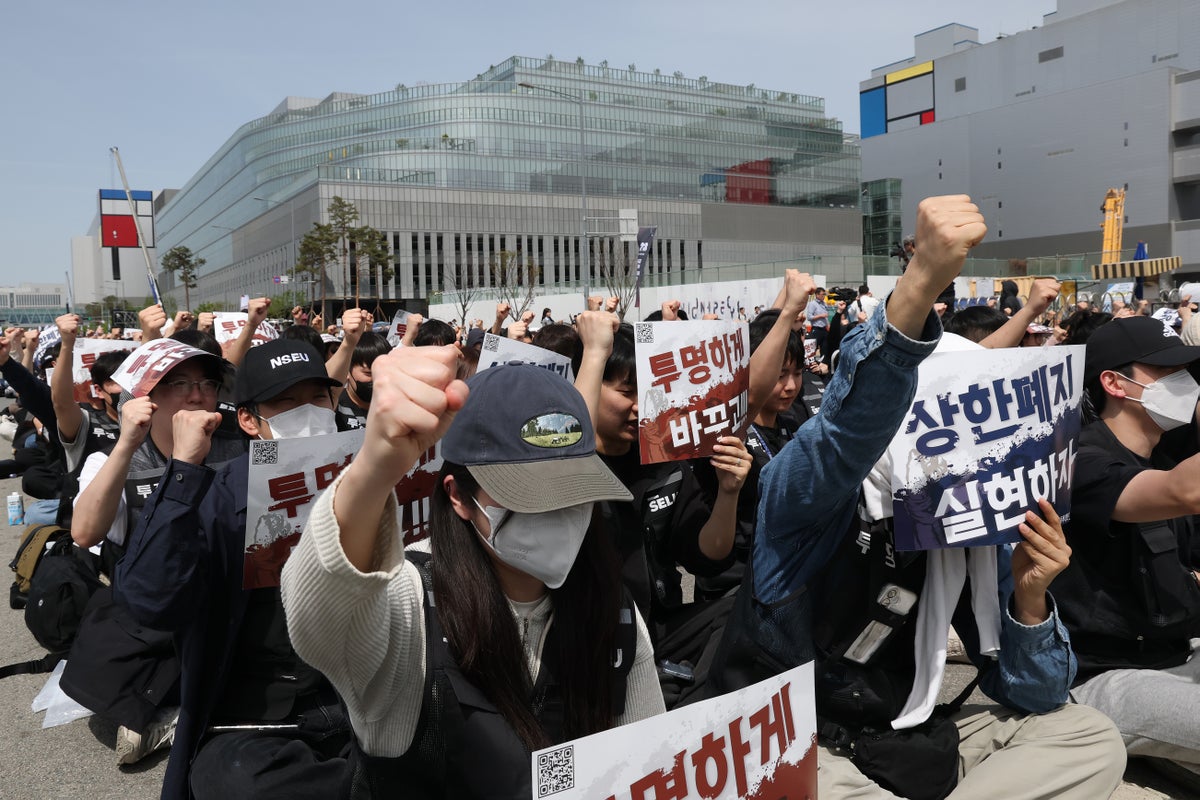
Samsung Electronics and its South Korean union have reportedly narrowed their differences, according to a mediator, as pressure mounts from the government and business groups to avert a potentially damaging strike.
The two parties are racing against the clock to finalise a deal on bonus payments before nearly 48,000 workers are set to walk out for 18 days starting on Thursday.
Such a significant and prolonged industrial action could inflict considerable damage on South Korea‘s economy, given that Samsung alone accounts for almost a quarter of the nation’s exports.
As the world’s largest memory chip maker, any disruption to Samsung’s production could also impact global supply chains, particularly at a time when the boom in artificial intelligence has already led to shortages.
Park Su-keun, chairman of the National Labor Relations Commission, which is facilitating the negotiations, indicated that while both sides have made concessions, they remain deadlocked on two crucial issues, though he did not elaborate further.
He told reporters, “There is some possibility that an agreement could be reached.” Talks were scheduled to conclude at 7pm (1000 GMT) on Tuesday.
Samsung declined to comment on the ongoing discussions. Meanwhile, a union representative stated that the union is “making every effort to come up with a plan to satisfy its members.”
While the threat of the strike has put South Korea on edge, investors have been heartened after the government threatened over the weekend to step in and order emergency arbitration. That would prevent the strike from going ahead for 30 days while the government mediates talks.
Shares in Samsung ended 2 per cent lower on Tuesday, paring losses after the news of narrowing differences. The stock is down 1.3 per cent for the past week.
“The reality is that all of our citizens are worried about this, considering the ripple effects that a Samsung strike could bring,” industry minister Kim Jung-kwan told parliament on Tuesday.
South Korean business groups have also urged the union not to proceed with the strike.
The strike could in a worst-case scenario shave 0.5 percentage points off a forecast 2.0 per cent expansion for the South Korean economy this year, according to an official from the country’s central bank, who declined to be named.
This assumes that around 30 trillion won ($19.9 billion) of chip production could be lost as well as a likely additional “few weeks” of disruption before production lines are operating normally again.
KB analyst Jeff Kim has estimated that an 18-day strike could disrupt global supplies of DRAM memory by 3 per cent to 4 per cent and NAND memory by 2 per cent to 3 per cent, which would likely fuel further price increases.

For many investors, rather than the potential strike itself, the biggest issue is whether Samsung caves to the union’s demand to have bigger bonuses written into contracts, resulting in permanent increases in labour costs.
“The point is how they negotiate the formalising of pay increases,” said Lee Seung-yub, a portfolio manager at Seoul-based hedge fund Quad Investment Management.
The union has demanded Samsung abolish a cap on bonuses that stands at 50 per cent of annual salaries, allocate 15% of annual operating profit to bonuses and formalise this in contracts.
Samsung has proposed that memory chip workers receive one-off bonuses this year that would top those of SK Hynix employees, while the bonus cap would stay in place.
The dispute is the biggest clash between Samsung and its labour union since Samsung Electronics Chairman Jay Y. Lee pledged in 2020 to put the firm’s past union-busting activities behind it.
Samsung remains one of the most sought-after workplaces in Korea, but employees are furious about the pay gap with smaller rival SK Hynix, which took the lead in supplying high-bandwidth memory for AI chip units to Nvidia.
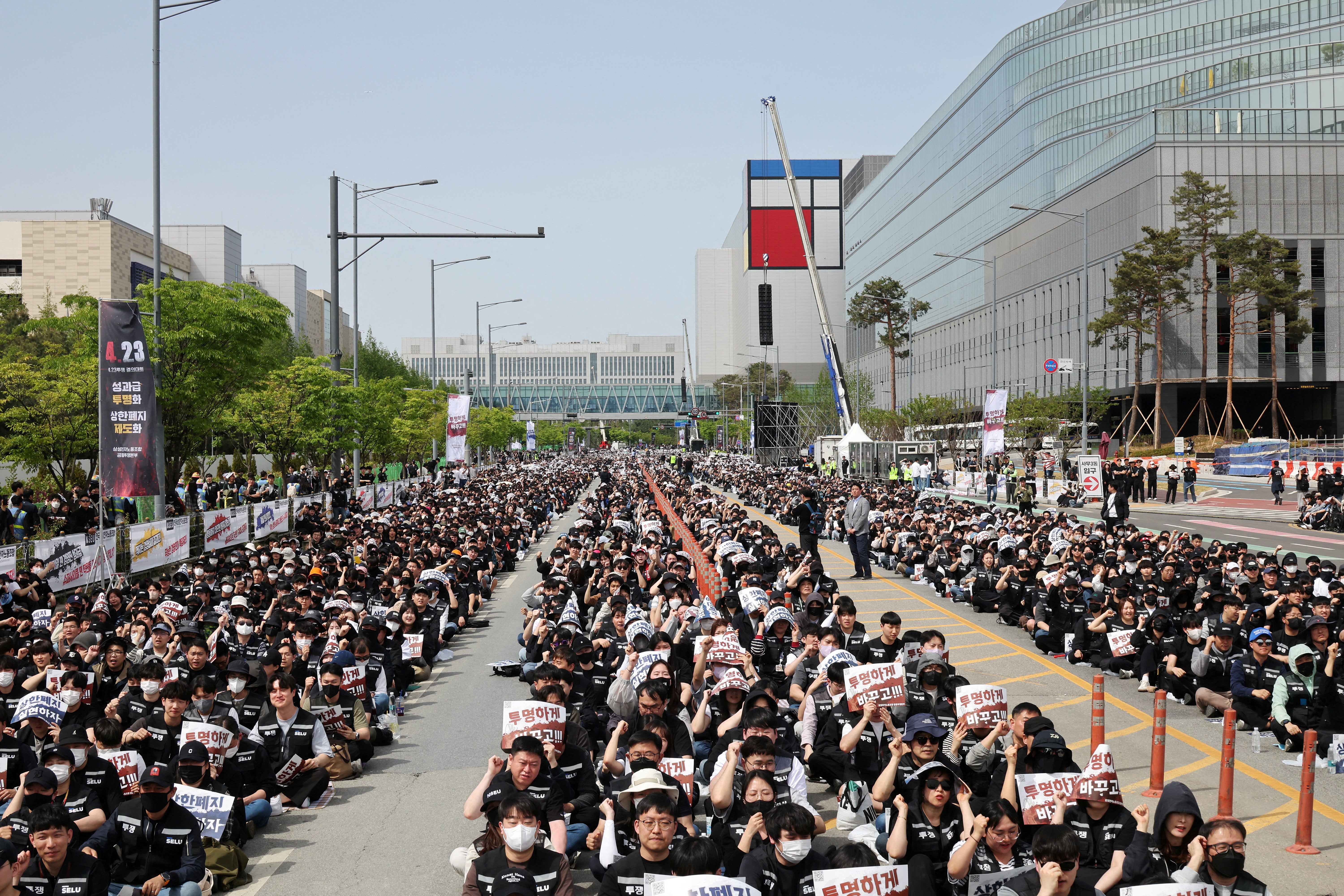
SK Hynix overhauled its pay structure last year. Samsung’s union says SK Hynix workers last year received bonuses more than three times higher than those of Samsung workers, resulting in an exodus of Samsung employees to SK Hynix and a surge in union membership.
A court on Monday partially granted Samsung’s request for an injunction, ruling that essential staffing levels at some production facilities must be maintained during any industrial action. Samsung has notified the union that this will require 7,087 workers to report for work even if the strike goes ahead.

The SNP leader says the proposed price cap on basic foodstuffs is not intended to force a fight with the UK government.
Source link


Italy’s imports grow 4.8% MoM in March amid trade rebound
Home Depot says core shopper is resilient in the face of higher gas prices, sales rise 5%
RBI dividend: Central bank board to meet on May 22 amid expectations of record payout

-

 Entertainment6 days ago
Conan O’Brien hat tricks as Oscar host
-

 Fashion6 days ago
Italy’s Zegna Group’s Q1 growth boosted by strong organic performance
-

 Entertainment1 week ago
Tom Brady gets back at Kevin Hart during Netflix roast
-

 Entertainment1 week ago
Martin Short: Facing tragedy with joy
-

 Sports1 week ago
Jacob Fatu unleashes vicious assault on Roman Reigns after World Heavyweight Championship loss at WWE Backlash
-

 Tech1 week ago
Papa Johns Is Getting Into Drone Delivery—but Not for Pizza
-

 Tech1 week ago
CUDA Proves Nvidia Is a Software Company
-

 Fashion1 week ago
EC clears €5-bn German state aid to back decarbonisation of industry