

Tech
Hyundai Motor Group and Vodafone IoT deploy connected cars across MENA region | Computer Weekly


Looking to empower customers in the Middle East, Vodafone IoT is teaming with Hyundai Motor Group to deploy regulatory-compliant in-car connectivity in Bahrain, the Kingdom of Saudi Arabia, Kuwait, Qatar and the United Arab Emirates (UAE).
The collaboration aims to deliver a seamless and intuitive digital experience, empowering drivers to manage and keep their vehicles safe anytime, anywhere.
It will see Vodafone IoT’s network partners in the Middle East region, such as e& UAE, work with Hyundai Motor Group, whose marques include Hyundai, Kia and Genesis. Vodafone said its Global SIM+ will deliver seamless, reliable and secure in-car connectivity that is compliant with local laws throughout the region.
The managed IoT connectivity system dynamically turns the Global IoT SIM into a local SIM. This offers local network credentials, data routing, compliance with national laws and seamless cross-border connectivity. Such features are seen as making it easier and more efficient for carmakers and manufacturers to launch services in regulated countries, as well as giving them global access to connected services.
Vodafone IoT believes the capabilities delivered by its partnerships with local network providers can ensure compliance, provide network resilience and reliable connectivity. Together, the network partners provide coverage in the region, advanced IoT capabilities and local expertise, enhancing the quality and reliability of Hyundai Motor Group’s connected services in the Middle East.
The Vodafone IoT managed connectivity platform also integrates directly into a local network partner’s infrastructure so that manufacturers can manage their global IoT estate from a single platform, giving them both global reach and centralised control over their operations.
“As manufacturers look to deploy connected vehicles in diverse geographies, it is vitally important that they are provided with connectivity that’s reliable, secure and compliant with national regulations,” said Vodafone IoT CEO Erik Brenneis.
“We are proud to partner with Hyundai Motor Group to deliver innovative in‑car connectivity powered by our Global SIM+, which provides local credentials and a seamless cross‑border service. It turns vehicles into secure connected platforms, keeping drivers and passengers safe, informed and connected. Together, we will extend these capabilities to more countries and more cars, shaping the future of connected mobility.”
Building on these capabilities, Hyundai, Kia, and Genesis customers in the Middle East will now have access to a wide range of connected car features, including remote vehicle control, real-time status monitoring and enhanced convenience services.
“The launch of Connected Car Services in the Middle East, aligned with the software-defined vehicle strategy of Hyundai Motor Group, represents a meaningful step toward delivering intelligent, personalised mobility experiences – empowering our customers with seamless connectivity and regionally tailored digital services that will redefine how they interact with their vehicles,” said Hyunwoo Go, head of the connectivity business team at Hyundai Motor Group.
“Thanks to Vodafone IoT’s leading managed connectivity platform, we are not just connecting cars, we are connecting people to a world of new possibilities, making their lives easier, safer and more enjoyable by combining our leadership in automotive innovation with Vodafone’s expertise in IoT.”
Going forward, Vodafone IoT and Hyundai plan to expand their in-car connectivity partnership to new countries in the Middle East and Africa in the near future.

One morning a few weeks ago, John Kiriakou got a call from his 16-year-old niece. “Uncle John, you’re exploding on TikTok,” he recalls her telling him.
Kiriakou, a 61-year-old ex-CIA officer who went to prison in 2013 for disclosing classified information related to the agency’s Middle East torture program, had no idea what she was talking about. He doesn’t have a TikTok account. He’s more of a Facebook lurker, if anything. But clips from a podcast Kiriakou filmed in January with Steven Bartlett, who hosts the Diary of a CEO show, which has more than 15 million subscribers on YouTube, were going viral without his intervention.
For nearly two decades, Kiriakou has been on a campaign to receive a presidential pardon. From 1990 to 2004, Kiriakou served as a CIA analyst and counterterrorism officer, leading a 2002 operation to capture Abu Zubaydah, who ran a training camp for al Qaeda fighters. During his detention, the CIA waterboarded Zubaydah. Kiriakou later discussed the agency’s torture tactics in a 2007 interview with ABC News, where he went on to serve as a terrorism consultant. Five years later, the Justice Department charged Kiriakou, who then pleaded guilty to disclosing the name of a covert operative who participated in CIA interrogations to journalists.
Though Kiriakou finished his prison sentence in 2015, he wants a presidential pardon to clear his name and get back decades of pension contributions. “I had 20 years of proud federal service. My pension was $700,000,” says Kiriakou. “Without that pension, I’m going to have to work until the day I die. It was wrong of them to take it from me, and I want it back. I can only get it back with a pardon.”
In recent years, he’s applied through official channels and tried navigating President Donald Trump’s informal and expensive clemency market. So far, his requests have gone unanswered. Now, he’s trying something different, appearing on some of the very same podcasts Trump did throughout the 2024 election. Clips of him chatting with Tucker Carlson and Joe Rogan, among others, won’t stop making the rounds—and the internet is loving it.
When Kiriakou sat down with Bartlett for the January podcast, they had a serious conversation discussing his career at the CIA, his whistleblowing, and, ultimately, his nearly two-year imprisonment. But it’s the stories Kiriakou tells throughout the episode—about gathering intelligence in countries like Pakistan or detailing the CIA’s MKUltra program—that have drawn millions of views in “brainrot”-style edits on platforms like TikTok and Instagram Reels.
“See you in two scrolls,” one commenter wrote on a clip of Kiriakou, joking about how frequently videos of him appeared on their For You page.
One user who goes by the handle @_bamboclat is credited by Know Your Meme for popularizing these edits of Kiriakou telling unimaginable stories about his time abroad. These clips have received around 50 million views on the account.
“I first found out about him through podcasts on TikTok. I think the reason why everyone is in love with him is because he’s a good storyteller,” says @_bamboclat, who declined to share his full name. “He’s been telling it for 20 years. Slowing down and speeding it up, the meme version of him, is pretty popular with Gen Z and the TikTok audience.”
The virality has turned Kiriakou into a cultural phenomenon. Following his newfound popularity, the Creative Artists Agency (CAA) signed him. Cameo—the platform that allows users to request personalized videos from their favorite celebrities—recruited Kiriakou last month. So far, he’s made more than 700 videos for fans for around $150 apiece. In one Cameo video, Kiriakou is asked to shout out a woman’s nail salon. The clip is being used as an advertisement for the business on TikTok.
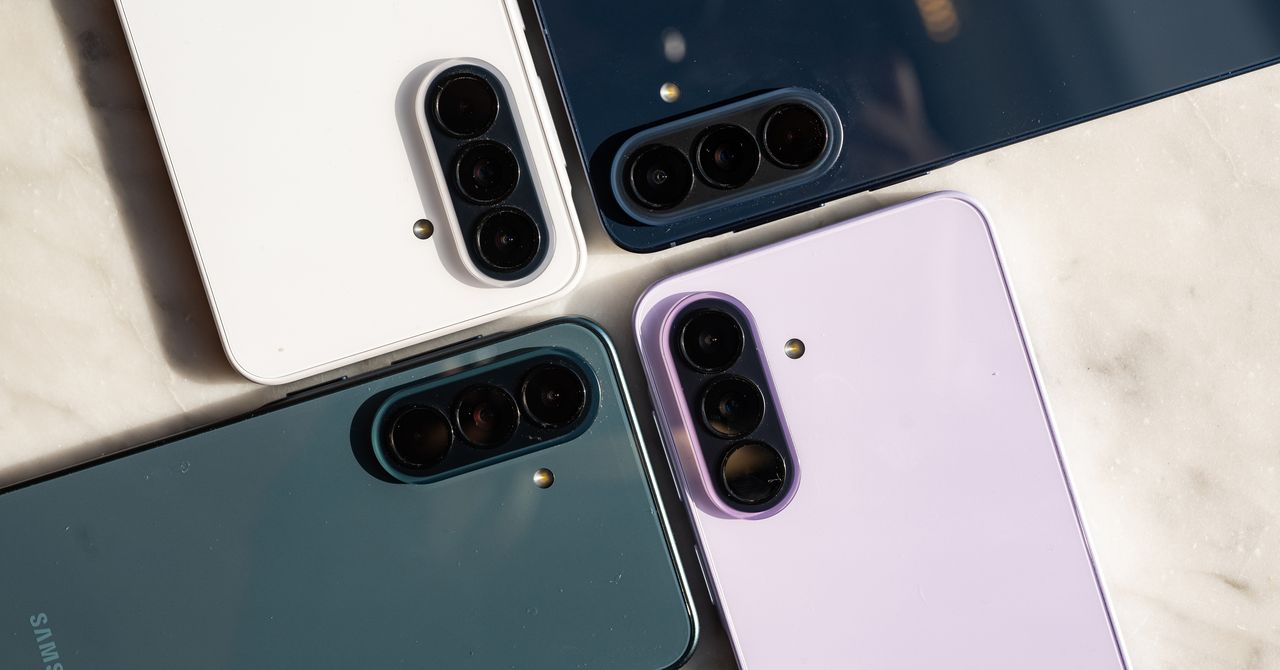
Last month, Samsung jacked up the price of two of its flagship smartphones by $100. Now, its two new midrange models—the Galaxy A37 5G and Galaxy A57 5G—are getting $50 price bumps, despite minor hardware updates over last year’s Galaxy A36 and A56. Samsung has also trimmed the lineup—there’s no successor to the Galaxy A26 this year, at least not yet.
These price increases may be indicative of the economic climate, what with tariffs, higher oil prices due to the war in Iran, and the memory shortage that has driven up RAM and storage costs across the board. If a phone’s price doesn’t go up, it could still mean fewer meaningful hardware upgrades to keep costs down, very much like the recent Google Pixel 10a. (The outlier is the iPhone 17e, which managed to add features like MagSafe and a new processor, along with a few other upgrades, without a change to the price over the iPhone 16e.)
“Price increases or ‘down‑speccing’ have become the norm,” writes Jitesh Ubrani, research manager at IDC, in an email to WIRED. “Unfortunately, consumers will need to adjust to this new reality. The biggest bottleneck for brands right now is memory, with suppliers facing tight availability and significantly higher costs than in past years.” Ubrani says that while geopolitical factors haven’t yet affected hardware pricing, they are adding uncertainty that could increase costs in the future.
Samsung did not comment on exactly what is driving the price bump. However, it says consumers eyeing its A-series phones prioritize upgrading out of necessity—maybe their current phone just broke or is really old—and they don’t care much for AI features. Value for money is the number one purchase driver, above performance and battery life. So it’s a little odd to see the company raise prices, though Samsung hopes the improvements are compelling.
The Galaxy A57 5G costs $550 with 8 GB of RAM and 128 GB of storage, and $610 if you bump storage to 256 GB. Meanwhile, the Galaxy A37 5G starts at $450 for 6 GB of RAM and 128 GB of storage, or $540 for 8 GB of RAM and 256 GB of storage. They both officially go on sale on April 9.
Small Updates
Processor upgrades are the main highlight for these phones. The Galaxy A37 is powered by Samsung’s Exynos 1480, which should offer 14 percent better CPU performance, 24 percent better graphics, and, perhaps shockingly, 167 percent better neural processing performance—helpful for AI tasks. That’s compared to the Qualcomm Snapdragon 6 Gen 3 chip in last year’s Galaxy A36.
The Galaxy A57 sports the Exynos 1680, which isn’t a huge leap over the Exynos 1580 in the Galaxy A56, but still offers a nice lift: 10 percent better CPU performance, 7 percent faster graphics, and 42 percent improved neural processing. Both of these phones still have the same 5,000-mAh battery capacity and charging speeds. (There’s no wireless charging, despite competing phones like the iPhone 17e or Google Pixel 10a offering the feature.)
The next time you’re scrolling your phone, take a moment to appreciate the feat: The seemingly mundane act is possible thanks to the coordination of 34 muscles, 27 joints, and over 100 tendons and ligaments in your hand. Indeed, our hands are the most nimble parts of our bodies. Mimicking their many nuanced gestures has been a longstanding challenge in robotics and virtual reality.
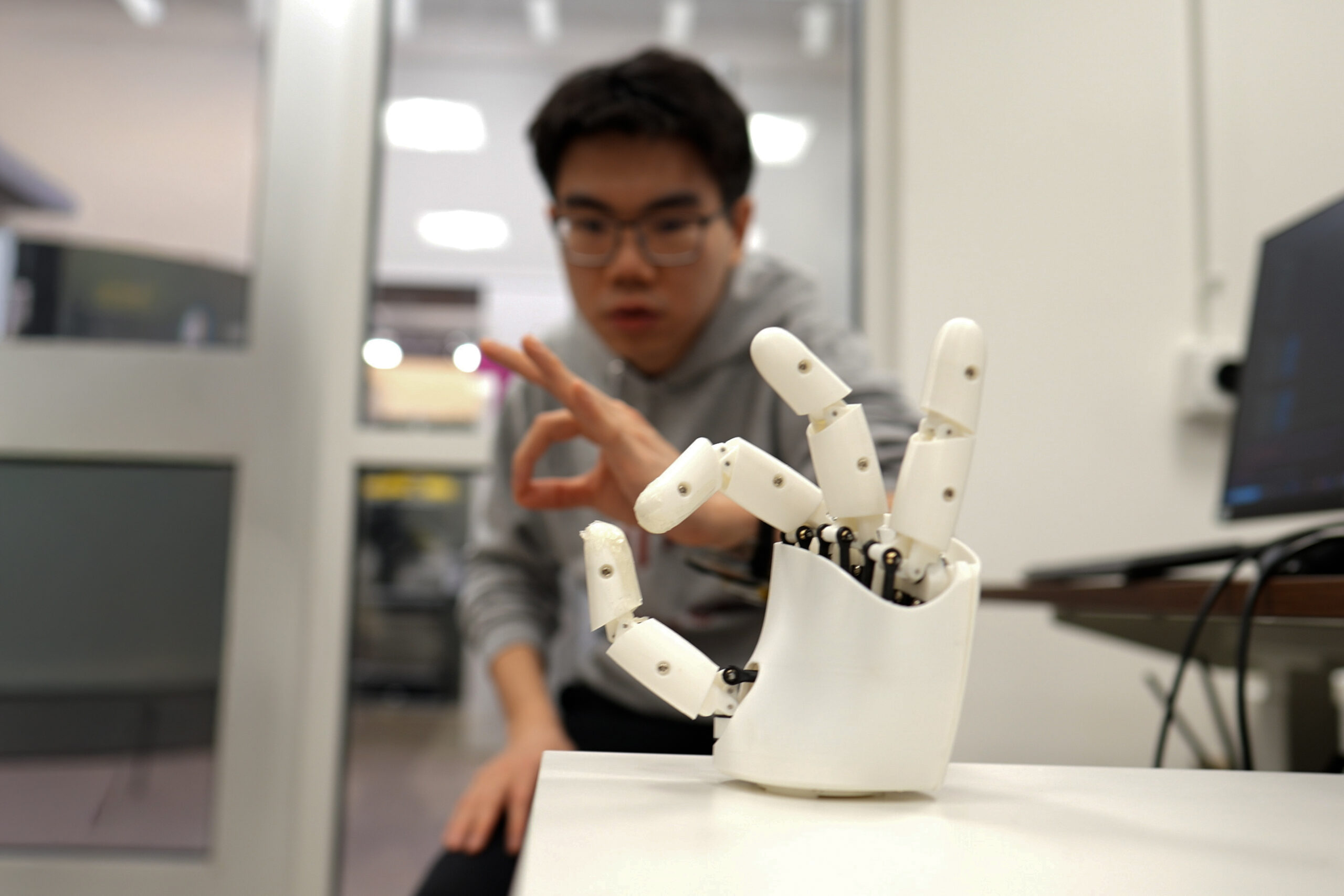
Now, MIT engineers have designed an ultrasound wristband that precisely tracks a wearer’s hand movements in real-time. The wristband produces ultrasound images of the wrist’s muscles, tendons, and ligaments as the hand moves, and is paired with an artificial intelligence algorithm that continuously translates the images into the corresponding positions of the five fingers and palm.
The researchers can train the wristband to learn a wearer’s hand motions, which the device can communicate in real-time to a robot or a virtual environment.
In demonstrations, the team has shown that a person wearing the wristband can wirelessly control a robotic hand. As the person gestures or points, the robot does the same. In a sort of wireless marionette interaction, the wearer can manipulate the robot to play a simple tune on the piano and shoot a small basketball into a desktop hoop. With the same wristband, a wearer can also manipulate objects on a computer screen, for instance pinching their fingers together to enlarge and minimize a virtual object.
The team is using the wristband to gather hand motion data from many more users with different hand sizes, finger shapes, and gestures. They envision building a large dataset of hand motions that can be plumbed, for instance, to train humanoid robots in dexterity tasks, such as performing certain surgical procedures. The ultrasound band could also be used to grasp, manipulate, and interact with objects in video games, design applications, or other virtual settings.
“We think this work has immediate impact in potentially replacing hand tracking techniques with wearable ultrasound bands in virtual and augmented reality,” says Xuanhe Zhao, the Uncas and Helen Whitaker Professor of Mechanical Engineering at MIT. “It could also provide huge amounts of training data for dexterous humanoid robots.”
Zhao, Gengxi Lu, and their colleagues present the wristband’s new design in a paper appearing today in Nature Electronics. Their MIT co-authors are former postdocs Xiaoyu Chen, Shucong Li, and Bolei Deng; graduate students SeongHyeon Kim and Dian Li; postdocs Shu Wang and Runze Li; and Anantha Chandrakasan, MIT provost and the Vannevar Bush Professor of Electrical Engineering and Computer Science. Other co-authors are graduate students Yushun Zheng and Junhang Zhang, Baoqiang Liu, Chen Gong, and Professor Qifa Zhou from the University of Southern California.
Seeing strings
There are currently a number of approaches to capturing and mimicking human hand dexterity in robots. Some approaches use cameras to record a person’s hand movements as they manipulate objects or perform tasks. Others involve having a person wear a glove with sensors, which records the person’s hand movements and transmits the data to a receiving robot. But erecting a complex camera system for different applications is impractical and prone to visual obstacles. And sensor-laden gloves could limit a person’s natural hand motions and sensations.
A third approach uses the electrical signals from muscles in the wrist or forearm that scientists then correlate with specific hand movements. Researchers have made significant advances in this approach, however these signals are easily affected by noise in the environment. They are also not sensitive enough to distinguish subtle changes in movements. For instance, they may discern whether a thumb and index finger are pinched together or pulled apart, but not much of the in-between path.
Zhao’s team wondered whether ultrasound imaging might capture more dexterous and continuous hand movements. His group has been developing various forms of ultrasound stickers — miniaturized versions of the transducers used in doctor’s offices that are paired with hydrogel material that can safely stick to skin.
In their new study, the team incorporated the ultrasound sticker design into a wearable wristband to continuously image the muscles and tendons in the wrist.
“The tendons and muscles in your wrist are like strings pulling on puppets, which are your fingers,” Lu says. “So the idea is: Each time you take a picture of the state of the strings, you’ll know the state of the hand.”
Mapping manipulation
The team designed a wristband with an ultrasound sticker that is the size of a smartwatch, and added onboard electronics that are about as small as a cellphone. They attached the wristband to a volunteer’s wrist and confirmed that the device produced clear and continuous images of the wrist as the volunteer moved their fingers in various gestures.
The challenge then was to relate the black and white ultrasound images of the wrist to specific positions of the hand. As it turns out, the fingers and thumb are capable of 22 degrees of freedom, or different ways of extending or angling. The researchers found that they could identify specific regions in their ultrasound images of the wrist that correlate to each of these 22 degrees of freedom. For instance, changes in one region relate to thumb extension, while changes in another region correlate with movements of the index finger.
To establish these connections, a volunteer wearing the wristband would move their hand in various positions while the researchers recorded the gestures with multiple cameras surrounding the volunteer. By matching changes in certain regions of the ultrasound images with hand positions recorded by the cameras, the team could label wrist image regions with the corresponding degree of freedom in the hand. But to do this translation continuously, and in real-time, would be an impossible task for humans.
So, the team turned to artificial intelligence. They used an AI algorithm that can be trained to recognize image patterns and correlate them with specific labels and, in this case, the hand’s various degrees of freedom. The researchers trained the algorithm with ultrasound images that they meticulously labeled, annotating the image regions associated with a specific degree of freedom. They tested the algorithm on a new set of ultrasound images and found it correctly predicted the corresponding hand gestures.
Once the researchers successfully paired the AI algorithm with the wristband, they tested the device on more volunteers. For the new study, eight volunteers with different hand and wrist sizes wore the wristband while they formed various hand gestures and grasps, including making the signs for all 26 letters in American Sign Language. They also held objects such as a tennis ball, a plastic bottle, a pair of scissors, and a pencil. In each case, the wristband precisely tracked and predicted the position of the hand.
To demonstrate potential applications, the team developed a simple computer program that they wirelessly paired with the wristband. As a wearer went through the motions of pinching and grasping, the gestures corresponded to zooming in and out on an object on the computer screen, and virtually moving and manipulating it in a smooth and continuous fashion.
The researchers also tested the wristband as a wireless controller of a simple commercial robotic hand. While wearing the wristband, a volunteer went through the motions of playing a keyboard. The robot in turn mimicked the motions in real-time to play a simple tune on a piano. The same robot was also able to mimic a person’s finger taps to play a desktop basketball game.
Zhao is planning to further miniaturize the wristband’s hardware, as well as train the AI software on many more gestures and movements from volunteers with wider ranging hand sizes and shapes. Ultimately, the team is building toward a wearable hand tracker that can be worn by anyone, to wirelessly manipulate humanoid robots or virtual objects with high dexterity.
“We believe this is the most advanced way to track dexterous hand motion, through wearable imaging of the wrist,” Zhao says. “We think these wearable ultrasound bands can provide intuitive and versatile controls for virtual reality and robotic hands.”
This research was supported, in part, by MIT, the U.S. National Institutes of Health, the U.S. National Science Foundation, the U.S. Department of Defense, and Singapore National Research Foundation through the Singapore-MIT Alliance for Research and Technology.


Graham Carey’s partner Rachel Borthwick passes away in India after breast cancer battle

Cristiano Ronaldo’s eldest son trained with Real Madrid’s academy – sources

PSL 11 ticket refund process to begin from March 30

-

 Fashion1 week ago
Sales at US apparel, clothing accessories stores up 4% YoY in Jan 2026
-
 Tech1 week ago
Justice Department Says Anthropic Can’t Be Trusted With Warfighting Systems
-

 Sports1 week ago
PCB files complaint over allowing Bangladesh to take review on penultimate ball – SUCH TV
-
 Business1 week ago
Stocks and pound rise as US rate call approaches
-

 Entertainment7 days ago
Val Kilmer revived 1 year after death through AI
-
 Business1 week ago
Brits cashing in jewellery as gold price hits record high
-

 Sports1 week ago
March Madness 2026 – How to watch in SA, start time, schedule, TV channel for NCAA championship basketball tournament
-

 Sports1 week ago
WBC championship: USA-Venezuela preview, live updates, analysis