

Business
Iea Oil Reserves Release: Iran crisis: IEA says strategic oil reserves to be released immediately in Asia-Oceania, from end-March in US and Europe – The Times of India

The International Energy Agency (IEA) said on Sunday that strategic oil reserves will be released “immediately” in Asia and Oceania, while supplies from member countries in the Americas and Europe will begin flowing from the end of March, as governments move to cushion the oil shock caused by the ongoing West Asia war.As per news agency AFP, the IEA said member countries had already submitted their individual implementation plans, with Asia-Oceania set to receive stocks immediately and America-Europe releases scheduled to start from late March.The agency said a total of 271.7 million barrels of government-managed stocks would be released worldwide under the emergency action.
Asia-Oceania to get oil first
The IEA said the first wave of emergency reserves will be made available fastest in the Asia-Pacific region, where supply stress has become particularly acute.“Individual implementation plans have been submitted to the IEA by Member countries. These plans indicate that stocks will be made available by IEA Member countries in Asia Oceania immediately,” the agency said, according to AFP.“Stocks from IEA Member countries in the Americas and Europe will be made available starting from the end of March,” it added.The announcement provides the clearest timeline yet on how the emergency stock release will actually be phased across regions after the agency agreed earlier this week to tap strategic reserves.
Biggest oil shock in market history, says IEA
IEA members agreed on Wednesday to draw down oil stockpiles in response to the war-driven price surge, in what is by far the largest-ever coordinated intervention of its kind.Calling the disruption unprecedented, the IEA said: “The war in the Middle East is creating the largest supply disruption in the history of the global oil market.”It described the latest emergency stockpile release as the sixth in its history and the first since Russia’s invasion of Ukraine in 2022, calling it a “significant and welcome buffer”.
Oil prices still near $100 despite reserve move
Despite the record intervention, oil prices have not cooled significantly.The announced releases have not had a major impact on crude prices so far, with oil still hovering around $100 a barrel, the highest level since 2022 and sharply above the sub-$70 levels seen before the war.That reflects market concerns that even a historic reserve release may not fully offset the loss of supply caused by the disruption of shipping routes in the Gulf.
Strait of Hormuz remains the key problem
The IEA made clear that the real solution lies not just in reserve releases, but in restoring normal tanker movement through the Strait of Hormuz.“The most important factor in ensuring a return to stable flows is the resumption of regular transit of shipping through the Strait of Hormuz,” the agency said.It added that adequate insurance mechanisms and physical protection for shipping would be critical for the resumption of flows.Iran has effectively blocked the strategic strait since the war began on February 28 with US-Israeli air strikes on Iranian targets.The waterway is one of the most important chokepoints in the global energy system and typically carries about one-fifth of gobal oil shipments.
S&P says reserve release may offer only limited relief
S&P Global Energy has warned that the IEA’s broader plan to release 400 million barrels of emergency oil stocks may provide only limited relief if the Strait of Hormuz remains shut.S&P said the release would help markets adjust to the current imbalance, but flagged uncertainty over whether the oil would reach the regions that need it most, especially Asian markets, where inventories are running down, news agency ANI reported.According to Jim Burkhard, vice president and global head of crude oil research at S&P Global Energy, “There is too much oil that cannot be exported via the Strait of Hormuz and not enough in Asia, where stocks are running down. The market is seriously unbalanced and that will continue until the Strait is reopened and upstream and downstream operations return to normal. It will not happen quickly”.It would take months for the 400 million-barrel release to offset the roughly 430 million-barrel reduction in global supply in March alone.
Global reserve push gathers pace
The Paris-based IEA had earlier agreed to make 400 million barrels available from members’ strategic reserves, far more than the 182.7 million barrels released after the Ukraine war began in 2022.IEA member countries currently hold over 1.2 billion barrels of public emergency oil stocks, plus another 600 million barrels of industry stocks held under government obligation.It also said countries such as Germany and Austria have already confirmed they will release parts of their strategic reserves, while Japan said it would begin drawing down stocks from Monday.The IEA’s latest update signals that the emergency release is now moving from announcement to implementation. But with oil still near $100, tanker flows still disrupted and the Strait of Hormuz effectively shut, markets appear to be betting that reserve barrels alone may not be enough to stabilise global energy supplies quickly.
Business
India among most resilient large EMs, better placed for future global shocks; policy reforms & strong buffers help: Moody’s – The Times of India

Amid the ongoing Middle East conflict, a recent report by Moody’s Ratings says that recent global shocks have shown India’s resilience among emerging economies to withstand pressures. The report credits the resilience to timely policy measures and the buildup of robust buffers.“India and Thailand are the sovereigns better placed to manage future global shocks. In both cases, the key policy choices that support stability were made well before the recent stress period,” Moody’s says.In its latest study on emerging-market sovereigns, the agency notes that India has ranked among the more resilient economies since 2020, based on multiple indicators such as sovereign bond spreads, domestic yield movements, and exchange-rate stability.The report highlights the following points of strength:Monetary policy frameworks are clear and predictable, inflation expectations are better anchored, and exchange rates are allowed to adjust when needed. This reduces the risk that currency moves turn into persistent inflation or force abrupt policy shifts.
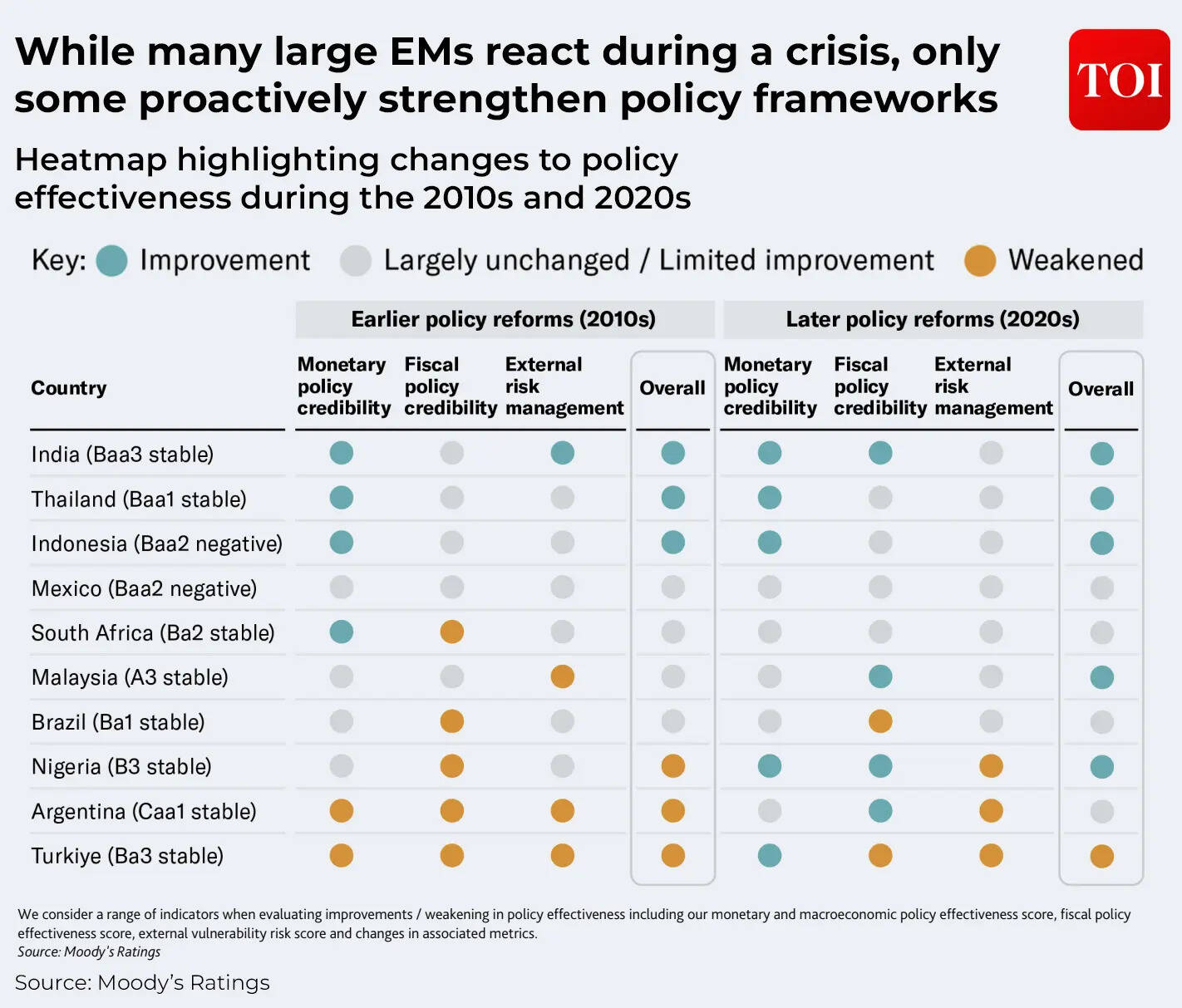
Both countries should also enter future periods of stress with strong and accessible buffers. India’s reliance on domestic funding is balanced by deep local markets and sizeable reserves, the report says.However it notes that India’s relatively high debt burden and weak fiscal balance limit the amount of space available to respond to successive shocks, while Thailand’s rising debt burden risks reducing resilience over time.The report points out that India has consistently demonstrated notable strength during periods of global volatility. Movements in credit spreads have been limited and short-lived, currency depreciation has remained controlled, and fluctuations in local bond yields have been orderly. These factors have helped the country retain uninterrupted access to financial markets even during turbulent phases.
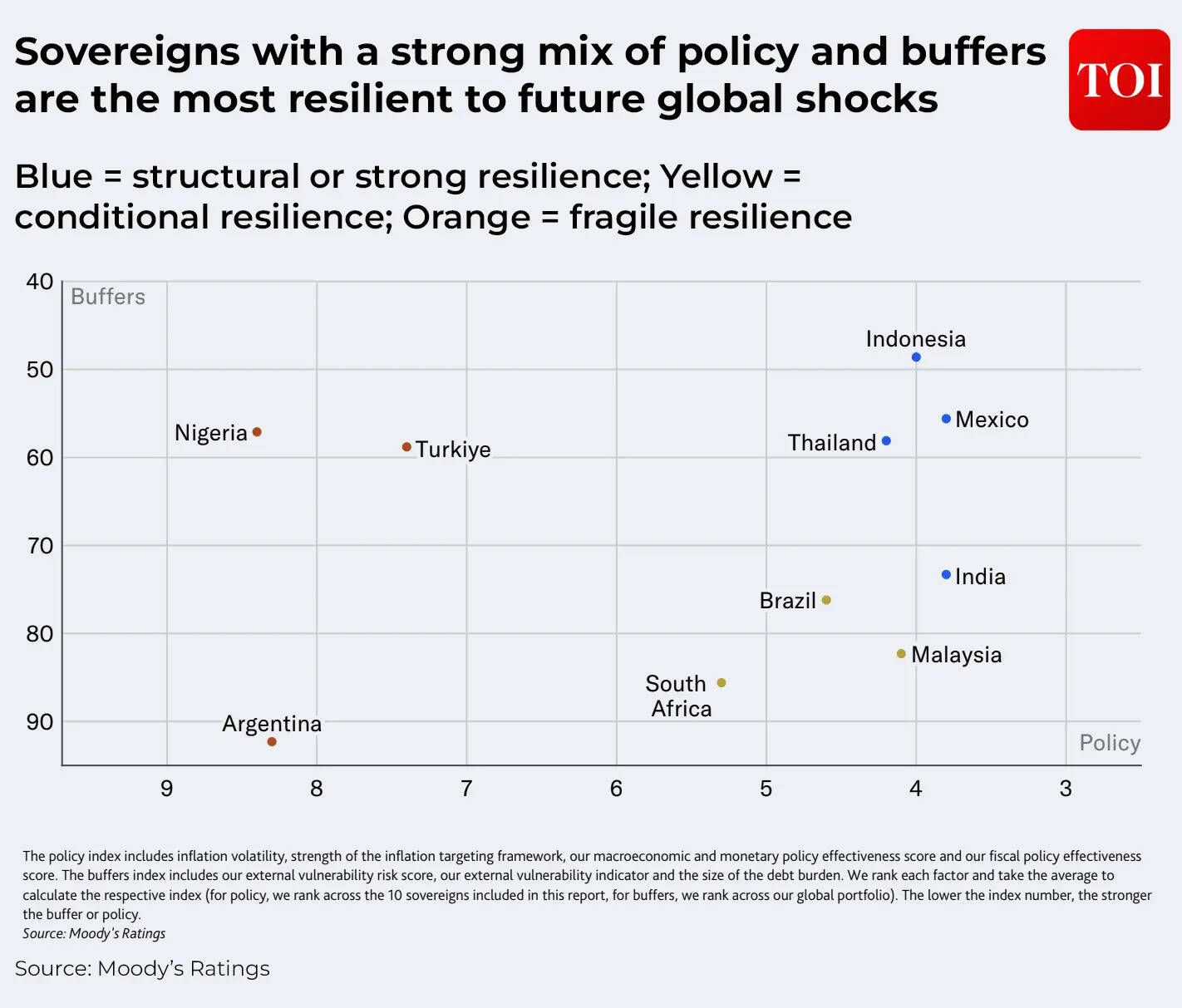
It underscores the role of India’s sizeable foreign-exchange reserves, which have helped stabilise the currency and maintain investor confidence during episodes of global stress, setting it apart from more vulnerable peers.Another key factor has been the presence of a transparent and consistent monetary policy framework. The adoption of inflation targeting well before recent global disruptions has ensured that inflation expectations remain anchored, thereby improving the economy’s ability to absorb external shocks.When compared with relatively more fragile economies such as Türkiye, Argentina and Nigeria, India has largely managed shocks through adjustments in prices rather than prolonged financing stress. This has been supported by deeper domestic financial markets and stronger policy credibility.

Rupee tumbled to a record low of 95.40 against US dollar in early trade on Tuesday, falling another 17 paise after already ending the previous session at its weakest-ever closing mark. Previously on Monday, the currency had declined sharply by 39 paise to close at 95.23 against the greenback.This comes as global uncertainty continues to be fueled by intensifying Middle East tensions, dragging down financial markets. Crude oil prices have remained elevated, intensifying concerns around inflation and slowing economic growth. During Monday’s trade, rupee opened at 94.95 in the interbank foreign exchange market before sliding throughout the session to settle at 95.23.The cautious sentiment was reflected on Dalal Street as well as benchmark indices tumbled in red. BSE Sensex was trading at 77,090.12, down 179.28 points or 0.23% as of 9:40 am. NSE Nifty50 also dipped to 24,036.95, down 63.85 points or 0.26%.Dilip Parmar, Senior Research Analyst, HDFC Securities told PTI, “The Indian rupee has hit a record low as the dollar recovered and crude oil prices held firm. This ongoing surge in oil prices, combined with foreign fund outflows, is putting a visible strain on India’s trade balance and broader economy. Persistent dollar demand is expected to keep the pressure on the rupee in the short term, driving the USD/INR higher toward the 95.35 and 95.70 levels.“Foreign Institutional Investors remained net buyers in equities worth Rs 2,835.62 crore on Monday, based on exchange figures. In the commodity market, oil prices continued to soar. Crude oil prices were trading at nearly $113 per barrel on May 5 as fresh attacks in the Strait of Hormuz heightened fears over the stability of the US-Iran ceasefire.
Brent crude futures eased 93 cents, or 0.8%, to $113.51 per barrel after settling up 5.8% on Monday
Iran renewed attacks on the United Arab Emirates on Tuesday, causing oil loading at the port of Fujairah to be at least partly halted after the third attack in four days. FILE IMAGE: PIXABAY
Brent crude futures retreated on Tuesday but held near $114 a barrel following fresh hostilities in the Middle East, while investors monitored developments in the US-Israeli conflict with Iran.
The US and Iran launched new attacks in the Gulf on Monday as they wrestled for control over the Strait of Hormuz with duelling maritime blockades, shaking a fragile truce.
Brent crude futures eased 93 cents, or 0.8%, to $113.51 per barrel at 0719 GMT after settling up 5.8% on Monday. US West Texas Intermediate (WTI) crude fell $2.16, or 2%, to $104.26, after gaining 4.4% in the previous session.
“Prices continue to trade in a highly volatile range, driven largely by ongoing tensions in the Strait of Hormuz,” said Phillip Nova’s senior market analyst Priyanka Sachdeva.
“While prices have eased slightly in recent sessions, this is not due to any real improvement in fundamentals, but rather a temporary relief after the US launched ‘Project Freedom,” she added.
Read: Oil prices jump 6% on UAE, vessel attacks
The US on Monday launched a new operation aimed at reopening the strait to shipping. Maersk later said the Alliance Fairfax, a US-flagged vehicle carrier, exited the Gulf via the Strait, accompanied by the US military.
“It shows that limited safe passage is possible under current conditions and helps chip away at some of the worst-case supply disruption fears,” said Tim Waterer, chief market analyst at KCM Trade, in an email.
“However, it’s still very much a one-off event rather than a full reopening,” he added.
Still, Iran launched attacks in the Gulf on Monday to counter US moves for control over the Strait of Hormuz, which connects the Gulf to wider markets and typically carries oil and gas supply equal to about 20% of global demand every day.
Read more: Truce hangs by a thread as Hormuz heats up
Several commercial vessels were reportedly struck in the area, while a key oil port in the United Arab Emirates was set ablaze after an Iranian strike. Trump’s attempt to use the US Navy to free up shipping is the war’s biggest escalation since a ceasefire was declared four weeks ago.
“Markets may find some relief today following President Trump’s overnight comments suggesting the conflict could continue for another two to three weeks,” said ING analysts in a client note.
However, there is considerable scepticism in the market on this view, given the recent escalation and the repeated extensions of projected timelines for ending hostilities since the conflict began, they added.


Global fashion brand Cider opens first permanent store in Los Angeles

LeBron James hypes up Caitlin Clark as she gears up for third Fever season

He Couldn’t Land a Job Interview. Was AI to Blame?

-

 Tech1 week ago
A Brain Implant for Depression Is About to Be Tested in Humans
-
 Business1 week ago
‘I had £20,000 stolen and had to fight a 13-month fraud reporting rule to get it back’
-

 Tech1 week ago
Almost 90% of women leave tech industry within 10 years | Computer Weekly
-
 Business1 week ago
Pakistan’s oil market is fuelling the crisis | The Express Tribune
-

 Sports7 days ago
Pro wrestling star Steph De Lander reveals how colleague’s advice helped lead her to title triumph at ACW
-

 Entertainment1 week ago
Norway joins Type 26 Frigate Programme to boost NATO naval power
-

 Entertainment1 week ago
Melania Trump says ABC should ‘take a stand’ on late-night host Kimmel
-

 Tech1 week ago
This Ambitious Laptop Doesn’t Leave Much Room for Your Hands