

Business
IMF-driven PSX rally fizzles amid geo-political concerns | The Express Tribune

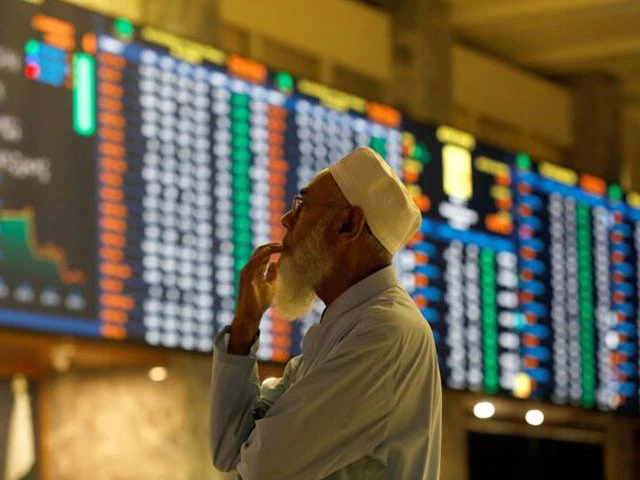
KSE-100 gains over 672 points in early trade; slumps over 900 points by midday as investors resort to profit-taking
A stock broker reacts while monitoring the market on the electronic board displaying share prices during trading session at the Pakistan Stock Exchange, in Karachi on July 3, 2023. Photo: Reuters/ File
KARACHI:
Pakistan equities witnessed a volatile session on Wednesday as early optimism at the Pakistan Stock Exchange (PSX) gave way to selling pressure amid rising geo-political concerns.
The benchmark KSE-100 Index opened on a positive note and displayed resilience during early trading hours, gaining as much as 672.16 points by 9:45am.
Buying activity was observed across key sectors, including automobile assemblers, cement, commercial banks, oil and gas exploration companies, OMCs, power generation and refinery stocks.
The initial rally was largely driven by the State Bank of Pakistan’s announcement that it had received $1.3 billion from the International Monetary Fund (IMF) under the Extended Fund Facility (EFF) and Resilience and Sustainability Facility (RSF) programmes, boosting investor confidence.
However, the momentum proved short-lived as geo-political jitters dampened market sentiment, prompting investors to resort to profit-taking and offloading positions.
As a result, the KSE-100 index slipped into the red zone and was hovering at 168,015.09 points, down 902.33 points, or 0.54%, with traded volume standing at 148.70 million shares and total traded value at Rs8.95 billion.
Trading remained underway at the time of filing this report, with investors closely monitoring developments on both the economic and geopolitical fronts.
Read: PSX ends lower amid choppy trading
On Tuesday, PSX witnessed a mixed yet largely negative session as investors remained cautious amid geopolitical uncertainty surrounding US-Iran peace negotiations.
After commencing trading on a firm footing, the benchmark KSE-100 index moved higher in early trade as renewed buying interest pushed the market to the intra-day high of 171,571.56 points. The momentum, however, proved short-lived, with investors resorting to profit-taking and dragging the index into negative territory during the latter half.
Subsequently, the index slipped to the intra-day low of 168,823.32 before closing at 168,916.22, down 1,590.09 points, or 0.93%.
Overall trading volumes decreased to 1.02 billion shares against Monday‘s total of 1.10 billion. The value of shares traded during the day stood at Rs32 billion. Shares of 485 companies were traded. Of these, 106 climbed, 346 fell and 33 remained unchanged.
Cnergyico PK was the volume leader with trading in 154.1 million shares, gaining Rs0.15 to close at Rs8.81. Foreign investors bought shares worth Rs280.4 million, the National Clearing Company reported.





Business
Trains at 220 kmph on Indian Railways soon! Cabinet approves Ahmedabad-Dholera semi high-speed rail project; check details – The Times of India
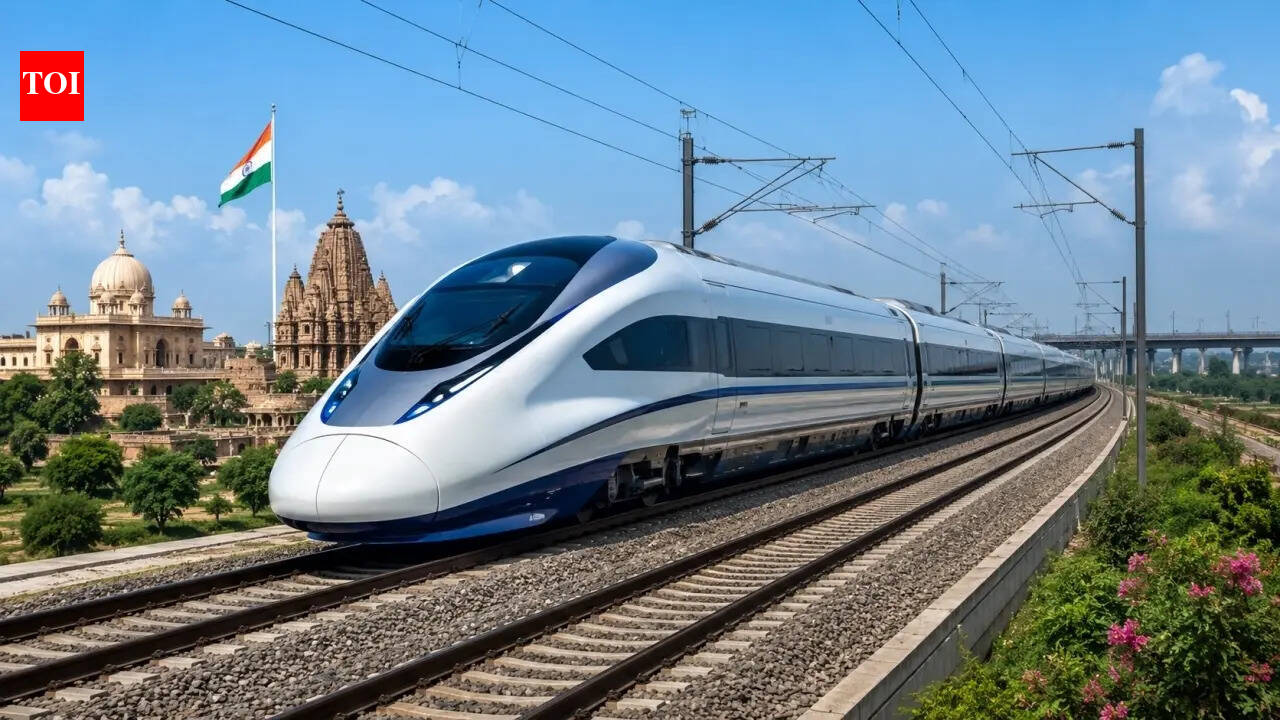
Trains at the speed of 220 kmph may soon run on Indian Railways with the Cabinet Committee on Economic Affairs, led by PM Narendra Modi, approving a new railway line. The CCEA gave its go ahead for Ahmedabad (Sarkhej) – Dholera semi high-speed double line project on Wednesday. Sabarmati to Dholera travel time will come down to 48 minutes with the new railway line, Railway minister Ashwini Vaishnaw said.The project will come up under the Ministry of Railways at an estimated investment of around Rs 20,667 crore. The corridor will become the first semi high-speed rail project of Indian Railways to be developed using indigenous technology, according to the Cabinet release.The proposed rail line is expected to improve connectivity between Ahmedabad, Dholera Special Investment Region, the upcoming Dholera International Airport and the Lothal National Maritime Heritage Complex. Faster rail access between Ahmedabad and Dholera is likely to significantly reduce travel duration, making daily commuting and same-day return journeys more convenient for passengers. Being India’s first semi high-speed rail corridor, the project is expected to act as a benchmark for the future phased rollout of similar rail networks across the country, the release said.The new railway line is aimed at strengthening direct connectivity and improving mobility while enhancing operational efficiency and service reliability for Indian Railways.The corridor has been planned under the PM Gati Shakti National Master Plan with an emphasis on integrated planning, multimodal connectivity and logistics efficiency through coordination among stakeholders. The initiative is expected to facilitate smoother movement of passengers, goods and services.Spread across the Ahmedabad district of Gujarat, the project will add nearly 134 kilometres to the existing railway network. It is also expected to improve connectivity for nearly 284 villages with a combined population of around five lakh people.As rail transport is considered energy-efficient and environmentally sustainable, the project is expected to contribute towards climate objectives and help reduce the country’s logistics costs. It is also projected to lower oil imports by about 0.48 crore litres and cut carbon emissions by nearly 2 crore kilograms, an impact considered equivalent to planting around 10 lakh trees.
The rupee slipped to a fresh all-time low against the US dollar on Wednesday, extending its recent losing streak as rising oil prices, overseas debt repayments and importer demand for hedging continued to weigh on the currency.The rupee weakened 0.1% to 95.7450 per dollar, moving past its previous record low of 95.7375 touched on Tuesday.Analysts said the pressure on the rupee has intensified since the outbreak of the US-Iran conflict earlier this year, which has sharply pushed up global crude oil prices and strained India’s external sector.Brent crude prices have risen nearly 50% since the Iran conflict began on February 28, while the rupee has weakened by more than 5% during the same period.
Oil shock weighs on India’s economic outlook
Economists have lowered India’s growth forecasts and raised inflation projections amid concerns over persistently high energy costs.“A collapse in oil prices or a resumption in portfolio flows are prerequisites for a durable turnaround in the rupee’s bearish run,” Radhika Rao, senior economist at DBS, said in a note quoted by Reuters.Traders and analysts told Reuters that the rupee’s losses would likely have been much steeper without regular interventions by the Reserve Bank of India and the use of regulatory measures to stabilise the currency.Prime Minister Narendra Modi over the weekend urged measures to conserve foreign exchange reserves, while the government on Tuesday increased import duties on precious metals in an effort to curb demand and support the rupee.
Markets speculate on possible RBI response
Markets are increasingly pricing in the possibility of interest rate hikes to defend the currency and contain inflationary pressure.“Markets are pricing in rate hikes to defend the rupee and address potential inflationary pressures, although we do not expect policy tightening to be the immediate response,” Rao said.Speaking at a conference in Switzerland on Tuesday, RBI governor Sanjay Malhotra said monetary policy could look through temporary supply shocks but may need to respond if inflation pressures become persistent.Malhotra also indicated that while India has so far avoided raising domestic fuel prices despite higher global crude rates, prolonged tensions in the Middle East may eventually force price hikes.Global financial markets remained cautious amid uncertainty over the Iran conflict and persistent inflation concerns in the United States.Foreign exchange markets were largely range-bound globally, while technology-focused equities gained on renewed optimism surrounding artificial intelligence despite stalled negotiations between Washington and Tehran.

Tui has assured holidaymakers that their peak summer flights will go ahead, despite fears of aviation fuel shortages caused by the Iran conflict.
Mathias Kiep, CFO of Tui Group, told The Independent: “I’m very much convinced that we will see no shortage in the next 10 weeks. There’s definitely enough fuel.”
Speaking as Europe’s biggest holiday company reported its financial results for October 2025-March 2026, he said: “We think that the discussion on fuel is a little bit artificial as we do see no shortages for the next few weeks.
“I would also see no impact in the summer at all except prices – and for the higher prices, we are luckily hedged.
“We do see that Europe now gets more oil from other countries like Nigeria because the increased prices made the production there profitable. We see that consumption is significantly lower than a year before and refinery capacity is also up.”
He said that even if the Strait of Hormuz remains closed in the long term, there will be no shortage.
The firm reported a “very successful” first half of its financial year between October 2025 and March this year. But it has warned that the second half “will require great dedication and flexibility”.
The war in Iran delivered a €40m (£35m) hit to profits – due to a combination of lost sales and the extra costs of bringing back holidaymakers from the Middle East and Asia.
In addition, Hurricane Melissa in Jamaica cost the company €5m (£4.3m).
Sebastian Ebel, chief executive of the Tui group, said: “We offer our customers a high level of security and quality, especially in turbulent times. The package holiday remains the gold standard.”
The occupancy rate on Tui cruises fell from 97 to 93 per cent due to the war in Iran. Two ships from the German cruise operation were stuck in the Gulf for 10 weeks.
Air bookings for the summer are 7 per cent below last year. The firm said people were happy to book two or three weeks in advance, but not two or three months.
Tui has seen no decline in the intention to travel, and no shift from air to surface transport. The hantavirus scare has had no impact on cruise demand.
Read more: Britons ditching Spain after rival destination drops EU biometric requirement


Princess Kate receives roaring welcome as she steps out in Reggio Emilia

US’ Kontoor Brands’ posts strong Q1, plans Lee divestiture
Trains at 220 kmph on Indian Railways soon! Cabinet approves Ahmedabad-Dholera semi high-speed rail project; check details – The Times of India

-

 Tech1 week ago
DHS Demanded Google Surrender Data on Canadian’s Activity, Location Over Anti-ICE Posts
-

 Tech5 days ago
A new frontier: Identity stack evolves for agentic systems | Computer Weekly
-

 Tech5 days ago
‘Orbs,’ ‘Saucers,’ and ‘Flashes’ on the Moon: Pentagon Drops New UFO Files
-

 Sports5 days ago
Shaheen Afridi achieves landmark feat during opening Test against Bangladesh
-

 Tech5 days ago
What Microsoft Executives Really Thought About OpenAI in 2018
-
 Business1 week ago
India among most resilient large EMs, better placed for future global shocks; policy reforms & strong buffers help: Moody’s – The Times of India
-

 Fashion5 days ago
New orders in German manufacturing up 5% MoM in Mar 2026: Destatis
-

 Tech5 days ago
Nick Bostrom Has a Plan for Humanity’s ‘Big Retirement’