

Business
India Surges Ahead While US, China, Russia Struggle: Harvard Economist Reveals Stunning Post-Covid Growth Story

New Delhi: India has emerged as the world’s fastest-growing economy, leaving nations like the United States, China and Russia struggling to catch up. The post-COVID recovery of the Indian economy has astonished global observers, from the World Bank to the International Monetary Fund. Now Harvard economist Jason Furman has shared a chart, which illustrates India’s extraordinary pace of growth.
The chart shows that while major economies are still grappling with pandemic aftershocks, India has achieved a rebound, consistently maintaining momentum.
Jason Furman shared the comparative growth chart on X (formerly Twitter), highlighting India’s performance from 2019 through the third quarter of 2025. It contrasts India’s nominal GDP trends before COVID-19 with current data, along with major economies such as the United States, the Eurozone, China and Russia.
The data shows India rising steadily, reaching projected GDP growth of +5% by mid-2025, making it the only major economy maintaining continuous upward momentum.
The chart shows that India began its post-pandemic recovery from a low point in 2020 and surpassed its pre-COVID trendline by 2022. By 2024, its growth reached +3%, and projections suggest +5% by the third quarter of 2025.
Furman emphasised that India’s growth is not a one-time surge but a result of structural strength. He pointed to digital infrastructure, investment reforms and a stable macroeconomic environment as key factors driving domestic consumption and investment, allowing India to continue growing even amid global challenges.
Other major economies, in contrast, are still facing hurdles. The Eurozone experienced the deepest contraction during the pandemic at -25%, while China faced a decline of -10%. Russia’s economy fell by -8%, and the United States and India both saw a drop of -5%.
Although recovery measures have helped the United States reach an estimated growth rate of around 2% by 2025, India’s rapid pace far outshines it. China’s recovery remains constrained due to the long-lasting effects of zero-COVID policies and real estate crises, with projected growth of -5% in 2025.
Russia continues to struggle near -8%, influenced heavily by the ongoing war with Ukraine, while the Eurozone is projected to achieve only -3% growth.
Global rating agencies are also expressing confidence in India’s continued momentum. The Investment Information and Credit Rating Agency (ICRA) expects India’s GDP growth to remain strong at 7% in the second quarter of FY 2026, following a 7.8% rise in the first quarter.
GVA projects 7.1%, while Moody’s predicts 7% GDP growth for 2025 and 6.4% for 2026.
India’s post-pandemic economic story is now a benchmark for resilience and rapid recovery. While the world’s leading economies are still managing the lingering effects of COVID-19, India has firmly established itself as a powerhouse, combining policy reforms, robust domestic demand and structural stability to surge ahead on the global stage.




Gold slumped more than 5%, ending a four-day rally on Tuesday. The metal was weighed down by a stronger dollar and fading prospects of an interest rate cut as inflation concerns intensified against the backdrop of a potentially prolonged conflict in West Asia. Spot gold was down 5.6% at $5,029.59 an ounce whereas prices had hit an over four-week high in the previous session. US gold futures lost 5.1% to $5,041.50.The US dollar, a competing safe-haven asset, rose to an over one-month peak, making dollar-priced bullion less affordable for holders of other currencies. US Treasury yields rose for a second consecutive session.Indian bullion traders and associations are speculating that gold could attain Rs 2 lakh per 10 gm and silver may well scale Rs 3.5 lakh per kg if the conflict does not abate swiftly.Spot silver fell 11.2% to $79.42 an ounce after climbing to a more than four-week high on Monday. As the Iran conflict entered its fourth day, crude oil benchmarks jumped over 8% in response.
Business
Oil Prices: US, Israel attack Iran: With oil prices up, forex volatility set to continue – The Times of India

MUMBAI: The rupee is likely to come under renewed pressure when forex markets open on Wednesday as the conflict in West Asia has worsened the trade and energy situation beyond expectations of analysts.On Tuesday, the Indonesian rupiah, South Korean won and Thai baht each fell by more than 1%, leading losses in Asia, while broader emerging-market currency indices dropped about 0.5% in their worst session since Nov 2024. The selloff followed a sharp escalation in the conflict, with Iran moving to effectively choke tanker traffic through the Strait of Hormuz, sending crude prices up roughly 9% in London trading. The spike in oil heightened concerns over inflation, wider current account deficits and delayed rate cuts in oil-importing economies. Investors rushed into the US dollar and gold, pushing the dollar to multi-month highs and triggering capital outflows from riskier assets.According to KN Dey, forex consultant, the rupee is most likely to breach 92 level this week. “Oil prices have risen sharply and supply chains are getting disrupted. Most Asian currencies have already fallen, with the Korean won and the Malaysian ringgit down over 1%. The rupee will open under pressure and a gap-down start is likely. Stop-loss levels could trigger early, adding to volatility,” he said. “Going ahead would be very tough, RBI’s intervention would only act as a speedy breaker.“What has worsened the conflict situation is that it has created a supply-chain crisis. “Beyond the immediate risk to oil and gas supplies from the Gulf, the broader concern is how the conflict may influence trade behavior across Asia,” said Choon Hong Chua, senior director, Moody’s. “This raises the risk of selective export restrictions, informal boycotts, and tighter customs scrutiny as govts seek to limit exposure to secondary sanctions or political repercussions,” he added.
Business
Iran Conflict: Middle East tensions: Global insurers exit Iranian waters as conflict deepens – The Times of India
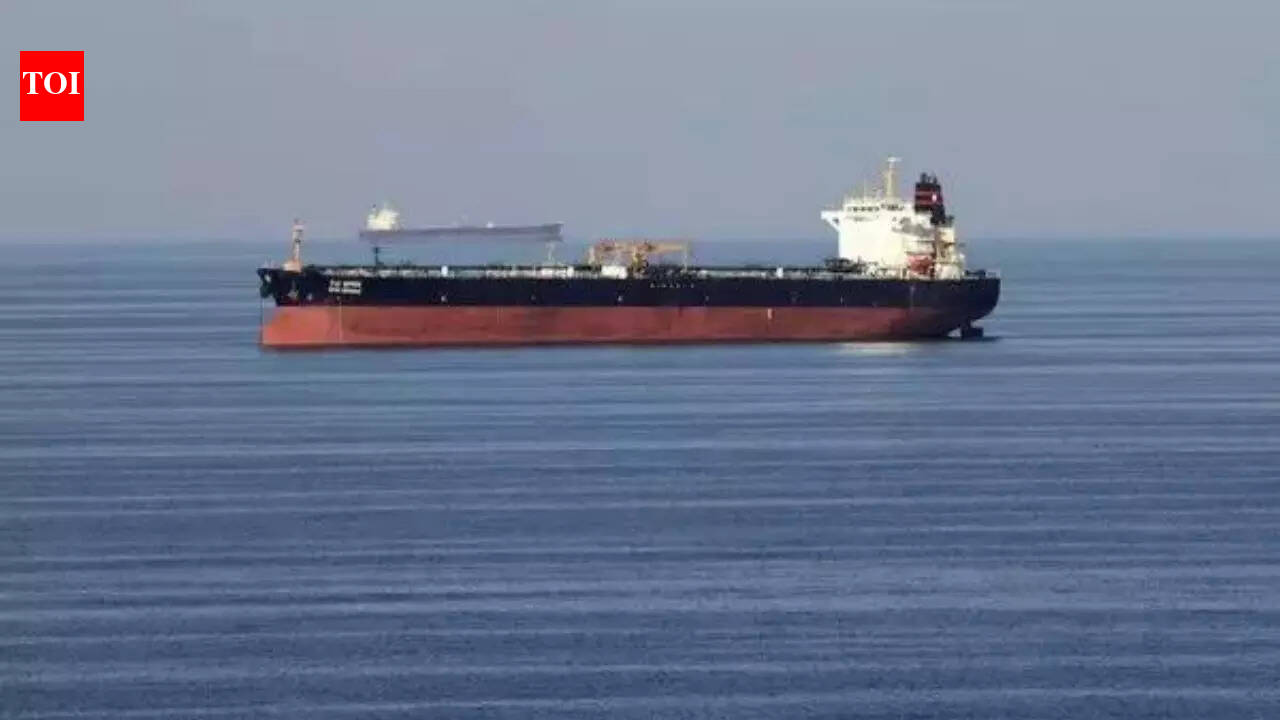
MUMBAI: India’s trade and energy supplies face fresh risks after reinsurers and Protection & Indemnity (P&I) clubs announced cancellation of war risk insurance for vessels transiting the Strait of Hormuz and Iranian waters, following an escalation in the Iran conflict. The cancellations, effective from this week, have left over 150 vessels stranded and disrupted a corridor that handles nearly one-fifth of global oil flows.P&I clubs are mutual, non-profit insurance associations owned by shipowners. They provide third-party liability cover through a pooled premium for risks such as cargo damage, pollution, crew injuries and collisions that are not covered under hull insurance. The clubs also provide legal support and dispute resolution across jurisdictions.“The industry is currently in a wait-and-watch mode, as much depends on how long the conflict persists. If it turns prolonged, insurers are likely to come together to create additional capacity for war-risk cover. Typically, there is an immediate surge in demand when hostilities break out, but that demand tends to ease quickly if the situation stabilises in a short span,” said Tapan Singhel, MD & CEO, Bajaj General Insurance.
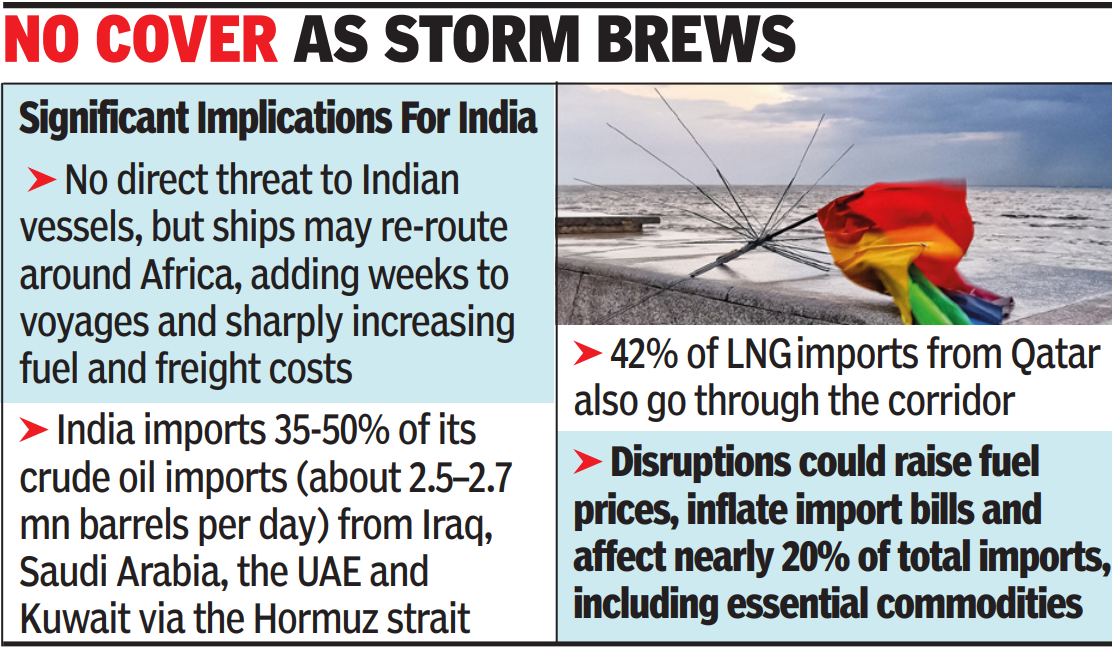
Brokers said that in the past when international reinsurers ceased to provide cover for some risks like terrorism the Indian market had provided the capacity by building an insurance pool where domestic companies come together and share the risks. However, this tie state-owned reinsurer GIC Re, which leads domestic marine pools, has itself issued cancellation notices for marine hull war risk covers effective March 3, 2026, mirroring global reinsurers and P&I clubs. The crisis has brought marine insurance centerstage, the share of this line of non-life had shrunk to around 2% of industry premium as risks ebbed due to containarisation and more safety in transport. The size of the premium also determines the capacity of the industry to provide large covers.Their role is central to global shipping. Without P&I cover, shipowners face potentially unlimited liabilities in the event of accidents, pollution or war-related damage. In high-risk zones, the absence of insurance effectively halts voyages, as operators are unwilling to expose vessels to uninsured losses. In previous crises in the Red Sea, war risk exclusions by insurers sharply curtailed traffic and drove up freight rates.In the current episode, major P&I clubs and reinsurers have issued notices cancelling war risk cover for Iranian waters, the Persian Gulf and the Strait of Hormuz, citing tanker damage, casualties and threats from Iranian forces. Reports of VHF warnings and GPS disruptions have added to concerns. Insurers have invoked standard cancellation clauses following US and Israeli strikes on Iran, with broader policy implications if the conflict further widens.Fresh war risk cover may be available, but at sharply higher premiums. Rates that were around 0.25% of vessel value have surged multiple times, rendering transits commercially unviable for many operators. Even where cover is available, shipowners remain wary of risks such as seizures or missile strikes.

Gold Prices: Gold retreats on strong dollar after four-day rally – The Times of India

Legendary Auburn coach Bruce Pearl backs Trump on Iran strikes, rips Obama and Biden over their strategy
Oil Prices: US, Israel attack Iran: With oil prices up, forex volatility set to continue – The Times of India

-

 Politics6 days ago
What are Iran’s ballistic missile capabilities?
-

 Politics6 days ago
US arrests ex-Air Force pilot for ‘training’ Chinese military
-
 Business1 week ago
Households set for lower energy bills amid price cap shake-up
-

 Sports1 week ago
Top 50 USMNT players of 2026, ranked by club form: USMNT Player Performance Index returns
-
 Business1 week ago
Lucid widely misses earnings expectations, forecasts continued EV growth in 2026
-

 Fashion5 days ago
Policy easing drives Argentina’s garment import surge in 2025
-

 Sports6 days ago
Sri Lanka’s Shanaka says constant criticism has affected players’ mental health
-

 Sports1 week ago
South Africa thrash India by 76 runs in T20 World Cup Super 8 – SUCH TV