

Business
India-US trade deal: How New Delhi’s 18% tariff compares with rival nations – The Times of India

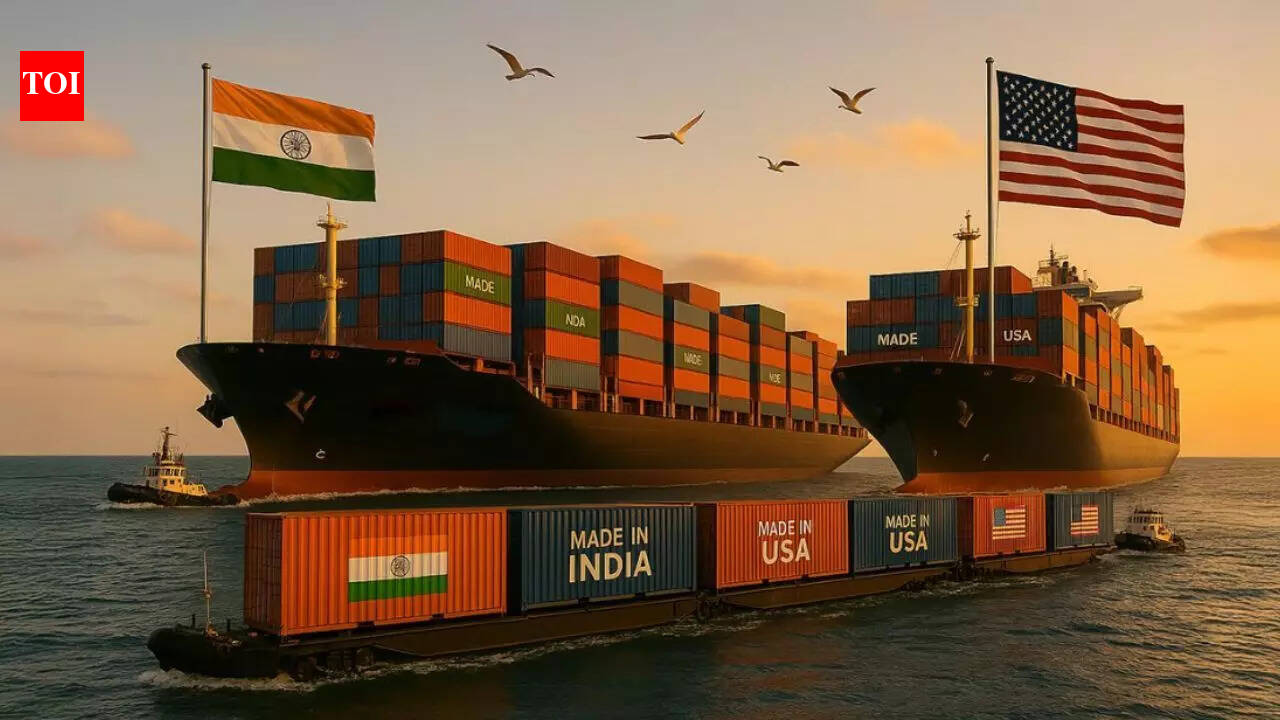
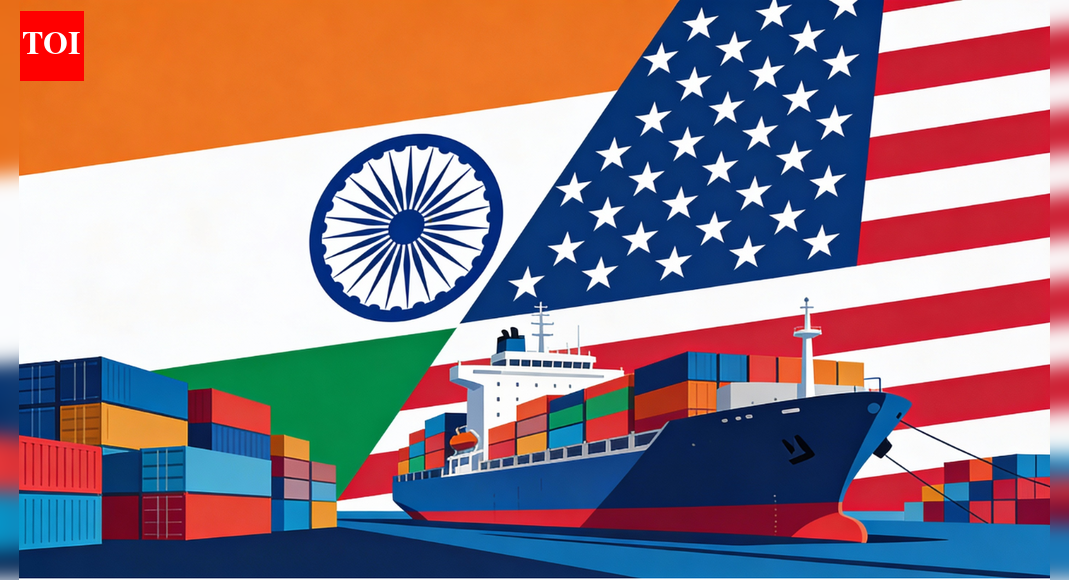
India and the United States have agreed on a framework for a bilateral trade deal under which Washington will reduce tariffs on Indian goods to 18% from the current 50%.The announcement is significant as the US had imposed steep duties on Indian exports entering American markets, effective August 27, 2025.
In August 2025, Washington announced a 25% tariff along with an additional 25% punitive duty on India for purchasing Russian crude oil and military equipment. These duties were imposed over and above existing tariffs on Indian goods. Under the new framework, the overall duty has now been brought down to 18% .Prime Minister Narendra Modi welcomed the move, saying he was delighted that “made in India products will now have a reduced tariff of 18%.”Tariffs are customs or import duties imposed by a country on goods bought from other nations.
How India compares globally
A comparison of US tariff rates across major economies places India in the middle of the global tariff spectrum, with an 18% duty on its exports.Brazil faces the steepest tariff at 50% , followed by Myanmar and Laos at 40% each. China attracts a 37% tariff, while South Africa faces a 30% levy.Several manufacturing hubs in Southeast Asia are subject to duties in the 19–20% range, including Vietnam and Bangladesh at 20% , and Malaysia, Cambodia and Thailand at 19% each.With an 18% tariff, India is now placed below most emerging-market competitors, offering it a relative pricing advantage in the US market.Advanced economies enjoy significantly lower tariffs. The European Union, Switzerland, Japan and South Korea each face a 15% duty, while the United Kingdom has the lowest rate at 10% .The reduction in tariffs is expected to benefit India’s labour-intensive sectors, as exporters will be able to price their products more competitively in the US market.
Why the US imposed tariffs
The US has argued that it faces a significant trade deficit with India, blaming New Delhi for imposing high tariffs on American goods, which it says restrict US exports to the Indian market.Under the proposed pact, India is expected to eliminate duties on certain goods immediately, phase out duties on others, reduce tariffs in some sectors, and offer quota-based tariff concessions for select products.However, sensitive sectors such as agriculture and dairy remain completely outside the ambit of the agreement, PTI reported.An executive order from the US is expected to provide greater clarity on tariff changes, while a joint statement from both countries will outline the sectors covered under the deal. Both are awaited.

The speed of price rises in the UK has stayed the same, according to data which was collected before the US-Israel war with Iran began.
Source link
Buying continued at the Pakistan Stock Exchange (PSX), with the benchmark KSE-100 Index gaining over 1,700 points during the opening minutes of trading on Wednesday. At 10 am, the benchmark index was at 155,730.37, up 1,764.37 points (1.13%).
Buying interest was observed in key sectors, including automobile assemblers, cement, commercial banks, fertiliser, oil and gas exploration companies, OMCs, power generation, and refinery. Index-heavy stocks, including ARL, HUBCO, PSO, MARI, OGDC, POL, PPL, HBL, MCB, and MEBL traded in the green.
On Tuesday, PSX ended with moderate gains as thin volumes and profit-taking capped the upward momentum despite supportive global cues and easing geopolitical concerns.
The KSE-100 Index closed at 153,966.36 points, gaining 1,225.99 points or 0.80%.
K-Electric led trading volumes with over 35 million shares exchanged, coinciding with the company’s announcement of a new chief executive earlier in the day.
Market heavyweights, including Engro Holdings, Fauji Fertiliser Company, Lucky Cement, Systems Limited, and Hub Power Company, contributed significantly to the index gains, while banking and select industrial stocks weighed on overall performance.
Despite the rebound, analysts noted that the market remained cautious after last week’s decline, which was driven by geopolitical uncertainty, particularly tensions in the Middle East, and concerns over global energy prices.
Experts suggest that future market direction will depend on regional stability, energy policy developments, and progress in ongoing discussions with the International Monetary Fund.
Globally, stocks rose, and oil fell on Wednesday on reports the US is seeking a month-long ceasefire in its war on Iran, and had sent a 15-point plan to Iran for discussion, raising hopes for a resumption of oil exports out of the Persian Gulf.
S&P 500 futures rose 0.9% in the Asian morning, European futures lifted 1.2%, and Brent crude futures fell about 6% to $98.30 a barrel.
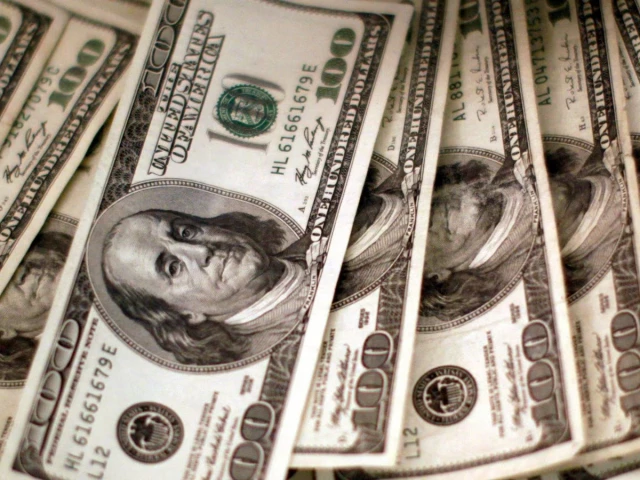
Fed hike odds jump to 26% from 70% cut probability week ago as Middle East war fuels inflation fears
A picture showing $100 bills. SOURCE: REUTERS
Currency markets took a breather on Wednesday, with traders cautious over United States President Donald Trump’s efforts to bring an end to the war with Iran. While Trump told reporters at the White House the US was making progress in talks with Iran, Tehran denied that direct negotiations had taken place, keeping investors on edge.
The US dollar index, which measures the greenback’s strength against a basket of six currencies, was last 0.13% higher at 99.317, with the euro little changed at $1.1603. The British pound was 0.16% weaker at $1.3388 as data showed that British consumer price inflation held at an annual rate of 3.0% in February, unchanged from January’s rate. However, inflation is broadly expected to pick up as the war in the Middle East pushes up prices.
The subdued volatility contrasted with a pickup in equities and a fall in crude oil prices after Trump said on Tuesday the US was making progress in its efforts to negotiate an end to the war.
Read: Trump approval sinks to 36% as fuel prices surge amid Iran war
“For those reacting to every breaking headline around dialogue between the US and its allies and Iran, including speculation of high-level talks and temporary ceasefire proposals, an element of fatigue is now firmly setting in,” said Chris Weston, head of research at Pepperstone Group Ltd in Melbourne.
Against the yen, the US dollar was up a slight 0.2% at 158.99, after the release of minutes from the Bank of Japan’s January policy meeting showed many board members saw the need to keep raising interest rates without any specific pace in mind. The Australian dollar weakened 0.33% to $0.697 after the release of inflation data for February, which showed a 3.7% rise prior to the start of the US-Israeli war with Iran, a slightly slower pace than expected by analysts.
Although markets still anticipate no change in US interest rates this year, expectations of policy tightening are rising. Fed funds futures now imply a 26.1% chance of a 25-basis-point hike at the Federal Reserve’s December meeting, compared to a 69.5% probability of a cut a week ago, according to CME Group’s FedWatch tool.
Read More: Global shares skid as oil surge threatens inflation shock
The Fed may need to keep interest rates steady “for some time” before further cuts are warranted, Fed Governor Michael Barr said on Tuesday, noting continued inflation above the Fed’s 2% target and the risks posed by the conflict in the Middle East.
Bond markets rebounded after a volatile week, with the yield on the US 10-year Treasury bond down 3.4 basis points at 4.356%. “Higher oil prices added to expectations of increasing inflationary pressures and tighter monetary policy,” analysts from Westpac wrote.
In cryptocurrencies, bitcoin climbed 1.6% to $71,202.33, while ether was up 1.2% at $2,174.14.


Queen Camilla daring move shocks Prince Harry after big announcement

US’ Torrid sees FY25 sales fall 9.4%, reports $7 mn loss

Wristband enables wearers to control a robotic hand with their own movements

-

 Fashion7 days ago
Sales at US apparel, clothing accessories stores up 4% YoY in Jan 2026
-
 Business1 week ago
Peloton is launching bikes and treadmills for gyms, accelerating commercial strategy
-
 Tech1 week ago
Justice Department Says Anthropic Can’t Be Trusted With Warfighting Systems
-

 Fashion1 week ago
Trump signs order to combat fraudulent ‘Made in America’ labels
-
 Business1 week ago
Stocks and pound rise as US rate call approaches
-

 Fashion1 week ago
Lenzing launches TENCEL Lyocell-HV100 at Intertextile Shanghai
-

 Sports1 week ago
PCB files complaint over allowing Bangladesh to take review on penultimate ball – SUCH TV
-

 Sports7 days ago
March Madness 2026 – How to watch in SA, start time, schedule, TV channel for NCAA championship basketball tournament