Connect with us

Politics

IQAir report shows the best and worst places for air quality in 2021

Published

on

IQAir report shows the best and worst places for air quality in 2021


CNN
 — 

Air pollution spiked to unhealthy levels around the world in 2021, according to a new report.

The report by IQAir, a company that tracks global air quality, found that average annual air pollution in every country — and 97% of cities — exceeded the World Health Organization’s air quality guidelines, which were designed to help governments craft regulations to protect public health.

Only 222 cities of the 6,475 analyzed had average air quality that met WHO’s standard. Three territories were found to have met WHO guidelines: the French territory of New Caledonia and the United States territories of Puerto Rico and the US Virgin Islands.

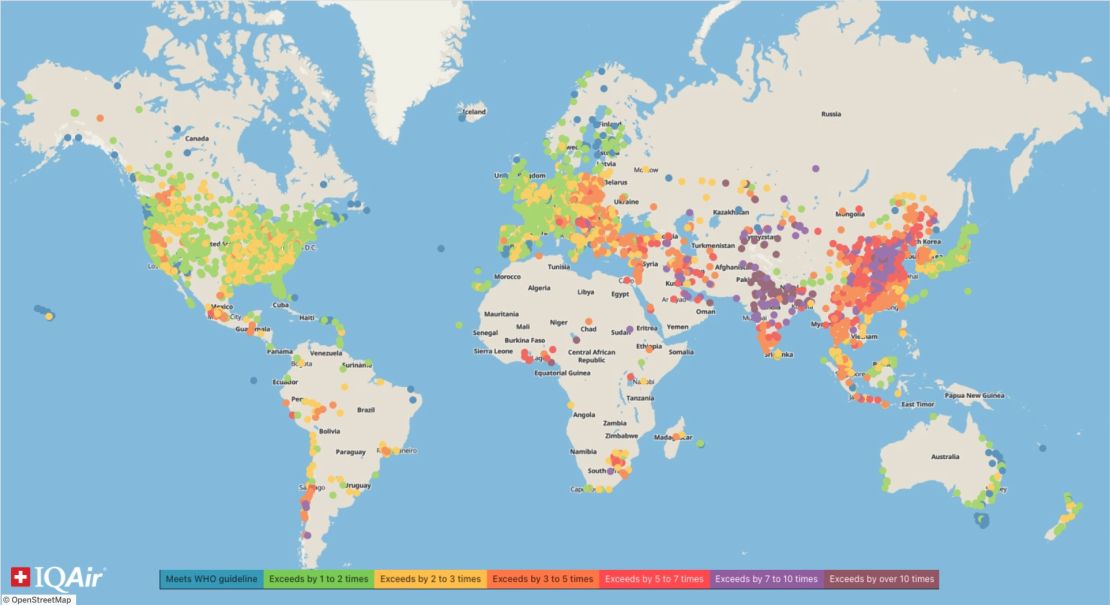
India, Pakistan and Bangladesh were among the countries with the worst air pollution, exceeding the guidelines by at least 10 times.

The Scandinavian countries, Australia, Canada, Japan and United Kingdom ranked among the best countries for air quality, with average levels that exceeded the guidelines by 1 to 2 times.

In the United States, IQAir found air pollution exceeded WHO guidelines by 2 to 3 times in 2021.

“This report underscores the need for governments around the world to help reduce global air pollution,” Glory Dolphin Hammes, CEO of IQAir North America, told CNN. “(Fine particulate matter) kills far too many people every year and governments need to set more stringent air quality national standards and explore better foreign policies that promote better air quality.”
20220322-aqi-world-static

Above: IQAir analyzed average annual air quality for more than 6,000 cities and categorized them from best air quality, in blue (Meets WHO PM2.5 guildline) to worst, in purple (Exceeds WHO PM2.5 guideline by over 10 times). An interactive map is available from IQAir.

It’s the first major global air quality report based on WHO’s new annual air pollution guidelines, which were updated in September 2021. The new guidelines halved the acceptable concentration of fine particulate matter — or PM 2.5 — from 10 down to 5 micrograms per cubic meter.

PM 2.5 is the tiniest pollutant yet also among the most dangerous. When inhaled, it travels deep into lung tissue where it can enter the bloodstream. It comes from sources like the burning of fossil fuels, dust storms and wildfires, and has been linked to a number of health threats including asthma, heart disease and other respiratory illnesses.

Millions of people die each year from air quality issues. In 2016, around 4.2 million premature deaths were associated with fine particulate matter, according to WHO. If the 2021 guidelines had been applied that year, WHO found there could have been nearly 3.3 million fewer pollution-related deaths.

IQAir analyzed pollution-monitoring stations in 6,475 cities across 117 countries, regions and territories.

In the US, air pollution spiked in 2021 compared to 2020. Out of the more than 2,400 US cities analyzed, Los Angeles air remained the most polluted, despite seeing a 6% decrease compared to 2020. Atlanta and Minneapolis saw significant increases in pollution, the report showed.

“The (United States’) reliance on fossil fuels, increasing severity of wildfires as well as varying enforcement of the Clean Air Act from administration to administration have all added to U.S. air pollution,” the authors wrote.

Researchers say the main sources of pollution in the US were fossil fuel-powered transportation, energy production and wildfires, which wreak havoc on the country’s most vulnerable and marginalized communities.

“We are heavily dependent on fossil fuels, especially in terms of transportation,” said Hammes, who lives a few miles from Los Angeles. “We can act smartly on this with zero emissions, but we’re still not doing it. And this is having a devastating impact on the air pollution that we’re seeing in major cities.”

Climate change-fueled wildfires played a significant role in reducing air quality in the US in 2021. The authors pointed to a number of fires that led to hazardous air pollution — including the Caldor and Dixie fires in California, as well as the Bootleg Fire in Oregon, which wafted smoke all the way to the East Coast in July.

China — which is among the countries with the worst air pollution — showed improved air quality in 2021. More than half of the Chinese cities analyzed in the report saw lower levels of air pollution compared to the previous year. The capital city of Beijing continued a five-year trend of improved air quality, according to the report, due to a policy-driven drawdown of polluting industries in the city.

The report also found that the Amazon Rainforest, which had acted as the world’s major defender against the climate crisis, emitted more carbon dioxide than it absorbed last year. Deforestation and wildfires have threatened the critical ecosystem, polluted the air and contributed to climate change.

“This is all a part of the formula that will lead to or is leading to global warming.” Hammes said.

The report also unveiled some inequalities: Monitoring stations remain scant in some developing countries in Africa, South America and the Middle East, resulting in a dearth of air quality data in those regions.

“When you don’t have that data, you’re really in the dark,” Hammes said.

Hammes noted the African country of Chad was included in the report for the first time, due to an improvement in its monitoring network. IQAir found the country’s air pollution was the second-highest in the world last year, behind Bangladesh.

Tarik Benmarhnia, a climate change epidemiologist at Scripps Institution of Oceanography who has studied the health impact of wildfire smoke, also noted that relying only on monitoring stations can lead to blind spots in these reports.

“I think it is great that they relied on different networks and not only governmental sources,” Benmarhnia, who was not involved in this report, told CNN. “However, many regions do not have enough stations and alternative techniques exist.”

The UN Intergovernmental Panel on Climate Change concluded in its 2021 report that, in addition to slowing the speed of global warming, curbing the use of fossil fuels would have the added benefit of improving air quality and public health.

Hammes said the IQAir report is even more reason for the world to wean off fossil fuel.

“We’ve got the report, we can read it, we can internalize it and really devote ourselves to taking action,” she said. “There needs to be a major move towards renewable energy. We need to take drastic action in order to reverse the tide of global warming; otherwise, the impact and the train that we’re on (would be) irreversible.”




Source link

Continue Reading
Click to comment

Leave a Reply

Your email address will not be published. Required fields are marked *

Politics

Key Iranian figures martyred in US-Israel military strikes

Published

on

Key Iranian figures martyred in US-Israel military strikes


Protesters demonstrate near the entrance of the Green Zone after assassination of Irans Supreme Leader Ayatollah Ali Khamenei, in Baghdad, Iraq, March 1, 2026. — Reuters
Protesters demonstrate near the entrance of the Green Zone after assassination of Iran’s Supreme Leader Ayatollah Ali Khamenei, in Baghdad, Iraq, March 1, 2026. — Reuters 

A number of Iranian senior leaders, including Supreme Leader Ayatollah Ali Khamenei, have embraced martyrdom in the “unprovoked and unwarranted” airstrikes by Israel and the United States.

As crowds gathered in Tehran, explosions rang out, and the Israeli military announced that it was again striking targets in the heart of the city — as more blasts were heard in Jerusalem, Riyadh, Dubai, Doha and Manama.

Iran’s President Masoud Pezeshkian declared Khamenei’s assassination a “declaration of war against Muslims” and warned: “Iran considers it its legitimate duty and right to avenge the perpetrators and masterminds of this historic crime.”

Iranian state media have confirmed the killing of several senior figures:

1. Ayatollah Ali Khamenei, supreme leader of Iran

2. Ali Shamkhani, representative of the Supreme Leader in the Supreme Defence Council

3. General Abdolrahim Mousavi, Iran’s Armed Forces chief of staff

4. Major General Mohammad Pakpour, commander-in-chief of the Islamic Revolution Guards Corps (IRGC)

5. Aziz Nasirzadeh, Minister of Defence

6. Gholamreza Rezaian, police intelligence chief of Iran

Separately, the daughter, son-in-law, and granddaughter of Ali Khamenei also embraced martyrdom in the US and Israeli airstrikes. 


Source link

Continue Reading

Politics

US-Iran conflict disrupts thousands of flights as travel chaos deepens

Published

on

US-Iran conflict disrupts thousands of flights as travel chaos deepens


Passengers looks at departure board at I Gusti Ngurah Rai International Airport as some flights to Dubai and Doha cancelled following strikes on Iran launched by the United States and Israel, in Kuta, Bali, Indonesia, March 1, 2026. — Reuters
  • Middle Eastern airport hubs remain closed or restricted.
  • Airlines reroute or cancel flights, affecting global schedules.
  • Risk of prolonged disruption due to regional conflicts.

DUBAI: Global air travel remained heavily disrupted on Sunday as continued air strikes kept major Middle Eastern airports, including Dubai, the world’s busiest international hub, closed in one of the sharpest aviation shocks in recent years.

Key transit airports including Dubai and Abu Dhabi in the UAE, and Doha in Qatar, were shut or severely restricted as much of the region’s airspace remained closed, with the Gulf grappling with uncertainty after U.S. and Israeli strikes killed Iranian Supreme Leader Ayatollah Ali Khamenei on Saturday.

Israel said it launched another wave of strikes on Iran on Sunday, while loud blasts were heard for a second day near Dubai and over Doha, after Iran launched retaliatory air attacks on the neighbouring Gulf states.

Dubai International Airport sustained damage during Iran’s attacks, while airports in Abu Dhabi and Kuwait were also hit. Thousands of flights have been affected across the Middle East since the U.S. first launched attacks on Iran on Saturday, according to data on FlightAware, a flight tracking platform.

Ripple effects

The airport closures have rippled far beyond the Middle East. Dubai and neighbouring Doha sit at the crossroads of east-west air travel, funnelling long-haul traffic between Europe and Asia through tightly scheduled networks of connecting flights. 

Smoke billows from Jebel Ali port after an Iranian attack, following United States and Israel strikes on Iran, in Dubai, United Arab Emirates, March 1, 2026. — Reuters
Smoke billows from Jebel Ali port after an Iranian attack, following United States and Israel strikes on Iran, in Dubai, United Arab Emirates, March 1, 2026. — Reuters 

With those hubs idle, aircraft and crews remained stranded out of position, disrupting airline schedules worldwide.

“It’s the sheer volume of people and the complexity,” said UK-based aviation analyst John Strickland.

“It is not only customers, it is the crews and aircraft all over place.”

Airlines across Europe, Asia and the Middle East cancelled or rerouted flights to avoid closed or restricted airspace, lengthening journeys and driving up fuel costs. The disruption has been intensified by the loss of Iranian and Iraqi overflight routes, which had grown more important since the Russia-Ukraine war forced airlines to avoid both countries’ airspace.

The Middle East airspace closures were squeezing airlines into narrower corridors, with fighting between Pakistan and Afghanistan adding a further risk, said Ian Petchenik, communications director at Flightradar24.

“The risk of protracted disruption is the main concern from a commercial aviation perspective,” Petchenik said.

“Any escalation in the conflict between Pakistan and Afghanistan that results in the closure of airspace would have drastic consequences for travel between Europe and Asia.”

Middle East flights halted

Airspace over Iran, Iraq, Kuwait, Israel, Bahrain, the UAE and Qatar remained virtually empty, maps by flight-tracking service Flightradar24 showed, and air strikes kept major Middle Eastern airports, including Dubai, Abu Dhabi and Doha shut or severely restricted.

Below is the latest on flights listed by airline in alphabetical order:

Aegean Airlines

Greece’s largest carrier suspended flights to and from Tel Aviv in Israel, Beirut in Lebanon and Erbil in Iraq until March 2.

Air Astana

The group cancelled all flights to the Middle East through March 3.

Air Canada

The airline said it has cancelled flights from Canada to Israel until March 8 and flights to Dubai until March 3.

Air Europa

The Spanish airline cancelled its flights to Tel Aviv on Sunday and Monday and is monitoring the situation to assess operations from Tuesday.

Air France KLM

Air France cancelled flights to and from Tel Aviv in Israel and Beirut in Lebanon for Saturday.

Its Dutch arm KLM said late on Saturday that this weekend’s flights to and from Dubai, Dammam and Riyadh have been cancelled. It had already brought forward suspension of its Amsterdam–Tel Aviv service to Saturday.

Air India

The carrier cancelled flights scheduled for Sunday from Delhi, Mumbai and Amritsar to London, New York, Chicago, Toronto, Frankfurt and Paris. It added that more flights to London, Birmingham, Amsterdam, Zurich, Milan, Vienna, Copenhagen and Frankfurt had been cancelled.

Azerbaijan Airlines

The airline has suspended flights to and from Dubai, Doha, Jeddah and Tel Aviv.

British Airways

IAG-owned British Airways said it has cancelled flights to Tel Aviv and Bahrain until March 3 and its flight to Amman on Saturday.

Cathay Pacific

Hong Kong’s Cathay Group, parent of Cathay Pacific Airways, suspended operations in the region, affecting passenger flights to and from Dubai and Riyadh, as well as freighter service at Al Maktoum airport. That is Dubai’s second airport after Dubai International Airport, the primary hub that handles most passenger traffic.

Emirates

Owing to multiple regional airspace closures, Emirates has suspended all operations to and from Dubai until 3pm UAE time on March 2.

Etihad

The UAE’s Etihad said flights scheduled to depart Abu Dhabi were suspended until 2pm local time on Sunday.

Flydubai

The airline said it had temporarily suspended all flights to and from Dubai until 3pm local time on Sunday.

Iberia Express

The Spanish airline owned by Iberia Group cancelled a flight to Tel Aviv scheduled for Saturday at 5pm local time.

IndiGo

IndiGo, India’s biggest airline, said it had extended a temporary suspension of select international flights using Middle East airspace until Monday.

ITA Airways

ITA Airways suspended flights to and from Tel Aviv and said it would not use the airspace of Israel, Lebanon, Jordan, Iraq and Iran until March 7. Flights to and from Dubai were suspended until March 1.

Japan Airlines

Japan Airlines cancelled a flight on Saturday from Tokyo Haneda to Doha as well as a return flight on March 1, Nikkei said.

LOT Polish Airlines

The airline suspended flights to Tel Aviv until March 15 and cancelled flights to Dubai and Riyadh until March 2.

Lufthansa

The German airline flights to and from Tel Aviv in Israel, Beirut in Lebanon and Oman until March 7 and flights to and from Dubai on Saturday and Sunday.

It also said it would not fly through Israeli, Lebanese, Jordanian, Iraqi and Iranian airspace until March 7.

Norwegian Air

The Nordic airline suspended all flights to and from Dubai until March 4, a company spokesperson said. The carrier did not suspend flights to Tel Aviv in Israel or Beirut in Lebanon because these destinations are only active in summer, he added.

Pegasus Airlines

The airline said that flights to Iran, Iraq, Jordan and Lebanon were cancelled up to and including March 2.

Qatar Airways

The airline said flights remain temporarily suspended owing to the closure of the Qatari airspace. It will provide a further update by 9am local time on Monday.

Scandinavian Airlines

The airline told Reuters it had suspended its flight to Tel Aviv from Copenhagen on Saturday. No decision had been made regarding flights on later dates.

Turkish Airlines

The airline cancelled flights to Qatar, Kuwait, Bahrain, the United Arab Emirates and Oman on Saturday and flights to Lebanon, Syria, Iraq, Iran and Jordan until March 2.

Virgin Atlantic

Virgin Atlantic said it will temporarily avoid Iraqi airspace, resulting in some pre-planned rerouting of flights and has cancelled its VS400 service from London Heathrow to Dubai on Saturday.

Wizz Air

The Hungarian carrier halted flights to and from Israel, Dubai, Abu Dhabi and Amman with immediate effect until March 7.

It added that operational decisions would continue to be reviewed and the flight schedule could be adjusted as the situation evolves.


Source link

Continue Reading

Politics

CIA intel guided strikes that martyred Iran supreme leader: NYT

Published

on

CIA intel guided strikes that martyred Iran supreme leader: NYT


Late Iranian Supreme Leader Ayatollah Ali Khamenei attends a ceremony to mark Ashura. — Reuters/File

CIA intelligence indicating Ayatollah Ali Khamenei would attend a meeting of top Iranian officials helped guide strikes in a US and Israeli attack that killed Iran’s supreme leader, the New York Times reported Sunday.

Khamenei was martyred in the strikes on capital Tehran, Iranian state media confirmed on Sunday, after the US and Israel vowed to seek regime change in the Islamic republic.

The American intelligence agency had been tracking Khamenei for months, the Times reported, citing people familiar with the operation, and learned that a meeting of top Iranian officials was set for Saturday morning at a leadership compound in the heart of Tehran.

Washington and Tel Aviv originally planned to launch strikes on Iran at night, but officials adjusted the plan based on the CIA intelligence, according to the Times.

The US gave the information to Israel, who planned to carry out the attack on Iranian leadership, the newspaper reported.

The operation began about 6am in Israel (0400 GMT), and long-range missiles struck the compound about 9:40am, the Times said.

Senior Iranian national security officials were in one building at the compound, and Khamenei was in a nearby building.

In addition to Khamenei, two top Iranian military leaders were killed in the bombing: the chief of the Revolutionary Guards, General Mohammad Pakpour, and another top security adviser, Ali Shamkhani, Iran’s judiciary confirmed.

Iran has since retaliated, with reported strikes across the Gulf, including in the Emirati capital Abu Dhabi and near regional US military bases, as the threat of a larger regional conflict grows.

US President Donald Trump, meanwhile, has said the American military’s bombing will continue “as long as necessary.”


Source link

Continue Reading

Trending