

Fashion
Is anybody fighting back in this trade war?

By
Bloomberg
Published
August 15, 2025
William Clayton, a businessman who served successive US presidents and became one of the chief architects of the Marshall Plan, was no fan of tariffs. He rated the barriers erected during the Great Depression as one of the great crimes of the century. It’s hard to imagine that Clayton, who believed that free trade was as important to prosperity as American aid and security guarantees, would remotely approve of Donald Trump‘s efforts to reshape commerce.
This White House-engineered upheaval, which pushed tariffs to levels unseen since the Smoot-Hawley law of 1930, will be costly — even if the full price isn’t immediately apparent. The global economy hasn’t suffered some of the direst consequences that were predicted in April. Demand for US assets has held up, despite the superficial allure of the “sell America” narrative. The International Monetary Fund doubts growth will suddenly crater, and inflation hasn’t taken off. Has a bullet been dodged or is shock delaying the pain?
It’s notable that countries aren’t exactly lining up to fire back. With the exception of China, which has escalated and retreated to match the White House rhythms, there’s been little by way of reprisals. “It’s not a war when only one side fights,” JPMorgan Chase & Co. economists said in a recent note. “The primary drag from the trade war will come from US tariff hikes, but we also looked for broad retaliation by US trading partners.” The counterattack “has not materialised; in fact, barriers to US exports have been lowered,” they wrote.
By no means does the firm anticipate zero harm. Business confidence is down but not collapsing. Capital spending will be constrained. And while chances of recession are still high, a better outcome remains very plausible.
This sort of guarded optimism — or qualified pessimism — is a break from the dark warnings. Christine Lagarde, head of the European Central Bank, told leaders to prepare for a worst-case scenario in which an antagonistic US drags the world into destructive economic conflict. The prime minister of Singapore, a city-state that thrived during the heyday of free trade, couldn’t hide his dismay: Tariffs aren’t the actions of friends, Lawrence Wong noted. His Canadian counterpart, Mark Carney, declared that relations with the US would be changed forever. Chinese President Xi Jinping has studiously matched American moves but also toned down his rhetoric and actions when appropriate. Washington and Beijing this week extended a pause on higher tariffs for 90 days, the latest in a series of suspensions.
India, which has been the subject of some bullish projections as China’s economy has slowed, is one of the few economies of significance that hasn’t cut a deal with Trump. But Prime Minister Narendra Modi also hasn’t gone measure for measure or shown a desire to get even with American businesses. Yes, there has been indignity and hurt feelings. The governor of the Reserve Bank of India dismissed Trump’s claim that commerce was dead there. He touted India’s contribution to global growth — about 18% compared to around 11% for the US — and insisted the local economy was doing well. This is in the ballpark, based on IMF projections. It also misses the point that in pure size, America dwarfs India.
Brazil, a comer that struggles to make good on its potential, is also refusing to bend. President Luiz Inacio Lula da Silva loathes dependence on the US and wants to be treated as an equal. But Trump doesn’t like a court case against Lula’s predecessor for allegedly plotting a coup. Brazil is trying to develop an alternative to the dollar and places great store in commercial ties to the BRICS group of emerging economies. Many of those nations, and aspiring members of the bloc, have cut deals with Trump, or are likely to do so. Brazil will come to some arrangement.
So has Trump got away with it? His aides reckoned that access to the American market is too lucrative to pass up, and they may have been right. It would also be naive to conclude there won’t be any cost. The global economy has slowed but hasn’t crashed, foreigners still purchase US Treasuries and it’s a safe bet that the greenback will be at the centre of the financial system for years.
But the nations humiliated won’t forget this experience. Asia’s economies will only get bigger and the siren call of greater integration with China will get louder. Trump’s efforts to destroy the existing order may yet prove an own goal. Just not this year.
Clayton, who became the top economic official at the State Department, believed that robust trade among the shattered nations of Western Europe was as important as physical rebuilding. The economic dislocation wrought by the conflagration had been underestimated; capitalism could revive the continent and prevent the political implosion of key countries. According to Benn Steil’s book The Marshall Plan: Dawn of the Cold War, Clayton insisted that the US “must run this show.”
Trump’s team brag about reconfiguring the system that grew from the ideals of the post-war era. The hubris may ultimately prove misplaced.





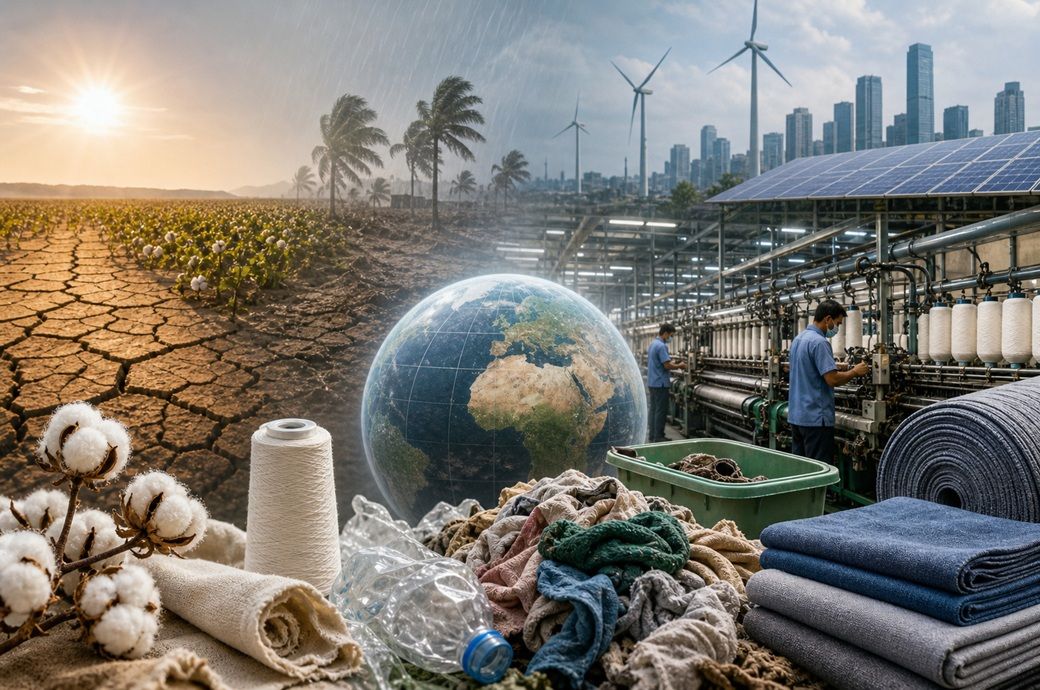
The apparel climate story has moved out of the ESG report and into the cost sheet. In ****–****, climate risk is showing up as cotton quality loss, import dependence, energy volatility, cooling capex, carbon-price exposure and mandatory textile-waste fees. For brands and suppliers, the question is no longer whether climate action is ‘responsible’. It is whether delay will make product margins uncompetitive.
The latest data makes the shift visible. Textile Exchange says global fibre production reached *** million tonnes in **** and could hit *** million tonnes by **** if business continues as usual. Polyester alone now makes up ** per cent of global fibre output, with ** per cent still fossil-based. That scale gives apparel a low-cost material engine, but it also ties the sector to fossil energy, petrochemical volatility and future carbon accounting.

Caprolactam (CPL) prices initially held near $*.**–*.**/kg with minimal movement, while nylon chips saw uptick to ~$*.***/kg (+*.* per cent WoW) driven by short-term restocking. Nylon filament yarn (DTY **D/**F) prices remained stable at ~$*.**–*.**/kg, supported by existing inventory and steady downstream textile operations.
By the second week (April * to April **), benzene stabilised, but caprolactam began to weaken to ~$*.**–*.**/kg (−*.* per cent WoW), signalling the start of broader chain pressure. Nylon chips responded with a mild correction to ~$*.***/kg (−* per cent WoW), while filament yarn prices continued to hold steady due to inventory buffers and ongoing execution of prior textile orders. In the third week (Apr **–**), caprolactam stable to ~$*.*/kg, and chips followed to ~$*.***/kg (Stable WoW).
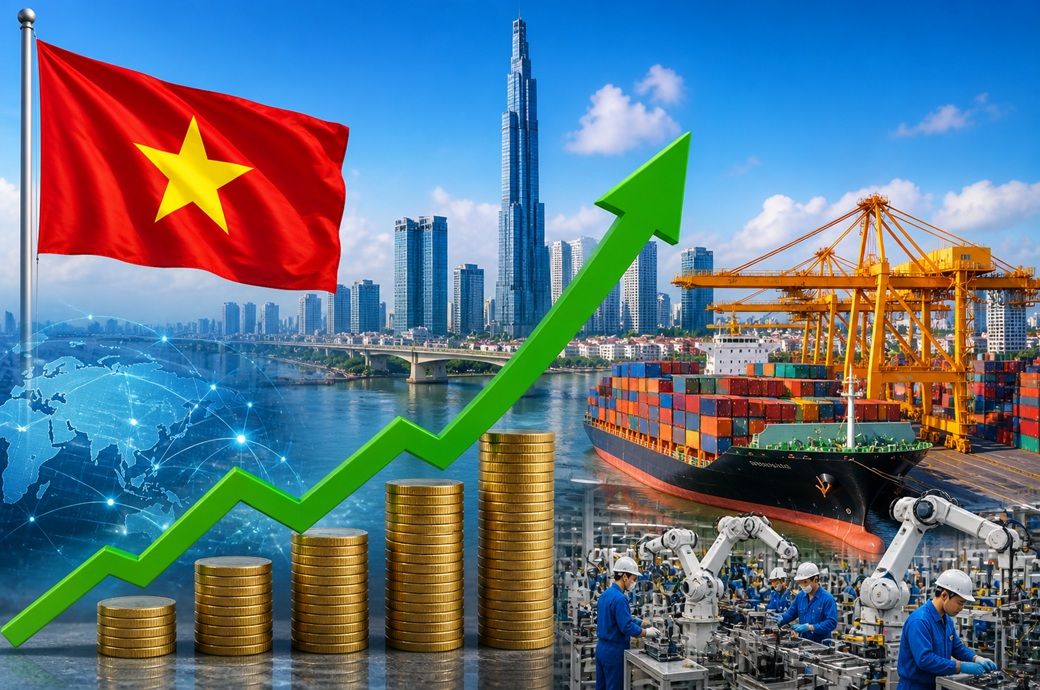
Total registered FDI, including newly registered and adjusted capital, along with foreign investors’ contributions and share purchases, reached $18.24 billion as of April 27, up 32 per cent year on year (YoY), according to the Ministry of Finance’s National Statistics Office (NSO).
Vietnam attracted $18.24 billion in FDI in January–April 2026, up 32 per cent, driven by manufacturing and processing.
Realised FDI hit a five-year high, signalling continued capacity expansion.
Trade surged to $344.17 billion, supported by strong US demand and rising imports from Asia, highlighting deeper global supply chain integration and export momentum.
A total of 1,249 new projects were licensed with combined registered capital of $12.15 billion, reflecting a 3.7 per cent annual increase in project numbers and a 2.2-fold rise in value. Manufacturing and processing dominated, attracting $8.12 billion, or 66.8 per cent of total newly registered capital.
Realised FDI in the January–April period was estimated at $7.40 billion, up 9.8 per cent YoY and marking the highest level for the period in the past five years. Of this, the manufacturing and processing sector disbursed $6.12 billion, accounting for 82.7 per cent. Meanwhile, 316 existing projects registered additional capital of $3.13 billion, representing a sharp 51 per cent decline compared to the same period last year. Combining newly registered and adjusted capital, total FDI into manufacturing and processing reached $10.49 billion, or 68.6 per cent of the total.
Foreign investors carried out 976 capital contribution and share purchase transactions worth $2.96 billion, up 61.9 per cent YoY. Among these, 325 deals increased enterprises’ charter capital by $445.13 million, while 651 share acquisitions without capital increases totalled $2.51 billion. Wholesale and retail trade led these investments, capturing $1.89 billion, or 63.9 per cent.
Among 53 countries and territories with newly licensed projects, Singapore was the largest investor with $6.05 billion, accounting for 49.8 per cent of the total. It was followed by the Republic of Korea with $4.08 billion (33.6 per cent), China with $524.1 million (4.3 per cent), Japan with $462 million (3.8 per cent), Hong Kong (China) with $329.2 million (2.7 per cent), and the Netherlands with $318.5 million (2.6 per cent).
On the trade front, Vietnam’s total trade with the rest of the world was estimated at $344.17 billion in the first four months of 2026, a significant increase from $277.21 billion in the same period last year, the NSO said. In April alone, trade volume reached an estimated $94.32 billion, rising 8 per cent from March and 26.7 per cent YoY.
The United States remained the largest importer of Vietnamese goods, with imports valued at $53.9 billion, while China continued as the top supplier with $69 billion. Imports from traditional markets also surged, with South Korea and ASEAN recording growth rates of 57.8 per cent and 44.3 per cent, respectively.
Fibre2Fashion News Desk (MS)


‘I Actually Thought He Was Going to Hit Me,’ OpenAI’s Greg Brockman Says of Elon Musk
Government needs to act on Middle East impact on retail, industry warns

WWE star Chelsea Green reveals she underwent ‘heart procedure’ to address SVT

-

 Tech1 week ago
A Brain Implant for Depression Is About to Be Tested in Humans
-

 Tech1 week ago
Almost 90% of women leave tech industry within 10 years | Computer Weekly
-

 Sports1 week ago
Pro wrestling star Steph De Lander reveals how colleague’s advice helped lead her to title triumph at ACW
-
 Business1 week ago
‘I had £20,000 stolen and had to fight a 13-month fraud reporting rule to get it back’
-

 Entertainment1 week ago
Norway joins Type 26 Frigate Programme to boost NATO naval power
-

 Tech1 week ago
Are tech leaders risking a cyber resourcing crisis? | Computer Weekly
-

 Entertainment1 week ago
Melania Trump says ABC should ‘take a stand’ on late-night host Kimmel
-
 Business6 days ago
PSX plunges over 4,800 points | The Express Tribune