

Politics
Israel approves strategy to assume control over Gaza

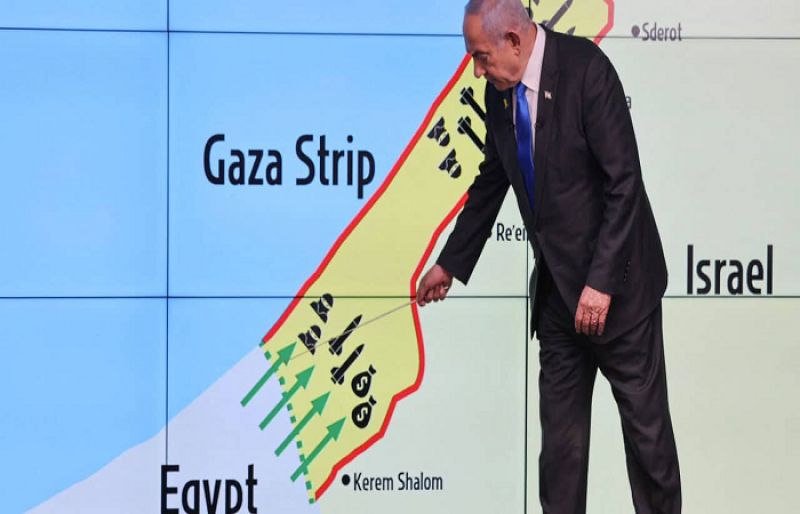

Israel’s political-security cabinet approved a plan early Friday to assume control of Gaza City, shortly after Prime Minister Benjamin Netanyahu reiterated his intention to establish full military control over the entire Gaza Strip, despite mounting domestic and international criticism of the nearly two-year-long conflict.
In a statement, Netanyahu’s office said, “The IDF will prepare to take control of Gaza City while facilitating humanitarian aid for civilians outside combat areas,” referring to the Israeli Defence Forces.
Gaza City, located in the northern part of the enclave, is the largest urban center in the region.
According to Axios journalist Barak Ravid, citing an Israeli official, the plan includes evacuating Palestinian civilians from Gaza City and launching a ground assault in the area.
During an interview with Fox News’ Bill Hemmer on Thursday, Netanyahu confirmed Israel’s intentions, stating “we intend to” when asked whether Israel aimed to take control of the entire coastal strip.
“We don’t want to keep it. We want to have a security perimeter. We don’t want to govern it. We don’t want to be there as a governing body.”
He said Israel wanted to hand over the territory to Arab forces that would govern it. He did not elaborate on the governance arrangements or which Arab countries could be involved.
Netanyahu made the comments to Fox News ahead of a meeting with a small group of senior ministers to discuss plans for the military to take control of more territory in Gaza.
Israeli officials described a previous meeting this week with the head of the military as tense, saying military chief Eyal Zamir had pushed back on expanding Israel’s campaign.
In its Friday statement, Netanyahu’s office said the vast majority of the political-security cabinet members believed that “the alternative plan presented in the cabinet would not achieve the defeat of Hamas nor the return of the hostages.”
Two government sources said any resolution by the security cabinet would need to be approved by the full cabinet, which may not meet until Sunday.
Among the scenarios being considered ahead of the security meeting was a phased takeover of areas in Gaza not yet under military control, one of the sources said, speaking on condition of anonymity.
Evacuation warnings could be issued to Palestinians in specific areas of Gaza, potentially giving them several weeks before the military moves in, the person added.
Total control of the territory would reverse a 2005 decision by Israel by which it withdrew Israeli citizens and soldiers from Gaza, while retaining control over its borders, airspace and utilities.
Right-wing parties blame that withdrawal decision for the Palestinian group Hamas gaining power there in a 2006 election.
It was unclear whether Netanyahu was foreseeing a prolonged takeover or a short-term operation. Israel has repeatedly said it aims to dismantle Hamas and free Israeli hostages.
Hamas in a statement called Netanyahu’s comments “a blatant coup” against the negotiation process.
“Netanyahu’s plans to expand the aggression confirm beyond any doubt that he seeks to get rid of his captives and sacrifice them,” the statement said.
Arab countries would “only support what Palestinians agree and decide on,” a Jordanian official source told Reuters, adding that security in Gaza should be handled through “legitimate Palestinian institutions.”
Hamas official Osama Hamdan told Al Jazeera the group would treat any force formed to govern Gaza as an “occupying” force linked to Israel.
Earlier this year Israel and the United States rejected an Egyptian proposal, backed by Arab leaders, that envisaged the creation of an administrative committee of independent, professional Palestinian technocrats entrusted with the governance of Gaza after the war.
Opinion polls show most Israelis want the war to end in a deal that would see the release of the remaining hostages.
The White House had no immediate comment. President Donald Trump has declined to say whether he supported or opposed a potential full military takeover of Gaza by Israel.
Netanyahu’s government has insisted on total victory over Hamas, which ignited the war when it staged a deadly October 2023 attack on Israel from Gaza.
The U.N. has called reports about a possible expansion of Israel’s military operations in Gaza “deeply alarming” if true.
The idea, pushed especially by far-right ministers in Netanyahu’s coalition, of Israeli forces moving into areas they do not already hold in the enclave has also generated alarm in Israel.
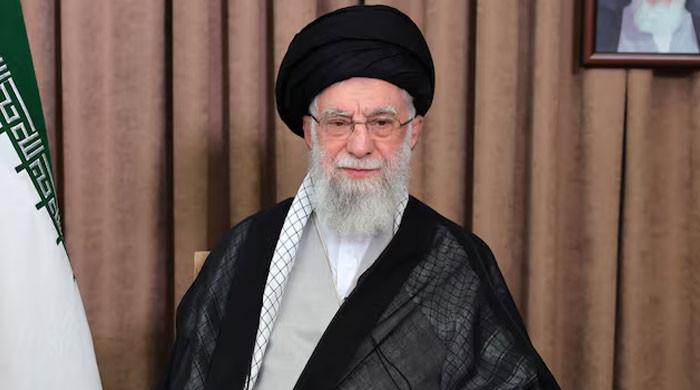
Iran’s Supreme Leader Ayatollah Ali Khamenei was martyred in US and Israeli strikes, state media confirmed, as another wave of attacks hit the country on Sunday.
Several countries, global bodies and prominent groups responded to the assassination of Iran’s supreme leader, urging de-escalation.
Pakistan
Prime Minister Shehbaz Sharif on Sunday denounced the targeting of Iran’s supreme leader in joint strikes by the United States and Israel, saying such actions were a “violation of the norms of international law”.
In a post on X, PM Shehbaz said that it was an age-old convention that the heads of state or government should not be targeted.
“Pakistan also expresses concern over the violation of the norms of international law. It is an age-old convention that the heads of state/government should not be targeted.”
Russia
President Vladimir Putin described Khamenei’s killing as a “cynical murder” that violated “all standards of human morality and international law”.
“Please accept my deep condolences in connection with the murder of the Supreme Leader of the Islamic Republic of Iran, Seyed Ali Khamenei, and members of his family, committed in cynical violation of all norms of human morality and international law.”
China
China said it “strongly condemns” the United States and Israel’s assassination of Iran’s Supreme Leader Ayatollah Ali Khamenei, calling again for a halt to military actions.
The assassination was “a serious violation of Iran’s sovereignty and security, a trampling on the aims and principles of the UN Charter and the basic norms of international relations”, Beijing’s foreign ministry said in a statement.
“China firmly opposes and strongly condemns this,” it added, calling for an “immediate halting of military operations”.
Malaysia
Malaysian Prime Minister Anwar Ibrahim on Sunday “unreservedly” condemned the killing of Iran’s Supreme Leader Ali Khamenei.
“I unreservedly condemn the killing of Iranian Supreme Leader Ali Khamenei. This act places the Middle East on the edge of grave and sustained instability. I extend my condolences to the Islamic Republic of Iran and to the Iranian people at this profoundly difficult momen,” wrote
Indonesia’s Ulema Muslim Clerical Council
“The Indonesian Ulema Council (MUI) expressed its deepest condolences for the death of Iran’s Supreme Leader, Ali Khamenei, as a result of the Israeli-American attack on February 28.
“The United States, which is playing a central role in managing the Palestinian conflict through the BoP (Board of Peace), faces a major question: is this strategy truly aimed at a just peace, or is it actually strengthening an unequal security architecture and burying Palestinian independence? Therefore, the MUI urges the Indonesian government to revoke its membership from the BoP.”
North Korea
North Korea condemned the US and Israeli strikes as an “illegal act of aggression”.
The attacks “constitute a thoroughly illegal act of aggression and the most vile form of violation of sovereignty in their nature”, a Ministry of Foreign Affairs spokesperson said, according to state media.
Iranian president
“The martyrdom of the Supreme Leader at the hands of Israel and the criminal America was a great disaster for our country… America and Israel should know that it will bring them nothing but embarrassment.”
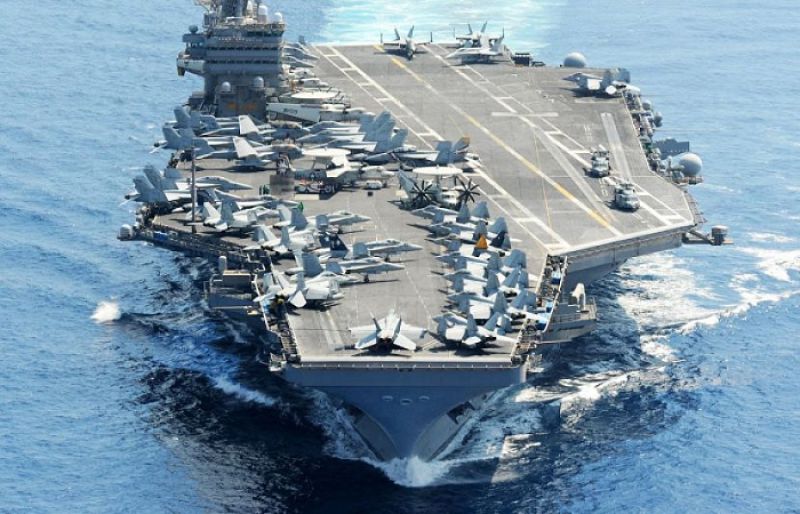
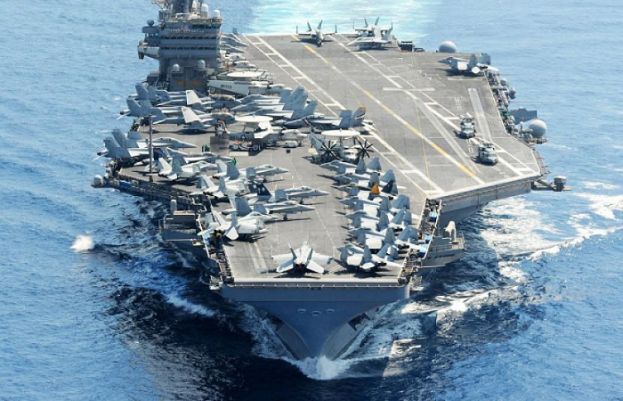
Iran’s Islamic Revolutionary Guard Corps (IRGC) on Sunday claimed it had launched ballistic missile strikes targeting a US aircraft carrier, identifying the vessel as the USS Abraham Lincoln, as part of what it called “Operation True Promise 4.”
In a statement, the IRGC’s public relations office said four ballistic missiles were fired at the carrier, adding that Iran’s military campaign had entered a “new phase.” The group warned that both land and sea would become the “burial place” for what it described as aggressors.
Multiple Waves of Strikes Announced
Earlier, the IRGC said it had launched the seventh and eighth waves of strikes under the same operation, in response to what it termed ongoing aggression by the United States and Israel.
Iran claimed it had carried out precision strikes on military targets in Israeli territory, including areas near Tel Aviv and Haifa. It also alleged that Israeli officials had taken shelter due to heightened security concerns.
Targets Across the Gulf
The IRGC further stated that it had targeted US-operated facilities in West Asia, including the US Fifth Fleet base in Bahrain, as well as installations in Qatar and the United Arab Emirates.
There has been no immediate confirmation from US or Israeli officials regarding the reported missile strikes or the extent of any damage.
Rising Regional Tensions
The developments mark a sharp escalation in regional tensions following reported military exchanges between Iran, Israel and US forces over the weekend.
Independent verification of the claims remains pending, and international observers have urged restraint amid fears of a broader conflict across the Middle East.
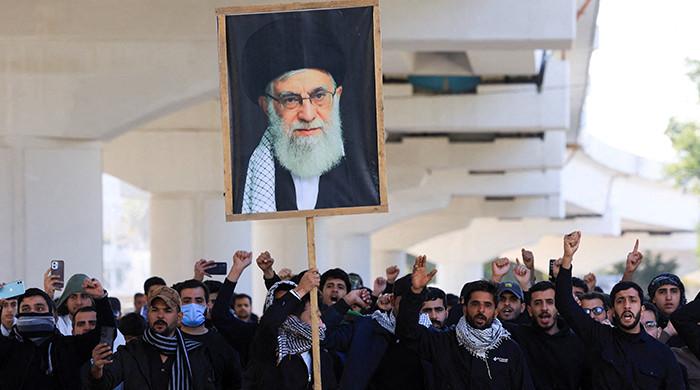
A number of Iranian senior leaders, including Supreme Leader Ayatollah Ali Khamenei, have embraced martyrdom in the “unprovoked and unwarranted” airstrikes by Israel and the United States.
As crowds gathered in Tehran, explosions rang out, and the Israeli military announced that it was again striking targets in the heart of the city — as more blasts were heard in Jerusalem, Riyadh, Dubai, Doha and Manama.
Iran’s President Masoud Pezeshkian declared Khamenei’s assassination a “declaration of war against Muslims” and warned: “Iran considers it its legitimate duty and right to avenge the perpetrators and masterminds of this historic crime.”
Iranian state media have confirmed the killing of several senior figures:
1. Ayatollah Ali Khamenei, supreme leader of Iran
2. Ali Shamkhani, representative of the Supreme Leader in the Supreme Defence Council
3. General Abdolrahim Mousavi, Iran’s Armed Forces chief of staff
4. Major General Mohammad Pakpour, commander-in-chief of the Islamic Revolution Guards Corps (IRGC)
5. Aziz Nasirzadeh, Minister of Defence
6. Gholamreza Rezaian, police intelligence chief of Iran
Separately, the daughter, son-in-law, and granddaughter of Ali Khamenei also embraced martyrdom in the US and Israeli airstrikes.


When We Were Young Festival announces 2026 hiatus: ‘See you in 2027’

NAACP Image Award host Deon Cole issues Tourette warning after BAFTAs

Late to set-piece party, Liverpool are making up for lost time

Pakistan carries out precision strikes on seven militant hideouts in Afghanistan

Eye-popping rise in one year: Betting on just gold and silver for long-term wealth creation? Think again! – The Times of India

Kansas’ Darryn Peterson misses most of 2nd half with cramping

-
 Politics1 week ago
Pakistan carries out precision strikes on seven militant hideouts in Afghanistan
-
Business1 week ago
Eye-popping rise in one year: Betting on just gold and silver for long-term wealth creation? Think again! – The Times of India
-
 Sports1 week ago
Kansas’ Darryn Peterson misses most of 2nd half with cramping
-

 Tech1 week ago
The Supreme Court’s Tariff Ruling Won’t Bring Car Prices Back to Earth
-

 Entertainment1 week ago
Viral monkey Punch makes IKEA toy global sensation: Here’s what it costs
-

 Tech1 week ago
These Cheap Noise-Cancelling Sony Headphones Are Even Cheaper Right Now
-

 Entertainment1 week ago
Saturday Sessions: Say She She performs "Under the Sun"
-

 Sports1 week ago
Floyd Mayweather to come out of retirement again