

Politics
Israel approves strategy to assume control over Gaza

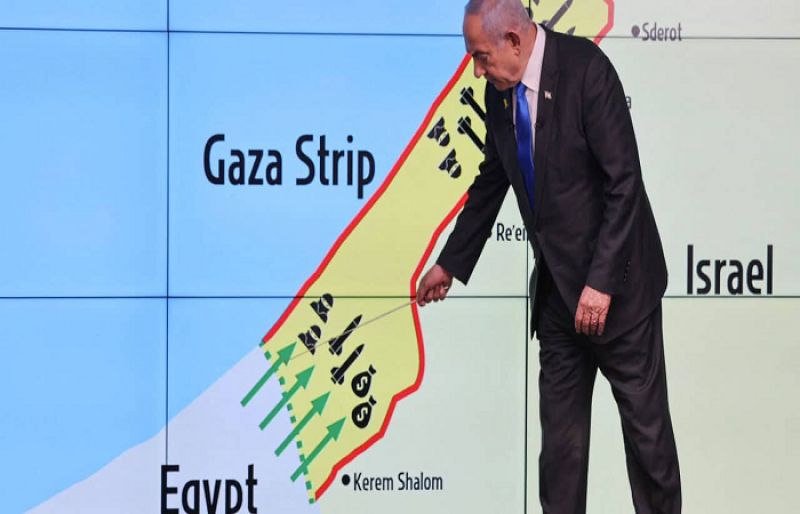

Israel’s political-security cabinet approved a plan early Friday to assume control of Gaza City, shortly after Prime Minister Benjamin Netanyahu reiterated his intention to establish full military control over the entire Gaza Strip, despite mounting domestic and international criticism of the nearly two-year-long conflict.
In a statement, Netanyahu’s office said, “The IDF will prepare to take control of Gaza City while facilitating humanitarian aid for civilians outside combat areas,” referring to the Israeli Defence Forces.
Gaza City, located in the northern part of the enclave, is the largest urban center in the region.
According to Axios journalist Barak Ravid, citing an Israeli official, the plan includes evacuating Palestinian civilians from Gaza City and launching a ground assault in the area.
During an interview with Fox News’ Bill Hemmer on Thursday, Netanyahu confirmed Israel’s intentions, stating “we intend to” when asked whether Israel aimed to take control of the entire coastal strip.
“We don’t want to keep it. We want to have a security perimeter. We don’t want to govern it. We don’t want to be there as a governing body.”
He said Israel wanted to hand over the territory to Arab forces that would govern it. He did not elaborate on the governance arrangements or which Arab countries could be involved.
Netanyahu made the comments to Fox News ahead of a meeting with a small group of senior ministers to discuss plans for the military to take control of more territory in Gaza.
Israeli officials described a previous meeting this week with the head of the military as tense, saying military chief Eyal Zamir had pushed back on expanding Israel’s campaign.
In its Friday statement, Netanyahu’s office said the vast majority of the political-security cabinet members believed that “the alternative plan presented in the cabinet would not achieve the defeat of Hamas nor the return of the hostages.”
Two government sources said any resolution by the security cabinet would need to be approved by the full cabinet, which may not meet until Sunday.
Among the scenarios being considered ahead of the security meeting was a phased takeover of areas in Gaza not yet under military control, one of the sources said, speaking on condition of anonymity.
Evacuation warnings could be issued to Palestinians in specific areas of Gaza, potentially giving them several weeks before the military moves in, the person added.
Total control of the territory would reverse a 2005 decision by Israel by which it withdrew Israeli citizens and soldiers from Gaza, while retaining control over its borders, airspace and utilities.
Right-wing parties blame that withdrawal decision for the Palestinian group Hamas gaining power there in a 2006 election.
It was unclear whether Netanyahu was foreseeing a prolonged takeover or a short-term operation. Israel has repeatedly said it aims to dismantle Hamas and free Israeli hostages.
Hamas in a statement called Netanyahu’s comments “a blatant coup” against the negotiation process.
“Netanyahu’s plans to expand the aggression confirm beyond any doubt that he seeks to get rid of his captives and sacrifice them,” the statement said.
Arab countries would “only support what Palestinians agree and decide on,” a Jordanian official source told Reuters, adding that security in Gaza should be handled through “legitimate Palestinian institutions.”
Hamas official Osama Hamdan told Al Jazeera the group would treat any force formed to govern Gaza as an “occupying” force linked to Israel.
Earlier this year Israel and the United States rejected an Egyptian proposal, backed by Arab leaders, that envisaged the creation of an administrative committee of independent, professional Palestinian technocrats entrusted with the governance of Gaza after the war.
Opinion polls show most Israelis want the war to end in a deal that would see the release of the remaining hostages.
The White House had no immediate comment. President Donald Trump has declined to say whether he supported or opposed a potential full military takeover of Gaza by Israel.
Netanyahu’s government has insisted on total victory over Hamas, which ignited the war when it staged a deadly October 2023 attack on Israel from Gaza.
The U.N. has called reports about a possible expansion of Israel’s military operations in Gaza “deeply alarming” if true.
The idea, pushed especially by far-right ministers in Netanyahu’s coalition, of Israeli forces moving into areas they do not already hold in the enclave has also generated alarm in Israel.
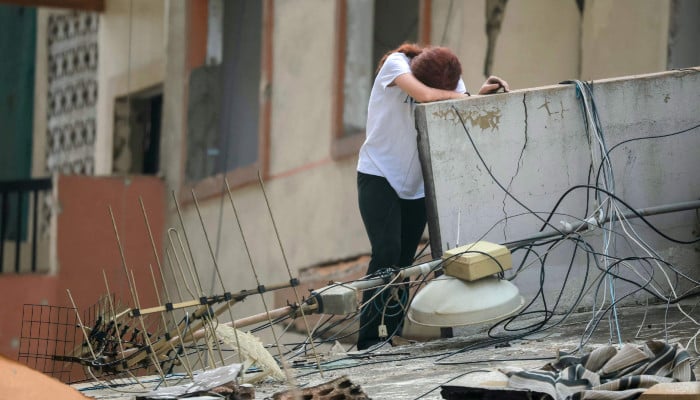
Khodr Sahmarani stood dazed beside the rubble of his south Lebanon home, his forehead in a white bandage, staring at the wreckage where his brother, nephew, and two neighbours died.
“I was upstairs, then I was underground. I screamed ‘Where are you, where are you?’, but there was no one,” he said after surviving an Israeli airstrike on the city of Nabatiyeh just hours before the ceasefire began at midnight on Thursday night.
The afternoon attack flattened what residents say was a five-storey building, creating a jumble of shattered concrete in the battered city.
Nabatiyeh rescuer Mohammad Sleiman told AFP they recovered one body from the strike site on Thursday night, and another three on Friday morning.
Sahmarani, 57, said rescuers “came and took me out of the rubble”.
Israel and Lebanon agreed to a 10-day ceasefire on Thursday in order to negotiate an end to six weeks of war between Israel and the Iran-backed group Hezbollah.
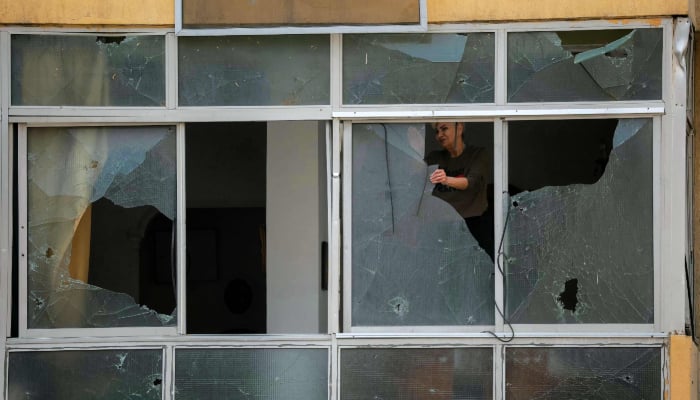
The conflict saw massive Israeli airstrikes across Lebanon and also a ground invasion in the south.
Lebanese authorities say the war that began on March 2 has killed nearly 2,300 people, and caused widespread devastation in southern towns and cities such as Nabatiyeh.
President Joseph Aoun said on Friday that “direct negotiations” with Israel “are crucial, and that the government aims to “consolidate a ceasefire, secure the withdrawal of Israeli forces from the occupied southern territories, recover prisoners, and address outstanding border disputes”.
Hezbollah halted military operations after the ceasefire came into effect, but warned that it was keeping its “finger on the trigger” in case Israel violated the truce.
‘For whose sake?’
Nabatiyeh’s streets were almost empty on Friday, and countless buildings in the city centre have been damaged or destroyed.
A few kilometres outside the city, a small group of Hezbollah supporters cheered on the trickle of cars coming from the direction of Beirut, flashing victory signs and waving the party’s yellow flag.
Deadly Israeli strikes were reported up to the final few minutes before the midnight Thursday deadline agreed upon by the two governments.
“It was the last hours. If it was the beginning of the war, the middle of the war, one can come to terms with it, but it was the last hours,” Sahmarani said, his eyes bloodshot and tearful.
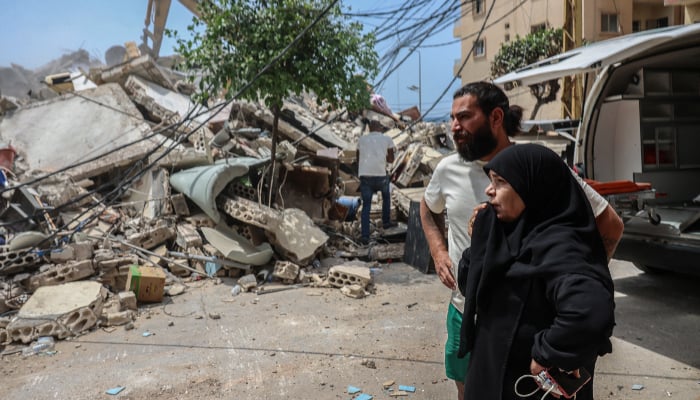
Fadel Hassan Zahri, a neighbour, said the people who were killed had been “lifelong friends of mine”.
“I wouldn’t eat without them, I wouldn’t drink without them.”
Zahri said he was appalled by the government’s willingness to negotiate potential peace and normalisation with Israel.
“We’ve been honourable all our lives… we do not normalise with Israel.”
Sahmarani said he has nowhere else to go and would probably crawl back into the rubble of his home at night and find a ledge or somewhere to lay his head.
“Where should I go now? Who will even look at me?” he asked, adding that he distrusted the Lebanese authorities.
“Let our leaders normalise; no one will listen to them and no one recognises them.
“For whose sake? For whose sake am I supposed to lose all of this?”
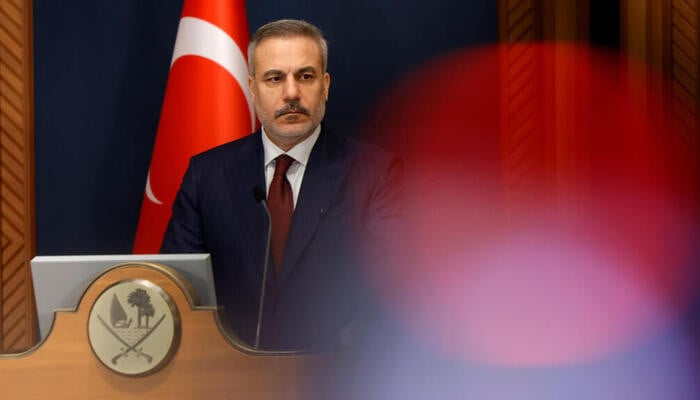
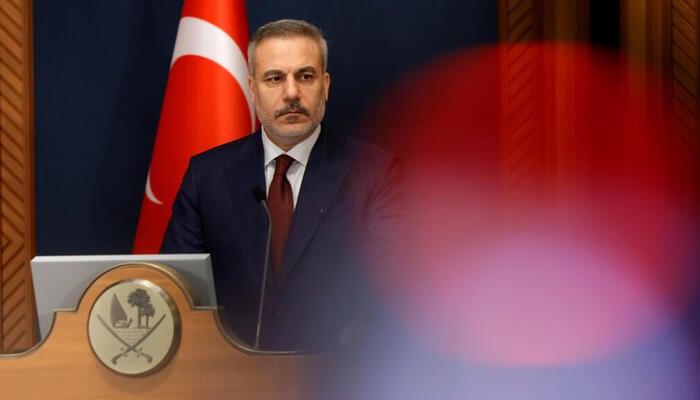
Turkiye’s top diplomat on Saturday accused Israel of creating an international “illusion” and using security concerns as a pretext to seize “more land,” in the latest flare-up in escalating tensions between the two regional powers.
Israel and Turkiye have been trading near-daily diplomatic barbs over a range of regional conflicts, from Israel’s war in Gaza to rising tensions linked to Iran.
“Israel is not after its own security. Israel is after more land,” Turkish Foreign Minister Hakan Fidan said at the Antalya Diplomacy Forum in the Mediterranean resort city.
“Security is being used by the Netanyahu government as an excuse to occupy more land,” he added, referring to Israeli Prime Minister Benjamin Netanyahu.
Speaking in English at a panel discussion, Fidan said Israel had created an “illusion” internationally by portraying itself as acting purely in its own defence.
“It has become very clear, especially in recent years, that it is more than that,” he said.
From Palestinian lands, including Gaza, the West Bank and East Jerusalem, and now extending towards Lebanon and Syria, Israel was pursuing “an onward occupation and expansionism in the region,” Fidan said.
“I think this has to stop.”
“Israel has to know that the only way to live peacefully in the region is to let other countries enjoy their own security, territorial integrity and freedom, and not to use power against them,” he added.
Turkiye and Israel have frequently been at odds, including over Israel’s military campaign in Gaza and differences over Syria’s future.
Relations were severely strained in 2010 when Israeli forces raided a flotilla of ships attempting to breach Israel’s naval blockade of Gaza, killing nine Turkish activists and one US national. The flotilla was co-organised by a Turkish aid group.
‘Move back to Russia-Ukraine talks’
Fidan on Friday met the foreign ministers of Pakistan, Saudi Arabia and Egypt for talks on regional issues, including the Middle East conflict, on the sidelines of the forum.
Asked about the discussions, Fidan said regional countries needed to come together to address shared challenges.
“It is time for all of us to come together in a very mature way and own our problems,” he said, again singling out Israel as the only country seeking territorial gains.
Commenting on Turkiye’s quiet diplomacy over the Russia-Ukraine war, Fidan said those efforts had been overshadowed by tensions involving Iran.
“That has left the Russia-Ukraine war on the side,” he said.
He added that attention should shift back to Ukraine talks once tensions with Iran eased, warning that the conflict remained open to escalation.
Turkiye, which has hosted several rounds of Russia-Ukraine negotiations, is also hosting Russian Foreign Minister Sergei Lavrov and Ukrainian Foreign Minister Andrii Sybiha at separate panels during the Antalya Diplomacy Forum.
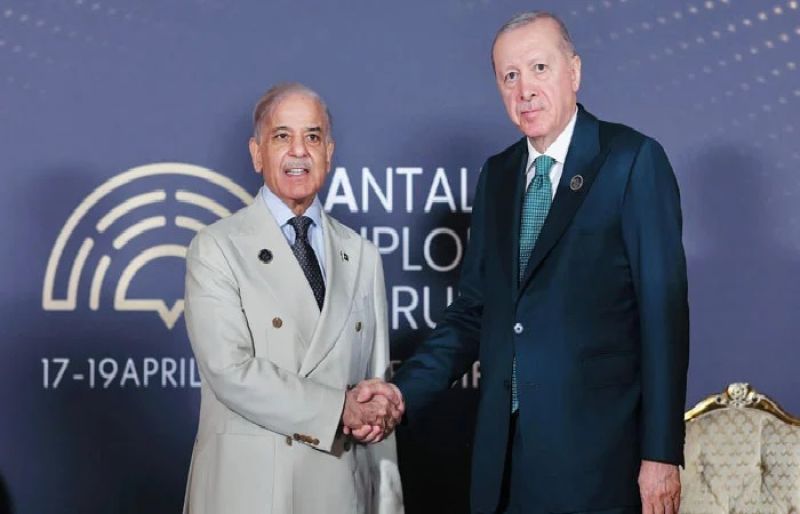
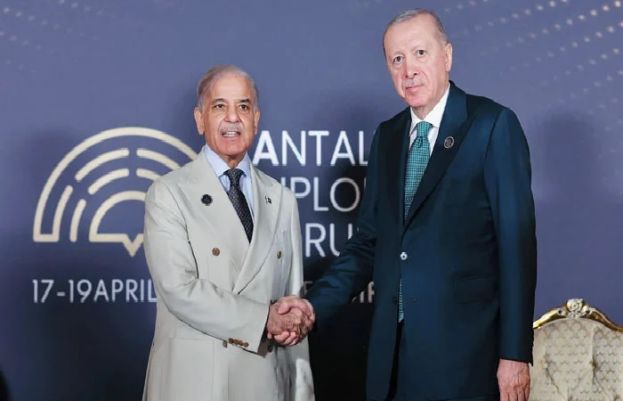
Prime Minister Shehbaz Sharif on Friday held a bilateral meeting with Turkish President Recep Tayyip Erdogan on the sidelines of the 5th Antalya Diplomacy Forum.
According to a statement released by the Prime Minister’s Office, during the warm and cordial meeting, President Erdogan welcomed PM Shehbaz to Turkiye and thanked him for attending the Antalya Diplomacy Forum.
The meeting comes a day after the premier reached Turkiye on the third leg of his tri-nation tour after concluding visits to Saudi Arabia and Qatar.
During his visit to Riyadh and Doha, PM Shehbaz held meetings with Saudi Crown Prince Mohammed bin Salman and Qatar’s Emir Sheikh Tamim bin Hamad Al Thani.
The Turkish president, during the meeting with PM Shehbaz on the sidelines of the diplomacy forum earlier today, praised the prime minister’s peace efforts and said Turkiye would continue to support Pakistan’s diplomatic initiative to bring peace to the region.
The prime minister thanked President Erdogan for his warm invitation and traditional Turkish hospitality extended to him and his delegation during his stay in Antalya.
He congratulated the Turkish president on the success of the Antalya Diplomacy Forum, which he said had transformed into an important global event.
The two leaders exchanged views on recent regional developments, particularly the evolving situation in the Middle East. PM Shehbaz thanked Erdogan for his strong support and encouragement of Pakistan’s peace efforts and shared with him the updates on how to extend the ceasefire and resume talks so that a peace agreement could be reached.
The two leaders also emphasised the importance of effectively utilising the current window of opportunity to advance a durable and lasting regional peace.
While reaffirming the deep-rooted, historic, and brotherly ties between Pakistan and Turkiye, both leaders expressed satisfaction at the positive trajectory of bilateral relations. They agreed to convene the 8th High-Level Strategic Cooperation Council (HLSCC) meeting in Ankara later this year.
The two leaders emphasised the importance of expediting the implementation of ongoing initiatives and exploring new opportunities to further deepen economic engagement.
The meeting concluded with both leaders reaffirming their resolve to further strengthen the strategic partnership between Pakistan and Türkiye, building on fraternal ties and a shared vision for peace and prosperity.
The meeting was attended by Deputy Prime Minister and Foreign Minister Ishaq Dar, Minister for Information Ataullah Tarar and other senior officials.
Turkish Foreign Minister Hakan Fidan and other senior Turkish officials were also present.
PM meets world leaders on sidelines of diplomacy forum
Prime Minister Shehbaz Sharif held a series of meetings with world leaders on the sidelines of the Antalya Diplomacy Forum.
During the interactions, the prime minister met Qatar’s Emir Sheikh Tamim bin Hamad Al Thani, Kazakhstan’s President Kassym-Jomart Tokayev, Azerbaijan’s President Ilham Aliyev, and Syria’s President Ahmed al-Sharaa.
He also held meetings with Qatar’s Prime Minister and Foreign Minister Sheikh Mohammed bin Abdulrahman bin Jassim Al Thani, as well as former Kosovo president Vjosa Osmani.


Hormuz flashpoint: Why Indian-flagged ships are in focus as Middle East tensions hit global shipping – The Times of India

The Smart Home Gadgets to Amp Up Your Curb Appeal

Royal fan defends Meghan Markle amid brutal criticism: ‘There was no BS’

-

 Politics1 week ago
Indian airlines hit hardest after Dubai limits foreign flights until May 31
-

 Entertainment5 days ago
Palace left in shock as Prince William cancels grand ceremony
-

 Sports5 days ago
The case for Man United’s Fernandes as Premier League’s best
-

 Politics1 week ago
Chinese, Taiwanese will unite, Xi tells Taiwan opposition leader
-
 Business5 days ago
UK could adopt EU single market rules under new legislation
-

 Entertainment1 week ago
Dua Lipa hits major career high ahead of wedding with Callum Turner
-
 Business1 week ago
He paid $248 in illegal tariffs for this coat. Will he ever get it back?
-

 Sports7 days ago
Lamar Jackson hits back at critics with faithful message on social media