

Politics
Lebanon truce impossible without Iran’s push in Islamabad talks: Sheikh Qassem

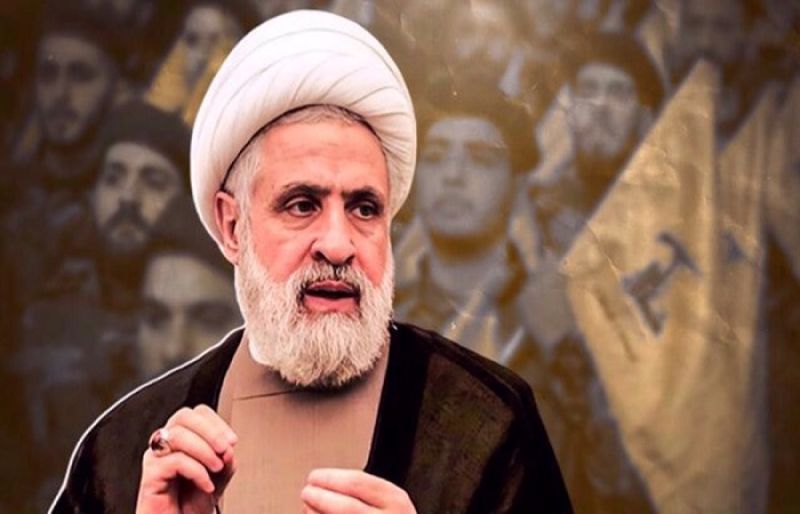
Hezbollah’s secretary general says Iran’s insistence on ending Israeli aggression against Lebanon during indirect negotiations with Washington was the decisive factor that made a ceasefire with Israel possible.
“A ceasefire would not have been achieved without Iran’s position during the Pakistan talks,” Sheikh Naim Qassem said in a statement released on Monday.
The Hezbollah chief noted that the Tel Aviv regime is currently at an impasse, and Hezbollah remains staunchly prepared, strong, and invincible.
Earlier this month, negotiations began between Iranian and US delegations in Islamabad on an end to the US-Israeli aggression against the Islamic Republic.
Ever since, Tehran had kept pushing for a ceasefire in Lebanon as a major condition for any progress in the talks and the start of the second round of negotiations.
This finally forced US President Donald Trump and the Tel Aviv regime to comply on this issue.
Israel was trying to continue the war on Lebanon despite the ceasefire in Iran, and the United States was also trying to evade this issue by violating its initial commitment.
Iran once again showed that it stands by its principled positions and that resistance pays off.
“The resistance continues to be strong and cannot be defeated, and the enemy was surprised by the steadfastness of the fighters,” the Hezbollah leader said.
He added that his fellow fighters will continue their defensive resistance in defense of Lebanon and its people.
“We will not return to what existed before March 2. We will respond to Israeli aggression and confront it,” Sheikh Qassem stressed.
He went on to roundly dismiss the notion of direct negotiations with Israel, emphasizing such talks would neither be in the interest of Lebanese authorities nor the Arab nation at large.
“We categorically reject direct negotiations, and those in power must know that their conduct will neither benefit Lebanon nor benefit themselves,” Sheikh Qassem pointed out.
The Hezbollah leader also sharply criticized the Beirut government for making concessions to the occupying Tel Aviv regime, urging officials to abandon the initiative seeking direct talks and instead opt for indirect negotiations.
Sheikh Qassem also underscored that Hezbollah’s weapons are tied to deterring Israeli aggression and safeguarding Lebanon’s territorial integrity.
He stressed that the Lebanese resistance movement would not disarm.
“The Zionist enemy, with the large-scale support of the United States, sought to pull the plug on Hezbollah, the Islamic resistance front and their popular base by means of the September 2024 onslaught. It employed all means to reach the objective. Yet, it has failed to make such an achievement,” the Hezbollah leader stated.
Sheikh Qassem stated that Israel has suffered a humiliating defeat in light of Hezbollah’s steadfastness and military prowess, its wide array of combat methods, discreet management of battles with Israeli forces, and unwavering support from all walks of the Lebanese society.
On March 2, Hezbollah launched military operations against the Israeli regime in response to its aggression against Iran, its repeated violations of the 2024 ceasefire, and its continued occupation of Lebanese territory in the country’s south.
Following the Iran-US ceasefire on 8 April, Tel Aviv was compelled to accept a ceasefire in Lebanon as well, after Tehran demanded an end to Israeli attacks on Lebanese soil as one of its primary conditions in indirect negotiations with Washington.
The Israeli military, however, quickly resumed its assaults on southern Lebanon, issuing evacuation threats for several areas even after the initial ten-day truce between Tel Aviv and Beirut was extended for an additional three weeks.
Israeli occupation forces also continue to hold parts of southern Lebanon, where they have imposed a so-called “Yellow Line” — a coercive military buffer resembling the regime’s notorious control measures in the besieged Gaza Strip.
According to Lebanese authorities, nearly 2,500 people have been killed in Lebanon since the Israeli regime launched its renewed offensive following Hezbollah’s 2 March operation.


- Court orders detention as federal case continues.
- Suspect calls himself “Friendly Federal Assassin”.
- Secret Service agent struck but vest stops shot.
The man accused of shooting a US Secret Service agent as he tried to breach security at a Washington dinner attended by President Donald Trump is facing federal charges of attempting to assassinate the president, a judge said in court on Monday.
Cole Tomas Allen, 31, of Torrance, California, also faces firearms charges in a three-count complaint.
Allen wore a blue prison jumpsuit at his first appearance in Washington federal court, two days after authorities said they foiled an attack at the White House Correspondents’ Association Dinner, an annual black-tie gathering of journalists and politicians.
“He attempted to assassinate the president of the United States, Donald J. Trump,” prosecutor Jocelyn Ballantine said in court.
Allen has not yet responded to the allegations. Seated at the defense table flanked by US Marshals, Allen said he would answer all questions truthfully and that he had a master’s degree in computer science.
US Magistrate Judge Matthew Sharbaughordered Allen detained while the case moves forward. Sharbaugh scheduled another hearing over Allen’s continued detention for Thursday.
‘Friendly Federal Assassin’
Allen left a manifesto with family members referring to himself as the “Friendly Federal Assassin” and discussing plans to target senior Trump administration officials, who were present in the hotel ballroom. Blanche said his targets likely included Trump himself.

White House press secretary Karoline Leavitt on Monday described the Saturday night attack as the third major assassination attempt against Trump, after two attempts on his life in 2024. She compared the rhetoric in the manifesto to criticism of Trump by his political opponents.
“Much of the manifesto of the would-be assassin is indistinguishable from the words that we hear daily from so many,” Leavitt said. “The entire Democrat Party has made their pitch to voters across the country that Donald Trump poses an existential threat to democracy, that he is a fascist.”
Prominent elected Democrats have condemned the shooting.
Allen booked a room at the Washington Hilton hotel, where the dinner took place, and traveled from California to Washington by train, officials said.
The shooting on Saturday rattled the press dinner, a prominent event on Washington’s social calendar, sending attendees scrambling under tables and prompting law enforcement to whisk senior officials out of the room. Trump, who was set to deliver remarks later in the evening, was rushed off the stage by security personnel after shots were fired.
Secret service agent struck
The suspect allegedly fired a shotgun at a Secret Service agent at a checkpoint inside the hotel before being tackled and arrested, according to authorities. Video footage Trump posted online showed the suspect sprinting through a hallway outside the ballroom.
US officials have said the suspect was subdued just inside a security perimeter and have touted his takedown as a law enforcement success. But the incident has revived concerns about the safety of Trump, who survived two assassination attempts during his 2024 presidential campaign, and other U.S. officials.
The Secret Service agent was struck but a tactical vest stopped the shot, and the agent was released from a hospital hours later.
Allen, who authorities said was armed with a handgun and multiple knives, in addition to the shotgun, was also taken to a local hospital to be evaluated following the shooting.
- UN nuclear talks begin as global tensions intensify.
- Guterres says treaty commitments remain unfulfilled.
- US President Trump signals potential nuclear tests.
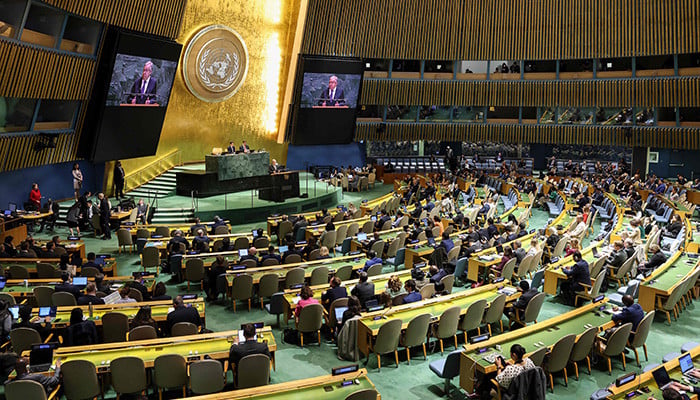
Signatories of the landmark nuclear non-proliferation treaty began a meeting Monday at the United Nations as fears of a renewed arms race escalate, with atomic powers again at loggerheads over safeguards.
In 2022, during the last review of the treaty considered the cornerstone of non-proliferation, UN Secretary-General Antonio Guterres warned humanity was “one misunderstanding, one miscalculation away from nuclear annihilation.”
On Monday, he warned “the drivers” of nuclear weapons proliferation were accelerating.
“For too long, the treaty has been eroding. Commitments remain unfulfilled. Trust and credibility are wearing thin. The drivers of proliferation are accelerating. We need to breathe life into the treaty once more,” Guterres said in opening remarks.
With global geopolitical friction only heightened since the last meeting, it was unclear what the gathering at UN headquarters could achieve.
France’s Foreign Minister Jean-Noel Barrot told signatories that “never has the risk of nuclear proliferation been so high, and the threat posed by Iran’s and North Korea’s programmes is intolerable for each and every state party to this treaty.”
Tempering expectations, Do Hung Viet, Vietnam’s UN ambassador and president of the conference, said: “We should not expect this conference to resolve the underlying strategic tensions of our time.”
“But a balanced outcome that reaffirms core commitments and set out practical steps forward would strengthen the integrity of the NPT,” he said.
“The success or failure of this conference will have implications way beyond these halls,” Viet added. “The prospects of a new nuclear arms race are looming over us.”
The nuclear non-proliferation treaty (NPT), signed by almost all countries on the planet — with notable exceptions including Israel, India and Pakistan — aims to prevent the spread of nuclear weapons, promote complete disarmament, and encourage cooperation on civilian nuclear projects.
The nine nuclear-armed states — Russia, the United States, France, the United Kingdom, China, India, Pakistan, Israel and North Korea — possessed 12,241 nuclear warheads in January 2025, the Stockholm International Peace Research Institute (Sipri) reported.
The US and Russia hold nearly 90% of nuclear weapons globally and have carried out major programs to modernise them in recent years, according to Sipri.
China has also rapidly increased its nuclear stockpile, Sipri said, with the G7 raising the alarm Friday over Moscow and Beijing boosting their nuclear capabilities.
US President Donald Trump has indicated his intention to conduct new nuclear tests, accusing others of doing so clandestinely.
In March, French President Emmanuel Macron announced a dramatic shift in nuclear deterrence, notably an increase in the atomic arsenal, currently numbering 290 warheads.
‘Affront’ to NPT
“It is obvious that trust is eroding, both inside and outside the NPT,” Seth Shelden of the International Campaign to Abolish Nuclear Weapons, a Nobel Peace Prize laureate, told AFP.
He questioned the likely outcome of the four-week summit.
Decisions on the NPT require agreement by consensus, with the previous two conferences failing to adopt final political declarations.
In 2015, the deadlock was largely due to opposition by Israel’s arch-ally Washington to creation of a nuclear-weapon-free zone in the Middle East.
A 2022 impasse was due mainly to Russian opposition to references to Ukraine’s nuclear power plant at Zaporizhzhia, occupied by Moscow.
This year’s summit could hit any number of stumbling blocks.
The ongoing war in Ukraine, Iran’s nuclear programme and the war there, proliferation fears and Pyongyang’s developing arsenal could all be deal-breakers.
The United States along with its allies Britain, the UAE and Australia spoke out at Iran’s appointment as a conference vice president.
Washington’s meeting envoy said conferring a leadership role on Tehran was an “affront” to countries that take the NPT “seriously.”
Artificial intelligence could be a prominent issue as some countries call for all sides to keep human control over nuclear weapons.
- Putin says he received message from Iran’s Supreme Leader.
- Moscow “will do everything” to achieve regional peace: Putin.
- Russia building two new nuclear units in Iran’s Bushehr.
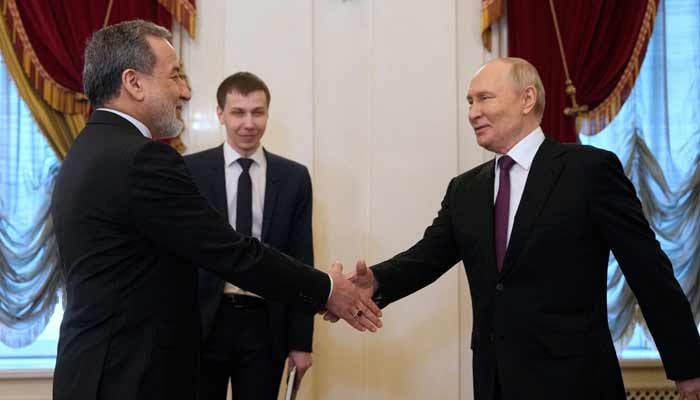
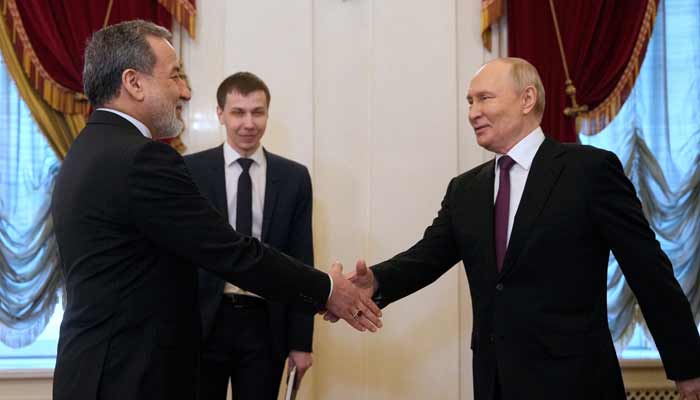
Russian President Vladimir Putin held talks with Iranian Foreign Minister Abbas Araghchi in St. Petersburg on Monday and told him he hoped the Iranian people would weather what he described as a “difficult period” and that peace would soon prevail.
Russia has offered to mediate to try to help restore calm to the Middle East following US and Israeli strikes on Iran, which Moscow has condemned. It has also repeatedly offered to store Iran’s enriched uranium as a way of defusing tensions, an offer the United States has not taken up.
“For our part, we will do everything that serves your interests and the interests of all the peoples of the region to ensure that peace is achieved as quickly as possible,” Putin told Araghchi, according to Russian state media.
“Last week I received a message from Iran’s Supreme Leader. I would like to ask you to convey my most sincere thanks for this and to confirm that Russia, like Iran, intends to continue our strategic relationship,” Putin added.
Iran last year sealed a 20-year strategic partnership agreement with Moscow, Russia is building two new nuclear units at Bushehr, the site of Iran’s only nuclear power plant, and Iran supplied Russia with Shahed drones for use against Ukraine.
Araghchi said relations between Russia and Iran would continue to strengthen and thanked Putin for Moscow’s support, the state RIA news agency reported.


Josh Duhamel provides relationship update with ex-wife Fergie

Why Spotify has no button to filter out AI music

‘I had £20,000 stolen and had to fight a 13-month fraud reporting rule to get it back’

-

 Sports1 week ago
NCAA men’s gymnastics championship: All-time winners list
-

 Sports1 week ago
WWE WrestleMania 42 Night 2: Live match results and analysis
-

 Fashion1 week ago
UK’s Sosandar returns to profitability amid robust FY26 performance
-

 Politics7 days ago
UK’s Starmer seeks to deflect blame over Mandelson appointment
-

 Entertainment1 week ago
Lee Anderson, Zarah Sultana kicked out of UK Parliament for calling PM ‘liar’
-
 Business1 week ago
How Trump’s psychedelics executive order could unlock stalled cannabis reform
-
 Business1 week ago
No fuel shortage: Govt assures 100% domestic LPG, PNG, CNG supply amid Hormuz energy crunch – The Times of India
-

 Sports1 week ago
Quetta Gladiators opt to bowl after winning toss against Peshawar Zalmi in PSL 11 clash