

Business
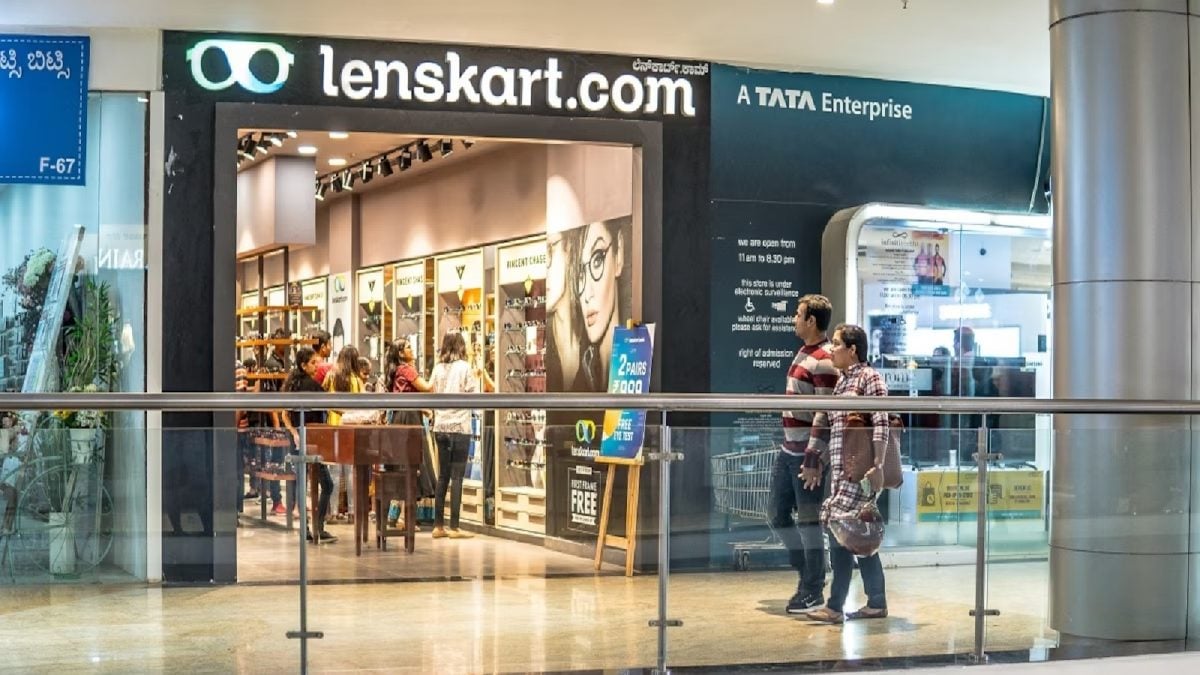
Lenskart IPO GMP Today Falls Amid Valuation Concerns: Know Opening Date, Price, Reviews

Last Updated:
Lenskart IPO GMP Today: The company’s grey market premium has slightly fallen to 16.5% on Wednesday, compared with over 18% on Tuesday and nearly 27% on Monday.
Lenskart IPO GMP Today.
Lenskart IPO GMP Today: Eyewear retailer Lenskart Solutions is set to launch its initial public offer (IPO) on Wednesday, October 31. The price band of the Rs 7,278-crore IPO has been fixed in the range of Rs 382-Rs 402 apiece. Analysts have raised valuation concerns with the IPO, which comes at a price-to-earnings (P/E) ratio of 230x. According to market observers, the grey market premium or GMP has slightly fallen to 16.5% on Wednesday, compared with over 18% on Tuesday and nearly 27% on Monday.
Lenskart IPO: Opening, Closing, Allotment, Listing Dates
The IPO will be opened on October 31 and closed on November 4. Its allotment will be finalised on November 6, while the stock listing is scheduled to take place on November 10 on both BSE and NSE.
Lenskart IPO GMP Today
According to market observers, unlisted shares of Lenskart Solutions Ltd are currently trading at Rs 468 apiece in the grey market, against the upper IPO price of Rs 402. It means a grey market premium (GMP) of 16.42%, indicating decent listing gains for investors.
The GMP is based on market sentiments and keeps changing. ‘Grey market premium’ indicates investors’ readiness to pay more than the issue price.
Lenskart IPO: What Analysts Say
Analysts point towards the high valuation of the company. SBI Securities said that at the upper end of the price band, Lenskart’s valuation stands at 10.1 times its FY25 EV/Sales and 68.7 times EV/EBITDA on a post-issue basis.
The analysts at SBI Securities cautioned that the issue appears stretched on valuation, which may cap potential listing gains. However, they highlighted the company’s strong business model and the significant growth opportunity in India’s expanding eyewear market as key positives.
The brokerage also noted that profitability metrics will need close monitoring as the company continues to scale its operations. Lenskart’s EBITDA margin has notably improved from 7% in FY23 to 14.7% in FY25, reflecting operational efficiency. Considering the company’s long-term prospects, SBI Securities has recommended subscribing to the IPO for the long term at the cut-off price.
Though the Lenskart Solutions IPO is debuting at a steep valuation of around 234 times its price-to-earnings (P/E) ratio, analysts said assessing the company’s valuation solely on the basis of its P/E ratio may not present a fair picture. They said Lenskart operates in a high-growth segment with significant untapped potential, given the low penetration of eyewear in India.
According to the Redseer Report, Lenskart emerged as the leading seller of prescription eyeglasses by volume in FY25 among organised retailers in India. The company has also expanded its footprint beyond domestic markets, establishing a presence in Japan, Southeast Asia, and the Middle East.
SBI MF Invests Rs 100 Crore In Lenskart
SBI Optimal Equity Fund (AIF) and SBI Emergent Fund (AIF), invested Rs 100 crore in eyewear retailer Lenskart Solutions Limited through a pre-IPO transaction at a transfer price of Rs 402 per equity share.
As part of the transaction, Neha Bansal, one of the promoters, who held 7.61% of Lenskart’s pre-offer paid-up equity share capital (fully diluted basis) prior to the transfer, transferred 2,487,561 equity shares. Neha Bansal continues to hold 7.46% of the pre-offer share capital of the Company on a fully diluted basis after the transfer. The share sale does not form part of the IPO Offer for Sale.
The investment comes on the eve of the opening of Lenskart’s Initial Public Offering (IPO) scheduled for Friday, October 31, 2025.
Last week, Billionaire investor Radhakishan Damani, founder of Avenue Supermarts (DMart), invested around Rs 90 crore in eyewear retailer Lenskart through a pre-IPO transaction, according to people familiar with the development.
Lenskart IPO Price Band and Size
The company has fixed the price band at Rs 382-402 per share for its IPO. At the upper end of the price band, Lenskart is seeking a valuation of around $7.91 billion (about Rs 72,700 crore).
The issue includes a fresh issue of shares worth Rs 2,150 crore, while the offer-for-sale (OFS) segment will see promoters and investors offloading more than 12.75 crore equity shares.
Key Selling Shareholders in the OFS
Along with founders and promoters (Peyush Bansal, Neha Bansal, Amit Chaudhary, and Sumeet Kapahi), several major investors are participating in the OFS. These include SoftBank’s SVF II Lightbulb (Cayman), Schroders Capital, PI Opportunities Fund, MacRitchie Investments, Kedaara Capital Fund, and Alpha Wave Ventures.
Notably, Schroders Capital Private Equity Asia (Mauritius) is set to make a complete exit, selling 1.9 crore shares, which represent a 1.13% stake in the company.
About Lenskart
Founded in 2010, Lenskart began as an online eyewear retailer and has since grown into one of India’s leading omnichannel eyewear brands with both online and offline presence. The company was valued at $6.1 billion as of September 2025, according to Tracxn data cited by Reuters.
In June 2025, the company transitioned into a public limited entity — changing its name from Lenskart Solutions Private Limited to Lenskart Solutions Limited after an extraordinary general meeting held on May 30.
Lenskart IPO Lead Managers and Objective
The fresh issue will be used for business expansion, new investments, acquisitions and general corporate purposes.
The IPO will be managed by a consortium of top investment bankers, while the registrar and book-running lead managers will be responsible for allotment and investor coordination.
With strong brand visibility, a robust online-offline model, and solid investor backing, the Lenskart IPO is expected to generate significant interest among both retail and institutional investors.

Haris is Deputy News Editor (Business) at news18.com. He writes on various issues related to personal finance, markets, economy and companies. Having over a decade of experience in financial journalism, Haris h…Read More
Haris is Deputy News Editor (Business) at news18.com. He writes on various issues related to personal finance, markets, economy and companies. Having over a decade of experience in financial journalism, Haris h… Read More
October 29, 2025, 12:14 IST
Read More
Business
Why is stock market up today? Sensex rises over 1,000 points; Nifty50 above 23,700 – top reasons for rally – The Times of India

Stock market rally today: Sensex and Nifty50 rallied strongly in trade on Thursday as firm global cues and possible steps to stem rupee’s fall boosted confidence. Both benchmarks rose over 1%, even as global and domestic challenges continued to weigh on sentiment.The sharp upswing added more than Rs 4 lakh crore to the total market capitalisation of companies listed on the BSE, pushing the overall valuation closer to Rs 463 lakh crore.Despite the bullish undertone in equities, several risk factors continue to keep investors on edge. The rupee touched a fresh record low after breaching the 95.8 mark against the US dollar for the first time, surpassing its previous lifetime low of 95.7950 recorded on Wednesday. The currency has weakened around 1.4 per cent so far this week and has hit new lows in every trading session from Tuesday through Thursday.
Why is stock market rising today? Top reasons
Tax on bonds to be cut?One of the key factors supporting market sentiment was a report suggesting that the government is evaluating a proposal to substantially reduce taxes on bond investments made by foreign investors to bring policies more in line with global standards and attract overseas capital inflows. According to a Bloomberg report, the proposal was recommended by the Reserve Bank of India and is under active consideration by the Finance Ministry.Following the report, the rupee recovered part of its earlier losses and government bond prices strengthened, leading to a decline of 2 basis points in the benchmark 10-year bond yield to 7.03 per cent. Expectations that such a move could revive foreign institutional investor inflows after sustained selling pressure appeared to lift overall market sentiment.Robust corporate earnings support sentimentA number of large companies have posted solid March-quarter results this earnings season, with Morgan Stanley stating that the earnings cycle appears to be recovering after a six-quarter mid-cycle slowdown. The brokerage expects profit growth to gather momentum further, supported by reflationary measures from the government and the Reserve Bank of India, including interest-rate cuts, banking sector deregulation and liquidity support.It also pointed to strong capital expenditure trends across sectors such as energy, defence, semiconductors, fertilisers and data centres, along with major tax reductions and a relatively growth-supportive fiscal stance.Markets closely tracking the US-China meetingInvestor attention is also firmly focused on the meeting between US President Donald Trump and Chinese President Xi Jinping following Trump’s arrival in China, amid years of geopolitical tensions between the world’s two largest economies.According to an ET report, Shaun Rein of China Market Research Group described the meeting as highly significant, noting that it marks the first visit by a US president to China in nine years since trade tensions escalated during the 2017-18 period. He said countries across the world, including India, the US, Europe and Africa, have been impacted by the prolonged geopolitical divide between Washington and Beijing.Positive trend across global marketsMost major global markets traded with gains, helping improve overall investor sentiment. South Korea’s Kospi surged nearly 2 per cent, while Hong Kong’s Hang Seng posted modest gains. In contrast, Japan’s Nikkei and China’s Shanghai Composite ended sharply lower.European equities had also finished higher in the previous session, with France’s CAC, the UK’s FTSE and Germany’s DAX advancing by as much as 0.75 per cent. On Wall Street, US markets closed firmly in positive territory, led by technology stocks, with the Nasdaq climbing more than 1 per cent.Cooling bond yields aid equitiesUS Treasury yields eased marginally, providing some relief to equity markets. The benchmark 10-year US Treasury yield slipped to 4.455 per cent, while the 30-year bond yield declined to 5.027 per cent. The yield on the 2-year Treasury note, which generally reflects expectations around future Federal Reserve rate decisions, fell to 3.965 per cent.Lower bond yields often reduce the attractiveness of fixed-income investments, prompting investors to shift towards equities and other risk assets, which can support stock market gains.(Disclaimer: Recommendations and views on the stock market, other asset classes or personal finance management tips given by experts are their own. These opinions do not represent the views of The Times of India.)

Some economists said the March figures pointed to signs of so-called “front loading”, suggesting that businesses and consumers were bringing forward activity ahead of expected shortages in supply or price increases, including in car sales and rentals.
Quantexa, a financial data platform, won the £175m contract to spot fraud and tax return errors.
Source link


Germany’s economic sentiment improves in May but stays negative

Beatles legend Paul McCartney says ‘untalented people are now incredibly famous’

Govt orders NCCIA probe into alleged Cambridge exam paper leaks

-

 Tech6 days ago
A new frontier: Identity stack evolves for agentic systems | Computer Weekly
-

 Tech6 days ago
‘Orbs,’ ‘Saucers,’ and ‘Flashes’ on the Moon: Pentagon Drops New UFO Files
-

 Tech6 days ago
Nick Bostrom Has a Plan for Humanity’s ‘Big Retirement’
-

 Fashion6 days ago
New orders in German manufacturing up 5% MoM in Mar 2026: Destatis
-

 Entertainment6 days ago
Rihanna embraces new tattoo given by children
-

 Sports6 days ago
Shaheen Afridi achieves landmark feat during opening Test against Bangladesh
-

 Tech6 days ago
What Microsoft Executives Really Thought About OpenAI in 2018
-

 Fashion6 days ago
US’ Carter’s taps retail veteran Sharon Price John as new CEO