

Fashion
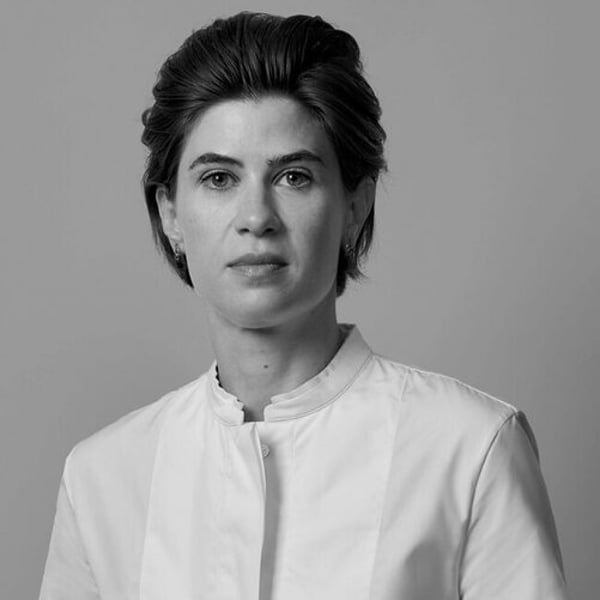
Maje’s Elina Kousourna: “We need to succeed in instilling pride among our teams in selling at full price”

Published
September 30, 2025
Like the SMCP Group, Maje posted sales growth in the first half of 2025. At the helm of the accessible‑luxury womenswear brand, which generated €458 million in revenue in 2024, Elina Kousourna has been quietly conducting in‑depth work for the past two years. Previously in charge of the group’s menswear label Fursac, she waited for growth to return before speaking. As she prepares to present her spring–summer 2026 collection to the press this Wednesday in the French capital, the CEO welcomed FashionNetwork.com to her understated yet elegant office in the heart of Paris, overlooking Rue de Rivoli and the Sully wing of the Louvre. She details her approach, from refining Maje’s stylistic signature to implementing a full‑price strategy and launching a new store concept this autumn.
FashionNetwork.com: Looking at the SMCP Group’s results, Maje posted growth in the first half of the year. What momentum are you seeing?
Elina Kousourna: Maje is doing very well. We are very optimistic given our strong momentum. We kicked off the season with a lot of energy. In mid‑September, we brought together our European store managers, a total of 400 people. Like many other brands, we hadn’t done this since Covid, and it generated a great deal of energy and enthusiasm.
FNW: In a market often portrayed as complicated, you posted growth of almost 3%. How do you explain this growth, and what measures have you put in place since you took over in 2023?
EK: It’s true that we count ourselves among the fortunate who are growing. But it’s not just a matter of luck. With our significant exposure in department stores, we can see the brands suffering around us. We are gaining market share on those floors. In fashion, there’s always an element of magic and creativity. In this respect, our stylistic work is paying off: I think our tone resonates with customers. But to generate growth, you need more. I believe in aligning all the different ingredients of the brand, and that’s what we’ve been working on for two years now.
FNW: Did this work first involve clarifying the brand territory?
EK: Indeed, as is often the case, it starts with the brand. The brand had just turned 25 when I arrived. It’s a very joyful, innovative brand that also likes to experiment, and it had explored many territories. It was time to state who Maje really is, what it stands for, and what its strongest propositions have in common. We’re incredibly lucky to have the founder still with the brand, and we worked closely with Judith, going back to the source.
FNW: What’s the founding element you’ve reworked?
EK: My favourite anecdote is what led Judith to create the brand, when she was working at her sister’s label (Sandro by Evelyne Chetrite, editor’s note). Asked what kind of woman she wanted to dress, she replied: “I want a woman lawyer not to have to go out and buy a man’s suit to go to work, but to be able to embrace her femininity in this world.” The message was neither militant nor feminist. It was an unapologetic stance in support of women, which at the time wasn’t very fashionable.
From there, we worked on themes and explored the balance around an unabashed femininity, the expression of freedom, but also a very joyful, grounded vision of life, without elitism or snobbery.
FNW: So your ambition was to dress the lawyer again?
EK: No. It stemmed more from the observation that all brands make trousers, tops, jackets, and blouses. For the customer, what is the statement we want to make? What’s the Maje touch we are going to find in each product? Once we’d defined these attributes, our aim was to elevate the brand and enhance the product. We’ve refocused our collections. The message is going to be stronger stylistically, but also in terms of the overall value of the products, whether that’s the price, the management of discount levels, stock management and, of course, quality and materials.
FNW: In‑store, the offer seems to revolve around businesswoman silhouettes and eveningwear. Are these the two pillars of your current offering?
EK: It’s true that we’ve moved away from a universe that was perhaps a little more whimsical. We’ve avoided repetition and over‑styling. We’ve chosen to focus far more on the depth rather than the breadth of our offer, and to bet on the productivity of our references rather than multiplying them. We’re retailers, so we’re confronted with the complexity of presenting our entire assortment in our stores. I believe that by putting more structure into our collections, we’ve also unlocked creativity.
FNW: This may seem counter‑intuitive…
EK: In reality, once the boxes we have to fill are clearly defined, the styles can be much freer. So at Maje, a suit isn’t a simple navy suit; it will have a certain volume in the jacket, a slim belt with a jewellery detail. Each element will feature a distinctive detail.
This very active woman doesn’t rule out going for a drink after work and perhaps ending up at a party. That’s why these propositions need an element of versatility. Festive, glamorous touches are prominent. She is not the classic businesswoman. It speaks to a very free, very assured woman who is not afraid to attract attention.
FNW: Your offer is global. How have you adapted it to appeal to customers in Asia and America?
EK: Once again, we are fortunate to be a retailer in those geographies too. Our teams feed the brand with their feedback. We’ve evolved. We make sure different occasions are covered, with different lengths, fits and ways of wearing. We’ve also given our regions more flexibility to define their assortments. We have a core offer that conveys the overall image we want for the brand. But within that, there’s flexibility to strengthen certain propositions by region. What’s very important is maintaining the brand’s overall coherence.
Growth driven by “full price”
FNW: Globally, consumption is under pressure. Even if you’re targeting customers with significant purchasing power, how can you justify your prices, with, for example, a T‑shirt costing around €120? How do you adapt your strategy?
EK: Of course, the situation is tense in this accessible‑luxury segment. But I think it remains extremely relevant. Luxury prices continue to soar, while fast fashion is even more aggressive, with prices that are a fraction of what Zara and H&M were charging a few years ago.
In this landscape, for us it’s not a question of price wars, but of what precisely we offer. Most of our T‑shirts are under €100. The €120 T‑shirt is from the capsule collection created with Celine Dion. And it’s selling very well! Let me come back to the brand’s growth. I’m extremely proud of the way it has happened. It’s growth driven by full‑price sales. It’s very rewarding for the brand and its products.
FNW: And what do you attribute that to?
EK: I believe customers come to Maje for our atelier’s work on design research and fit adjustments, but also for advances in production and our collaboration with audited factories. Today, 80% of our styles are made predominantly with a certified main fabric. Of course, we can wonder how much of this the customer knows, but today 100% of our products are traceable. Then there’s the in‑store service, with a commitment to recruiting, training and developing our networks. We have sales associates who are proactive in making suggestions and supporting customers. And we’re developing other solutions, with garments that can be resold second‑hand, guaranteed and repaired by Maje. It’s a package that isn’t priced, but it has real value. Honesty and transparency help customers perceive that value. I feel completely comfortable justifying the price of the €120 T‑shirt, and I’m very proud that today’s Maje customer is increasingly buying at full price.
FNW: How are you making the transition from a fashion retailer to a premium retailer offering these services? What are your investment priorities?
EK: Today, our clear priorities are image, elevating the brand, its premium positioning, and explaining and highlighting all the services or other values inherent in our products and the brand. That’s not easy in a world where every image is consumed in a fraction of a second. We don’t control which information customers will pick up, but our responsibility is to ensure the quality of fits and materials, to use more natural materials, to move towards innovative materials, and to limit our environmental impact. All these elements, which customers may not see or know about, ultimately create a virtuous circle. One of my major focuses has been managing for full‑price sales and reducing the discount rate, which continues to deliver very impressive results. This also impacts stock management. It’s something customers cannot see directly. But I think they do notice the drop in the volume of products available or on promotion. And that creates a virtuous circle, because when a sales associate says a product won’t be available in two weeks, it’s true!
FNW: Reducing discounting is difficult to implement, given the high expectations around the “strikethrough” price. How do you manage to reduce this dependence?
EK: First of all, I’m very proud to say that Maje has reduced its production volumes for the second year running. It’s not a communication angle, but we’ve done it, and I’m a great believer in these virtuous circles. In reality, our job isn’t to chase volume growth but to drive efficiency. And that’s beneficial for our margins and stock management. I also think it makes our relationship with customers more honest. We’ve seen an excellent improvement in our results on this point. In Europe, the vast majority of our sales are at full price.
FNW: As a manager, what freedom of action does this full‑price policy give you?
EK: It’s fundamental. When we start buying for the next season, we stop projecting sales on markdowns. The aim is for markdown periods to be reserved for genuine residual stock. But it’s a big job. During sales periods, we still have to organise the presentation of the new collection. In a competitive environment, our sales teams would be completely demoralised if we had nothing to offer. It’s the right dynamic, but when we started implementing this strategy, it was a revolution.
FNW: It’s a radical transformation.
EK: Retail has historically looked in the rear‑view mirror to prepare for the future. We’re trying to break out of those paradigms. That doesn’t mean we should do away with promotions. We’re in a good position because we’ve had collections that performed. But promotions are also there to sell‑through. A bad season can—and will—happen. You have to be clear‑eyed. But it’s the controlled stock that needs to be sold off. Let’s set a trajectory; let’s define the optimum. We’ll never fully reach it, but we can at least move towards it step by step. And yes, in retail, we are slaves to “N‑1”. And the first time, there was a lot of grumbling. We were in a markdown period, and we were declining.
FNW: Were the teams surprised by this phase of decline?
EK : Obviously! Because neighbouring stores pull ahead during promotional periods. So we had to create pride around that and say, “OK, it’s fine for a couple of weeks, and then it’s a fresh start.” This also meant revisiting their objectives. The focus of their performance is now on full‑price sales. But we’ve delivered so much growth at full price that we were able to bring them on board.
Customers respond immediately. Last year, for mid‑season promotions and Black Friday, we saw a marked decline, with half as many discounted styles as the year before. And we had an incredible December.
The advantage is that the customer doesn’t feel she’s looking at a product similar to one that was on promotion two weeks earlier. This reduces price resistance. It’s manageable. We accept that November may be catastrophic in volume terms if she shops outside those windows. It’s very easy to achieve growth on markdowns. But here, we’re trying to build for the long term. And it’s working across all markets.
A new store concept
FNW: The brand has scaled back its activities in China and opened up new markets in parallel. How is international business progressing?
EK: In France and Europe, we still have some development opportunities, but these are our mature markets, and we are relocating to more prestigious sites, renovating, and developing a new concept. In North America, we’re still assessing the impact of customs duties, and we have increased prices by less than 10%, with no impact on demand so far. We have a new partner in Canada, which has opened its first stores. In China, we’ve consolidated the situation and will soon be able to revisit it. And we have a number of exciting developments in the Middle East, Mexico and various Latin American countries. We’ve also opened in India, and we’re looking for the location of the next boutique. We’ve just opened in Jordan, and also in Georgia. We work with more than 25 partners with local market expertise. These are exciting projects.
FNW: Are you talking about a new store concept?
EK: Yes, on the business side we have a winning formula for now. We’re going to continue with the same ingredients, and we will communicate them as much as possible to customers. That’s why we’ve worked on a new store concept. The first is on King’s Road in London. And in France, we’re opening it in early October at the Rue Vieille‑du‑Temple boutique. Maje hadn’t revisited its concept for over 10 years. The idea was to make these stores a living space where every detail expresses the brand and leaves a lasting impression on the customer.
FNW: What does the expression “living space” mean for a new Maje concept?
EK: The idea is that we want anyone to come in and feel good. Judith worked with Valériane Lazard (who, among other things, designed the Polène boutiques), and every element has been carefully chosen to convey the brand’s different ingredients, whether femininity, sensuality, comfort or soft curves. In the same spirit, we’ve developed a new sales ceremony. We know this is an essential part of our customers’ relationship with the brand.
FNW: How will this new concept be deployed?
EK: We’re in the process of modelling it. In some cases, we’ve rationalised our store network to be able to renovate. But we aim to reach as many locations as possible, with complete renovations or more compact expressions of the concept to carry this renewal into the stores. Already, beyond the two we’ve mentioned, we’ll have five or six renovations before the end of the year. And new stores are scheduled to open in China and Mexico.
FNW: These are major projects. But how do you deal internally with the uncertainty surrounding the future of the SMCP Group’s shareholding? What impact does this have on the teams?
EK: We try to keep the impact as close to zero as possible. Honestly, we’re fortunate that there’s not much in this saga we can influence. Personally, I’ve been with the group for 10 years, and I’m experiencing the fourth change in shareholding. We’re really focused on delivering the brand’s roadmap. And I think that’s how our employees feel: we’re all involved in the project. Maje is 25 years old and has seen highs and lows, and more or less fantastic moments.
FNW: So, what are Maje’s ambitions for the next three years?
EK: I’d say we need to be wildly ambitious—completely so. We have to multiply our ambitions. Whatever the yardstick, we must cultivate sincerity in our approach. And Maje will continue to be a highly relevant, essential brand on the market—healthy and, above all, desirable.
This article is an automatic translation.
Click here to read the original article.
Copyright © 2025 FashionNetwork.com All rights reserved.







“The improved order situation in industry has brightened sentiment somewhat. However, as a result of the Iran war, energy costs have risen sharply, and uncertainty among companies has also increased. That runs counter to a stronger economic recovery,” said Timo Wollmershauser, head of forecasts at ifo.
Firms in Germany have raised investment plans, with ifo expectations rising to 0.2 points in March from -3.1 in December 2025.
Industry led gains, especially non-energy sectors, while energy-intensive segments and chemicals remained weak.
Services showed modest optimism, but trade stayed pessimistic.
Rising energy costs and geopolitical uncertainty temper recovery.
The most notable rise in the willingness to invest was in industry. Expectations rose to +0.1 points in March, up from -6.9 points in December. The outlook improved particularly strongly in non-energy-intensive industries, where significantly more companies were planning to expand their investments this year, ifo said in a press release.
In energy-intensive industries, however, the willingness to invest remains subdued. At -9 points in March, the balance remained virtually unchanged from December (-8.9 points). In the chemical industry, investment expectations even declined further, from -15.8 to -16.2 points.
Overall, the corresponding balance in manufacturing rose from -4.1 to +1.2 points. “Companies across all sectors also want to invest more in software. The growing use of artificial intelligence is likely to play a role in that,” said ifo economic expert Lara Zarges.
In trade, companies remain the most pessimistic. The balance of investment expectations stood at -9.6 points in March, virtually unchanged from the level in December. Service providers, on the other hand, confirmed their slightly positive outlook from December: Their investment expectations improved from +1.1 to +2.8 points.
The points for the ifo investment expectations indicate the percentage of companies that intend to increase their investments on balance.
Fibre2Fashion News Desk (SG)
The report highlighted that although overall energy demand growth slowed compared with 2024 and remained slightly below the previous decade’s average, electricity demand rose by around 3 per cent, driven by increased usage across buildings, industry, electric vehicles, and data centres.
Global energy demand growth slowed to 1.3 per cent in 2025, while electricity demand rose around 3 per cent, driven by EVs, industry, and data centres, according to IEA.
Solar PV led supply growth for the first time.
Oil demand grew modestly, and coal growth slowed.
CO2 emissions rose slightly.
Renewables and nuclear expansion highlighted an accelerating shift towards cleaner energy systems.
Solar photovoltaic (PV) emerged as the largest contributor to global energy supply growth for the first time, accounting for over 25 per cent of the increase. Natural gas followed with a 17 per cent share, while renewables and nuclear together met nearly 60 per cent of additional demand.
Global oil demand rose modestly by 0.7 per cent, reflecting the continued expansion of electric vehicles, with sales surpassing 20 million units in 2025. Coal demand growth slowed overall, with declines in China offset by increases in the United States due to high natural gas prices.
“Global energy demand continued to increase in 2025 against a complex economic and geopolitical backdrop, with one trend unmistakeable: the expanding electrification of economies,” said Fatih Birol, IEA executive director.
He added that electricity consumption was growing much faster than overall energy demand, with one energy source outpacing all others. He noted that solar PV accounted for over a quarter of global energy demand growth for the first time, followed by natural gas, and added that countries prioritising resilience and diversification would be better placed to manage volatility and ensure secure, affordable energy.
Regional trends varied significantly. Energy demand growth in the United States rose sharply, supported by industrial activity, data centre expansion, and colder weather, while China’s growth slowed to 1.7 per cent due to rising renewable adoption and improved efficiency.
Global energy-related CO2 emissions increased marginally by around 0.4 per cent. Emissions declined in China and remained flat in India, aided by renewable deployment and favourable weather conditions, while advanced economies recorded higher emissions growth due to colder winter conditions.
In the power sector, solar PV generation surged by a record 600 terawatt-hours, marking the largest annual increase for any electricity generation technology. Battery storage emerged as the fastest-growing segment, with around 110 gigawatts of new capacity added, while nuclear energy also saw renewed momentum with over 12 gigawatts of new reactors under construction.
The IEA noted that cumulative deployment of low-emissions technologies since 2019 now offsets fossil fuel consumption equivalent to the entire energy demand of Latin America, underscoring the accelerating transition towards cleaner energy systems.
Fibre2Fashion News Desk (SG)
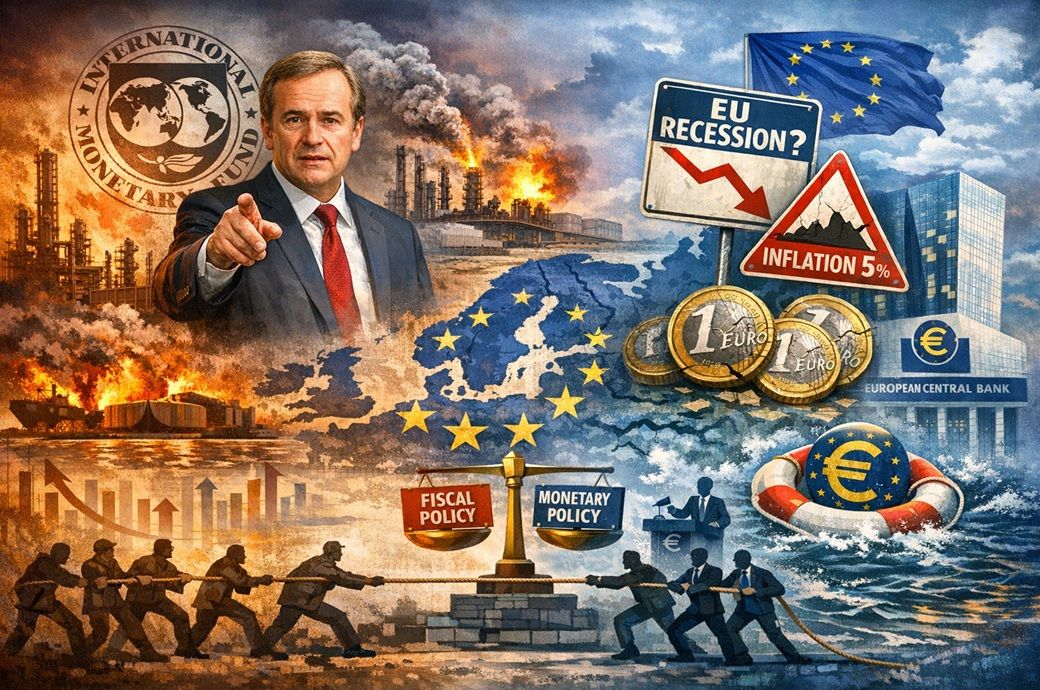
In a blog post, Alfred Kammer, director of the IMF’s European department, said his organisation sees growth slowing down in the continent. Initial data point already to weaker private investment and consumption.
The energy shock that has hit Europe due to the Middle East conflict, though smaller than in 2022, is weighing on growth and pushing inflation higher, an IMF expert recently cautioned.
IMF sees growth slowing down in the continent.
Initial data point already to weaker private investment and consumption.
Central banks must remain laser focused on keeping inflation expectations anchored, he wrote.
The outlook for euro area growth is projected at just 1.1 per cent in 2026, for the European Union it is 1.3 per cent; and this forecast comes with a high degree of uncertainty.
In a more severe scenario as described in the World Economic Outlook—a persistent supply shock compounded by tightening financial conditions—the EU could come close to recession with inflation approaching 5 per cent. No European country is spared, Kammer observed.
Policymakers face intense pressure—to act fast, visibly and for all, which results in policies that have more long-term downsides than short-term benefits, he wrote.
Targeted support is much more effective. Europe’s response to this shock should be shaped by two imperatives, he suggested. First, robust macroeconomic policy that is fit for a world with unpredictable and frequent shocks, and second, resilience built without wasting fiscal resources or getting in the way of markets.
The first imperative involves getting monetary and fiscal policy right. Central banks must remain laser focused on keeping inflation expectations anchored, the IMF expert wrote.
In the euro area, where inflation is close to target and medium-term expectations are broadly anchored, the European Central Bank has some scope to wait and observe the shock evolve before acting. IMF now expects a cumulative 50 basis point increase in the policy rate by the end of this year, maintaining a broadly neutral monetary stance in light of higher near-term inflation expectations, Kammer noted.
A rise in core inflation or increasing medium-term expectations would warrant a more restrictive stance, he wrote.
“Europe must reform under pressure. The current shock is not an argument for delay. It is all the more reason to push forward the reform agenda,” Kammer added.
Fibre2Fashion News Desk (DS)


TAG Heuer Has Dropped New Polylight-Powered F1s

WhatsApp to let users generate private summaries of unread chats
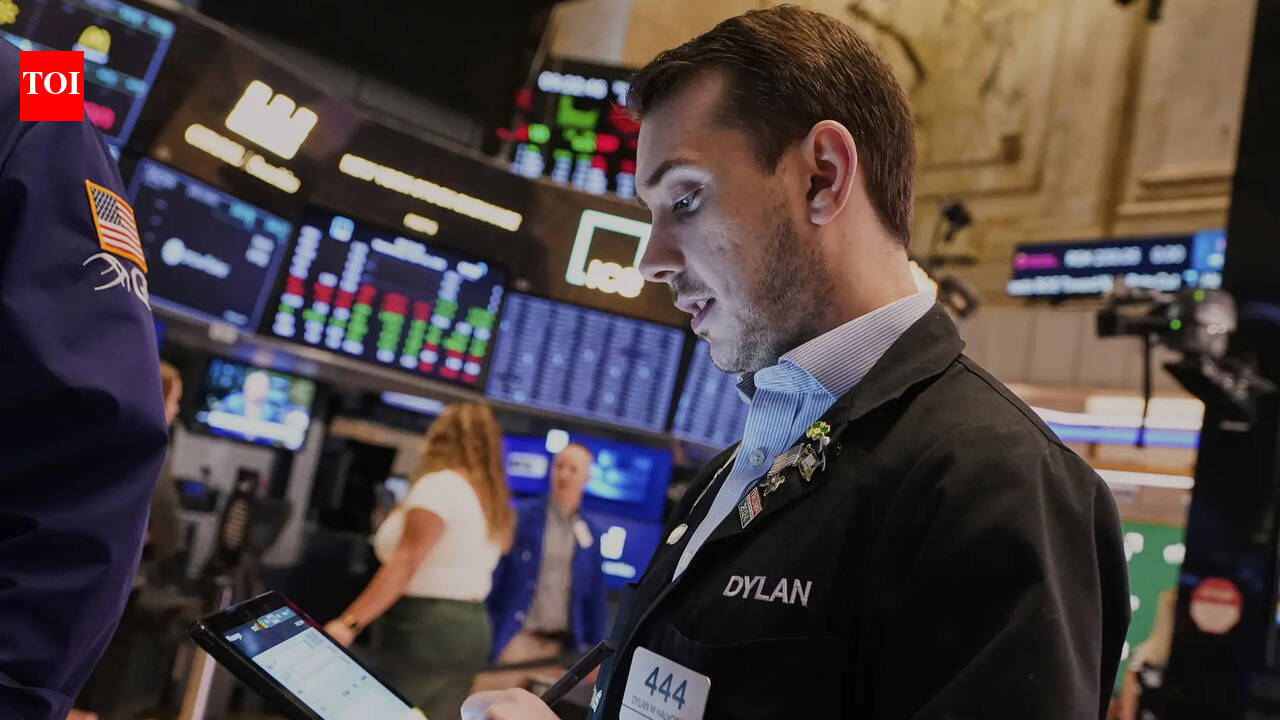
US stocks today: Wall Street inches higher as markets eye ceasefire deadline; Dow jumps 300 points, S&P 500 remains flat – The Times of India

-

 Fashion5 days ago
France’s LVMH Q1 revenue falls 6%, shows resilience amid Iran war
-

 Sports1 week ago
The case for Man United’s Fernandes as Premier League’s best
-

 Entertainment1 week ago
Palace left in shock as Prince William cancels grand ceremony
-
 Business1 week ago
UK could adopt EU single market rules under new legislation
-

 Entertainment6 days ago
Is Claude down? Here’s why users are seeing errors
-

 Fashion1 week ago
Energy emerges as biggest cost driver in textile margins
-
 Business1 week ago
Delta Air Lines unveils first new Delta One suite in premium cabin arms race
-

 Fashion1 week ago
Asia claims largest share of markets on Kearney FDI Confidence Index