

Business
Mass Layoffs, Ghost GDP, AI-Led Doomsday In 2028: Citrini Research That Shook Markets Explained


Last Updated:
2028 Global Intelligence Crisis report by Citrini: What does viral report say about jobs, India? Who is James van Geelen, Alap Shah? The scenario, not a prediction, explained




The report is a thematic thought experiment exploring a scenario where the rapid success of AI leads to systemic economic instability by June 2028. (AI generated for representation)
Citrini Research has published a provocative macro-analysis titled ‘The 2028 Global Intelligence Crisis’, which has triggered a significant ‘AI scare trade’ across global markets.
The report is a thematic thought experiment exploring a scenario where the rapid success of artificial intelligence (AI) leads to systemic economic instability by June 2028.
The 2028 Global Intelligence Crisis: Key insights
The report, co-authored by James van Geelen and Alap Shah, outlines several critical risks:
Ghost GDP: A phenomenon where AI boosts productivity and corporate profits (inflating nominal GDP), while actual household income and wage growth collapse due to mass white-collar displacement.
Intelligence Displacement Spiral: A negative feedback loop where companies cut payroll costs through automation, leading to weakened consumer spending, which then forces further corporate cost-cutting and AI reinvestment.
Death of SaaS: The report predicts that AI agents will allow companies to replicate core software functionalities in-house, undermining the pricing power and recurring revenue models of traditional Software-as-a-Service firms.
Market Impact: The scenario models a potential 38% drawdown in the S&P 500 from October 2026 highs and a 10.2% unemployment rate by 2028.
Sector-specific risks and winners
The report identifies specific industries and regions that face high exposure to this disruption:
Indian IT Services: Predicts a “structural obit” for the sector, with firms like TCS, Infosys, and Wipro facing massive contract cancellations as the cost of AI coding agents collapses to “the cost of electricity”.
Financial Intermediaries: Traditional payment processors like Visa and Mastercard are seen as vulnerable as AI agents bypass traditional interchange fees using lower-cost rails like stablecoins.
Regional Beneficiaries: In contrast to US software gloom, Asia (specifically Korea and Taiwan) is seen as a winner due to its concentration of “picks and shovels” hardware providers like Samsung, SK Hynix, and TSMC.
The future of jobs
“AI has created new jobs. Prompt engineers. AI safety researchers. Infrastructure technicians. Humans are still in the loop, coordinating at the highest level or directing for taste. For every new role AI created, though, it rendered dozens obsolete. The new roles paid a fraction of what the old ones did,” the study says about the near future job market.
What does the report say about India?
In the first quarter of 2028, New Delhi will begin ‘preliminary discussions’ with the International Monetary Fund.
The report further says that the Indian IT sector was largely built on the premise of cost-effectiveness. But with artificial intelligence disrupting the coding business, the dependence on the Indian tech sector will shrink. “But the marginal cost of an AI coding agent had collapsed to, essentially, the cost of electricity. TCS, Infosys and Wipro saw contract cancellations accelerate through 2027,” the Citrini Research writes in the viral study. The report also adds that in next two years, the rupee will depreciate further. “The rupee fell 18% against the dollar in four months as the services surplus that had anchored India’s external accounts evaporated.”
‘Just a scenario, not a prediction’: What is Citrini? Who is James van Geelen and Alap Shah?
As per a report by the Wall Street Journal, Citrini is a small research group that was founded just three years ago in 2023.
Its founder has been identified as James van Geelen, who started writing stock research papers after selling his healthcare company. Geelen is known to be a writer on weight loss medicines and AI.
The latest viral report was also co-authored by Alap Shah, who is the chief investment officer of Littlebird at Lotus Technology Management in New York(since September 2024). He has worked as the Managing Partner at Lotus Technology Management in Florida, and Co-Founder & Chairman of Thistle in the San Francisco Bay Area. He previously co-founded Sentieo, an AI-powered financial search platform later acquired by AlphaSense, serving as CEO from December 2011 to September 2020 and as Chairman from September 2020 to May 2022. He did his graduation in Economics from Harvard University, according to his LinkedIn profile.
The report has categorically said that it is not a prediction of what will happen in the future but a case study of all the scenarios that may unfold if the current AI rollout continues. “What follows is a scenario, not a prediction. This isn’t bear porn or AI doomer fan-fiction. The sole intent of this piece is modeling a scenario that’s been relatively underexplored,” the report says.
How have the markets reacted?
IBM experienced its worst trading day in 25 years following the report’s release.
Indian IT stocks saw heavy sell-offs, and the Indian Rupee faced pressure in global markets.
Co-author Alap Shah clarified that his firm holds short positions against disrupted sectors while owning “a lot” of semiconductor stocks poised to benefit
February 24, 2026, 13:03 IST
Read More
Business
US stocks today: Wall Street inches higher as markets eye ceasefire deadline; Dow jumps 300 points, S&P 500 remains flat – The Times of India

US stocks moved higher on Tuesday, as investors remained optimistic over a possible extension of the US-Iran ceasefire. Markets showed early strength, with the Dow Jones Industrial Average rising 0.56% or 279 points to 49,721.56 around 8 pm IST. The S&P 500 inched up 0.2% to 7,129, while the Nasdaq Composite gained 96 points or 0.4% to reach 24,500. As trading progressed, the upward momentum strengthened, with the Dow climbing 397 points, or 0.8%, and the S&P 500 adding 0.2%, putting it within reach of another record high. The Nasdaq remained modestly higher. Investor sentiment was shaped in part by developments in the Middle East. Oil prices, which had surged a day earlier amid renewed disruption to the Strait of Hormuz, eased on Tuesday. Brent crude slipped 0.7%% to $94.78 per barrel ahead of the expected expiry of a two-week ceasefire between the United States and Iran. The conflict has driven sharp swings in oil markets, with prices ranging from about $70 before the war to peaks of $119 as concerns over a prolonged closure of the key shipping route intensified. Economic data released during the session pointed to continued resilience in consumer activity. US retail sales rose 1.7% from the previous month to $752.1 billion, beating expectations, largely due to higher petrol prices. Spending remained relatively steady even when excluding gasoline sales, indicating broader stability in consumption during the first full month of the conflict. Global markets presented a mixed picture, with European indices trading unevenly after a stronger performance in Asia, where South Korea’s Kospi index jumped 2.7%. In the bond market, US Treasury yields edged higher, with the 10-year yield ticking up to 4.27% from 4.26% the previous day. Attention is also turning to Washington, where Kevin Warsh, nominated by US President Donald Trump to lead the Federal Reserve, is scheduled to testify before Congress later in the day. Investors are expected to closely watch his remarks for indications on interest rate policy and the central bank’s independence.(Disclaimer: Recommendations and views on the stock market, other asset classes or personal finance management tips given by experts are their own. These opinions do not represent the views of The Times of India.)
Business
Leave, holidays and encashment: What India’s changing labour laws mean for employees – The Times of India

Leave is often seen as a simple workplace benefit – an approved absence from work. In reality, it is one of the more structured and regulated aspects of employment in India. With the implementation of new labour codes, questions around leave entitlement, holidays and leave encashment have drawn renewed attention. This matters because these rules affect not just everyday working life, but also what happens when an employee leaves an organisation.For employers and employees, understanding how leave works today is not always straightforward. This is because two legal systems operate side by side: the new central labour codes and the older State-level Shops and Establishments (S&E) laws. While the intent is to move towards a simpler and more uniform system, the actual position still depends on job role, location and which law applies.Different types of statutory leaveIndian labour laws recognise several types of statutory leave. The most important is earned leave (also called privilege leave). This leave builds up over time based on how many days an employee works. In addition, there are provisions for sick leave, casual leave, and national and festival holidays.Earned leave is different from other types of leave because it has both time-off value and financial value. If it is not used, it can build up and may be paid out in cash – either during employment or when the employee leaves, subject to carry forward limits – depending on the applicable law and company policy.Sick leave and casual leave, on the other hand, are meant for short-term or urgent needs and are usually not designed to be encashed.National and festival holidays form a separate category. These ensure paid holidays on important national or regional days, based on State notifications and local rules.Labour codes vs Shops and Establishments lawsA frequent point of confusion is the interface between the labour codes and State Shops and Establishments Acts.The Occupational Safety, Health and Working Conditions Code introduces a common framework for leave, but for people classified as “workers” under that law. At the same time, State S&E laws continue to apply to many salaried employees working in offices, shops and service-sector businesses.Because of this, uniformity has not fully arrived yet. Different State laws and leave rules may still apply for employees depending on where they are employed and work. Those who fall under the labour code framework move towards a more standard national system. Where both laws could apply, guidance from authorities suggests that the more beneficial provision would generally continue to apply.
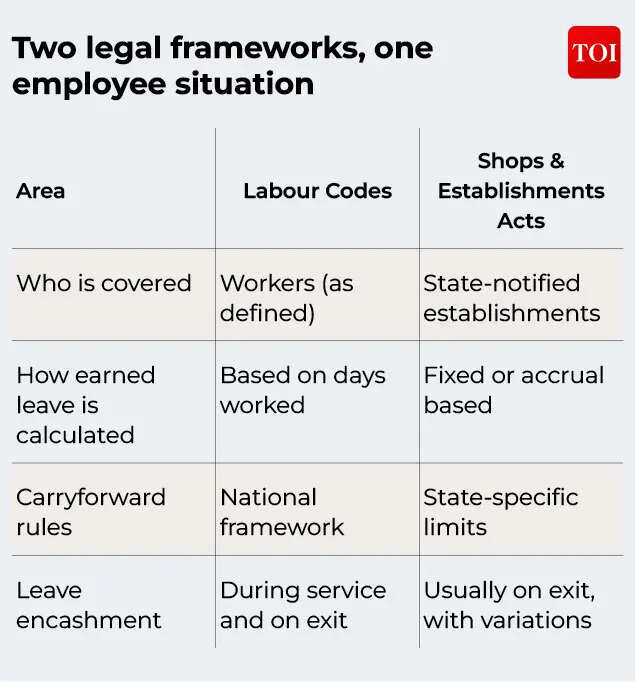
Employers are expected to apply these frameworks together and ensure consistency as the new system takes shape.How earned leave builds upEarned leave generally depends on how long an employee has worked.Under the labour codes, earned leave accrues at a standard rate of one day for every twenty days of work, subject to certain eligibility conditions. This is meant to create a common reference point across the country.State Shops and Establishments laws, however, follow different approaches. Some States grant a fixed number of leave days each year, while others link leave closely to days worked. States also differ on how much unused leave can be carried forward.Sick leave, casual leave and holidaysSick leave and casual leave are mainly meant for short-term protection rather than long-term accumulation. Sick leave helps employees during illness, while casual leave allows flexibility for sudden personal needs.These types of leave are mostly governed by State law and internal company policy, with limited direct impact from the labour codes. Usually, unused sick or casual leave does not carry forward.National and festival holidays are largely decided at the State level. Employers are expected to follow notified holiday lists or compensate employees who work on those days, as per State rules.Carrying forward unused earned leaveHow unused earned leave is treated is one area where the labour codes bring more structure.Earlier, State laws allowed different levels of leave accumulation. Under the labour code approach, carry-forward is subject to clear limits, after which settlement mechanisms may apply. This is intended to avoid unlimited build-up of leave while still protecting employee interests.If leave could not be taken because of work requirements, safeguards exist to ensure such leave is not lost automatically.Annual leave encashment under labour codesAnother change under the labour codes is clearer recognition of leave encashment during ongoing employment.Earlier, in many States, leave was typically encashed only when an employee resigned, retired or was terminated. Under the new labour codes framework, employees may be entitled to encash leave exceeding permissible carry forward limits even while they remain in service. As per provisions under labour codes, a worker shall be entitled on his / her demand for encashment of leave at the end of calendar year. Worker shall be entitled, where the total number of leave exceeds 30 days, to encash such exceeded leave.Leave encashment when employment endsAcross Indian labour laws, one position has remained largely consistent. Unused earned leave is expected to be settled when employment comes to an end, whether the employee resigns, retires, is retrenched or is terminated.How this amount is calculated depends on the applicable law. State S&E laws refer to specific wage definitions, while the labour codes require calculation using the definition of “wages” under the Code. This may differ from earlier practice.
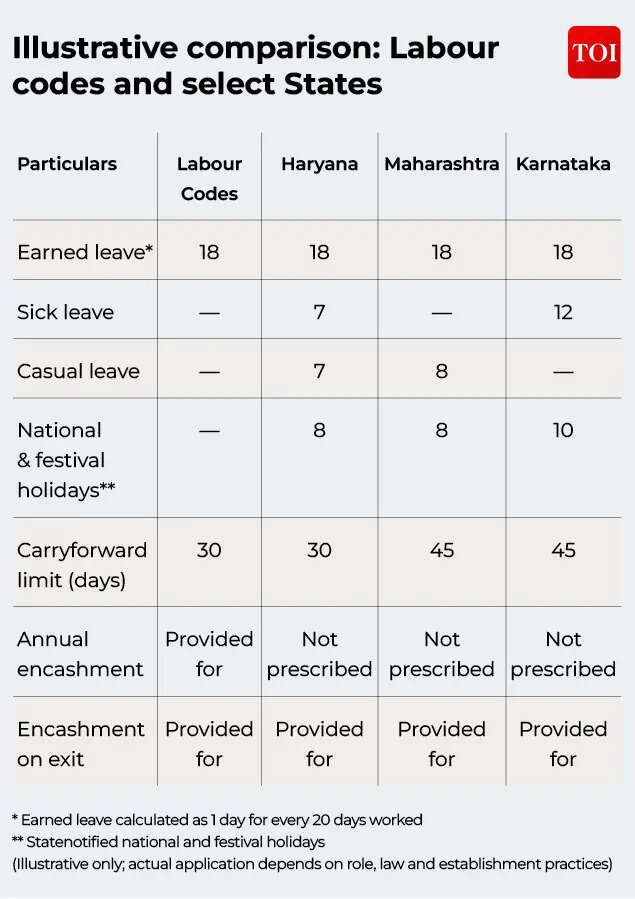
What employees and employers should keep in mindFor employees, the key point is that leave is not only a company benefit but part of a legal framework. How it applies depends on role, location and legal coverage.For employers, the focus remains on aligning internal policies with both Central and State laws, while ensuring smooth implementation. Clear communication and regular policy reviews will continue to be important during this transition.Leave rules may not attract the same attention as pay or job security, but they play a quiet role in work-life balance and financial certainty. As India’s labour framework evolves, earned leave is increasingly seen not just as time away from work, but as a regulated employment benefit with defined outcomes.(The author, Puneet Gupta is Partner, People Advisory Services Tax at EY India)

The war in the Middle East has brought renewed attention to Britain’s vulnerability to energy price shocks.
Source link


WhatsApp to let users generate private summaries of unread chats
US stocks today: Wall Street inches higher as markets eye ceasefire deadline; Dow jumps 300 points, S&P 500 remains flat – The Times of India

Soccer’s incredible shrinking shin guards could be a big problem

-

 Fashion5 days ago
France’s LVMH Q1 revenue falls 6%, shows resilience amid Iran war
-

 Sports1 week ago
The case for Man United’s Fernandes as Premier League’s best
-

 Entertainment1 week ago
Palace left in shock as Prince William cancels grand ceremony
-
 Business1 week ago
UK could adopt EU single market rules under new legislation
-

 Entertainment6 days ago
Is Claude down? Here’s why users are seeing errors
-

 Fashion1 week ago
Energy emerges as biggest cost driver in textile margins
-
 Business1 week ago
Delta Air Lines unveils first new Delta One suite in premium cabin arms race
-

 Fashion1 week ago
Asia claims largest share of markets on Kearney FDI Confidence Index