

Business
Massive sell-off sends PSX into trading halt | The Express Tribune

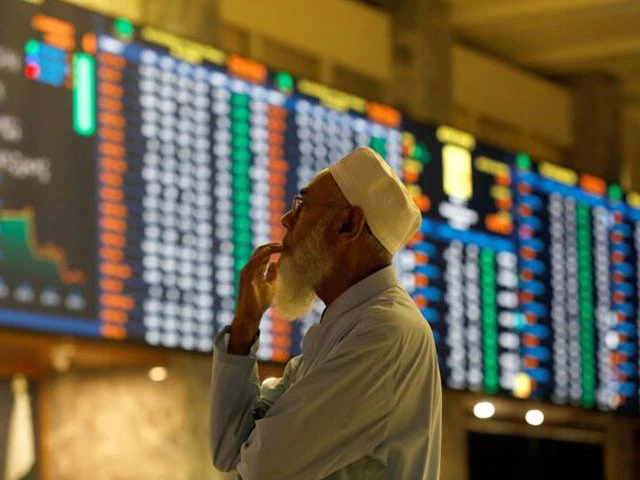
KSE-100 tumbles over 7,000 points at open amid oil price shock and policy uncertainty
A stock broker reacts while monitoring the market on the electronic board displaying share prices during trading session at the Pakistan Stock Exchange, in Karachi on July 3, 2023. Photo: Reuters/ File
KARACHI:
Heavy selling gripped Pakistan Stock Exchange (PSX) on Monday as the benchmark KSE-100 index plunged at the start of trading, falling by 7,322 points, or 6.21% shortly after the market opened. The sharp decline triggered widespread panic among investors and intensified pressure across major sectors.
According to market data recorded at 12:44 pm, the KSE-100 index was standing at 146,620.56 points, reflecting a loss of 10,995.24 , or 6.98%, compared with the previous session’s close.
In response to the steep fall, the PSX issued a market halt notice, stating that a trading suspension had been activated after the KSE-30 index dropped by 5% from its previous closing level. As per PSX regulations, trading across all equity markets was temporarily halted and all outstanding orders in the system were automatically cancelled. The exchange further informed participants that trading would resume according to the prescribed reopening schedule following the halt.
Market sentiment remained fragile amid growing uncertainty surrounding the upcoming monetary policy decision. The Monetary Policy Committee (MPC) is scheduled to announce its interest rate decision later today, and concerns over a potential rate hike have added to investor nervousness.
Also read: Shares skid as oil surge threatens inflation shock
This uncertainty, combined with a sharp increase in global oil prices, fuelled widespread selling across the market, ultimately leading to the trading halt.
KTrade Securities equity trader Ahmed Sheraz told The Express Tribune that the unprecedented surge in oil prices from around 83/bbl to nearly $119/bbl — had already weighed heavily on investor sentiment. Besides, hopes of a potential de-escalation failed to materialise as hostilities intensified, further exacerbated by strikes on oil tankers in the region, he commented.
“For Pakistan, persistently higher oil prices could carry significant economic repercussions, like current account deficit, pressure on Pakistani rupee, inflation and including the risk of slower growth.”
This concern is further compounded by the possibility of an interest rate hike, with the MPC set to announce its decision later today (Monday). Amid this increasingly uncertain backdrop, investor anxiety triggered broad-based selling across the market, ultimately leading to a trading halt today, Sheraz added.





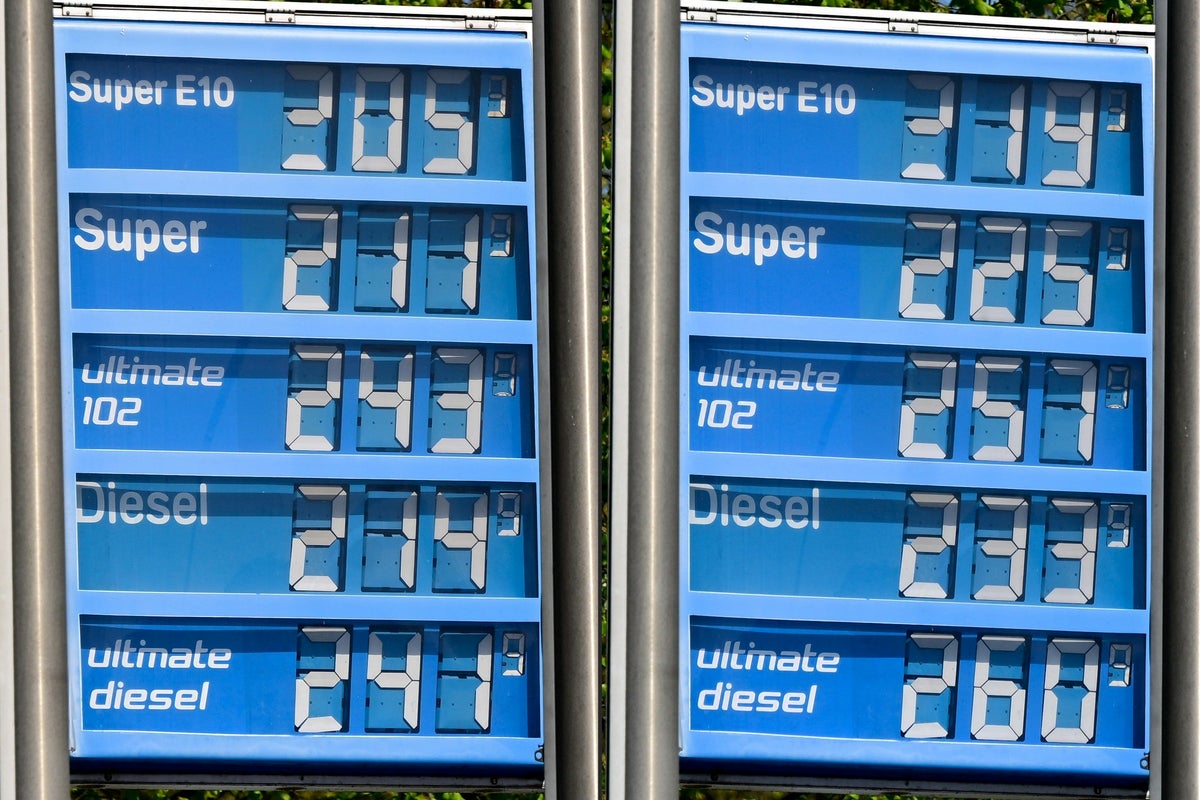
Oil prices jumped on Tuesday as Donald Trump weighed Iran’s latest proposal to end the war.
The US president is unhappy with the latest Iranian proposal, a US official said on Monday. Iranian sources disclosed that Tehran’s proposal avoided addressing its nuclear programme until hostilities cease and Gulf shipping disputes are resolved.
Trump’s displeasure with the Iranian offer leaves the conflict deadlocked, with Iran shutting shipping flows through the Strait of Hormuz, which typically carries supply equal to about 20 per cent of global oil and gas consumption, and the US keeping in place its blockade of Iranian ports.
Brent crude rose to $108.13 per barrel, hovering near a three-week high, while US West Texas Intermediate went up to $96.48.
Both benchmarks are well above pre-war levels. Brent was trading at $72 before the US-Israeli war on Iran began on 28 February.
Asian stocks were broadly subdued at the opening. While MSCI’s broadest index of Asia-Pacific shares outside Japan was down 0.12 per cent, hovering near the record high it touched on Monday, Nikkei fell 0.5 per cent.
The S&P 500 eked out modest gains on Monday and was on course for a nearly 10 per cent gain for April. US stock futures were 0.1 per cent higher in Asian hours.
Indian shares are set to open lower on Tuesday, with GIFT Nifty futures pointing to the benchmark Nifty 50 opening below Monday’s close of 24,092.70. Both Nifty and Sensex snapped a three-session losing run on Monday, led by a rebound in technology stocks, but the broader momentum remained constrained by unresolved tensions around the Strait of Hormuz.
Elevated oil prices are a particular headwind for India, the world’s third-largest crude importer, heightening inflation risks, pressuring economic growth and widening the country’s import bill.
Foreign portfolio investors offloaded domestic stocks worth Rs 11.5bn ($122m) on Monday, extending their selling streak to a sixth straight session.
Vessel crossings showed signs of recovery over the weekend, according to the maritime intelligence firm Windward, but analysts warned increased movement was yet to translate into a surge in oil and gas flows.
Iran reportedly offered to end its blockade of the waterway without addressing its nuclear programme, passing the proposal to Washington through Pakistani mediators. But Mr Trump has made ending Iran’s atomic programme a condition for any deal.
Central banks are also in focus this week, with the Bank of Japan, the US Federal Reserve, the Bank of England, and the European Central Bank all due to announce policy decisions. All are expected to hold rates steady, but markets will be watching closely for signals about how policymakers plan to respond to the inflationary pressure from the war.
“The BOJ is likely to stay highly sensitive to market volatility,” Fred Neumann, chief Asia economist at HSBC, told Reuters. “Our base case remains one single 25 basis point hike this year in July, but a June rate rise becomes more likely if the Strait of Hormuz is still effectively closed after mid-May.”
Mumbai: RBI has required banks to report all foreign exchange derivative deals involving the rupee undertaken in India and globally by their entire group, including overseas branches, subsidiaries, and parent entities. This brings into view offshore trades that were earlier largely invisible. This applies to both OTC deliverable and offshore non-deliverable contracts, meaning even speculative offshore bets on the rupee must now be disclosed. Banks now must report detailed transaction data-size, counterparty, maturity, and structure-no later than two working days, though trades below $1 million and certain already-reported or internal hedging transactions are exempt.
Business
Renters’ Rights Act: My tenant owes £15,000 in rent, but I can’t get them out of the property

Currently, under a so-called Section 21 notice, a landlord can evict a tenant without giving a reason – and with just eight weeks’ notice. The new legislation will restrict landlords to a handful of legal reasons for evictions, including wanting to move back in, anti-social behaviour by tenants or persistent rent arrears.

Oil prices edge higher as Trump weighs Iran’s latest proposal to open Hormuz

Political economy of power failure

‘The Voice’ star Dylan Carter died at 24: Cause of death revealed

-

 Sports1 week ago
NCAA men’s gymnastics championship: All-time winners list
-

 Sports1 week ago
WWE WrestleMania 42 Night 2: Live match results and analysis
-

 Fashion1 week ago
UK’s Sosandar returns to profitability amid robust FY26 performance
-

 Politics7 days ago
UK’s Starmer seeks to deflect blame over Mandelson appointment
-

 Entertainment1 week ago
Lee Anderson, Zarah Sultana kicked out of UK Parliament for calling PM ‘liar’
-
 Business1 week ago
How Trump’s psychedelics executive order could unlock stalled cannabis reform
-
 Business1 week ago
No fuel shortage: Govt assures 100% domestic LPG, PNG, CNG supply amid Hormuz energy crunch – The Times of India
-

 Sports1 week ago
Quetta Gladiators opt to bowl after winning toss against Peshawar Zalmi in PSL 11 clash