

Business
Mercedes F1 boss Toto Wolff sells a piece of his ownership stake to CrowdStrike CEO George Kurtz


Mercedes-AMG Petronas F1 CEO and team principal Toto Wolff is bringing in new team ownership, selling a portion of his holdings to CrowdStrike founder and CEO George Kurtz, the executives told CNBC Thursday.
Kurtz’s personal acquisition expands a partnership between the auto racing team and software provider that dates to 2019. It also expands the tech industry’s push into global motorsport. The financial terms of Kurtz’s investment were not disclosed, but a person familiar with the matter told CNBC the deal values the Mercedes team at $6 billion.
“You have all these new fans coming in,” Kurtz said. “The reason why CrowdStrike is involved in Formula One is [because] there is a return… We perfected that, and we want to bring that to the United States, to the tech market, and have other partnerships that can exploit that and make the best of Formula One.”
Mercedes said Thursday that Kurtz acquired a 15% minority interest in Wolff’s controlled ownership entity, which represents one third of the team — making Kurtz’s share 5%. Mercedes-Benz and chemicals giant INEOS each also own one third.
Mercedes’ British driver George Russell races during the first practice session for the Las Vegas Formula One Grand Prix on November 16, 2023, in Las Vegas, Nevada.
Angela Weiss | AFP | Getty Images
Kurtz will become a technology advisor for Mercedes F1, helping broaden the team’s work in data analytics as the sport becomes increasingly tech-driven with more simulation-heavy and AI-led development processes. He’ll join a committee that includes Mercedes-Benz CEO Ola Källenius, INEOS founder Jim Ratcliffe and Wolff. Governance of the team remains unchanged.
The team said Kurtz will also focus on expanding its U.S. and global tech partnerships. CrowdStrike provides AI-powered protection for the team’s infrastructure.
“[I] couldn’t be more excited about something that’s been in the making for a bit, and it really comes off the heels of a long-term partnership that we have at CrowdStrike with Mercedes,” Kurtz said in an interview with CNBC Thursday.
Kurtz is unusual among billionaire investors in that he’s a competitive racer himself. He has won major endurance events, including the 24 Hours of Le Mans race, Petit Le Mans, the Six Hours of the Glen and the Indianapolis 8 Hour, and secured multiple series titles in 2023.
The ownership shuffle comes as Mercedes tries to climb back toward the top of motorsport after falling behind McLaren and Red Bull in recent seasons. The team won eight straight constructors’ titles from 2014 to 2021 but hasn’t won since. A 2026 regulations and engine overhaul has raised expectations for a turnaround.
“We’re the only sport that combines the cutting-edge technology, science and the gladiator in the car and the people’s business,” Wolff said. “Next year, particularly, you know, these challenges that come towards us are huge. We will be having an engine that is 50% electric with 100% sustainable fuel, a car that will generate its downforce while, at the same time, maximum downforce, while at the same time trying to save, you know, some of the electric energy.”
F1’s popularity in America continues to surge, fueled by Netflix’s “Drive to Survive” docuseries, Apple’s blockbuster “F1: The Movie” release, three U.S. races on the calendar and the addition of a Cadillac-sponsored team next year.
Disclosure: CNBC is a sponsor of the McLaren Formula 1 racing team. Sara Eisen is a member of the McLaren Advisory Board.










Business
US stocks today: Wall Street inches higher as markets eye ceasefire deadline; Dow jumps 300 points, S&P 500 remains flat – The Times of India
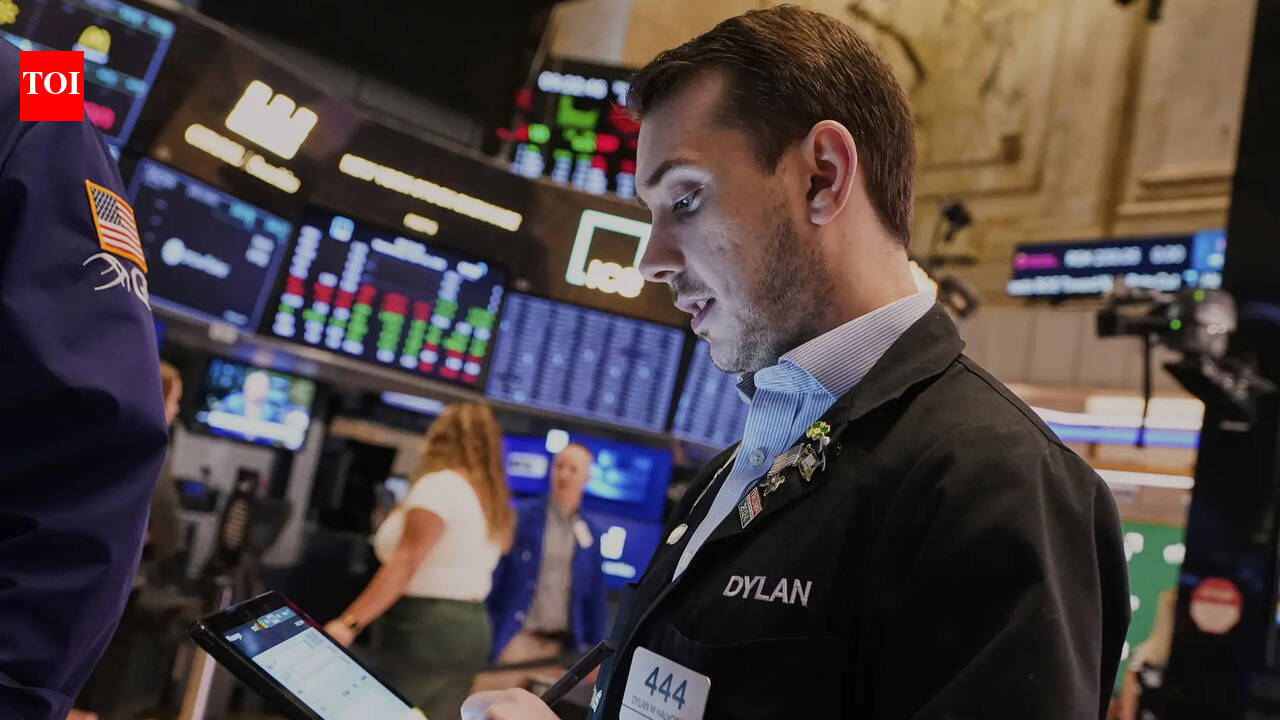
US stocks moved higher on Tuesday, as investors remained optimistic over a possible extension of the US-Iran ceasefire. Markets showed early strength, with the Dow Jones Industrial Average rising 0.56% or 279 points to 49,721.56 around 8 pm IST. The S&P 500 inched up 0.2% to 7,129, while the Nasdaq Composite gained 96 points or 0.4% to reach 24,500. As trading progressed, the upward momentum strengthened, with the Dow climbing 397 points, or 0.8%, and the S&P 500 adding 0.2%, putting it within reach of another record high. The Nasdaq remained modestly higher. Investor sentiment was shaped in part by developments in the Middle East. Oil prices, which had surged a day earlier amid renewed disruption to the Strait of Hormuz, eased on Tuesday. Brent crude slipped 0.7%% to $94.78 per barrel ahead of the expected expiry of a two-week ceasefire between the United States and Iran. The conflict has driven sharp swings in oil markets, with prices ranging from about $70 before the war to peaks of $119 as concerns over a prolonged closure of the key shipping route intensified. Economic data released during the session pointed to continued resilience in consumer activity. US retail sales rose 1.7% from the previous month to $752.1 billion, beating expectations, largely due to higher petrol prices. Spending remained relatively steady even when excluding gasoline sales, indicating broader stability in consumption during the first full month of the conflict. Global markets presented a mixed picture, with European indices trading unevenly after a stronger performance in Asia, where South Korea’s Kospi index jumped 2.7%. In the bond market, US Treasury yields edged higher, with the 10-year yield ticking up to 4.27% from 4.26% the previous day. Attention is also turning to Washington, where Kevin Warsh, nominated by US President Donald Trump to lead the Federal Reserve, is scheduled to testify before Congress later in the day. Investors are expected to closely watch his remarks for indications on interest rate policy and the central bank’s independence.(Disclaimer: Recommendations and views on the stock market, other asset classes or personal finance management tips given by experts are their own. These opinions do not represent the views of The Times of India.)
Business
Leave, holidays and encashment: What India’s changing labour laws mean for employees – The Times of India

Leave is often seen as a simple workplace benefit – an approved absence from work. In reality, it is one of the more structured and regulated aspects of employment in India. With the implementation of new labour codes, questions around leave entitlement, holidays and leave encashment have drawn renewed attention. This matters because these rules affect not just everyday working life, but also what happens when an employee leaves an organisation.For employers and employees, understanding how leave works today is not always straightforward. This is because two legal systems operate side by side: the new central labour codes and the older State-level Shops and Establishments (S&E) laws. While the intent is to move towards a simpler and more uniform system, the actual position still depends on job role, location and which law applies.Different types of statutory leaveIndian labour laws recognise several types of statutory leave. The most important is earned leave (also called privilege leave). This leave builds up over time based on how many days an employee works. In addition, there are provisions for sick leave, casual leave, and national and festival holidays.Earned leave is different from other types of leave because it has both time-off value and financial value. If it is not used, it can build up and may be paid out in cash – either during employment or when the employee leaves, subject to carry forward limits – depending on the applicable law and company policy.Sick leave and casual leave, on the other hand, are meant for short-term or urgent needs and are usually not designed to be encashed.National and festival holidays form a separate category. These ensure paid holidays on important national or regional days, based on State notifications and local rules.Labour codes vs Shops and Establishments lawsA frequent point of confusion is the interface between the labour codes and State Shops and Establishments Acts.The Occupational Safety, Health and Working Conditions Code introduces a common framework for leave, but for people classified as “workers” under that law. At the same time, State S&E laws continue to apply to many salaried employees working in offices, shops and service-sector businesses.Because of this, uniformity has not fully arrived yet. Different State laws and leave rules may still apply for employees depending on where they are employed and work. Those who fall under the labour code framework move towards a more standard national system. Where both laws could apply, guidance from authorities suggests that the more beneficial provision would generally continue to apply.
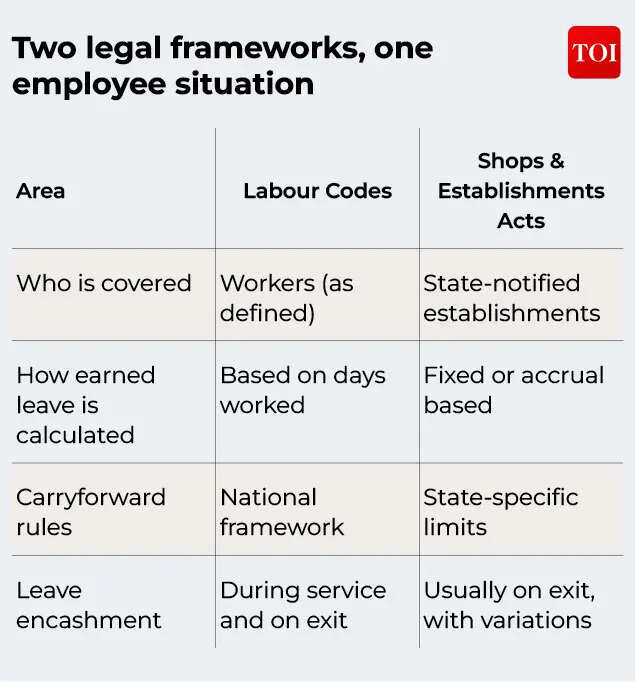
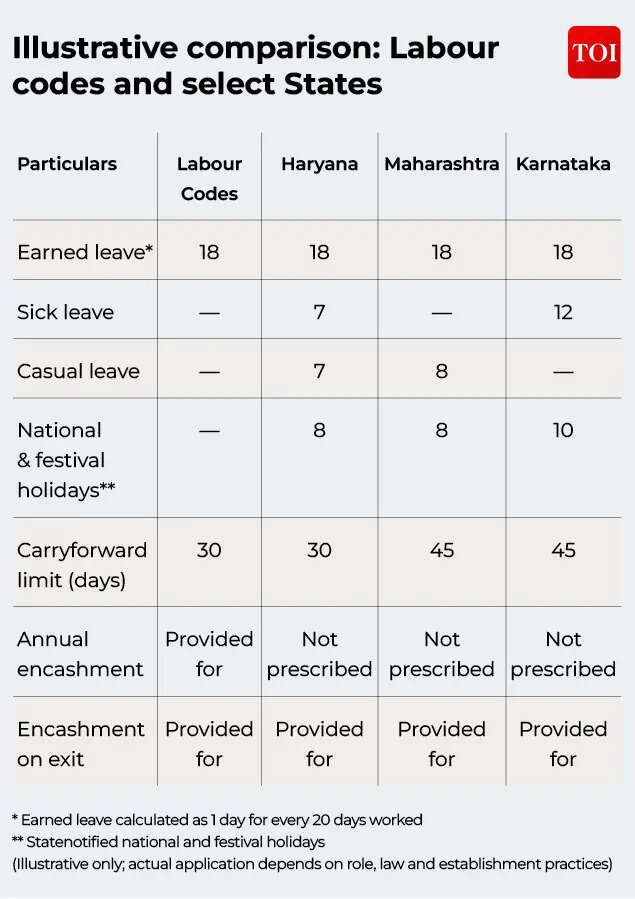
Employers are expected to apply these frameworks together and ensure consistency as the new system takes shape.How earned leave builds upEarned leave generally depends on how long an employee has worked.Under the labour codes, earned leave accrues at a standard rate of one day for every twenty days of work, subject to certain eligibility conditions. This is meant to create a common reference point across the country.State Shops and Establishments laws, however, follow different approaches. Some States grant a fixed number of leave days each year, while others link leave closely to days worked. States also differ on how much unused leave can be carried forward.Sick leave, casual leave and holidaysSick leave and casual leave are mainly meant for short-term protection rather than long-term accumulation. Sick leave helps employees during illness, while casual leave allows flexibility for sudden personal needs.These types of leave are mostly governed by State law and internal company policy, with limited direct impact from the labour codes. Usually, unused sick or casual leave does not carry forward.National and festival holidays are largely decided at the State level. Employers are expected to follow notified holiday lists or compensate employees who work on those days, as per State rules.Carrying forward unused earned leaveHow unused earned leave is treated is one area where the labour codes bring more structure.Earlier, State laws allowed different levels of leave accumulation. Under the labour code approach, carry-forward is subject to clear limits, after which settlement mechanisms may apply. This is intended to avoid unlimited build-up of leave while still protecting employee interests.If leave could not be taken because of work requirements, safeguards exist to ensure such leave is not lost automatically.Annual leave encashment under labour codesAnother change under the labour codes is clearer recognition of leave encashment during ongoing employment.Earlier, in many States, leave was typically encashed only when an employee resigned, retired or was terminated. Under the new labour codes framework, employees may be entitled to encash leave exceeding permissible carry forward limits even while they remain in service. As per provisions under labour codes, a worker shall be entitled on his / her demand for encashment of leave at the end of calendar year. Worker shall be entitled, where the total number of leave exceeds 30 days, to encash such exceeded leave.Leave encashment when employment endsAcross Indian labour laws, one position has remained largely consistent. Unused earned leave is expected to be settled when employment comes to an end, whether the employee resigns, retires, is retrenched or is terminated.How this amount is calculated depends on the applicable law. State S&E laws refer to specific wage definitions, while the labour codes require calculation using the definition of “wages” under the Code. This may differ from earlier practice.
What employees and employers should keep in mindFor employees, the key point is that leave is not only a company benefit but part of a legal framework. How it applies depends on role, location and legal coverage.For employers, the focus remains on aligning internal policies with both Central and State laws, while ensuring smooth implementation. Clear communication and regular policy reviews will continue to be important during this transition.Leave rules may not attract the same attention as pay or job security, but they play a quiet role in work-life balance and financial certainty. As India’s labour framework evolves, earned leave is increasingly seen not just as time away from work, but as a regulated employment benefit with defined outcomes.(The author, Puneet Gupta is Partner, People Advisory Services Tax at EY India)

The war in the Middle East has brought renewed attention to Britain’s vulnerability to energy price shocks.
Source link


TAG Heuer Has Dropped New Polylight-Powered F1s

WhatsApp to let users generate private summaries of unread chats
US stocks today: Wall Street inches higher as markets eye ceasefire deadline; Dow jumps 300 points, S&P 500 remains flat – The Times of India

-

 Fashion5 days ago
France’s LVMH Q1 revenue falls 6%, shows resilience amid Iran war
-

 Sports1 week ago
The case for Man United’s Fernandes as Premier League’s best
-

 Entertainment1 week ago
Palace left in shock as Prince William cancels grand ceremony
-
 Business1 week ago
UK could adopt EU single market rules under new legislation
-

 Entertainment6 days ago
Is Claude down? Here’s why users are seeing errors
-

 Fashion1 week ago
Energy emerges as biggest cost driver in textile margins
-
 Business1 week ago
Delta Air Lines unveils first new Delta One suite in premium cabin arms race
-

 Fashion1 week ago
Asia claims largest share of markets on Kearney FDI Confidence Index