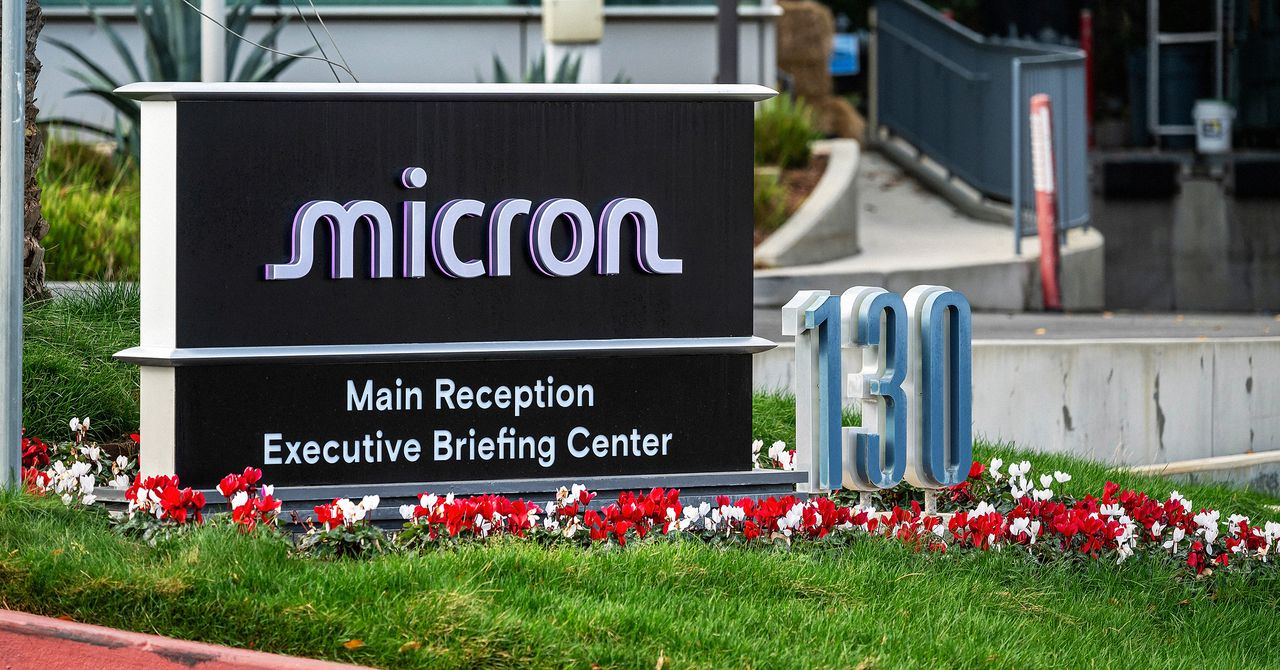
Days after Micron broke ground on a $100 billion chip factory in New York state, a coalition of environmentalists, labor unions, and civil rights groups are urging the US tech giant to sign a deal that would make a series of promises to be a good neighbor legally enforceable.
Micron’s megafab to make memory chips is on track to become the biggest commercial development in state history and the largest chipmaking complex in the country. Officials held a groundbreaking ceremony in the city of Clay, near Syracuse, last Friday. The first chips could arrive in five years, though the entire site won’t be finished for 20 years.
Organizers and members of the Central New York United for Community Benefits Coalition—composed of about 25 mostly local advocacy groups—tell WIRED that they welcome the project. They also appreciate that Micron has already pledged to hire locally and address some of the physical and social impacts of its construction. But the coalition members believe oversight is lacking and that Micron could get away with polluting the environment and worsening the region’s economicinequality.
“We want to have real, strong, transparent, and enforceable commitments,” says Anna Smith, a senior researcher at Jobs to Move America, a union-friendly national nonprofit that is helping to organize the coalition.
On Wednesday, the coalition published a letter emailed to Micron CEO Sanjay Mehrotra inviting him to meet and begin negotiations on what’s known as a community benefits agreement, which would codify the company’s pledges on hiring, environmental protection, and local investment.
Micron did not immediately respond to a request for comment on the letter.
Companies such as Micron aren’t obligated to strike deals with community groups. But the New York coalition is basing its campaign on similar efforts by other US organizations. Some of them have successfully pressured big construction projects, such as an airport and a bus factory, into signing contracts to invest in schools, build affordable housing, conduct more environmental studies, or buy locally. Crucially, these agreements can be enforced through the courts.
Proponents of the agreements say making deals can help companies neutralize opposition and clear a smoother path for construction, hiring, and ongoing integration in the community. Provisions can include oversight panels and annual public reporting. A database compiled by Columbia Law School shows dozens of benefits agreements for major projects over the past decade.
“We have seen such agreements negotiated by companies with coalitions like ours across the country become win-wins, where the employers, workers and community organizations work together to ensure the needs of all parties are met,” the New York coalition wrote in the letter to Micron.
It added that a comprehensive deal will “further fulfill Micron’s commitments to being a good neighbor” and ensure good faith promises “translate into concrete, measurable benefits.”
Amid the pushback, some projects have already been abandoned or relocated. Organizers of the New York coalition believe the Micron campaign, if it leads to a deal, could be a template for winning concessions even as development moves forward. “This project can be done well,” Smith says. “Let’s get to the finish line together.”
Seeking Commitment
The coalition’s members include environmental advocates the Sierra Club Atlantic Chapter and SustainCNY; racial justice groups Urban Jobs Task Force and the Syracuse chapter of NAACP; and labor organizations including Local 320 of the IUE-CWA, a union representing factory workers.
They zeroed in on Micron partly because of the public subsidies its project could end up receiving—up to $25 billion. The company’s promise of employing 9,000 people has buoyed support but some in the community remain concerned about the trade-offs. One point of aggravation has been that local authorities are displacing a 91-year-old great-grandmother from her home of 60 years to make way for Micron.
Coffee is the original biohack and the nation’s most popular productivity tool. As we adjust to the changeover to daylight saving time, the caffeine-addicted WIRED Reviews team is writing about our favorite coffee brewing routines and devices. Today, reviewer Peter Cottell expounds on why espresso machines don’t have to be any fancier than a Casabrews 5700. Look out for other Java.Base stories about other WIRED writers’ favorite brewing methods.
There’s a slogan in the guitar world that claims “tone is stored in the fingers.” It’s a reductive notion that’s meant to urge upstart shredders to journey within for an ideal guitar sound that suits them best rather than spend a lifetime and tens of thousands of dollars on expensive pedals, amps, and a high-end guitar with a boomer’s signature engraved on the headstock. The irony of this phrase is that it’s usually muttered by the very geezers who can afford such gear; think Joe Bonamassa, John Mayer, and James Dolan, whom the guitar world refers to as “blues lawyers.”
Fancy coffee gear can get you pretty far, but it’s as useless as a $20,000 Les Paul without technique or inspiration. The punk boom of 1977 showed ambitious musicians that they could get pretty far with attitude and initiative. But it was amidst the egalitarian post-punk boom of the early ’80s that we learned practicing your instrument and keeping an open mind can lead to transcendence, financial circumstances be damned.
In the summer of 2008, I found myself unemployed with a communications degree from a large state college, so I took the next logical step and took a turn in the service industry. A local chain of coffee shops was the first employer to call me back, so off I went to become a barista despite having, until then, consumed a total of 2 cups of coffee in my entire life. I spent the first year drinking cold brew and working afternoon or evening shifts. Then I was moved to mornings, and I had to learn how to dial in an espresso machine. And everything changed forever.
I don’t recall the make or model of the machine, but you’ll get an idea of its form and function when you imagine a local second-wave shop with a ragged GVC aesthetic, a crowded bulletin board that’s overrun with business cards from sex pests turned yoga instructors, and a silly alliterative name like Jammin’ Java or Expresso Express. At the onset, “dialing in” consisted of jiggling the grind size on the grinder until it spit out a pile of grounds that yielded a shot anywhere between 20 and 40 seconds. There was no scale, and the temperature and pressure specs of the machine were a mystery, and no one cared about any of this because most of the espresso drinks we sold were doused in DaVinci syrup and 2 percent milk. It wasn’t until the hammer came down on everyone behind the counter’s overconsumption of expensive sugary drinks that I was forced to reckon with espresso. I spent the next three years figuring out how to coax something drinkable out of this cursed, faltering machine, and I finally reached the same conclusion as many before me: Espresso is universal. It is the base unit of caffeination. The binary code of the coffee world. The bottom brick of everything earthy, bitter, brown, and rich.
After my stint at the declining café in Ohio, I moved across the country and graduated to a bakery-coffee-shop hybrid in Portland, Oregon. While it wasn’t a bona fide third-wave shop, we were close enough to stalwarts on the scene like Heart and Stumptown, so we took coffee as seriously as we could. The morning crew was responsible for dialing in three different grinders: decaf, a blend, and a single origin. Walking to work before dawn in the silent fog was a meditative experience, no matter how hungover I was, and the process of taking notes while sipping shots and adjusting the grinder and extraction time ever so slightly is a morning ritual I would return to daily if I could. Then your coworker arrives, the stereo turns from ambient techno to Electric Wizard, the customers slowly trickle in, and all hell breaks loose. You become one with the machine.
Anthropic filed a federal lawsuit against the US Department of Defense and other federal agencies on Monday, challenging its designation of the AI company as a “supply-chain risk.”
The Pentagon formally sanctioned Anthropic last week, capping a weeks-long, publicly aired disagreement over limits on use of its generative AI technology for military applications such as autonomous weapons.
“We do not believe this action is legally sound, and we see no choice but to challenge it in court,” Anthropic CEO Dario Amodei wrote in a blog post on Thursday.
The lawsuit, which was filed in a federal court in California, requested that a judge reverse the designation and stop federal agencies from enforcing it. “The Constitution does not allow the government to wield its enormous power to punish a company for its protected speech,” Anthropic said in the filing. “Anthropic turns to the judiciary as a last resort to vindicate its rights and halt the Executive’s unlawful campaign of retaliation.”
The AI startup, which develops a suite of AI models called Claude, is facing the possibility of losing hundreds of millions of dollars in annual revenue from the Pentagon and the rest of the US government. It also may lose the business of software companies that incorporate Claude into services they sell to federal agencies. Several Anthropic customers have reportedlysaid they are pursuing alternatives due to the Defense Department’s risk designation.
Amodei wrote that the “vast majority” of Anthropic’s customers will not have to make changes. The US government’s designation “plainly applies only to the use of Claude by customers as a direct part of contracts with the” military, he said. General use of Anthropic technologies by military contractors should be unaffected.
The Department of Defense, which also goes by the Department of War, and the White House did not immediately respond to requests for comment about Anthropic’s lawsuit.
Attorneys with expertise in government contracting say Anthropic faces a difficult battle in court. The rules that authorize the Department of Defense to label a tech company as a supply-chain risk don’t allow for much in the way of an appeal. “It’s 100 percent in the government’s prerogative to set the parameters of a contract,” says Brett Johnson, a partner at the law firm Snell & Wilmer. The Pentagon, he says, also has the right to express that a product of concern, if used by any of its suppliers, “hurts the government’s ability to effectuate its mission.”
Anthropic’s best chance of success in court could be proving it was singled out, Johnson says. Soon after Defense Secretary Pete Hegseth announced that he was designating Anthropic a supply-chain risk, rival OpenAI announced it had struck a new contract with the Pentagon. That could be instrumental to Anthropic’s legal argument if the company can demonstrate it was seeking similar terms as the ChatGPT developer.
OpenAI said its deal included contractual and technical means of assuring its technology would not be used for mass domestic surveillance or to direct autonomous weapons systems. It added that it opposed the action against Anthropic and did know why its rival could not reach the same deal with the government.
Military Priority
Hegseth has prioritized military adoption of AI technologies, with posters recently seen in the Pentagon showing him pointing and that read, “I want you to use AI.” The dispute with Anthropic kicked up in January after Hegseth ordered several AI suppliers to agree that the department was free to use their technologies for any lawful purpose.
Anthropic, which is the only company currently providing AI chatbot and analysis tools for the military’s most sensitive use cases, pushed back. It contends that its technologies are not yet capable enough to be used for mass domestic surveillance of Americans or fully autonomous weapons. Hegseth has said Anthropic wants veto power over judgments that should be left to the Defense Department.
Nick Pearson, CIO at Ricoh Europe, describes his job as energising. The company’s shift in business model presents challenges and significant opportunities for him to draw on previous experience at other blue-chip firms.
Pearson joined the printer and tech services supplier in December 2023. He was previously head of IT platforms at Vodafone and held senior tech roles at RS Group and PepsiCo, where he spent almost a decade and was latterly UK IT director. In his role as CIO at Ricoh, Pearson is a member of the European executive board engaged in business transformation.
“We’re going through a seismic change that pivots Ricoh from a device and manufacturing company – an asset-based firm – into a services organisation,” he says.
“That shift on all levels – the way people think, the way we build systems, the way we sell, the way we operate, and the way we deliver – is energising. And that change is occurring against the backdrop of everything happening in the wider technology space.”
Assuming responsibility
Tokyo-listed Ricoh employs close to 80,000 people globally across three core divisions: Japan and Asia-Pacific, EMEA and North America. Pearson reports to the European CEO, who reports to the global CEO.
Pearson says the company runs a federated business across its three regions, loosely coupled back to its Tokyo headquarters. The European division employs about 17,000 people and boasts annual revenues of more than £3bn.
“For me, it’s a nice opportunity in a chunky organisation,” he says.
One element of the loosely coupled relationship with the Japan headquarters is that the company doesn’t have a global IT organisation. Pearson is part of a board in Japan that governs technology and creates a strategy across North America, Europe and Japan. This IT leadership approach was one of the major attractions of the role.
“There wasn’t a CIO [at Ricoh] before me. Running technology was a role someone adopted as part of their C-suite responsibilities. Now, a big part of my role is talking about the benefits of technology”
Nick Pearson, Ricoh Europe
“This model allows us to operate a fairly autonomous but linked IT estate, without over-globalising platforms and services. At PepsiCo, we pushed globalisation to the extent where, as a CIO or IT director, your role shifted at a regional level into more of a business relationship – you were the director of how you provide those globalised services,” he says.
“Ricoh is loosely coupled. And that setup excited me as a CIO, because it gives you the innovation space and the opportunity to deliver solutions that are ultimately closer to the customers here in Europe, rather than a global standard becoming the accepted index.”
Pearson says another appealing factor was that he knew Ricoh and respected its work. He had partnered with the firm at PepsiCo, where the technology specialist ran his helpdesk. Pearson recognised from initial discussions with senior executives at Ricoh that reporting directly to the European CEO would allow him to showcase the crucial role of digitisation.
“The conversations were about putting technology at the very heart of the business,” he says. “Before I joined, we never really had an IT leadership voice on the board. There wasn’t a CIO before me. Running technology was a role someone adopted as part of their C-suite responsibilities. Now, a big part of my role is talking about the benefits of technology.”
Shifting priorities
Pearson’s role has two main components. First, he assumes a traditional CIO position, overseeing artificial intelligence (AI), data, digital transformation, cyber security and business applications, while managing an internal team and a growing network of partners.
“I provide technology services to 17,000 people in Europe, about 200 applications, and all the services that run enterprise IT,” he says. “That’s my CIO stomping ground where I’m feeding, watering, supporting and operationally running IT.”
The other half of Pearson’s role is external facing. As a technology company, Ricoh sells products and services to CIOs. His conversations with his digital peers focus on his company’s developments across a range of areas, from private cloud to software that supports customers to technologies that form part of the company’s internet of things (IoT) platform.
“I am not the product owner of those end-solutions,” he says. “That responsibility sits in the commercial business. But the platforms and the technologies that support our solutions are a thread of mine that we’re growing. We’re moving away from just being a back-office function and looking at those front-office solutions that we’re providing.”
In short, suggests Pearson, some of the products and services his team develops in the back office might become front-office solutions for the firm’s customers. He describes this approach as a customer-zero strategy, where Ricoh Europe uses its own technologies before releasing them to the public.
“I’m trying to bring that approach through,” he says. “So, for instance, what are we doing for workplace experience? What are we building out in terms of capabilities, and where do they land? Private clouds are a good example. Our customers need a private cloud solution, and so do I. It’s about building something that’s a scalable solution and a win/win for us.”
Enabling transformation
Pearson says the broad aspiration is to use technology to help power the company’s business transformation from products to services. This shift is already underway. He estimates that about 55% of the company’s revenue now comes from services.
Some growth has come from the development of new services in key areas, such as cyber security, cloud, document management and meeting room spaces. Another key growth factor has been acquisitions, including the 2023 purchase of digital infrastructure and managed services company PFH Technology Group.
“My job collectively is to look at some decent growth, some declining growth, and explore opportunities to pivot,” says Pearson, reflecting on the transformation. “I need to consider how we run a model for everything from acquisitions through to manufacturing and print, our distribution business, while also growing our IT services organisation.”
Pearson says his IT strategy to enable this effort has “two brains” – a fit-for-growth element for internal IT and a second part that focuses on growth. When it comes to internal IT, Pearson is striving for operational excellence. He is working to speed up day-to-day technology delivery, and that’s meant taking a detailed look at the underlying architecture.
“Ricoh was on a journey, using quite monolithic stacks around Oracle and big back-office systems,” he says.
“We need to get to a more agile model, so we’ve got choices and flexibility. So, for example, we’re driving a dual strategy in an area like ERP [enterprise resource planning]. We’ve got Oracle, but we don’t want to slow the business down. We want to offer choice.”
When it comes to the second part of his strategy, supporting growth, Pearson says the organisation needs to ensure that cyber security awareness becomes a key part of its DNA, particularly on the manufacturing and distribution side of the business. Meanwhile, continuing to grow the services side of the business means giving people secure access to data-enabled platforms, such as the internet of things (IoT), private cloud and automation.
“Our approach to emerging technology is that we’re using AI where it matters,” he says. “We are a very much taking an ‘N-minus-one’ view in the sense that we say, ‘Let’s leverage, let’s partner, let’s scale, let’s use what’s working for our customers and for us internally,’ and we think that’s the best way we’re going to get value from this technology.”
Driving growth
Pearson has developed Ricoh Europe’s AI strategy over the past 12 months. He’s set up a tri-party AI council alongside the head of service operations and the commercial manager in Spain, which is one of the company’s most progressive businesses.
This council explores opportunities to buy, build and reuse emerging technologies operationally and commercially. Internally, the company is investigating how to use Microsoft Copilot technologies to boost operational productivity. Externally, the organisation considers how data can be used to improve customer processes, such as using AI to boost room-booking capabilities and exploit office space more effectively.
We’ll be doing AI where it matters, people will understand where it matters, and they’ll be using it where it matters, not because of the fear of missing out Nick Pearson, Ricoh Europe
Pearson is eager to make some key developments through 2026. His team is rolling out ServiceNow field service management technology to about 2,000 engineers across Europe.
“That means we can get better engineer automation, better fixed rates for when people visit clients, and we’ve got a lot of work we’re doing to automate our helpdesk facilities as customers call contact centres to get better problem resolution,” he says.
Another priority relates to an overarching initiative called One Ricoh, where his team ensures acquired businesses and their staff can benefit from using a standardised application estate.
“We’re looking at our back-office systems, especially around ERP, where we’re bringing companies across Europe into a consolidated solution set. That’s driving efficiency,” he says.
Pearson also wants to drive business growth by exploiting information. Ricoh Europe uses the Snowflake data platform and has invested in Microsoft technologies, such as Power BI and Fabric.
“We want to power a step change in business capabilities,” he says. “We’re setting up a data factory, which hopefully helps our AI journey as well, with more employees shifting into becoming data product owners on that side.”
Looking forward, Pearson suggests the platform he’s building will deliver a strong, digitally enabled business two years from now.
“Number one, we will have capabilities in data and applications that mean, whether you’re a small or a big business in Ricoh, selling a single line or every line of our portfolio, you’ll have standard tooling to enable you to do that,” he says.
Second, he expects his customer-zero strategy to produce big benefits. “We’ll be out there, proud and innovative in the way we run our company, and showing our workplace experience outside-in.”
Finally, Pearson says the organisation will have established a clear data and AI strategy that is recognised by internal staff and external customers.
“We’ll be doing AI where it matters, people will understand where it matters, and they’ll be using it where it matters, not because of the fear of missing out,” he says.


















 Politics2 days ago
 Sports3 days ago
 Sports1 week ago
 Entertainment1 week ago
 Entertainment2 days ago

 Sports1 week ago