

Tech
Microsoft urges tech rivals to cover datacentre expansion-related power costs to protect consumers | Computer Weekly


Microsoft is calling on more technology companies to “pay their own way” when covering the electricity costs associated with running artificial intelligence (AI) infrastructure and datacentres, rather than expect consumers to foot the bill.
The software giant’s vice-president and chair, Brad Smith, said Microsoft has vowed to “pay our way” to ensure its datacentres do not increase the electricity bills of everyday consumers, and that other tech firms should follow suit as well.
Expanding on this point, he said the US has an ageing electricity transmission infrastructure that is already straining under the weight of the demands put on it, with upgrades hampered by supply chain constraints on transformers and high-voltage equipment.
The impact of the latter is making it difficult to boost the transmission capacity of existing electricity networks, and building new ones can take up to a decade due to “permitting and siting delays”, said Smith, in a blog post.
“Some have suggested that AI will be so beneficial that the public should help pay for the added electricity the country needs for it … but we disagree with this approach,” he continued.
“Especially when tech companies are so profitable, we believe that it’s both unfair and politically unrealistic for our industry to ask the public to shoulder added electricity costs for AI. Instead, we believe the long-term success of AI infrastructure requires that tech companies pay their own way for the electricity costs they create.”
According to Smith, this approach will be needed to ensure the US and its AI infrastructure can tap into a “rapidly growing supply of electricity” and retain its leading position in the field of AI.
Stated goal
As detailed in the blog post, Smith went on to share examples of how Microsoft is already working with utility providers and public bodies to ensure the energy consumption habits of its datacentres do not financially burden local communities. “Our goal is straightforward: to ensure that the electricity cost of serving our datacentres is not passed on to our residential customers,” he said.
To guard against this, Smith said the company is asking utility providers to set higher energy rates for the company to cover the electricity costs of the datacentres it builds, owns and operates.
“In some areas, communities are already starting to benefit from this approach,” he said. “As part of our datacentre investment in Wisconsin, we are supporting a new rate structure that would charge ‘very large customers’, including datacentres, the cost of the electricity required to serve them.
“This protects residents by preventing those costs from being passed on, [but we] recognise the need to ensure that datacentre communities benefit everywhere,” said Smith. “We believe this approach can and should be a model for other states.”
The company is also committing to working with local utility providers, and paying for electricity capacity and support for grid infrastructure upgrades for its datacentre expansion plans. “We’ll [also] pursue innovation to make our datacentres more efficient … [by] using AI to reduce energy use and improve the performance of our software and hardware in the design and management of our datacentres,” he said.
“And we are collaborating closely with utilities to leverage tools like AI to improve planning, get more electricity from existing lines and equipment, improve system resilience and durability, and speed the development of new infrastructure, including nuclear energy technologies,” added Smith.
“By embedding these innovations into datacentres and by collaborating directly with local utilities, communities gain access to systems that are more efficient, more reliable and better prepared to support growth without increasing costs for households.”
National energy security and supply
The impact the growing demand for power-hungry AI datacentres is having on national energy security and supply is also a top-of-mind concern for the UK, and has been for some time, with the National Grid rolling out a series of initiatives to address the issue.
In line with Microsoft’s proposals, Computer Weekly has also covered cases of datacentre operators committing to financing electricity grid and substation upgrades in areas where they want to build facilities as part of their planning applications.
In the US, though, Microsoft’s blog emerged within days of a social media post being published by US president Donald Trump that stated his administration is working with “major American technology companies” to ensure US citizens “never” have to pay higher electricity bills because of datacentres.
In the post, he said his team has already been working closely with Microsoft on this matter to “ensure that Americans don’t ‘pick up the tab’” for its datacentre energy consumption habits. “The big technology companies who build [datacentres] must pay their own way,” added Trump.

A national housing shortage is straining finances and communities across the United States. In Massachusetts, at least 222,000 homes will have to be built in the next 10 years to meet the population’s needs. At the same time, there are numerous challenges in traditional construction. There’s a shortage of skilled construction workers. Most projects involve multiple contractors and subcontractors, adding complexity and lag time. And the construction process, as well as the buildings themselves, can be a major source of emissions that contribute to climate change.
Reframe Systems, co-founded by Vikas Enti SM ’20, uses robotics, software, and high-performance materials to address these problems. Founded in 2022, the company deploys microfactories that bring housing fabrication and production closer to the regions where the homes are needed. The first homes designed and manufactured in Reframe’s first microfactory have been fully built in Arlington and Somerville, Massachusetts.
Enti’s experiences in MIT System Design and Management (SDM) shaped the company from its start. “Learning how to navigate the system and finding the optimal value for each stakeholder has been a key part of the business strategy,” he says, “and that’s rooted in what I learned at SDM.”
Better tools for system-level problems
Enti applied to SDM’s master of science in engineering and management while he was working at Kiva Systems, overseeing its acquisition by Amazon and transformation into Amazon Robotics. He found that the SDM program’s fundamentals of systems engineering, system architecture, and project management provided him with the tools he needed to address system-level problems in his work.
While he was at MIT, Enti also served as an associate director for the MIT $100K Entrepreneurship Competition, which offers students and researchers mentorship, feedback, and potential funding for their startup ideas. He realized that “there isn’t a single formula for how businesses start, or how long it takes to get them started,” he says, which helped shape his plans to start his own business.
Enti took a leave of absence from MIT to oversee the expansion of Amazon Robotics in Europe. He returned and completed his degree in 2020, writing his thesis on developing technology that could mitigate falls for elderly people. This instinct to use his education for a good cause resurfaced when his daughters were born. He wanted his future business to address a real-world problem and have a social impact, while also reducing carbon emissions.
Growing housing, shrinking emissions
Enti concluded that housing, with immediate real-world impact and a significant share of global carbon emissions, was the right problem to work on. He reached out to his colleagues Aaron Small and Felipe Polido from Amazon Robotics to share his idea for advanced, low-cost factories that could be deployed quickly and close to where they were needed. The two joined him as co-founders.
Currently, the microfactory in Andover, Massachusetts, produces structural panels, with robotics completing wall and ceiling framing and people completing the rest of the work, including wiring and plumbing. Eventually, Reframe hopes to automate more of the building process through further use of robotics. The modular construction process allows for reduced waste and disruption on the eventual home site. And the finished homes are designed to be energy-efficient and ready for solar panel installation. The company is set to start work soon on a group of homes in Devens, Massachusetts.
In addition to the Andover location, Reframe is setting up in southern California to help rebuild homes that were destroyed in the area’s January 2025 wildfires. The company’s software-assisted design process and the adjustability of the microfactories allows them to meet local zoning and building codes and align with the local architectural aesthetic. This means that in Somerville, Reframe’s completed buildings look like modernized versions of the neighboring three-story buildings, known locally as “triple-deckers.” On the other side of the country, Reframe’s design offerings include Spanish-style and craftsman homes.
“Housing is a complex systems problem,” Enti says, explaining the impact SDM has had on his work at Reframe. The methods and tools taught in the integrated core class EM.412 (Foundations of System Design and Management) help him tackle systems-level problems and take the needs of multiple stakeholders into account. The Reframe team used technology roadmapping as they devised their overall business plan, inspired by the work of Olivier de Weck, associate head of the MIT Department of Aeronautics and Astronautics. And lectures on project management from Bryan Moser, SDM’s academic director, remain relevant.
“Embracing the fact that this is a systems problem, and learning how to navigate the system and the stakeholders to make sure we’re finding the optimal value, has been a key part of the business strategy,” Enti says.
Reframe Systems is set to continue learning through iteration as they plan to expand their network of microfactories. The company remains committed to the core vision of sustainably meeting the country’s need for more housing. “I’m grateful we get to do this,” Enti says. “Once you strip away all the robotics, the advanced algorithms, and the factories, these are high-quality, healthy homes that families get to live in and grow.”
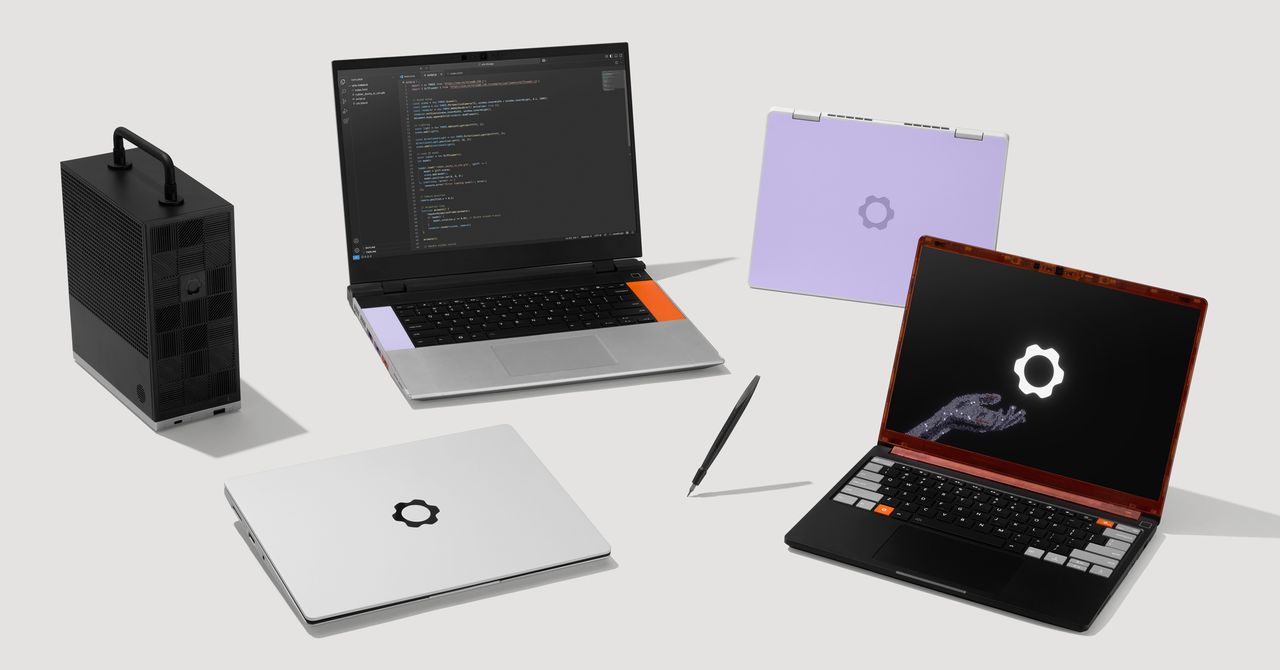
Framework, the company that makes laptops designed for optimal repairability, announced a new version of its main product, a 13-inch screen laptop. It’s called the Framework Laptop 13 Pro, and it has far better battery life, a touchscreen, a haptic touchpad, and is fitted with Intel processors.
At an event in San Francisco today, Framework CEO Nirav Patel showed off the company’s new tech, opening with a joke about making Framework AI—something the company is very much not doing. Framework’s whole thing, after all, is aiming to give users control over the physical tech they use.
“That industry is fighting for you to own nothing, and they own everything,” Patel said about the AI industry. “We’re fighting for a future where you can own everything and be free.”
Framework used the event to detail other updates coming to its 16-inch laptop. It also showed off previews of an official developer kit and a wireless keyboard for controlling your rig from the couch.
Framework 13 Pro
As the name implies, the 13 Pro is a step up from the company’s last version, the Framework 13. It’s also pricier, starting at $1,199 for a DIY Edition that requires assembling the computer yourself. Pre-built units start at $1,499 but can be upgraded with more features. Framework says it will start shipping the 13 Pro in June.
Framework’s signature move for its products is the ability to take the thing apart. The 13 Pro is made with that ethos in mind, so its parts can be easily swapped out, upgraded, or replaced. Four Thunderbolt 4 interfaces let you pick which ports (USB-C, HDMI, etc.) you want and then choose where to place them. Framework says it planned the laptop with cross-generation compatibility in mind, so current Framebook 13 laptop owners will be able to use new 13 Pro parts like the mainboard, display, and battery, and put them into their existing machine.
The big changes in the guts of the 13 Pro come from Framework’s shift away from using an AMD processor to Intel’s Core Ultra Series 3 processors, which Framework described in its press release as “just insanely efficient.” That efficiency, along with a bigger battery, translates to more than 20 hours of battery life while streaming 4K Netflix videos, at least that’s the claim. That’s almost 12 hours longer than the Framework 13.

Courtesy of Framework

Courtesy of Framework

OpenAI launched a new image generation AI model on Tuesday, dubbed ChatGPT Images 2.0. This model can generate more than one image from a single prompt, like an entire study booklet, as well as output text, including in non-English languages, like Chinese and Hindi. This release is available globally for ChatGPT and Codex users, with a more powerful version available for paying subscribers.
When any major AI company releases a new image model, it can revive interest and boost usage, especially if social media users adopt a meme-able trend, transforming images of themselves. Last year, Google’s launch of the Nano Banana model was a major moment for the company, especially when users started posting hyperrealistic figurines of themselves online. Earlier this year, ChatGPT Images made waves on social media as users shared AI-generated caricatures.
What’s Different?
Since the new model can tap into ChatGPT’s “reasoning” capabilities, Images 2.0 can search the internet for recent information and generate more than one image at a time. In essence, the bot can use additional steps to output more thorough generations from a single prompt. Images 2.0 also has a more recent knowledge cutoff date: December 2025.
This also means that outputs from the new model are more granular. For example, I generated an infographic with San Francisco’s weather forecast for the next day, as well as activities worth doing. The image ChatGPT generated included accurate weather details for the rainy day, along with accurate-looking drawings of the Ferry Building, Castro Theater, Painted Ladies houses, and Transamerica Pyramid.
Additionally, Images 2.0 is more customizable for users who want unique aspect ratios for image outputs. The new model can generate images, ranging from 3:1 wide to 1:3 tall, and users can adjust the image’s size as part of their prompt to the AI tool.
First Impressions
After a few hours of generating images with the new model, I was generally impressed with the text rendering capabilities, in English at least. Not that long ago, image outputs featuring text, from any of the major models, often included numerous malformed characters or words with errant extra letters. ChatGPT struggled to label images accurately two years prior, so the cleaner, more complex outputs from Images 2.0 are a sign of continued improvement. Google has also focused on improving image outputs featuring text in its recent iterations of Nano Banana.



Michael Jackson’s important family members snubbed biopic’s LA premiere

Blake Lively reveals what she lost due to Justin Baldoni’s smear campaign

Trump repeats call for Congress to rein in college sports

-

 Fashion6 days ago
France’s LVMH Q1 revenue falls 6%, shows resilience amid Iran war
-

 Sports1 week ago
The case for Man United’s Fernandes as Premier League’s best
-

 Entertainment1 week ago
Palace left in shock as Prince William cancels grand ceremony
-
 Business1 week ago
UK could adopt EU single market rules under new legislation
-

 Entertainment7 days ago
Is Claude down? Here’s why users are seeing errors
-

 Fashion1 week ago
Energy emerges as biggest cost driver in textile margins
-
 Business1 week ago
Delta Air Lines unveils first new Delta One suite in premium cabin arms race
-

 Fashion1 week ago
Asia claims largest share of markets on Kearney FDI Confidence Index