

Business
Middle East crisis: Oil tops $100, nears 4-year high as Saudis cut production – The Times of India

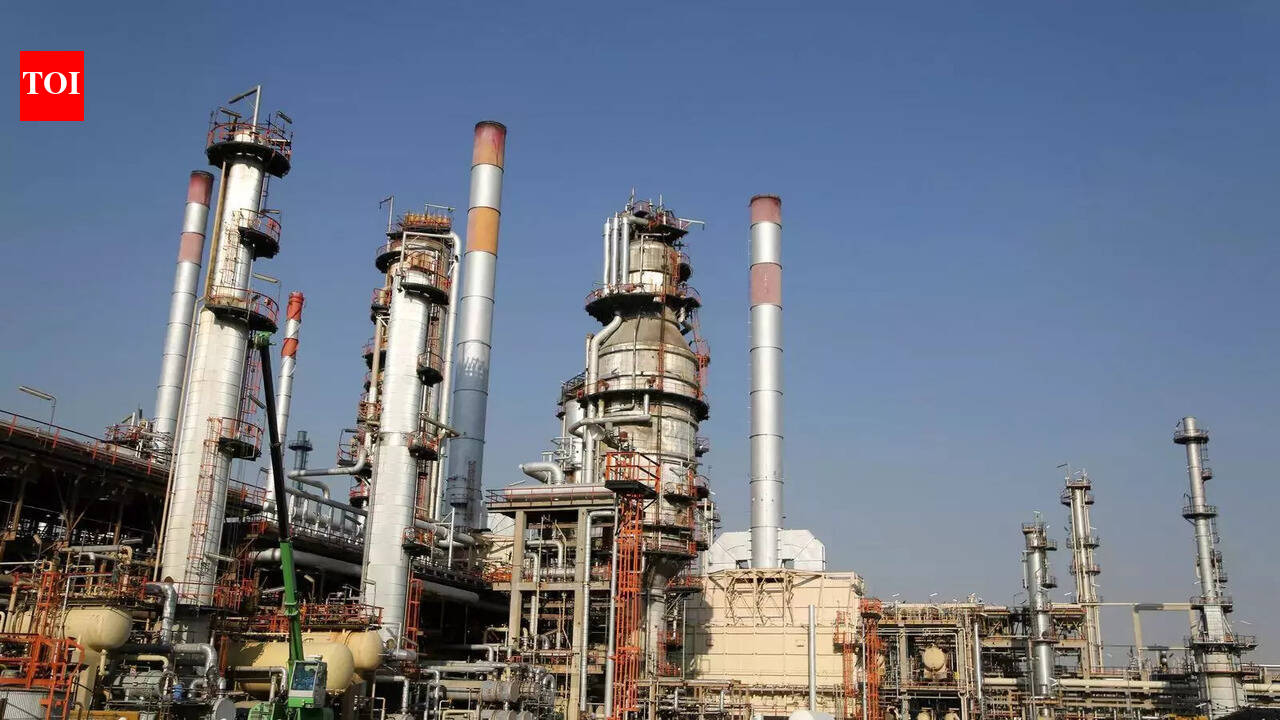
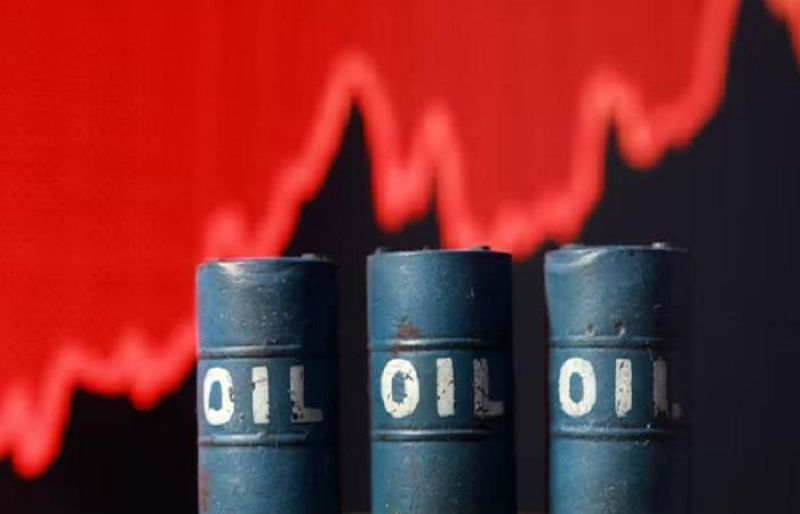
Oil prices surged to $120 a barrel before retreating to $102 Monday as Saudi Arabia was reported to be cutting output, adding to the supply squeeze due to disruption in the Strait of Hormuz.Finance ministers of developed G7 nations, who met Monday evening, deferred plans to tap their strategic reserves to cool down the global flare-up in prices, while vowing to keep close tabs on the evolving supply situation.Although Brent prices touched the highest level seen since mid-2022, govt officials said there was no immediate plan to increase pump prices of fuel in India. “We are nicely placed vis-a-vis crude. There is unlikely to be a rise in petrol and diesel prices in the foreseeable future, even if prices remain at $110-120 a barrel,” said a senior govt official.
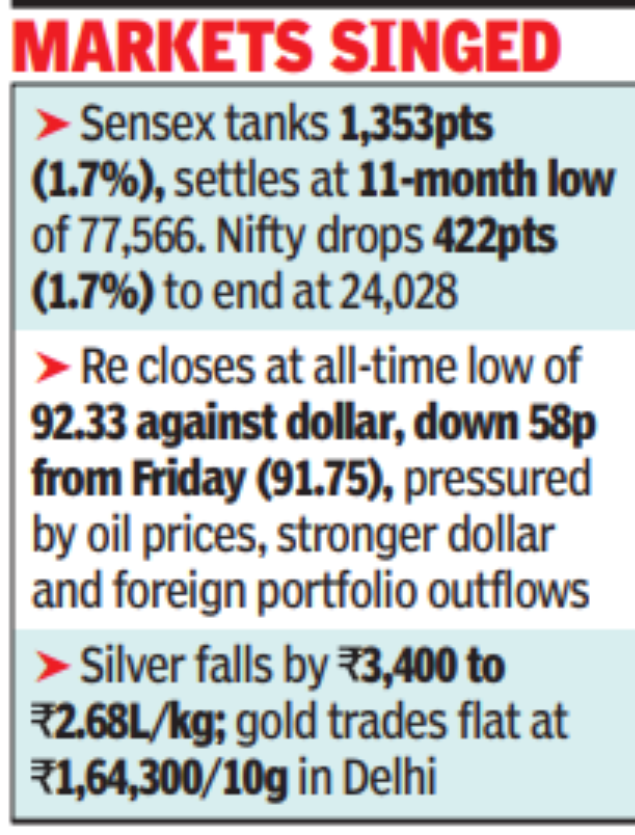
Iran conflict sends Brent soaring 65% since Feb 28
The Indian basket was on the verge of hitting $100 a barrel after having reached $99.12 on Friday, almost 40% higher than the Feb 27 level of $71.19. Since Feb 28, when the US and Israel bombed Iran, global benchmark Brent has surged as much as 65%.The statement came amid reports that Saudi Aramco had begun reducing production from two of its fields, joining Iraq, Kuwait, Qatar and the UAE, as they ran out of storage due to blocked shipments.Govt officials, however, reiterated that India has sufficient stock of oil and gas to meet domestic requirements. They also sought to dispel rumours of a scarcity of fuel and dismissed reports of shortages anywhere in the country. Officials also maintained there are adequate stocks of aviation turbine fuel. “India is also a producer and exporter of ATF; there is no need to worry,” said one of them.The disruptions have prompted govts to initiate emergency action. For instance, Japan, which imports around 95% of its oil from West Asia, has instructed a national oil reserve storage site to prepare for a possible crude release, while China has asked refiners to halt fuel exports. South Korea has capped prices for the first time in 30 years, while Vietnam removed import tariffs on fuels. Bangladesh has shut universities to conserve electricity and fuel.Panic across markets prompted G7 finance ministers to consider releasing crude from strategic reserves, a step officials said was not being considered by India as it sought to secure its supply lines.India, world’s third-largest oil-importing and consuming nation, has 5.3 million tonnes of underground strategic reserves, which are at 80% of their capacity. “The crisis (that led to a rise in prices) is not our creation. Those responsible have to deal with it and create situations to ease (prices). Ours is an India first policy,” said a govt functionary.India is not a full member of IEA and does not have an obligation to follow the diktat of the international body, officials added.
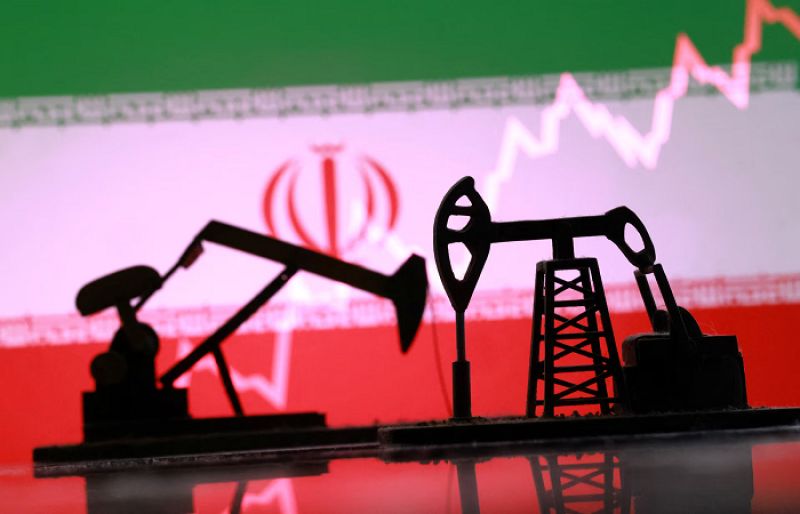

The United Arab Emirates has decided to leave the Opec group of oil producers after six decades of membership amid an energy supply shock in the Middle East spurred by the US-Israeli war with Iran.
The UAE announced the decision, through the state-run WAM news agency, which will be effective from May 1.
Opec (Organisation of Petroleum Exporting Countries) was founded in Iran in 1960 and aims to co-ordinate production among member countries, stabilise oil markets and keep supply and income steady.
The UAE joined Opec in 1967, and its departure will leave the oil cartel with 11 member countries including Saudi Arabia, Iran and Iraq.
A statement on the WAM news agency read: “This decision follows a comprehensive review of the UAE’s production policy and its current and future capacity and is based on our national interest and our commitment to contributing effectively to meeting the market’s pressing needs.
“While near-term volatility, including disruptions in the Arabian Gulf and the Strait of Hormuz, continues to affect supply dynamics, underlying trends point to sustained growth in global energy demand over the medium to long-term.”
The statement went on to say that following its exit, the UAE would “continue to act responsibly, bringing additional production to market in a gradual and measured manner”.
It has been reported that the UAE has expressed frustrations with production quotas agreed by Opec members in a bid to control oil prices, with the decision also referring to a desire for greater flexibility.
But the announcement comes at a fraught time in the Middle East with the closure of the Strait of Hormuz disrupting oil and gas supplies around the world and sending prices soaring.
David Oxley, chief climate and commodities economist for Capital Economics, said the UAE had been “itching to pump more oil”.
“The UAE’s desire to pump more oil has been placated up to now by a combination of the rest of Opec turning a blind eye to its overproduction and also raising its quota levels,” he said.
The economist suggested that, if energy flows get back to normal once the Strait of Hormuz reopens, then the UAE’s departure from Opec could “feasibly” result in it pumping an additional one million barrels per day – the equivalent of about 1% of global oil demand.
Mr Oxley also warned that the move could trigger other members leaving Opec which would have bigger implications for the global oil market and prices.

There was a fresh blow for Rachel Reeves as government borrowing costs hit the highest level since the financial crash of 2008.
The yield on 10-year bonds – the most widely used benchmark of government debt costs went over 5 per cent on City trading screens.
Sometimes such moves are a blip followed by a fall, but instead they stayed at 5.1 per cent on Tuesday.
The interest rate paid on UK government debt is a sign of confidence in the wider economy; the higher the yield, the more investors are demanding to lend to the government.
Lucy Smith, senior investment manager at investment management firm Killik & Co, said: “Today the 10-year UK gilt yield has risen above 5 per cent for the first time since 2008. This is bad news for Reeves as she attempts to contain government borrowing costs whilst encouraging growth.”
The chancellor was already dealing with rising inflation, up from 3 per cent to 3.3 per cent in the most recent official figures, and has faced speculation that the prime minister may look to remove her in a shake-up of his team.
Retailers are warning of rises in the cost of food and fuel, a further blow to those on the lowest incomes who were already stretched. Local council elections on May 4 are expected to see a Labour battering at the polls.
The International Monetary Fund (IMF) recently revised UK growth forecasts for the year down from 1.3 per cent to 0.8 per cent. Some economists fear she may have to find new tax rises.
Ms Smith added: “The Iran war has caused oil prices to spike, with the price of oil remaining above $100 a barrel, up from around $60 in December. The UK is a net importer of oil, so this increase is likely to create a supply-side inflationary shock, worsening the UK’s inflationary outlook. The combination of higher inflation and lower growth presents a significant challenge for the chancellor and may result in further tax rises or reduced spending in the next budget later this year.”
City insiders say that political instability within the UK government, particularly surrounding the Peter Mandelson vetting inquiry, may have also contributed to rising yields, as instability makes investors less willing to hold government debt.
Some spy opportunities for retail investors, since government debt is guaranteed. Bonds can be bought via all major investment platforms and held in tax-free ISAs.
Alan Miller at investment firm SCM Direct said: “Long gilts at 5 per cent plus are the best deal retail savers have had in years. Wrap it in an ISA, and you keep the lot.”
Ms Reeves has been trying to create so-called “headroom”, which means the UK’s finances remain within the guidance she has given to Parliament. Some experts argue she has handled this well.
Andrew Goodwin at Oxford Economics says: “We calculate that if gilt yields and market expectations for bank rate stay where they are now, it would knock about £7.5bn off the chancellor’s £23.6bn headroom at this autumn’s Budget. But this won’t force the chancellor to take corrective action. Indeed, it demonstrates that her decision to increase headroom at the 2025 Budget was a wise one because it has given her the room to absorb this unexpected shock without having to respond with higher taxes.”
The Bank of England’s Monetary Policy Committee (MPC) meets on Thursday and is expected to hold interest rates at 3.75 per cent.
Before the Iran war, it was widely expected that the Bank would cut rates two or three times this year, leading to lower mortgage costs.
Critics say government policy is as much to blame as global events.
Kallum Pickering, chief economist at Peel Hunt, wrote in a note: “Over the past decade, the UK economy has suffered a succession of policy mistakes and resulting rates of inflation which have consistently exceeded the prevailing trends across other major economies. Unsurprisingly, it no longer takes much to spook UK government debt markets.”

A UPS driver sits in his truck on April 15, 2026 in the Flatbush neighborhood of the Brooklyn borough in New York City.
Michael M. Santiago | Getty Images
United Parcel Service on Tuesday posted first-quarter earnings results that beat on the top and bottom lines.
Shares of the delivery giant sank roughly 5% in premarket trading.
Here’s how the company performed in its first quarter, compared with what Wall Street was expecting, based on a survey of analysts by LSEG:
- Earnings per share: $1.07 adjusted vs. $1.02 expected
- Revenue: $21.2 billion vs. $20.99 billion expected
For the quarter ended March 31, UPS reported net income of $864 million, or $1.02 per share, compared with $1.19 billion, or $1.40 per share, a year prior. Adjusting for one-time items, the company reported a profit of $906 million, or $1.07 per share. Revenue fell to $21.2 billion from $21.5 billion a year ago.
“The first quarter of 2026 marked a critical transition period for UPS in which we needed to flawlessly execute several major strategic actions and we delivered,” CEO Carol Tomé said in a statement. “With that behind us, we expect to return to consolidated revenue and operating profit growth, and adjusted operating margin expansion in the second quarter of this year.”
For its full-year 2026 outlook, the company reaffirmed its consolidated financial estimate of $89.7 billion in revenue and non-GAAP adjusted operating margin of 9.6%.
“It is early in the year to raise [guidance],” Tomé said on a call with analysts on Tuesday, adding that there are no indications to be concerned about the health of the business.
In its domestic segment, UPS said revenue dropped 2.3%, primarily due to an expected decline in volume.
UPS is also in the midst of a turnaround plan and enhancing the automation in its network. In the first three months of the year, UPS said it achieved $600 million in cost savings from its network efficiency program, with expectations to reach $3 billion in year-over-year savings in 2026.
Company executives added on the call with analysts that fuel surcharges have not had a material impact on UPS’ business and that it remains too early to determine exact impacts from the war in the Middle East.


Iran, US allowed Russian superyacht to cross Strait of Hormuz, says source

BCC warns UK govt on economic risks after global shocks

UAE To Exit OPEC After Nearly 60 Years

-

 Sports1 week ago
NCAA men’s gymnastics championship: All-time winners list
-

 Sports1 week ago
WWE WrestleMania 42 Night 2: Live match results and analysis
-

 Politics1 week ago
UK’s Starmer seeks to deflect blame over Mandelson appointment
-

 Fashion1 week ago
UK’s Sosandar returns to profitability amid robust FY26 performance
-
 Entertainment1 week ago
Lee Anderson, Zarah Sultana kicked out of UK Parliament for calling PM ‘liar’
-
 Business1 week ago
How Trump’s psychedelics executive order could unlock stalled cannabis reform
-
 Business7 days ago
Us-India Trade Talks: US–India trade deal: Where do talks stand & what to expect – explained – The Times of India
-
 Business1 week ago
Exercise to test response to offshore energy threat involving vessels and drones