

Tech
MIT engineers design an aerial microrobot that can fly as fast as a bumblebee

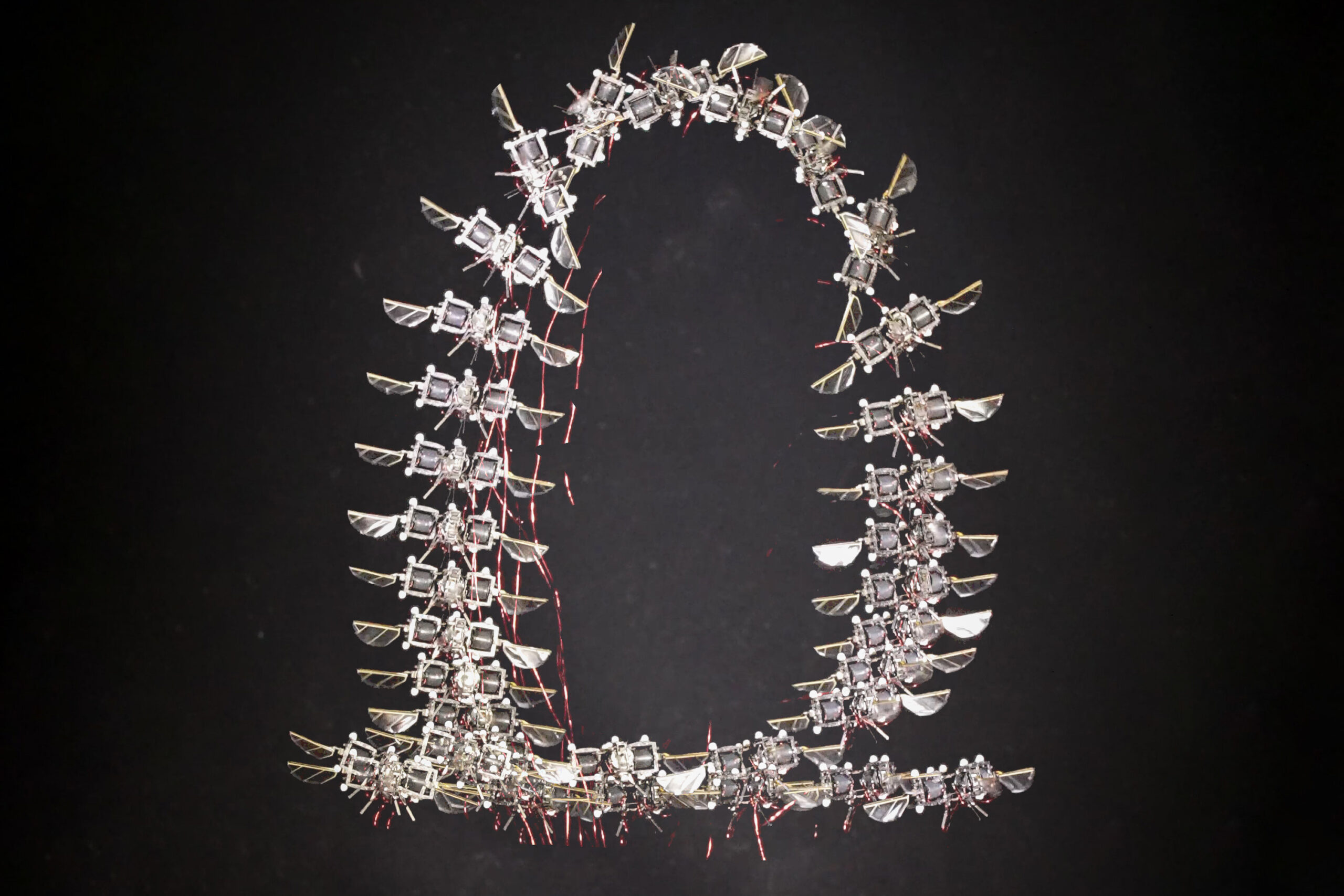
In the future, tiny flying robots could be deployed to aid in the search for survivors trapped beneath the rubble after a devastating earthquake. Like real insects, these robots could flit through tight spaces larger robots can’t reach, while simultaneously dodging stationary obstacles and pieces of falling rubble.
So far, aerial microrobots have only been able to fly slowly along smooth trajectories, far from the swift, agile flight of real insects — until now.
MIT researchers have demonstrated aerial microrobots that can fly with speed and agility that is comparable to their biological counterparts. A collaborative team designed a new AI-based controller for the robotic bug that enabled it to follow gymnastic flight paths, such as executing continuous body flips.
With a two-part control scheme that combines high performance with computational efficiency, the robot’s speed and acceleration increased by about 450 percent and 250 percent, respectively, compared to the researchers’ best previous demonstrations.
The speedy robot was agile enough to complete 10 consecutive somersaults in 11 seconds, even when wind disturbances threatened to push it off course.
Credit: Courtesy of the Soft and Micro Robotics Laboratory
“We want to be able to use these robots in scenarios that more traditional quad copter robots would have trouble flying into, but that insects could navigate. Now, with our bioinspired control framework, the flight performance of our robot is comparable to insects in terms of speed, acceleration, and the pitching angle. This is quite an exciting step toward that future goal,” says Kevin Chen, an associate professor in the Department of Electrical Engineering and Computer Science (EECS), head of the Soft and Micro Robotics Laboratory within the Research Laboratory of Electronics (RLE), and co-senior author of a paper on the robot.
Chen is joined on the paper by co-lead authors Yi-Hsuan Hsiao, an EECS MIT graduate student; Andrea Tagliabue PhD ’24; and Owen Matteson, a graduate student in the Department of Aeronautics and Astronautics (AeroAstro); as well as EECS graduate student Suhan Kim; Tong Zhao MEng ’23; and co-senior author Jonathan P. How, the Ford Professor of Engineering in the Department of Aeronautics and Astronautics and a principal investigator in the Laboratory for Information and Decision Systems (LIDS). The research appears today in Science Advances.
An AI controller
Chen’s group has been building robotic insects for more than five years.
They recently developed a more durable version of their tiny robot, a microcassette-sized device that weighs less than a paperclip. The new version utilizes larger, flapping wings that enable more agile movements. They are powered by a set of squishy artificial muscles that flap the wings at an extremely fast rate.
But the controller — the “brain” of the robot that determines its position and tells it where to fly — was hand-tuned by a human, limiting the robot’s performance.
For the robot to fly quickly and aggressively like a real insect, it needed a more robust controller that could account for uncertainty and perform complex optimizations quickly.
Such a controller would be too computationally intensive to be deployed in real time, especially with the complicated aerodynamics of the lightweight robot.
To overcome this challenge, Chen’s group joined forces with How’s team and, together, they crafted a two-step, AI-driven control scheme that provides the robustness necessary for complex, rapid maneuvers, and the computational efficiency needed for real-time deployment.
“The hardware advances pushed the controller so there was more we could do on the software side, but at the same time, as the controller developed, there was more they could do with the hardware. As Kevin’s team demonstrates new capabilities, we demonstrate that we can utilize them,” How says.
For the first step, the team built what is known as a model-predictive controller. This type of powerful controller uses a dynamic, mathematical model to predict the behavior of the robot and plan the optimal series of actions to safely follow a trajectory.
While computationally intensive, it can plan challenging maneuvers like aerial somersaults, rapid turns, and aggressive body tilting. This high-performance planner is also designed to consider constraints on the force and torque the robot could apply, which is essential for avoiding collisions.
For instance, to perform multiple flips in a row, the robot would need to decelerate in such a way that its initial conditions are exactly right for doing the flip again.
“If small errors creep in, and you try to repeat that flip 10 times with those small errors, the robot will just crash. We need to have robust flight control,” How says.
They use this expert planner to train a “policy” based on a deep-learning model, to control the robot in real time, through a process called imitation learning. A policy is the robot’s decision-making engine, which tells the robot where and how to fly.
Essentially, the imitation-learning process compresses the powerful controller into a computationally efficient AI model that can run very fast.
The key was having a smart way to create just enough training data, which would teach the policy everything it needs to know for aggressive maneuvers.
“The robust training method is the secret sauce of this technique,” How explains.
The AI-driven policy takes robot positions as inputs and outputs control commands in real time, such as thrust force and torques.
Insect-like performance
In their experiments, this two-step approach enabled the insect-scale robot to fly 447 percent faster while exhibiting a 255 percent increase in acceleration. The robot was able to complete 10 somersaults in 11 seconds, and the tiny robot never strayed more than 4 or 5 centimeters off its planned trajectory.
“This work demonstrates that soft and microrobots, traditionally limited in speed, can now leverage advanced control algorithms to achieve agility approaching that of natural insects and larger robots, opening up new opportunities for multimodal locomotion,” says Hsiao.
The researchers were also able to demonstrate saccade movement, which occurs when insects pitch very aggressively, fly rapidly to a certain position, and then pitch the other way to stop. This rapid acceleration and deceleration help insects localize themselves and see clearly.
“This bio-mimicking flight behavior could help us in the future when we start putting cameras and sensors on board the robot,” Chen says.
Adding sensors and cameras so the microrobots can fly outdoors, without being attached to a complex motion capture system, will be a major area of future work.
The researchers also want to study how onboard sensors could help the robots avoid colliding with one another or coordinate navigation.
“For the micro-robotics community, I hope this paper signals a paradigm shift by showing that we can develop a new control architecture that is high-performing and efficient at the same time,” says Chen.
“This work is especially impressive because these robots still perform precise flips and fast turns despite the large uncertainties that come from relatively large fabrication tolerances in small-scale manufacturing, wind gusts of more than 1 meter per second, and even its power tether wrapping around the robot as it performs repeated flips,” says Sarah Bergbreiter, a professor of mechanical engineering at Carnegie Mellon University, who was not involved with this work.
“Although the controller currently runs on an external computer rather than onboard the robot, the authors demonstrate that similar, but less precise, control policies may be feasible even with the more limited computation available on an insect-scale robot. This is exciting because it points toward future insect-scale robots with agility approaching that of their biological counterparts,” she adds.
This research is funded, in part, by the National Science Foundation (NSF), the Office of Naval Research, Air Force Office of Scientific Research, MathWorks, and the Zakhartchenko Fellowship.

The Department of Justice announced Thursday that it arrested Gannon Ken Van Dyke, an enlisted member of the US Army’s special forces, for allegedly using “classified, nonpublic” information about the capture of Venezuelan president Nicolás Maduro to notch more than $400,000 in profits on Polymarket trades. A grand jury indicted him on five counts, including multiple violations of the Commodity Exchange Act.
Van Dyke is the first person to be charged with insider trading on a prediction market in the United States. Lawmakers have been voicing concerns for months about the high likelihood that politicians and public servants could use nonpublic information to profit from trades on leading industry platforms like Polymarket and Kalshi, which have exploded in popularity over the past year.
The arrest comes just weeks after Department of Justice prosecutors met with Polymarket about potential insider tradition violations. In February, Israeli authorities arrested two citizens, an army reservist and a civilian, for allegedly leaking classified information by making wagers on Polymarket related to military operations. Kalshi, Polymarket’s primary rival in the United States, recently fined three politicians for breaking its insider trading rules, but it did not flag the violations for further enforcement to the Commodity Futures Trading Commission (CFTC), the federal agency that oversees prediction markets.
After Van Dyke’s arrest was made public, Polymarket posted a statement to social media noting that it had “identified a user trading on classified government information” and “referred the matter to the DOJ & cooperated with their investigation.” The company declined to comment further.
According to court documents, Van Dyke has been an active duty US soldier since September 2008 and rose to the level of master sergeant in 2023. At the time of the alleged trading activity, he was stationed at Fort Bragg in Fayetteville, North Carolina, and assigned to the Army’s Special Operations Command Western Hemisphere Operations.
“I have been crystal clear that anyone who engages in fraud, manipulation, or insider trading in any of our markets will face the full force of the law,” CFTC chair Michael Selig said in a statement. “The defendant was entrusted with confidential information about US operations and yet took action that endangered US national security and put the lives of American service members in harm’s way.”
The complaint alleges that Van Dyke was involved in the planning and execution of Maduro’s arrest and that he was aware that he wasn’t authorized to share nonpublic information about US military operations. The complaint says that Van Dyke signed a nondisclosure agreement that forbade him from revealing sensitive or classified government information “by writing, word, conduct, or otherwise.” The complaint also alleges Van Dyke saved a screenshot to his Google account “displaying the results of an artificial intelligence query” outlining how the US Special Forces maintains many classified files including “operational details that are not available to the public.”
On December 26, Van Dyke allegedly opened an account on Polymarket and took out around $35,000 from his bank account before transferring it to a cryptocurrency exchange.
The following day, Van Dyke allegedly made his first Venezuela-related trade on Polymarket, putting a little less than $100 on a “YES” contract that US forces would be in Venezuela by January 31, 2026. Prosecutors accuse him of ultimately making 13 Venezuela-related transactions on the platform, seven of those—totaling hundreds of thousands of shares—on a “YES” contract for “Maduro out by … January 31, 2026.” In other words, Van Dyke allegedly stood to make an enormous profit if the Venezuelan leader wound up out of power by the end of the month.
Tech
Newly Deciphered Sabotage Malware May Have Targeted Iran’s Nuclear Program—and Predates Stuxnet

Instead, Kamluk saw that it was a self-spreading piece of code with very different intentions. Using what was referred to within the code as “wormlet” functionality, Fast16 is designed to copy itself to other computers on the network via Windows’ network share feature. It checks for a list of security applications, and if none are present, installs the Fast16.sys kernel driver on the target machine.
That kernel driver then reads the code of applications as they’re loaded into the computer’s memory, monitoring for a long list of specific patterns—“rules” that allow it to identify when a target application is running. When it detects the target software, it carries out its apparent goal: silently altering the calculations the software is running to imperceptibly corrupt its results.
“This actually had a very significant payload inside, and pretty much everybody who looked at it before had missed it,” says Costin Raiu, a researcher at security consultancy TLP:Black who previously led the team that included Kamluk and Guerrero-Saade at Russian security firm Kaspersky, which did early work analyzing Stuxnet and related malware. “This is designed to be a long-term, very subtle sabotage which probably would be very, very difficult to notice.”
Searching for software that met the criteria of Fast16’s “rules” for an intended sabotage target, Kamluk and Guerrero-Saade found their three candidates: the MOHID, PKPM, and LS-DYNA software. As for the “wormlet” feature, they believe that the spreading mechanism was designed so that when a victim double-checks their calculation or simulation results with a different computer in the same lab, that machine, too, will confirm the erroneous result, making the deception all the more difficult to discover or understand.
In terms of other cybersabotage operations, only Stuxnet is remotely in the same class as Fast16, Guerrero-Saade argues. The complexity and sophistication of the malware, too, place it in Stuxnet’s realm of high-priority, high-resource state-sponsored hacking. “There are few scenarios where you go through this kind of development effort for a covert operation,” Guerrero-Saade says. “Somebody bent a paradigm in order to slow down or damage or throw off a process that they considered to be of critical importance.”
The Iran Hypothesis
All of that fits the hypothesis that Fast16 might, like Stuxnet, have been aimed at disrupting Iran’s ambitions of building a nuclear weapon. TLP:Black’s Raiu argues that, beyond a mere possibility, targeting Iran represents the most likely explanation—a “medium-high confidence” theory that Fast16 was “designed as a cyber strike package” that targeted Iran’s AMAD nuclear project, a plan by the regime of Ayatollah Khameini to obtain nuclear weapons in the early 2000s.
“This is another dimension of cyberattacks, another way to to wage this cyberwar against Iran’s nuclear program,” Raiu says.
In fact, Guerrero-Saade and Kamluk point to a paper published by the Institute for Science and International Security, which collected public evidence of Iranian scientists carrying out research that could contribute to the development of a nuclear weapon. In several of those documented cases, the scientists’ research used the LS-DYNA software that Guerrero-Saade and Kamluk found to have been a potential Fast16 target.

Some Rednote users have reported that their accounts were automatically converted from the Chinese to the international version of the website recently. One American user, who asked to remain anonymous to avoid being punished by the platform, shared a screenshot with WIRED showing that when he logged into the platform in April, a banner appeared that read “Your account is a rednote account. We have automatically redirected you to rednote.com.”
The user says he registered his account with a Chinese phone number years ago, but suspects his account was converted because of using a non-Chinese IP address. “I have never posted from China. It’s always been in the United States. Obviously, in one glance, they can see this is an American posting in English,” he says.
Looming Split
After TikTok sidestepped a US shutdown by selling a majority stake in its American business, most of the “refugees” who had fled to Rednote went back to the video app or to other platforms. Those who stayed often did so because they value reading about and talking directly with Chinese people living in China. They now worry that a corporate split could destroy what had been one of the strongest bridges between the Chinese internet and the wider world.
Jerry Liu, a Vancouver-based TikTok influencer known for sharing funny content about Rednote itself, said in a November video that he was told by staff at the company’s Shanghai office that international users should expect to see less Chinese content and more North American content in the future. “I feel frustrated. I think it’s just gonna be less fun,” he said in the video.
Rednote had tried the TikTok localization playbook before—it launched a slew of regionally focused apps roughly three years ago with names like Uniik, Spark, Catalog, Takib, habU, and S’More that each catered to specific countries outside China, but they failed to catch on. The effort could have been a lesson for the company about the value of its massive Chinese content ecosystem to people in other countries, but as is often the case, regulatory and political considerations appear to have taken priority.
“I don’t want to see Americans talking about Coachella. I did that on Instagram, I didn’t join Xiaohongshu to see Instagram,” says the American user who was recently redirected to Rednote.
Security Concerns
As Rednote goes global, the company is no doubt looking to Chinese predecessors like WeChat and TikTok for ideas about how to navigate the minefield of content moderation and data privacy. So far, its approach looks to more closely resemble that of WeChat.
For over a decade, WeChat has sorted users based largely on one criterion: whether they used a Chinese or a foreign number to sign up. That has allowed users to cross Tencent’s digital border by unlinking and relinking their WeChat accounts to different mobile numbers.
Jeffrey Knockel, an assistant professor of computer science at Bowdoin College, found that Tencent censors content on WeChat and Weixin differently, even though the two platforms are integrated with one another and users can communicate across them. He says Chinese users are subject to a real-time keyword-matching filter to censor politically sensitive speech, but “if you registered for WeChat using a Canadian or an American phone number, your messages aren’t necessarily under that kind of censorship.”
Knockel says WeChat’s blended content moderation approach may have made some people wary about using the app. “Users are generally distrustful of the platform. They don’t know if they’re being watched and censored,” he says. As Rednote moves in a similar direction, it will be worth watching whether international audiences end up having similar misgivings.
This is an edition of Zeyi Yang and Louise Matsakis’ Made in China newsletter. Read previous newsletters here.


Bangladesh, EU sign Partnership and Cooperation Agreement

Hair oil, ACs, soaps become costlier: How FMCG companies are dealing with Middle East supply blow – The Times of India

Sarah Ferguson puts King Charles in tough spot with bombshell offer

-

 Fashion1 week ago
France’s LVMH Q1 revenue falls 6%, shows resilience amid Iran war
-

 Entertainment1 week ago
Is Claude down? Here’s why users are seeing errors
-

 Sports1 week ago
PSL 11: Peshawar Zalmi win toss, opt to field first against Quetta Gladiators
-

 Tech1 week ago
The Deepfake Nudes Crisis in Schools Is Much Worse Than You Thought
-
 Business1 week ago
Standard Life buys rival in £2b deal to create savings giant
-

 Tech1 week ago
CYBERUK ’26: UK lagging on legal protections for cyber pros | Computer Weekly
-
 Business1 week ago
PepsiCo earnings beat estimates as North American food business improves
-

 Fashion1 week ago
Raymond unveils luxury Chairman’s Collection Store in Mumbai