

Tech
MIT engineers design an aerial microrobot that can fly as fast as a bumblebee

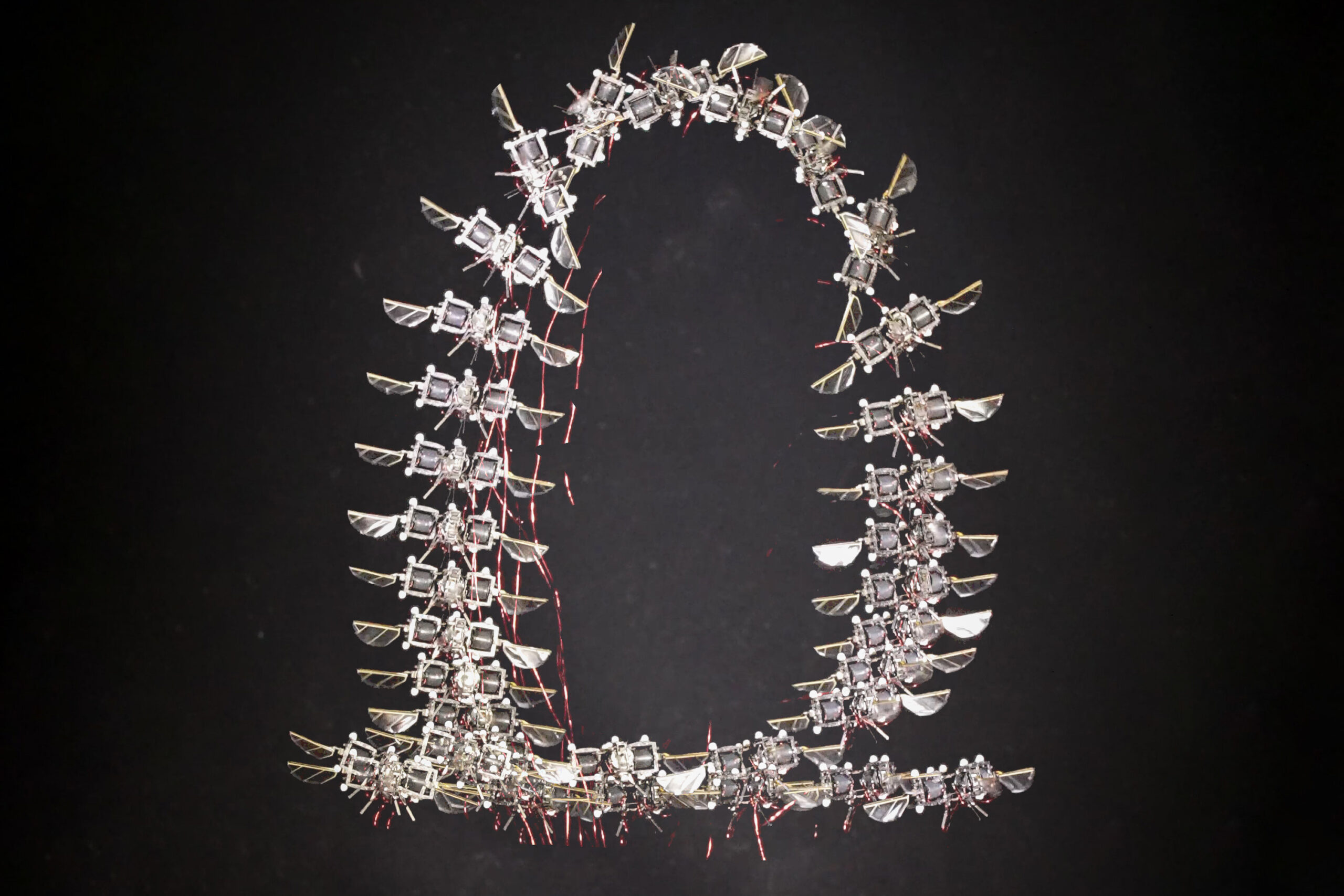
In the future, tiny flying robots could be deployed to aid in the search for survivors trapped beneath the rubble after a devastating earthquake. Like real insects, these robots could flit through tight spaces larger robots can’t reach, while simultaneously dodging stationary obstacles and pieces of falling rubble.
So far, aerial microrobots have only been able to fly slowly along smooth trajectories, far from the swift, agile flight of real insects — until now.
MIT researchers have demonstrated aerial microrobots that can fly with speed and agility that is comparable to their biological counterparts. A collaborative team designed a new AI-based controller for the robotic bug that enabled it to follow gymnastic flight paths, such as executing continuous body flips.
With a two-part control scheme that combines high performance with computational efficiency, the robot’s speed and acceleration increased by about 450 percent and 250 percent, respectively, compared to the researchers’ best previous demonstrations.
The speedy robot was agile enough to complete 10 consecutive somersaults in 11 seconds, even when wind disturbances threatened to push it off course.
Credit: Courtesy of the Soft and Micro Robotics Laboratory
“We want to be able to use these robots in scenarios that more traditional quad copter robots would have trouble flying into, but that insects could navigate. Now, with our bioinspired control framework, the flight performance of our robot is comparable to insects in terms of speed, acceleration, and the pitching angle. This is quite an exciting step toward that future goal,” says Kevin Chen, an associate professor in the Department of Electrical Engineering and Computer Science (EECS), head of the Soft and Micro Robotics Laboratory within the Research Laboratory of Electronics (RLE), and co-senior author of a paper on the robot.
Chen is joined on the paper by co-lead authors Yi-Hsuan Hsiao, an EECS MIT graduate student; Andrea Tagliabue PhD ’24; and Owen Matteson, a graduate student in the Department of Aeronautics and Astronautics (AeroAstro); as well as EECS graduate student Suhan Kim; Tong Zhao MEng ’23; and co-senior author Jonathan P. How, the Ford Professor of Engineering in the Department of Aeronautics and Astronautics and a principal investigator in the Laboratory for Information and Decision Systems (LIDS). The research appears today in Science Advances.
An AI controller
Chen’s group has been building robotic insects for more than five years.
They recently developed a more durable version of their tiny robot, a microcassette-sized device that weighs less than a paperclip. The new version utilizes larger, flapping wings that enable more agile movements. They are powered by a set of squishy artificial muscles that flap the wings at an extremely fast rate.
But the controller — the “brain” of the robot that determines its position and tells it where to fly — was hand-tuned by a human, limiting the robot’s performance.
For the robot to fly quickly and aggressively like a real insect, it needed a more robust controller that could account for uncertainty and perform complex optimizations quickly.
Such a controller would be too computationally intensive to be deployed in real time, especially with the complicated aerodynamics of the lightweight robot.
To overcome this challenge, Chen’s group joined forces with How’s team and, together, they crafted a two-step, AI-driven control scheme that provides the robustness necessary for complex, rapid maneuvers, and the computational efficiency needed for real-time deployment.
“The hardware advances pushed the controller so there was more we could do on the software side, but at the same time, as the controller developed, there was more they could do with the hardware. As Kevin’s team demonstrates new capabilities, we demonstrate that we can utilize them,” How says.
For the first step, the team built what is known as a model-predictive controller. This type of powerful controller uses a dynamic, mathematical model to predict the behavior of the robot and plan the optimal series of actions to safely follow a trajectory.
While computationally intensive, it can plan challenging maneuvers like aerial somersaults, rapid turns, and aggressive body tilting. This high-performance planner is also designed to consider constraints on the force and torque the robot could apply, which is essential for avoiding collisions.
For instance, to perform multiple flips in a row, the robot would need to decelerate in such a way that its initial conditions are exactly right for doing the flip again.
“If small errors creep in, and you try to repeat that flip 10 times with those small errors, the robot will just crash. We need to have robust flight control,” How says.
They use this expert planner to train a “policy” based on a deep-learning model, to control the robot in real time, through a process called imitation learning. A policy is the robot’s decision-making engine, which tells the robot where and how to fly.
Essentially, the imitation-learning process compresses the powerful controller into a computationally efficient AI model that can run very fast.
The key was having a smart way to create just enough training data, which would teach the policy everything it needs to know for aggressive maneuvers.
“The robust training method is the secret sauce of this technique,” How explains.
The AI-driven policy takes robot positions as inputs and outputs control commands in real time, such as thrust force and torques.
Insect-like performance
In their experiments, this two-step approach enabled the insect-scale robot to fly 447 percent faster while exhibiting a 255 percent increase in acceleration. The robot was able to complete 10 somersaults in 11 seconds, and the tiny robot never strayed more than 4 or 5 centimeters off its planned trajectory.
“This work demonstrates that soft and microrobots, traditionally limited in speed, can now leverage advanced control algorithms to achieve agility approaching that of natural insects and larger robots, opening up new opportunities for multimodal locomotion,” says Hsiao.
The researchers were also able to demonstrate saccade movement, which occurs when insects pitch very aggressively, fly rapidly to a certain position, and then pitch the other way to stop. This rapid acceleration and deceleration help insects localize themselves and see clearly.
“This bio-mimicking flight behavior could help us in the future when we start putting cameras and sensors on board the robot,” Chen says.
Adding sensors and cameras so the microrobots can fly outdoors, without being attached to a complex motion capture system, will be a major area of future work.
The researchers also want to study how onboard sensors could help the robots avoid colliding with one another or coordinate navigation.
“For the micro-robotics community, I hope this paper signals a paradigm shift by showing that we can develop a new control architecture that is high-performing and efficient at the same time,” says Chen.
“This work is especially impressive because these robots still perform precise flips and fast turns despite the large uncertainties that come from relatively large fabrication tolerances in small-scale manufacturing, wind gusts of more than 1 meter per second, and even its power tether wrapping around the robot as it performs repeated flips,” says Sarah Bergbreiter, a professor of mechanical engineering at Carnegie Mellon University, who was not involved with this work.
“Although the controller currently runs on an external computer rather than onboard the robot, the authors demonstrate that similar, but less precise, control policies may be feasible even with the more limited computation available on an insect-scale robot. This is exciting because it points toward future insect-scale robots with agility approaching that of their biological counterparts,” she adds.
This research is funded, in part, by the National Science Foundation (NSF), the Office of Naval Research, Air Force Office of Scientific Research, MathWorks, and the Zakhartchenko Fellowship.

The Iran war has spiked gas prices. The RAM crisis has spiked prices on electronics. A wide swath of imported goods costs more than before due to Trump’s tariffs. Right now, your wallet is likely feeling the squeeze.
It’s a tumultuous time, and the constant media barrage of doom and gloom doesn’t help ease anxieties. It’s also hard to figure out when things will get better, so you’re stuck in a rut of worrying about finances. It’s OK. Take a breath. The first thing to remember, according to “The Budgetnista” Tiffany Aliche, is that the economy is cyclical.
“I’ve lived long enough to see many ‘worst times,’” Aliche says. She’s a financial educator and author of The New York Times Best Seller Get Good with Money. “Well, if it is the worst time, what the hell can I do about it? Sometimes you have to take the apps off your phone. I took Instagram off my phone, and I allow myself to check it on my laptop, which is far less addictive.”
Constrict your doomscrolling so you won’t feel the constant anxieties from the day’s news. Now, how can you actually find ways to conserve and save money? First, look at tightening your spending as much as possible. Aliche says you should analyze your credit card statements and see exactly where your money is going. Is there any wiggle room? Can you cut a few subscriptions to save a few bucks every month? She calls it the ramen noodle budget.
Once you make those adjustments, it’s worth thinking about bigger changes. It might be that those plans never have to come to fruition—like moving in with parents or getting a roommate to save money on housing. “Make the doomsday plan,” she says. “You don’t have to act on it now, but what is that plan if things really get rough, and start having those conversations.”
Sean Pyles, producer and host of NerdWallet’s Smart Money podcast (also a certified financial planner), echoed Aliche’s sentiment of starting with your most recent spending to see where your money is going, and see if it aligns with your values and goals. Do you really need to Uber everywhere? He’s also a fan of keeping a level head and avoiding rash decisions, especially when there’s a lot of volatility in the stock market. Focus on your time horizon instead, and ignore the swings in the market.
“The wiser step is to ignore it as noise and realize that this is someone else’s problem, not mine right now,” he says. “Focus on what you can control. Maybe you have a financial goal to save for a vacation or a wedding, or it is your retirement you’re investing for now—do what you can to make sure you’re on track to meet those goals.”
It’s prudent to build up an emergency fund. Aliche recommends saving up ideally six months of your noodle budget, which you’d typically spend on necessities like rent, mortgage, and utilities. Both Aliche and Pyles suggested automating your finances as much as you can. Set it up so that you have some cash—maybe $100—going into your emergency fund every paycheck. Aliche says you can even ask your employer to split your salary so that it goes into specific accounts, like half of it going into a checking account and the other half going to a high-yield savings account.
Expert Tips on Saving Money
With those budgeting tips in mind, I also asked the writers and editors on WIRED’s Gear and Reviews teams—along with Aliche and Pyles—for ways they save money, whether that’s through specific gear they own or services they use. Hopefully, some of these suggestions can help you save some cash not just now but whenever you’re in a pinch.
Cardmaxxing
“I have been really relying on my credit card points and doing what I can to maximize the points I’ve been earning on everyday purchases. If you have a solid credit card that’s getting a good reward rate for things like going out to eat or taking ride shares, that can actually offset the cost of summer travel, because we’ve seen jet fuel prices go up a lot recently. This might be a great time to cash in the points you have just sitting in your credit card account not being used.” —Sean Pyles
Energy Savings
“I have the Google [Nest] Thermostat—I travel a lot, so I have the thermostat on my phone. So if I’m not going to be at home, then I’m like, who’s heating the house? I’m not home, I don’t care. To a certain degree, obviously, you don’t want to freeze your pipes. Lean into your thermostat … use smart technology so that you’re not using energy in a way that’s inefficient.” —Tiffany Aliche
Baby Bonanza
My wife and I are both practiced deal hunters, so much so that she was actually excited when I told her I landed her engagement ring from an upscale consignment store. (I got it at half price!) She’s always been the pro to my amateur, but with the addition of our first child, she transitioned to fully operational Deals Terminator, where she zeroed in on a variety of resources to help us land most of our baby stuff for 10 cents on the dollar (or less).
We started by hitting up friends and family, but whatever we couldn’t procure from hand-me-downs has come from a mixture of local consignment stores, sites like Facebook Marketplace and Buy Nothing, Poshmark, and even good old-fashioned eBay. Swap programs like Just Between Friends are another great way to keep your baby clothed, and we’ve kept our library fresh by hitting up used bookstores as well as Dolly Parton’s Imagination Library, which grants you one free book a month. Virtually everything you buy in these early stages will be gone in a year or two at most. That makes going cheap on essentials a must for keeping costs down. —Ryan Waniata
Free Ride
Back in 2022, I wrote about how Filson’s Dryden Duffle Pack was hands down my favorite gear item ever. Then Filson killed it. The folly of discontinuing what was at the time the best bag in the world wasn’t lost on Huckberry, mind you, who, realizing Filson’s error, collaborated with the brand to bring a version back for its store. Now, finally seeing the error of its ways, Filson has resurrected the peerless Duffle Pack itself.
Why do I tell you this? Well, the money-saving genius of this bag lies in its ability to morph between a hand-carry, standard shoulder duffel, and a rucksack, thanks to two backpack straps cleverly hidden in the base. When I fly, I shun cabin cases in favor of the Duffle Pack, because low-cost, money-grabbing budget airlines increasingly like to charge extra for taking overhead carry-on cases onto a flight. Backpacks are usually free. You can easily fit a week’s worth of clothes, toiletries, tech (yes, there’s even a dedicated 16-inch laptop pocket), adapters, cables, and more into the Duffle Pack’s cavernous 46 liters of space. All you then need to do is waltz onto your flight with the trusty Filson in backpack mode, and you won’t have paid one cent extra. —Jeremy White
Too Good to Go
I’ve gobbled up so many delicious snacks, like artisanal conchas, and hefty dinners, like Mission-style burritos, at a discounted rate by using the Too Good to Go app (Android, iOS). Restaurants and bakers list their unsold food at the end of the day for people to buy through TGTG. While sometimes the portions can be on the smaller end, and you don’t get to pick what you get, the app is a reliable option for cheap, late-night munchies. —Reece Rogers
Buy Used

A user browsing Facebook on a computer in Tunis, Tunisia.Photograph: Imen Ben Youssef/Getty Images
A great deal of furniture in my home was acquired through Facebook Marketplace. Much depends on the area you live in, but you’ll be surprised at just how much stuff people list on there at reasonable prices, and you can usually haggle to get the price a little lower. Be very careful of scams, and always make sure you meet people in public spaces when making purchases. But Facebook Marketplace isn’t the only option for used gear; for big appliances or electronics, I usually check retail stores like Amazon or Best Buy for open-box or used listings, and if nothing comes up, usually I can find the item I want on eBay. I’ve bought several excellent lenses for my Nikon camera, saving hundreds of dollars had I bought new. —Julian Chokkattu
Or Buy Refurbished
Brand new always means paying a premium, but many folks are put off buying used because they don’t want the risk of a scuffed phone or a scammy seller. There is a happy middle ground: Buy refurbished. Go directly to major players like Apple, and you can get decent discounts on MacBooks or iPhones that come packaged like new with a warranty period. Our last two MacBooks were both refurbs from Apple, and they’re as good as new. I dive deeper into this in my guide on How to Buy Refurbished Electronics. —Simon Hill
Freeze Food
If you manage to find large quantities of food on markdown, you’d be surprised at how much you can freeze with little to no loss of flavor or texture. Beyond the usual suspects like meat, butter, and leftovers, I use Souper Cubes trays to portion cut-up fruit and about-to-be-expired sauces and condiments, I vacuum-seal hard cheeses, and I individually wrap baked goods like bread and buns before deep freezing. (As a bonus, freezing actually lowers bread’s glycemic index.) —Kat Merck
Skip the Gas-Guzzling Car

Courtesy of Specialized
Everyone thinks that transitioning away from driving your car (and paying insane gas prices!) means that it has to be all or nothing. This is not true. My rule is that when you can, just substitute one trip per day where you would’ve driven a car with a bike, ebike, scooter, walking, public transit, or carpooling. For me, that means biking my kids to school. For you, that might mean walking to the corner store instead of driving to the market for ketchup, or asking to get picked up on the way to the bar instead of meeting people there. Bonus: You might end up seeing your friends more, too. —Adrienne So
My Friend Libby
I can’t begin to add up the amount of money I’ve saved over the years with my tried and true Kindle + Libby app combo. I’m a big reader, and using Overdrive’s Libby in conjunction with my local library card gets me free and sometimes instant access to a huge variety of ebooks, audiobooks, and magazines. As any regular library user knows, sometimes you have to wait for the most popular titles to become available. The app even has a path to requesting that your library buy a new ebook license for books it might not have. Those resisting the siren call of Amazon’s e-reader can use Libby in conjunction with other devices, too (though that process is a little more complicated), or even choose to read some books natively, right in the app. —Aarian Marshall
You Need a Budget

Courtesy of YNAB
After reading WIRED editor Adrienne So’s story about YNAB, or You Need A Budget, I decided to give the app a go. I was instantly hooked on YNAB’s seemingly straightforward premise. Ideally, you can only spend the money you actually have, so why not plan for the best way to do that? Link YNAB to your bank account and divide your money into any categories you want. Then, every bit of payment and income is tracked and sorted into customized categories that show what you spend money on. It’s both a blessing and a curse to see exactly how much you spend on takeout, but YNAB makes it easy to reallocate those funds, little bits at a time, into something else you want to invest in. Yeah, there’s a yearly fee for the service, but at least the service shows you how to set aside the costs. —Boone Ashworth
Rush Tickets
Just because you’re saving money doesn’t mean you have to sit at home solemnly on the couch every night! You should consider calling your local theater to see what their policy is for night-of, rush tickets. The discount might be even deeper than you expect. Recently, my partner and I had a lovely date night at a theater in San Francisco that was showing a stage adaptation of Paranormal Activity. Spooky! We showed up around an hour before curtain and snagged two $15 tickets, which were originally priced over $100. There are official apps that specialize in these kinds of tickets, like TodayTix for Broadway shows in New York City, but there most likely is an option local to your area if you do some digging. —Reece Rogers
Budget Apparel
Noihsaf Bazaar. What the heck is a Noihsaf? Well, it’s “fashion” spelled backward, of course. But there’s nothing retrograde about this website, which lists gently used apparel, footwear, and decor from independent designers, small shops, and vintage resellers. That’s what makes Noihsaf Bazaar stand out among the Poshmarks and Depops of the used-clothing world. The stuff you’ll find here is, for the most part, unique and interesting and from labels that you haven’t heard of. Sure, you’ll find the occasional Pendleton flannel or Levi’s denim jacket, but the indie vibes always win out. Only the best stuff makes it onto the site, too. Noihsaf’s team of curators vets items before they get listed, and inventory turns over frequently, so shopping here is like stepping into the world’s most well-curated vintage shop. And the deals are often screamin’, with filters to show items that are on sale or listings that are expiring soon. —Michael Calore
Thrifting Fun
Speaking of vintage shops, you would not believe the treasure I find at the thrift store ($200-plus blouses and jeans with tags still on, hello?), which has ruined me forever for buying clothes at retail price. They always need a good clean when they come home, and I buy Blueland laundry detergent tabs in bulk. Bang for buck, no microplastics leeching into our water supply, and the Spring Bloom scent is lovely. —Julia Forbes
Aldi Girl
I’ve always been an Aldi girl, and quite frankly, I don’t understand how anybody can afford to be anything else. Aldi mostly sells private-label groceries with minimal packaging, and it charges for bags and shopping carts (though the latter fee is just a 25-cent deposit). Bring your reusable bag! Shopping there has cut my grocery budget in half. I did join Costco recently, too, for bulk items like protein shakes and energy drinks, and the gas savings from filling my tank there have paid for my membership so far. I also started meal prepping this year, which includes making extra batches of my favorites so I can DoorDash from my freezer instead of my phone. —Louryn Strampe
Tech
Capital injection, acquisition further Render Networks in critical infrastructure | Computer Weekly

Render Networks has announced $20m AUD in private equity growth funding alongside the acquisition of GIS software firm mPower Innovations, and extended its system of execution to electric infrastructure.
The funding round comes from existing shareholders, advised by Black Kite Partners, and Render says it marks a “decisive step” in its evolution from field-first execution leader to the end-to-end system of execution for critical infrastructure. Combined with the mPower acquisition, Render’s investments span the entire asset lifecycle through design-deployment operations and lifecycle management, for both telecom and electric utilities.
Render says the moment for infrastructure is happening now, with the buildout of critical infrastructure entering its most capital-intensive era in a generation. It noted that that artificial intelligence (AI) and hyperscaler datacentres are creating cascading, interdependent demand, from fibre broadband through to the power grid that sustains them. In addition, it said that utilities must deploy capital smarter and faster while managing greater complexity and maintaining full auditability across every asset, at a scale existing execution systems were never designed to handle.
Render cited a study from consumer education group PowerLines showing that the US electric sector alone faces a $1.4tn investment cycle through 2030, driven by AI load growth, the accelerating shift to renewables, and grid resilience mandates.
Over the past 18 months, Render Networks has built and validated its system of execution across the telco sector, enabling large-scale fibre to the home, long haul and datacentre expansion.
The funding is intended to accelerate Render Networks’ AI-first product roadmap, anchored in two platforms – geospatial foundation Esri ArcGIS and AI infrastructure ClearWay on Databricks – which are said to be built for the scale of modern infrastructure.
With the former, Render is transitioning its spatial engine to Esri’s ArcGIS, the geospatial platform for electric, utility and connectivity infrastructure. Design, execution and operations will now all be grounded in a single, consistent geospatial model – and mPower’s existing Esri-native architecture validates this approach and accelerates the transition.
In terms of AI infrastructure, Render Networks says it will continue to advance ClearWay, its agentic AI architecture built on Databricks as the foundation for its data and AI platform. The plan is to move beyond static analysis to a federated system of governed agents capable of validating, approving and acting on work in real time.
From a financial perspective, Render said that in private markets, as capital accelerates into hyperscaler and edge datacentre development, its unified system will now deliver the risk mitigation and execution visibility required across interdependent critical infrastructure, protecting capital deployment and compressing time to revenue.
“Render has built something rare – an execution platform that actually reflects what happens in the field,” said Adrian Kerley of Black Kite Partners. “As infrastructure spending accelerates across both broadband and electric, the market needs a solution that can deliver verified, auditable outcomes at scale.”
The acquisition of mPower Innovations is designed to complete the Render Networks portfolio, enabling operators and build partners to deploy capital with precision and speed at a moment of massive industrial AI and datacentre demand.
CEO of mPower Jason Brown and founder Greg Calcari will continue at Render in senior leadership roles, and mPower’s software services reach across design, asset management, outage management, interactive voice response and data analytics, enabling Render Networks to address the full infrastructure asset lifecycle.
“Reliability starts with a shared operational truth,” said Brown. “By joining Render Networks, operators and builders can manage and deploy critical infrastructure with complete accuracy rooted in what is actually happening in the field – not what was planned on paper. Our customers can move forward with confidence and speed, knowing their system of execution reflects verified field reality.”
With CEO Stephen Rose now heading into his second year, and following the finance and acquisition, Render believes its management has now anchored growth with a clear mandate: ensure every asset deployed has the best possible return on capital and ensure the entire deployment lifecycle is verifiable, visible and ready to perform for decades. That platform serves as the foundation on which to build a system of execution to address the full asset lifecycle for both electric and telco sectors.
“Billions of dollars are moving into infrastructure deployment in the next five years, and the demand on infrastructure leaders leaves no margin for error,” said Rose. “Our existing shareholders are doubling down on what we’ve built and the market we’re moving into. With mPower, we extend our system of execution across both sectors, ensuring every asset is rapidly monetised, and the entire asset and deployment lifecycle is verifiable, visible and de-risked.”

The Department of Justice announced Thursday that it arrested Gannon Ken Van Dyke, an enlisted member of the US Army’s special forces, for allegedly using “classified, nonpublic” information about the capture of Venezuelan president Nicolás Maduro to notch more than $400,000 in profits on Polymarket trades. A grand jury indicted him on five counts, including multiple violations of the Commodity Exchange Act.
Van Dyke is the first person to be charged with insider trading on a prediction market in the United States. Lawmakers have been voicing concerns for months about the high likelihood that politicians and public servants could use nonpublic information to profit from trades on leading industry platforms like Polymarket and Kalshi, which have exploded in popularity over the past year.
The arrest comes just weeks after Department of Justice prosecutors met with Polymarket about potential insider tradition violations. In February, Israeli authorities arrested two citizens, an army reservist and a civilian, for allegedly leaking classified information by making wagers on Polymarket related to military operations. Kalshi, Polymarket’s primary rival in the United States, recently fined three politicians for breaking its insider trading rules, but it did not flag the violations for further enforcement to the Commodity Futures Trading Commission (CFTC), the federal agency that oversees prediction markets.
After Van Dyke’s arrest was made public, Polymarket posted a statement to social media noting that it had “identified a user trading on classified government information” and “referred the matter to the DOJ & cooperated with their investigation.” The company declined to comment further.
According to court documents, Van Dyke has been an active duty US soldier since September 2008 and rose to the level of master sergeant in 2023. At the time of the alleged trading activity, he was stationed at Fort Bragg in Fayetteville, North Carolina, and assigned to the Army’s Special Operations Command Western Hemisphere Operations.
“I have been crystal clear that anyone who engages in fraud, manipulation, or insider trading in any of our markets will face the full force of the law,” CFTC chair Michael Selig said in a statement. “The defendant was entrusted with confidential information about US operations and yet took action that endangered US national security and put the lives of American service members in harm’s way.”
The complaint alleges that Van Dyke was involved in the planning and execution of Maduro’s arrest and that he was aware that he wasn’t authorized to share nonpublic information about US military operations. The complaint says that Van Dyke signed a nondisclosure agreement that forbade him from revealing sensitive or classified government information “by writing, word, conduct, or otherwise.” The complaint also alleges Van Dyke saved a screenshot to his Google account “displaying the results of an artificial intelligence query” outlining how the US Special Forces maintains many classified files including “operational details that are not available to the public.”
On December 26, Van Dyke allegedly opened an account on Polymarket and took out around $35,000 from his bank account before transferring it to a cryptocurrency exchange.
The following day, Van Dyke allegedly made his first Venezuela-related trade on Polymarket, putting a little less than $100 on a “YES” contract that US forces would be in Venezuela by January 31, 2026. Prosecutors accuse him of ultimately making 13 Venezuela-related transactions on the platform, seven of those—totaling hundreds of thousands of shares—on a “YES” contract for “Maduro out by … January 31, 2026.” In other words, Van Dyke allegedly stood to make an enormous profit if the Venezuelan leader wound up out of power by the end of the month.


Anne Hathaway makes shocking confession about Taylor Swift’s music

Video: Who’s Getting a Tariff Refund?

US soldier allegedly bet on Venezuelan leader Maduro operation using intel

-

 Fashion1 week ago
France’s LVMH Q1 revenue falls 6%, shows resilience amid Iran war
-

 Entertainment1 week ago
Is Claude down? Here’s why users are seeing errors
-

 Sports1 week ago
PSL 11: Peshawar Zalmi win toss, opt to field first against Quetta Gladiators
-

 Tech1 week ago
CYBERUK ’26: UK lagging on legal protections for cyber pros | Computer Weekly
-
 Business1 week ago
PepsiCo earnings beat estimates as North American food business improves
-

 Sports5 days ago
WWE WrestleMania 42 Night 2: Live match results and analysis
-

 Fashion1 week ago
Raymond unveils luxury Chairman’s Collection Store in Mumbai
-

 Sports5 days ago
NCAA men’s gymnastics championship: All-time winners list