

Business
Netherland’s renewables drive putting pressure on its power grid

John LaurensonBusiness reporter, Rotterdam
 AFP via Getty Images
In a Dutch government TV campaign called “Flip the Switch” an actress warns viewers about their electricity usage.
“When we all use electricity at the same time, our power grid gets overloaded,” she says. “This can cause malfunctions. So, use as little electricity as possible between four and nine.”
It is the sign that, in one of the most-advanced economies in the world, something has gone wrong with the country’s power supply.
The Netherlands has been an enthusiastic adopter of electric cars. It has the highest number of charging points per capita in Europe.
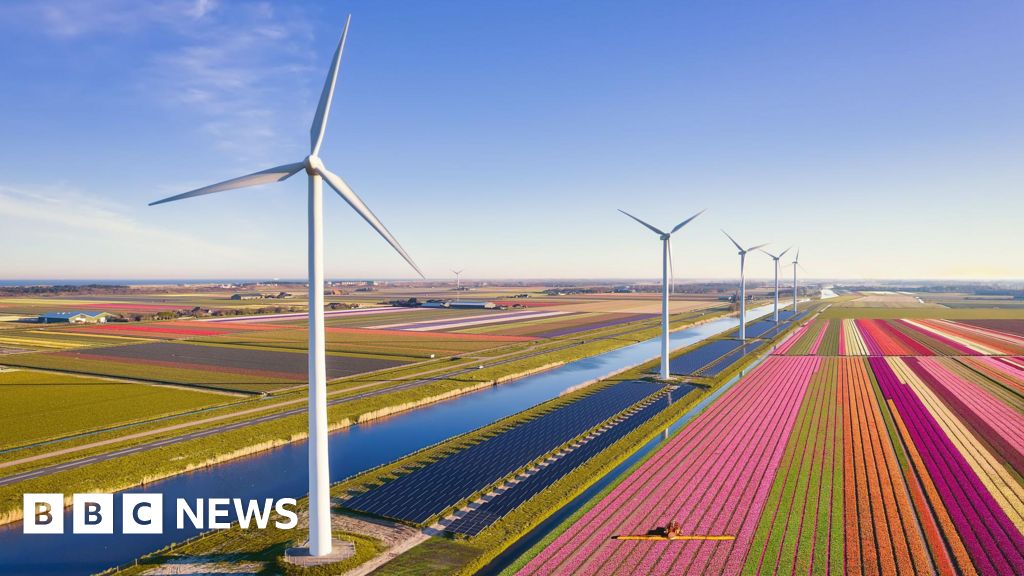
As for electricity production, the Netherlands has replaced gas from its large North Sea reserves with wind and solar.
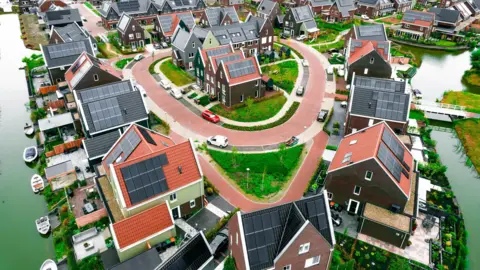
So much so that it leads the way in Europe for the number of solar panels per person. In fact, more than one third of Dutch homes have solar panels fitted.
The country is also aiming for offshore wind farms to be its biggest source of energy by 2030.
This is all good in environmental terms, but it’s putting the Dutch national electricity grid under enormous stress, and in recent years there have been a number of power cuts.
The problem is “grid congestion”, says Kees-Jan Rameau, chief executive of Dutch energy producer and supplier Eneco, 70% of whose electricity generation is now solar and wind.
“Grid congestion is like a traffic jam on the power grid. It’s caused by either too much power demand in a certain area, or too much power supply put onto the grid, more than the grid can handle.”
He explains that the problem is that the grid “was designed in the days when we had just a few very large, mainly gas-fired power plants”.
“So we built a grid with very big power lines close to those power plants, and increasingly smaller power lines as you got more towards the households.
“Nowadays we’re switching to renewables, and that means there’s a lot of power being injected into the grid in the outskirts of the network where there are only relatively small power lines.”
And these small power lines are struggling to cope with all the electricity coming in from wind turbines and solar panels scattered around the country.

 AFP via Getty Images
Damien Ernst, professor of electrical engineering at Belgium’s Liege University, is one of Europe’s leading experts on electricity grids. He says it is an expensive problem for the Netherlands to solve.
“They have a grid crisis because they haven’t invested enough in their distribution networks, in their transmission networks, so they are facing bottlenecks everywhere, and it will take years and billions of dollars to solve this.”
Prof Ernst adds that it is a Europe-wide issue. “We have an enormous amount of solar panels being installed, and they are installed at a rate that is much, much too high for the grid to be able to accommodate.”
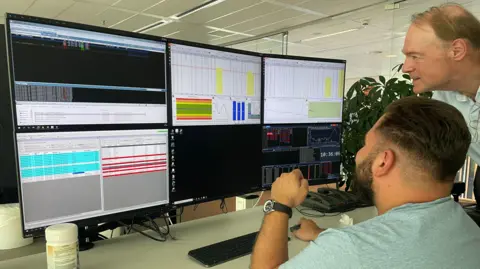
At Eneco’s headquarters in Rotterdam, Mr Kees-Jan Rameau highlights a large control panel that the company calls its “virtual power plant” and “the brain of our operations”. It is used to help balance the grid, avoiding blackouts.
When electricity generation is too high across the Netherlands, it enables Eneco to turn wind turbines out of the wind and turn off solar panels.
As for when demand for electricity is too high, it lowers the power to customers who have accepted to allow Eneco to stop or reduce their electricity supply when the network is under strain in exchange for lower prices.
But for homes and companies who want to scale-up their use of electricity with a new or larger grid connection, that, increasingly, is just not possible.
“Often consumers want to install a heat pump, or charge their electric vehicle at home, but that requires a much bigger power connection, and increasingly they just cannot get it,” says Mr Kees-Jan Rameau.
He adds that it is worse for businesses. “Often they want to expand their operations, and they just cannot get extra capacity from the grid operators.
And it has got to the point where even new housing construction in the Netherlands is becoming increasingly difficult, because there’s just no capacity to connect those new neighbourhoods to the grid.”
Those people, and companies, end up on waiting lists for a number of years. At the same time there are also waiting lists for those who want to supply the grid with power, such as a new home fitted with solar panels on its roof.
Tennet, the government-owned agency that runs the Netherlands’ national grid, says that 8,000 companies are currently waiting to be able to feed in electricity, while 12,000 others are waiting for permission to use more power.
Some sectors of the Dutch economy are warning that it is hampering their growth. “Grid congestion is putting the future of the Dutch chemical industry at risk… while in other countries it will be easier to invest,” says the President of the Dutch Chemical Association Nienke Homan.
So, was all this avoidable? “In hindsight I think almost every problem is avoidable,” says Mr Kees-Jan Rameau.
He adds that following the 2015 Paris Agreement on trying to tackle climate change, “we were very much focussing on increasing the renewable power generation side. But we kind of underestimated the impact it would have on the power grid.”
Tennet is now planning to spend €200bn ($235bn; £174bn) on reinforcing the grid, including laying some 100,000km (62,000 miles) of new cables between now and 2050.
That’s a huge amount of money, but there is also a big cost to not spending it. Grid congestion is costing the Dutch economy up to €35bn a year, according to a 2024 report from management consultancy group Boston Consulting Group.
Eugene Beijings, who is in charge of grid congestion with Tennet, says that patience is sadly required. “To strengthen and reinforce the grid, we need to double, triple, sometimes increase tenfold the capacity of the existing grid.
“And it’s taking on average about 10 years to do a project like that before it goes live, of which the first eight are legislation and getting the rights to put cables in the ground with all property owners. And only the last two years are the construction period.
“And meanwhile the energy transition is going that fast that we cannot cope with it, with the existing grid. So every additional request [to connect] is adding to the waiting list.”
 Zet ook de knop om
At the Dutch energy ministry, which is actually called the Ministry for Climate Policy and Green Growth, the Minister Sophie Hermans wasn’t available for an interview. But her office gave a statement:
“In hindsight, the speed at which our electricity consumption has grown might have been collectively underestimated in the past by all parties involved. It is also hard to predict where the growth will occur first, as this results from individual companies/sectors and households.”
As for solutions, the ministry says it has a “National Grid Congestion Action Plan” focussed on adjusting legislation so grid expansion permits can be granted more quickly.
It is encouraging people to make better use of the existing grid with, for example, its Flip the Switch campaign.
And the financial incentive for people who feed their surplus solar electricity into the grid is being reduced to almost nothing. In some cases, people will even have to pay to feed solar power into the grid.
Business
Gurugram Attracts Rs 86,588 Crore In Real Estate Investments In 2025 As RERA Clears 131 Projects

Last Updated:
Alongside rising investments, Gurugram RERA strengthened regulatory oversight to safeguard homebuyer and investor interests



Gurgaon Real Estate (Representative Image)
Gurugram emerged as one of India’s top real estate investment destinations in 2025, with projects worth Rs 86,588 crore receiving regulatory approvals during the year, according to data from the Gurugram Real Estate Regulatory Authority (Gurugram RERA).
Market observers said the numbers reflect strong investor confidence in the NCR’s largest commercial and residential hub.
Gurugram RERA registered 131 projects in calendar year 2025, representing development potential of 35,455 units across housing and commercial segments.
A striking feature of the data was the dominance of large-ticket projects. Just 28 major developments accounted for investments worth Rs 59,360 crore, highlighting the growing influence of institutional capital and large developers in shaping Gurugram’s property market.
Residential assets continued to attract the bulk of investment interest. Of the total units approved, 31,455 were residential, underscoring sustained end-user demand and long-term confidence in the city’s housing fundamentals.
According to Authority data, the residential mix included 17,405 group housing units, 5,720 mixed land use units, 4,040 residential floor units, 2,122 affordable group housing units, 1,954 units under the Deen Dayal housing scheme, and 214 residential plotted colony units.
Market observers said this diversified supply pipeline indicates capital deployment across both premium and mass segments, helping reduce concentration risk and deepen market resilience.
On the commercial side, Gurugram RERA approved about 4,000 commercial units, of which 168 were dedicated to IT parks, reinforcing Gurugram’s position as a preferred hub for technology firms and Global Capability Centres.
Analysts noted that the combination of office-led employment growth and residential expansion continues to make Gurugram attractive for long-term capital deployment.
Industry experts said the scale of investments approved in 2025 highlights Gurugram’s ability to attract capital despite global uncertainty, supported by infrastructure growth, a strong corporate base and an improving regulatory environment.
“With a large pipeline of approved projects and sustained interest from developers and institutional investors, Gurugram is expected to remain a key real estate investment destination in the coming years,” a Gurugram-based real estate expert said.
Tighter regulatory checks
Alongside rising investments, Gurugram RERA strengthened regulatory oversight to enhance transparency and safeguard homebuyer and investor interests.
“These steps included stricter scrutiny of developer submissions, mandatory site inspections by domain experts, and public consultation through mandatory notices before project registration,” an Authority official said.
 Click here to add News18 as your preferred news source on Google.
January 16, 2026, 07:44 IST
Read More

Last Updated:
National Startup Day highlights India’s thriving startup ecosystem, celebrating innovation, entrepreneurship and job creation driven by founders, unicorns and Startup India mission
National Startup Day 2026 honours Indian startups, entrepreneurs and innovators driving economic growth and job creation.
National Startup Day 2026: India’s startup ecosystem has evolved into one of the world’s most vibrant and promising innovation hubs. To recognise the contribution of entrepreneurs, founders and startups transforming ideas into impactful solutions, National Startup Day is observed every year on January 16 across the country.
Launched by Prime Minister Narendra Modi in 2022, the day celebrates visionary entrepreneurs who play a crucial role in economic growth, employment generation and technological advancement.
National Startup Day serves as a reminder that innovation, backed by determination and policy support, can reshape society and create global impact.
National Startup Day 2026 Theme
The official theme for National Startup Day 2026 is yet to be announced. However, the core focus areas are expected to revolve around:
- Innovation and emerging technologies
- Entrepreneurship and leadership
- Self-reliance (Atmanirbhar Bharat)
- Startup India Mission
- Youth empowerment
- Job creation
How Startups Are Shaping India’s Future
India currently ranks as the third-largest startup ecosystem globally, with over 1.59 lakh startups recognised by the Department for Promotion of Industry and Internal Trade (DPIIT) as of early 2025. Backed by 100+ unicorns, the ecosystem continues to grow rapidly.
Metro cities such as Bengaluru, Hyderabad, Mumbai and Delhi-NCR lead this expansion, while Tier-2 and Tier-3 cities are emerging as new innovation centres, adding diversity and scale to India’s entrepreneurial journey.
Startups across fintech, edtech, health-tech, e-commerce and deep-tech are addressing real-world challenges and gaining global recognition. Technologies like artificial intelligence, blockchain and IoT are increasingly driving innovation, according to Startup India ecosystem reports.
Industry-Wise Startup Impact
DPIIT-recognised startups have generated over 16.6 lakh direct jobs across sectors as of October 31, 2024, strengthening India’s employment landscape.
- IT Services: 2.04 lakh jobs
- Healthcare & Life Sciences: 1.47 lakh jobs
- Commercial & Professional Services: 94,000 jobs
Through the Startup India initiative, the government continues to focus on skill development, funding access, ecosystem collaboration and global outreach.
Key Initiatives Under Startup India
- Capacity building and mentorship
- Outreach and awareness programmes
- Ecosystem development events
- International exposure and global linkages
- Collaboration between startups, corporates and institutions.
Click here to add News18 as your preferred news source on Google.
January 16, 2026, 07:00 IST
Read More

The government on Thursday kept petrol and high-speed diesel (HSD) prices unchanged at Rs253.17 per litre and Rs257.08 per litre respectively, for the coming fortnight, starting from January 16.
This decision was notified in a press release issued by the Petroleum Division.
Earlier, it was expected that the prices of all petroleum products would go down by up to Rs4.50 per litre (over 1pc each) today in view of variation in the international market.
Petrol is primarily used in private transport, small vehicles, rickshaws, and two-wheelers, and directly impacts the budgets of the middle and lower-middle classes.
Meanwhile, most of the transport sector runs on HSD. Its price is considered inflationary, as it is mostly used in heavy transport vehicles, trains, and agricultural engines such as trucks, buses, tractors, tube wells, and threshers, and particularly adds to the prices of vegetables and other eatables.
The government is currently charging about Rs100 per litre on petrol and about Rs97 per litre on diesel.


Pamela Anderson reacts to seeing Seth Rogen at Golden Globes
Gurugram Attracts Rs 86,588 Crore In Real Estate Investments In 2025 As RERA Clears 131 Projects

‘Head coach’ vs ‘manager’: Why job title matters for Chelsea, Man United

-

 Politics1 week ago
UK says provided assistance in US-led tanker seizure
-

 Entertainment1 week ago
Does new US food pyramid put too much steak on your plate?
-

 Entertainment1 week ago
Why did Nick Reiner’s lawyer Alan Jackson withdraw from case?
-
 Business1 week ago
Trump moves to ban home purchases by institutional investors
-

 Sports5 days ago
Clock is ticking for Frank at Spurs, with dwindling evidence he deserves extra time
-

 Sports1 week ago
PGA of America CEO steps down after one year to take care of mother and mother-in-law
-
 Business1 week ago
Bulls dominate as KSE-100 breaks past 186,000 mark – SUCH TV
-

 Tech3 days ago
New Proposed Legislation Would Let Self-Driving Cars Operate in New York State