

Tech
New design tackles integer factorization problems through digital probabilistic computing

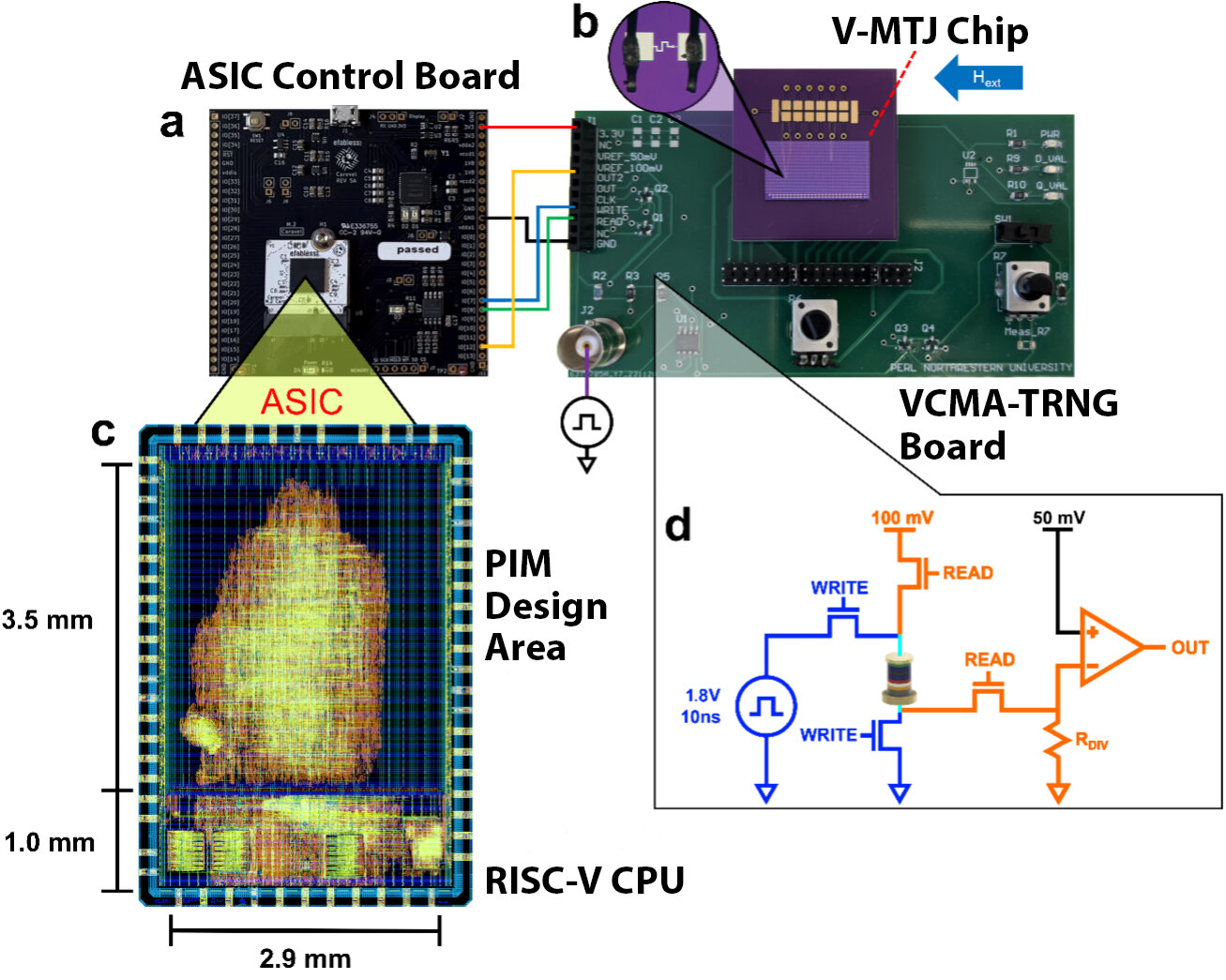
Probabilistic Ising machines (PIMs) are advanced and specialized computing systems that could tackle computationally hard problems, such as optimization or integer factorization tasks, more efficiently than classical systems. To solve problems, PIMs rely on interacting probabilistic bits (p-bits), networks of interacting units of digital information with values that randomly fluctuate between 0 and 1, but that can be biased to converge to yield desired solutions.
A class of PIMs that are intensively investigated use magnetic devices to inject randomness into a digital transistor-based circuit. While these systems have been found to be promising for the rapid resolution of various domain-specific and advanced problems, their large-scale design and reliable fabrication have so far proved challenging. This is primarily because their upscaling requires the precise control of small magnetic moments and often also entails the use of large circuits that convert digital signals into analog voltages and other additional components.
Researchers at Northwestern University and other institutes recently developed a new application-specific integrated circuit (ASIC) that could be used to create better performing probabilistic computers. In a paper published in Nature Electronics, they presented a probabilistic computer based on the new circuit and showed that it could perform integer factorization tasks.
“We were interested in exploring how one could build a scalable probabilistic computer by custom-designing an ASIC using foundry CMOS technology,” Pedram Khalili Amiri, senior author of the paper, told Tech Xplore.
“Our intuition was that by taking advantage of the digital CMOS platform and the high transistor densities available in today’s semiconductor technology, one could eventually build very large-scale probabilistic computers that can tackle problems related to, for example, combinatorial optimization. As a first step, we decided to try out these ideas, and develop the computing architecture and design approach, using a less advanced (130 nm) foundry node.”
When reviewing previous literature in the field and experimenting with probabilistic computing architectures, Amiri and his colleagues realized that, despite its numerous advantages, CMOS technology does not appear to be well-suited for creating random bit sequences. Notably, the creation of these random sequences is central to the functioning of probabilistic computers.
To overcome this limitation of CMOS technology, the researchers adapted voltage-controlled magnetic tunnel junctions (V-MTJs), hardware components that they introduced in their earlier work and had previously applied to the creation of magnetic random-access memory (MRAM) devices. They changed some elements of these devices so that they would serve as high-throughput and compact sources of randomness (i.e., entropy).
“Our probabilistic computer consists of an array of bistable probabilistic elements (called probabilistic bits or p-bits),” explained Amiri. “The interactions between these p-bits can be programmed so that the p-bit network (called a probabilistic Ising machine or PIM) collectively searches through the solution space of a problem. Our p-bits are implemented using digital CMOS circuitry on our ASIC and use bit sequences read from an adjacent V-MTJ chip to provide the required randomness. The energy minimum of the PIM is designed to correspond to the solution of the computing problem of interest.”

The new probabilistic architecture developed by Amiri and his colleagues could theoretically be used to efficiently tackle many real-world problems, including various optimization tasks. As part of their study, however, the team specifically applied their architecture to integer factorization tasks, which are known to be very challenging to solve computationally.
“This was a good place to start, mainly because there is only one correct solution to be found in the entire energy landscape, and because it is easy to check whether we found the right factors or not,” said Amiri. “The same approach, however, can be applied to many other computing problems.”
Two central advantages of the architecture developed by this research team are that it is digital and synchronous. This is in contrast with most other PIMs introduced in earlier works.
“This means that the probabilistic computer works with a clock that determines a well-defined time interval upon which p-bits can update and does not require area-consuming circuits such as digital-to-analog converters,” said Amiri. “In addition, the use of V-MTJs, which are currently implemented in a separate chip from the ASIC but can eventually be integrated within it, saves area and can provide high-throughput random bit sequences to the p-bits.”
V-MTJs, the components that Amiri and his colleagues used to create their architecture, were found to be inherently more robust against device-to-device variations when used to generate random bits compared to other spintronic random bit generators used in the past. The team’s initial findings were highly promising, highlighting the promise of their approach for creating probabilistic computers.
Notably, although it relies on VMTJs, the new approach is also compatible with established CMOS manufacturing processes and digital design strategies. In the future, it could contribute to the large-scale fabrication of PIMs that could solve a wide range of real-world optimization problems faster and more efficiently.
“Our next step will be to adapt this design to implement problems other than factorization,” added Amiri. “For example, we have a chip in the works that is tailored to other optimization problems with real-world significance. In addition, we plan to integrate the V-MTJs directly on the CMOS in a more advanced foundry node, which would allow us to make the probabilistic computer even more compact.”
Written for you by our author Ingrid Fadelli, edited by Gaby Clark, and fact-checked and reviewed by Robert Egan—this article is the result of careful human work. We rely on readers like you to keep independent science journalism alive.
If this reporting matters to you,
please consider a donation (especially monthly).
You’ll get an ad-free account as a thank-you.
More information:
Christian Duffee et al, An integrated-circuit-based probabilistic computer that uses voltage-controlled magnetic tunnel junctions as its entropy source, Nature Electronics (2025). DOI: 10.1038/s41928-025-01439-6. On arXiv: DOI: 10.48550/arxiv.2412.08017
© 2025 Science X Network
Citation:
New design tackles integer factorization problems through digital probabilistic computing (2025, September 22)
retrieved 22 September 2025
from https://techxplore.com/news/2025-09-tackles-integer-factorization-problems-digital.html
This document is subject to copyright. Apart from any fair dealing for the purpose of private study or research, no
part may be reproduced without the written permission. The content is provided for information purposes only.













Word documents, and even PDF files, aren’t necessarily safe. These normally innocuous files can be injected with malicious “poison” code or simple scripts of code that can be a serious security risk.
You probably already know it’s dangerous to open files from sources you can’t necessarily trust. If you’re an activist or journalist—or anyone who occasionally depends on anonymous tips to do their jobs—you might run into a situation where potentially useful information is inside a Microsoft Word document or PDF file that you can’t exactly vouch for. Wouldn’t it be nice if you could open those files and read them without exposing your device to potential security risks?
Dangerzone is a free and open source tool built for this purpose. Originally built by journalist and security engineer Micah Lee, this application opens files in a sandbox environment with no internet access, then converts the file to an image-based PDF with no scripting enabled. The resulting PDF has any malicious code stripped out and should be safe to open—at least, as safe as anything can be.
“You can think of it like printing a document and then rescanning it to remove anything sketchy, except all done in software,” explains the about page, which includes a lot of fascinating details about how the application works.
To get started, download and install Dangerzone. There are downloads for Windows, macOS, and various Linux systems. The first time you run it there will be a brief setup, after which you can simply drag files to the window.
Photograph: Justin Pot
The application can open and convert PDF, Word, Excel, PowerPoint, Open Office, EPUB, and image files. You can drag and drop multiple documents at once, if you’d like.
After adding documents you will be asked a few questions: where you’d like the resulting files to end up, whether they should open after the conversion is done, and whether you’d like to use optical character recognition (OCR) in order to make the document searchable. You can also move the original, potentially unsafe documents into a subfolder named “unsafe,” helping ensure you don’t confuse them with the newly made safe ones.
.png)
Photograph: Justin Pot

I always tell people that the best thing I’ve ever tested for my job here on the WIRED Reviews team is my automatic litter box from Litter-Robot. I recommend every cat owner invest in an automatic litter box. If they can swing it, the Litter-Robot is the best one to invest in. You’ll be able to say goodbye to the days of scooping and smells while this nifty machine does the grunt work for you.
Litter-Robot is the OG automatic litter box, and the name itself has become synonymous with the concept. And that’s not by accident, as the brand makes incredibly well-made, ergonomic products to help the lives of pet parents everywhere. Along with their famous automatic litter boxes, they also make a super sleek automatic pet feeder that I’ve also tested (and loved). These gadgets are an investment, and can be pricey, but we here at WIRED love the brand so much that we’ve rounded up some of the best Litter-Robot promo codes, coupons, and deals to make these life-changing pet machines more affordable. Because your pet (and you) deserve it.
Get $150 Off Litter-Robot Bundles This Month: No Promo Code Needed
One of the best ways to save big without needing a Litter-Robot promo code is to buy in a bundle. Litter-Robot has several bundles that give you all the essentials you’ll need to get started using your automatic litter box, like a litter trapping mat, replacement waste bags, odor eliminators, litter, and more. A bundle is a great way to save money on the purchases you’ll already have to make, without needing a Litter-Robot coupon. You can get $150 off several different bundles, including Litter-Robot 4 models, as well as the newly released Litter-Robot 5 and Litter-Robot EVO models.
Get the Best Deals on the Litter-Robot 4
I’ve tested well over a dozen models of automatic litter boxes from different brands, including several models from Litter-Robot. The one I keep coming back to is my personal favorite, the Litter-Robot 4. Even though the 5 is the newest model (I’ve tested it and I’m in the process of writing the review now), I just can’t quit you, Litter-Robot 4! I still think it’s one of the best automatic litter boxes you can buy: it has a user-friendly, intuitive connected app that isn’t overcrowded or confusing, the drawer is easy to pull out to remove waste, it has buttons on the top to manually change, and it doesn’t take up a large footprint on the floor. Plus, with a variety of discounted bundles to choose from, you won’t even need a Litter-Robot promo code.
Litter-Robot 5 Pro Insights Bundle Discount: $150 Off
As previously mentioned, I just tested the Litter-Robot 5 Pro, part of Litter-Robot’s recently released line of brand new models. I was seriously impressed with this model, which looks super similar to the Litter-Robot 4, but has a built-in camera to see what’s going on inside and outside of the box. The newest model isn’t cheap, but right now, the Litter-Robot 5 Pro Insights Bundle is only $999 ($152 off). This bundle includes the newest Litter-Robot 5 Pro with built-in camera, plus a litter tracking mat and waste drawer liners to get you started. And as an added bonus, Litter-Robot has a 90-day in-home trial, one-year warranty, and free shipping to the lower 48.
Take $50 Off the Litter-Robot EVO Starter Bundle
The Litter-Robot EVO is another newly released model from Litter-Robot, but this one is a more pared-down, basic version that’s streamlined and compact. I personally love the simpler models (hence my paragraph-long love letter to the Litter-Robot 4 above). If you’re someone who doesn’t need to watch a camera feed of your cat peeing and pooing, the EVO is a more affordable, basic option that gets the job done efficiently. Right now, the Litter-Robot EVO Starter Bundle is $782 ($50 off), and has everything you need to get settled with your new auto box, including waste drawer liners, a litter trap mat, a bag of litter, and odor traps to keep things smelling fresh.
Save 35% on Cat Essentials With a Litter-Robot Discount Code
If you live in a big city like me, there’s nothing worse than carrying heavy litter down icy streets or in hot, packed subway cars. Autoshipping my (often heavy) cat essentials has been a game-changer. If you choose autoship, you’ll save 35% on cat essentials like litter, waste drawer liners, odor traps, filters, and more with this Litter-Robot discount code.
{Get 35% Off Litter-Robot Accessories
I love my Litter-Robot 4, but I highly encourage everyone to spring for the Litter-Robot-branded accessories to accompany the device. This automatic litter box works excellently as is, but things like a ramp for senior cats, filter replacements, and odor traps will keep the device running like new for longer. Keep your investment in tip-top shape for way less with discounted accessories and bundles, for up to 35% off.

If your TV isn’t as smart as you hoped, or you just hate its built-in interface for some reason, there are a variety of other options for dedicated streaming. For households that watch a lot of shows and movies on Prime Video or use Alexa for their smart home management, we recommend checking out the Fire TV Stick 4K Max. The latest generation is currently marked down to just $35 for the Amazon Big Spring Sale, a $25 discount from its usual price.
While the Fire TV Stick is a good choice for Prime Video, it plays well with basically all of the major streaming services you’d expect, including Netflix, Disney+, and HBO Max. The previous generation had just 8 GB of storage, but the new model’s upgraded 16 GB means you won’t have to choose which apps to keep and which to delete. If you have a compatible controller and an Xbox Game Pass subscription, you can even stream games directly to the Fire TV Stick right from the cloud. With some help from Wi-Fi 6E, apps will download faster and stream at higher quality with less buffering, as long as your router supports it.
One of the standout features is the Fire TV Stick’s integration with Alexa smart home systems. While watching your shows, you can easily pull up a picture-in-picture of any security feeds, and there are options to control other smart devices, like lights, right from your television. The remote even doubles as an Alexa with its built-in microphone, letting you find shows or ask questions without getting off the couch. With a built-in gallery mode, the TV can slowly rotate through photos and paintings like a screensaver, and you can ask the remote to quickly find out what you’re looking at.
The world of streaming devices is surprisingly deep, so if you’re curious what else is out there, make sure to swing by our guide to the best 4K streaming sticks and hubs. For the Alexa and Amazon-powered home, there’s no substitute for the Fire TV Stick 4K Max, so make sure to grab yours for just $35 before the sale ends.


King Charles important annual tradition hit with setback as warning issued

This App Makes Even the Sketchiest PDF or Word Doc Safe to Open

‘I sent eight letters’: Drivers hope for payout from car finance redress scheme

-

 Politics7 days ago
Afghanistan announces release of detained US citizen
-

 Sports7 days ago
Broadcast industry CEO says consolidation is ‘essential’ to compete for NFL soaring media rights prices
-

 Entertainment7 days ago
UN warns migratory freshwater fish numbers are spiralling
-

 Tech1 week ago
Can a Home Appliance Fix the Problem of Soft-Plastic Waste?
-
 Business7 days ago
Property Play: Home flippers see smallest profits since the Great Recession, real estate data firm says
-
 Business1 week ago
Gold prices soar in Pakistan – SUCH TV
-

 Fashion7 days ago
ICE cotton slips on weaker crude, profit booking
-
 Business7 days ago
More women are entering wealth management, but few are in advisory roles, study finds