

Tech
Novel smart fabrics give robots a delicate grip

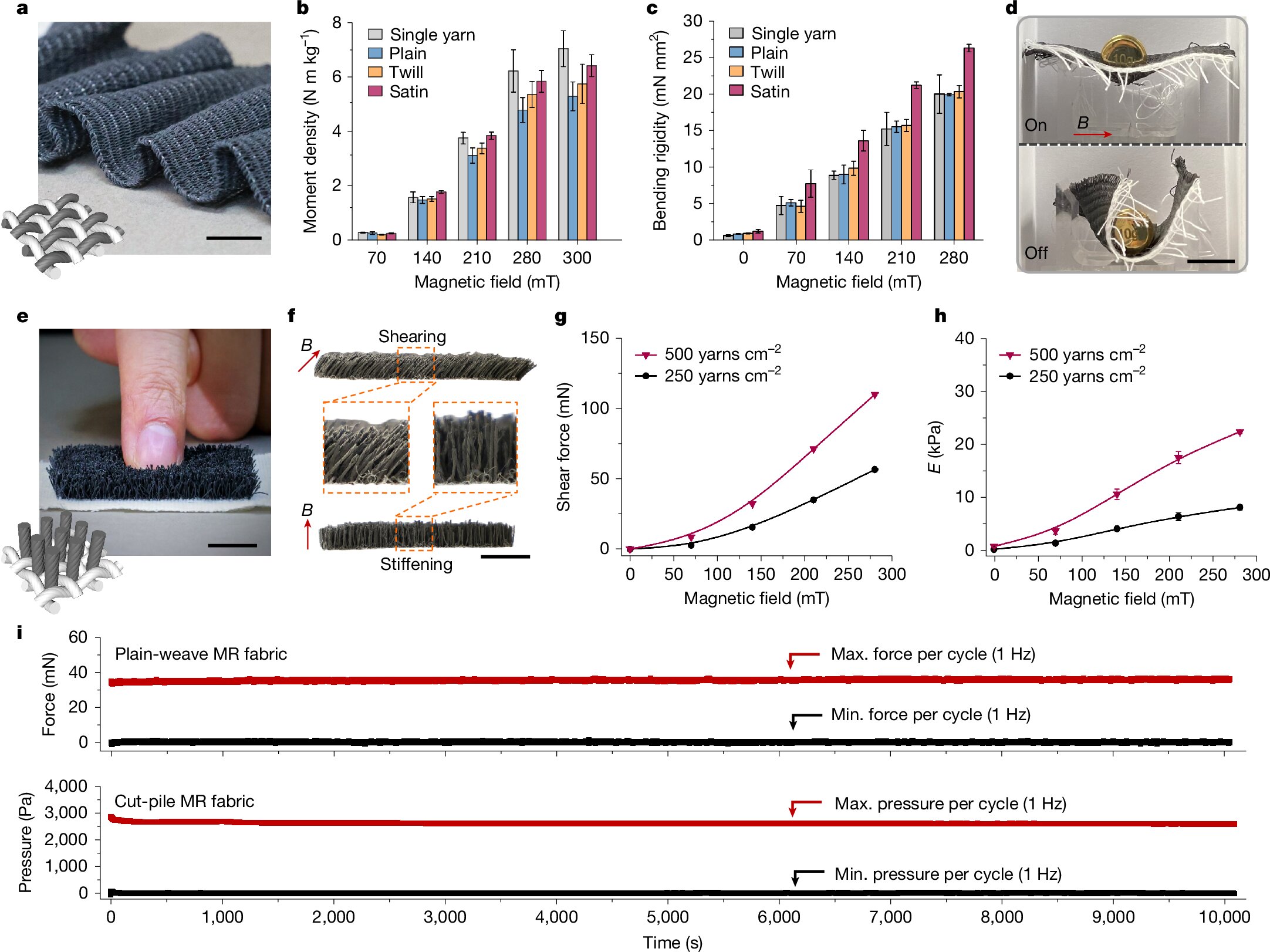
Robots aren’t always the most delicate of machines when handling fragile objects. They don’t have the lightness of touch of humans. But that could be about to change thanks to a new development in smart materials.
Researchers have developed a method for weaving flexible fibers that can be controlled by magnetic fields. Not only can this be used for robot hands to pick up objects like soft fruits, potato chips and worms, but it can also be used in a range of other applications. These include gloves that provide a realistic touch in virtual reality and breathable fabrics.
Creating a new smart fiber
In a paper published in the journal Nature, researchers detail how they created their smart textile, which can bend, stiffen or change its surface texture on demand. First, the team mixed tiny, soft magnetic particles (carbonyl iron) into extremely thin, flexible fibers of a polymer, LDPE (low-density polyethylene).
To overcome the challenge of making a fiber that is both thin and packed with magnetic materials, the researchers used a process called melt spinning. This high-speed technique allowed them to create fibers just 57 micrometers in diameter.
The next stage involved twisting seven of the fibers together into a helical yarn. The importance of this shape is that it can respond to a magnetic field from any direction. This is what truly sets it apart from other smart materials.
Instead of being limited to simple “on/off” reactions (like heating or stiffening when a voltage is applied), which is called scalar control, the helical shape provides the material with directional control. That means it can respond to the strength and direction of the magnetic field, which allows more sophisticated movements.
“Our work provides insights into stimuli-responsive fibrous materials, elevating them from scalar to sophisticated vector control, heralding an era of smart textile innovation,” wrote the researchers in their paper.
Real-world applications
The team created two types of fabrics from the yarn. A woven textile that is best for bending and stretching, and a cut-pile fabric that looks and feels like a soft brush. From the woven textile, they made a kind of fabric patch that automatically opens and closes tiny ventilation slits in response to a magnetic field cycling on and off. This could be used to manage sweat and heat instantly.
With the cut-pile fabric, they built a soft robotic gripper. Because the thousands of magnetic fibers can individually stiffen and mold around objects, the gripper enables robots to safely and gently pick up delicate objects.
Additionally, the researchers made a virtual reality haptic glove. When you grab a virtual object, a remote magnetic field stiffens the fibers or presses them against your skin to simulate real-world tactile sensations.
Next up for the team is to improve the materials for commercial use, ensuring they are durable and safe for comfortable, everyday clothing.
Written for you by our author Paul Arnold, edited by Gaby Clark, and fact-checked and reviewed by Robert Egan—this article is the result of careful human work. We rely on readers like you to keep independent science journalism alive.
If this reporting matters to you,
please consider a donation (especially monthly).
You’ll get an ad-free account as a thank-you.
More information:
Junhong Pu et al, Vector-stimuli-responsive magnetorheological fibrous materials, Nature (2025). DOI: 10.1038/s41586-025-09706-4
© 2025 Science X Network
Citation:
Novel smart fabrics give robots a delicate grip (2025, November 13)
retrieved 13 November 2025
from https://techxplore.com/news/2025-11-smart-fabrics-robots-delicate.html
This document is subject to copyright. Apart from any fair dealing for the purpose of private study or research, no
part may be reproduced without the written permission. The content is provided for information purposes only.










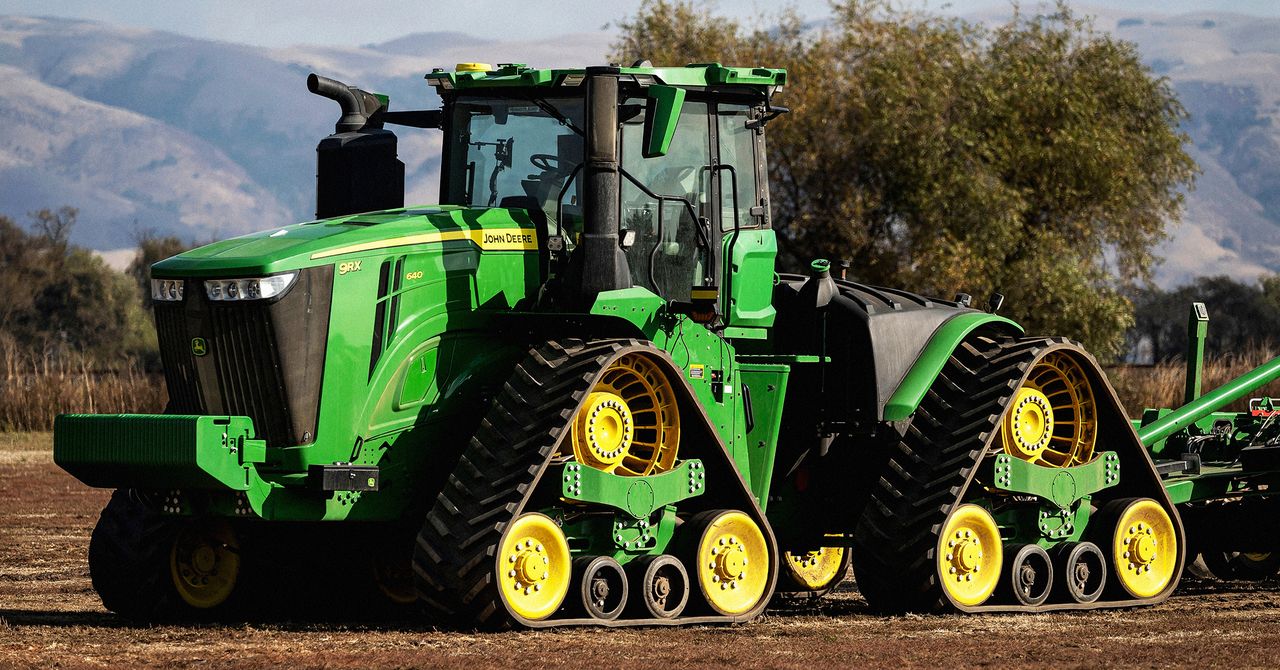
Iowa lawmakers voted to advance state House bill 751 last week, legislation that would ensure farmers in the state can freely repair their own agricultural equipment, like tractors. This Tuesday, the bill was renamed to House File 2709, and it will be voted on again. Should the political winds align, it will go through the Iowa House and Senate before the Iowa Legislature adjourns on April 21.
The bill is the first of nearly 57 state bills supported by repair advocates across the country in 2026. Many of them focus on farm equipment in states like Oklahoma, Wyoming, Delaware, and West Virginia. Repair advocates hope a win in Iowa—the second-highest-grossing state in the US for agricultural products, behind California—will help further legislative and broader efforts to make phones, cars, and other devices more repairable.
“This isn’t just a blue state thing; this isn’t just a Colorado activist thing,” says Elizabeth Chamberlain, director of sustainability for the right-to-repair advocate arm of iFixit. “Its real. Farmers have trouble repairing their equipment and want change.”
Farmers and their tractors have long been a focal point of the right-to-repair movement, the ever-growing global effort to let product owners fix their own devices and equipment without manufacturer approval. Farmers who use tractors to plant, cultivate, and harvest crops often need to repair their equipment while they work. Waiting for manufacturer approval to get something fixed, or taking the time to bring the equipment to an approved dealership, can cause delays, frustration, and missed opportunities to harvest crops.
The Iowa bill defines which agricultural equipment it covers, including tractors, trailers, combines, sprayers, balers, and other equipment used to cultivate and harvest crops. It excludes aircraft and irrigation equipment, along with jet skis and snowmobiles.
Manufacturers would also be required to provide owners with data—documentation, like manuals, and access to embedded operating software—on their tractors, including future patches and fixes, all without charging for it or requiring authorization for internet access. The bill also limits the use of digital locks—software restrictions that prevent accessing features without manufacturer approval.
Oh Deere
The most prominent opposition to the Iowa bill is tractor manufacturer John Deere, which has a long history of opposing repair efforts and frustrating farmers who want to take more control of their equipment. The company is still fighting a lawsuit the US Federal Trade Commission levied against John Deere in January 2025 for “unlawful” repairability policies. The company has lobbied against the Iowa bill and outright opposes its passing.
“John Deere is steadfast in supporting farmers’ ability to repair their equipment,” wrote a John Deere representative in a statement responding to WIRED’s inquiry. “And we back that up by offering industry-leading self-repair tools and resources to both equipment owners and alternative service providers.”
John Deere points to its online repair hub that catalogs ways its product owners can repair their products. Chamberlain says it is true that John Deere offers self-repair options, but they are not always in line with the reality of what farmers need to make fixes in the moment.
“Ultimately, it doesn’t matter if the vast majority of repairs are possible if there’s a repair that takes your equipment down and that means loss of harvest or having to wait weeks for a dealer representative to come out,” Chamberlain says.
John Deere has said it supports third-party and self-repair of its equipment before. In 2023, John Deere and the American Farm Bureau agreed to a memorandum of understanding about how the company would allow access to repairs on its products in response to repair laws passing in states like Colorado. But repair advocates criticized the move, saying the memorandum did little to make John Deere adhere to new regulations.

If you’re an esteemed Android user like me, and you felt left out of yesterday’s deal on the AirPods Pro 3, I’ve got you covered today with an even bigger discount on the Pixel Buds Pro 2. Both Amazon and Best Buy have the hazel color marked down from $229 to $180, a $49 discount on Google’s most upgraded wireless earbuds.
-
Photograph: Julian Chokkattu
-
-


The first change you’ll notice from the previous generation Pixel Buds Pro is that the newer model is much lighter, and the buds are 27 percent smaller. As a result, these are an excellent choice for anyone with small ears, and they stay put super well. Reviewer Parker Hall “had no problem doing hours of tree pruning and going on long sweaty runs in Portland’s early fall heat wave.”
With some help from top-notch physical sound isolation, the active noise-canceling on these is just as good as Apple’s and even goes toe-to-toe with big hitters like Bose and Sony. The transparency mode works just as well, too, with a wider range and clearer audio than a lot of other headphones offer. When it’s time to actually turn up the tunes, you can enjoy a wide, natural soundstage that has excellent detail in the midrange and clear, sparkling treble.
The Gemini integration, unfortunately, leaves a bit to be desired. It’s not the smoothest experience, particularly when asking multiple questions, and the Pixel Buds Pro 2 aren’t offering anything that other earbuds can’t do. Apple’s live translations and heart rate monitors are more useful features, but if you’re on Android, you’re locked out of them anyway.
If you’re interested in upgrading your earbud game, and you already have a Pixel, you can grab the Pixel Buds Pro 2 in hazel for $180 from either Amazon or Best Buy. If that color doesn’t suit you, I also spotted lesser discounts on the peony color for $189, or the porcelain color for $210. For anyone who isn’t already sold on the Pixel Buds Pro 2, make sure to swing by our guide to the best wireless earbuds, with picks for both Apple and Android owners.
Tech
‘Uncanny Valley’: Pentagon vs. ‘Woke’ Anthropic, Agentic vs. Mimetic, and Trump vs. State of the Union

Guys, before we go to break, there’s something very near and dear to my heart that WIRED wrote about this week. It’s something I love even more than biathlon. It is undersea internet cables.
Leah Feiger: I love when you talk about this. I think that the first time you brought this up to me was approximately one week into your tenure as executive editor, and you’re like, “Leah, do you know what I love?” and it’s undersea internet cables.
Brian Barrett: Yeah. I was like, “Number one, undersea internet cables. Number two, my children. Number three …” that was sort of the gist of it. That’s how I always introduce myself. I want to take everybody back to December 14th, 1988. The top movie in theaters is Twins starring Arnold Schwarzenegger and Danny DeVito.
Zoë Schiffer: Legitimately never heard of it.
Leah Feiger: Wait, Zoë. What?
Brian Barrett: What? Anyway, Arnold is agentic and Danny DeVito’s mimetic. The top song—
Zoë Schiffer: Now I get it.
Brian Barrett: —the top song is “Look Away” by Chicago. Now that, I also am not—I don’t remember that one at all. And the first undersea fiber optic cable connecting the United States, UK and France went live. This was the day that the internet went global, which is crazy—
Zoë Schiffer: That is crazy.
Brian Barrett: —that it was relatively recent. The reason we’re writing about it now is that that original cable, which is called TAT-8, is being pulled up. It’s out of commission. It’s old, it’s decrepit, so I identify, and it’s being pulled up and put out to pasture because the technology’s gotten better. But in this great feature that we published, it is a look at how this changed the world basically, and how we take for granted—but the reason I am so into undersea cable stories is because it’s so easy to forget that the internet is a physical thing and that the maintenance of those things is really what makes all this connectivity happen. So yeah, TAT-8. Any other fond memories of TAT-8? Or, no. What did you guys think reading this feature?
Zoë Schiffer: Well, famously we were not alive in 1988.
Leah Feiger: Yeah. Sorry, Brian. You’re older than us. Just a reminder.
Brian Barrett: Hurts.
Zoë Schiffer: But the part of this story that I wanted to talk about, which felt like a real intersection of both of your interests was the myth of the shark attacks.
Brian Barrett: Oh, yeah.
Leah Feiger: OK. So to back up a little bit, these cables, at the very beginning, when they were put in, Brian would be able to talk about this way more because he’s kind of a freak about cables if you haven’t realized already. These cables would sometimes have unexplained damage, and looking back on it years later, engineers figured out that this kind of happens, that if you are putting cables underseas, there will be wind, there will be changes, things will get moved around. Of course, there will be damages, but that is not how they felt at the time. These engineers assumed that it was sharks, that sharks were biting their cables, that they were destroying the internet. The cables were reinforced with all these protective layers, all of these things, because they were like, “Oh, my God, the sharks are quite literally ending all of this for us.” But this article goes into great detail of how they figured out it wasn’t the sharks, and by thinking that it was the sharks, it actually helped make all of this technology that much better and stronger, but the sharks were innocent, you guys. The sharks were innocent.


Switzerland’s Rieter orders steady at $907 mn amid cautious market

Sharon Osbourne curates special BRIT awards tribute for Ozzy

The 2026 men’s college basketball coaching carousel guide

-
 Tech1 week ago
A $10K Bounty Awaits Anyone Who Can Hack Ring Cameras to Stop Sharing Data With Amazon
-
 Business7 days ago
US Top Court Blocks Trump’s Tariff Orders: Does It Mean Zero Duties For Indian Goods?
-

 Fashion7 days ago
ICE cotton ticks higher on crude oil rally
-

 Tech1 week ago
Donald Trump Jr.’s Private DC Club Has Mysterious Ties to an Ex-Cop With a Controversial Past
-
 Business6 days ago
Eye-popping rise in one year: Betting on just gold and silver for long-term wealth creation? Think again! – The Times of India
-

 Entertainment6 days ago
Viral monkey Punch makes IKEA toy global sensation: Here’s what it costs
-

 Sports7 days ago
Brett Favre blasts NFL for no longer appealing to ‘true’ fans: ‘There’s been a slight shift’
-

 Entertainment7 days ago
The White Lotus” creator Mike White reflects on his time on “Survivor