

Business
OGRA dismisses reports of Rs73 petrol, Rs84 diesel hike as ‘completely baseless’ | The Express Tribune

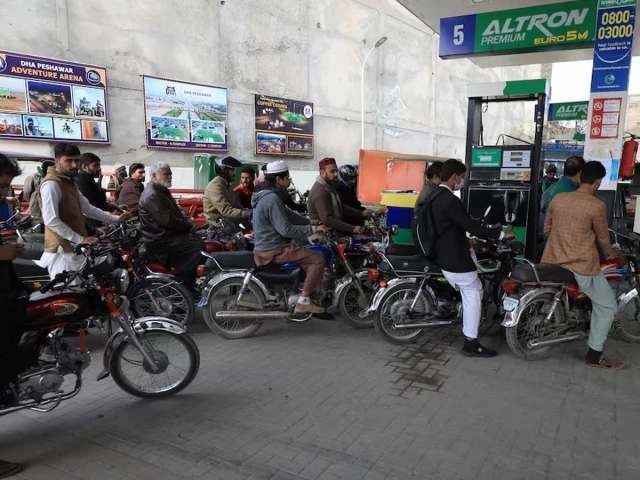
People wait for their turn to get fuel at a petrol station in Peshawar. Photo: Reuters/ File
KARACHI:
The Oil and Gas Regulatory Authority (OGRA) on Tuesday rejected reports circulating on social media claiming a Rs73 increase in petrol prices and a Rs84 increase in diesel prices.
OGRA spokesperson Imran Ghaznavi told The Express Tribune that messages claiming a significant rise in petrol prices had no basis. “The message circulating on social media regarding an increase in petrol prices is completely false and misleading. No such summary has been sent by the OGRA to the prime minister,” he said.
“The public is advised not to rely on unverified social media forwards and to follow only official announcements issued by the Government of Pakistan or OGRA through verified channels,” he added.
The Associated Press of Pakistan (APP) had reported rumours circulating on social media about a petrol price increase of Rs73.40 and a possible diesel hike, which OGRA rejected.
A day earlier, while announcing austerity measures in the wake of the Middle East crisis, Prime Minister Shehbaz Sharif said petrol prices were expected to rise internationally in the coming days, but the government would try not to pass the burden on to the public.
Commenting on the recent increase in fuel prices, he said the government had been forced to raise oil prices in recent days, which he acknowledged was “undoubtedly a very difficult decision”. “I was advised to raise petrol prices much more than what was eventually announced, but I chose a middle path,” he added.
Read More: PM Shehbaz announces 4-day work week
Last Friday, the government increased the petrol and diesel prices by Rs55 per litre or 20%, signaling his government’s willingness to preempt any crisis. However, the increase in petrol prices was Rs23 per litre more than the need and the government went on to earn more revenues rather than sticking to the principle of just recovering the international oil prices from the domestic consumers.
The sharp increase has intensified the cost of living, with residents reporting higher transport fares and rising prices of daily-use items.
People also reported disputes at petrol pumps, where attendants were refusing to dispense fuel worth less than one litre. According to residents, many customers asked for petrol worth Rs150 or Rs200, but pump staff declined, saying the nozzle rate is fixed and fuel is either dispensed in smaller or larger quantities, leading to frequent arguments.
The rise in petrol prices also pushed up the cost of fruits, vegetables and other daily necessities. Shopkeepers said the transport cost of bringing fruits, vegetables and goods had previously been around Rs1,000 per trip but had now increased to between Rs2,500 and Rs3,000.
Drivers providing pick-and-drop services for schoolchildren have also raised their fares, with residents saying the entire burden has shifted to the public.





Home sales made a small gain to start the year, but higher mortgage rates now could throw cold water on the spring season.
Existing home sales in February rose 1.7% from January to a seasonally adjusted, annualized rate of 4.09 million units, according to the National Association of Realtors. Sales were down 1.4% from February of last year.
This count represents closed sales, so deals were likely inked in December and January, when mortgage rates fell a bit and stayed solidly in a low range near 6% on the 30-year-fixed mortgage. Rates were about a full percentage point higher the year before.
“Despite the modest gain in home sales, actual housing demand remains muted relative to wage growth and job gains,” Lawrence Yun, chief economist for the Realtors, said in a release. “Wage growth is now outpacing home price growth by almost four percentage points. Mortgage rates are also measurably lower compared to a year ago.”
Yun also noted that there are over 6 million more jobs now than there were in 2019, yet home sales per year are down by 1 million.
Lower mortgage rates helped improve affordability slightly, but low inventory is still a significant headwind. There were 1.29 million units for sale at the end of February, an increase of 2.4% from January and 4.9% from February 2025. At the current sales pace, that is a 3.8-month supply, unchanged from January. A six-month supply is considered a balanced market between buyer and seller.
More sellers who delisted their homes last fall, due to slower sales and weak consumer confidence, are relisting their homes now, according to Redfin, a real estate brokerage. Nearly 45,000 homes that were delisted last year were relisted for sale in January. That is the highest January figure since Redfin began tracking this metric a decade ago and represents a record 3.6% of homes that were on the market in January.
“Inventory is growing, but sluggishly,” Yun said. “If demand picks up notably in the coming months and outpaces supply growth, home prices will inevitably rise. That is why increasing supply is so important to help limit home price growth, improve housing affordability, and boost transactions.”
Tight supply, however, is keeping prices just barely higher. The median price of a home sold in February was $398,000, an increase of 0.3% year over year. Sales continue to be strongest in the highest price category, properties listed at $1 million or above. Sales were down sharply on the lowest end of the market.
It continues to take longer to sell a home, at 47 days, up from 42 days one year ago. First-time buyers represented 34% of total sales, an increase from 31% a year ago. Investors made up 16% of sales, unchanged from a year ago.

Europe’s largest carmaker said post-tax profits had dropped to their lowest level since 2016.
Source link
Business
Major UAE refinery shut as Saudi Aramco warns war spells catastrophe for oil | The Express Tribune
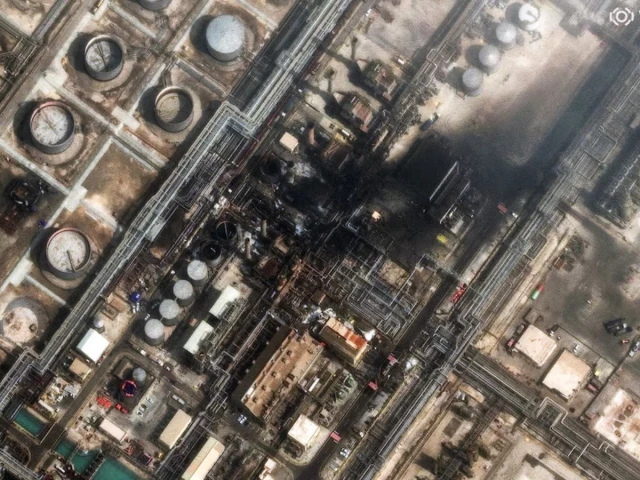
State-owned oil company Adnoc describes its Ruwais facility as ‘the world’s fourth-largest single-site refinery’
A satellite image shows smoke rising in the Ras Tanura oil refinery in Saudi Arabia after a drone attack, in Ras Tanura, Saudi Arabia, March 2 PHOTO: REUTERS
One of the world’s largest refineries in the United Arab Emirates was shut as a “precaution” after a drone attack nearby, a source said, while Saudi giant Aramco warned of the war’s devastating consequences on oil.
Aramco CEO and president Amin H. Nasser warned the war could have “catastrophic consequences” on oil markets, and called for reopening the Strait of Hormuz — which normally carries about 20% of global oil supplies but has been closed by the conflict.
Tehran appears to be attempting to knock major Gulf refineries offline as it tightens its chokehold on the Strait of Hormuz in a quest to inflict maximum pain on the global economy.
“The Ruwais refinery has halted operations out of precaution,” the source said, requesting anonymity to discuss sensitive matters.
Read More: Iran vows ‘eye for an eye’, warns Trump to ‘be careful not to be eliminated’
Earlier, the Abu Dhabi Media Office said a drone attack caused a fire in Ruwais Industrial City in the emirate of Abu Dhabi.
تتعامل الجهات المختصة في إمارة أبوظبي مع نشوب حريق في إحدى المنشآت ضمن مجمع الرويس الصناعي، ناجم عن استهداف بالطائرات المسيرة، دون تسجيل إصابات حتى الآن.
وأهابت الجهات المختصة بالجمهور استقاء المعلومات من المصادر الرسمية فقط، وتجنُّب تداول الشائعات أو المعلومات غير الموثوقة.
— مكتب أبوظبي الإعلامي (@ADMediaOffice) March 10, 2026
Neither the source nor the authorities said whether the refinery had been hit.
State-owned oil company Adnoc describes its Ruwais facility as “the world’s fourth-largest single-site refinery”.
The Middle East war has now severely destabilised supplies. Iran has fired at energy installations across the Gulf, including Aramco’s sprawling Ras Tanura facility, which halted some operations.
The massive complex on the Gulf coast is home to one of the Middle East’s largest refineries and is a cornerstone of the Saudi energy sector.
Saudi oil fields have also been targeted.
A driver working at the Ruwais industrial complex told AFP he was picking up staff who were ordered to evacuate.
“Just as we were about to leave, we saw two more bursts of fire rising from the complex, with loud sounds like explosions,” he said, requesting not to be named.
Read More: Over 10,000 Chinese citizens return from Middle East amid war
‘Chain reaction’
“The disruption has caused a severe chain reaction in not only shipping and insurance but there’s also a drastic domino effect on aviation, agriculture, automotive and other industries,” Nasser told a media call to announce Aramco’s 2025 earnings.
“There would be catastrophic consequences for the world’s oil markets the longer the disruption goes on, and the more drastic the consequences for the global economy.
The oil-rich Gulf has borne the brunt of Iran’s attacks in response to US-Israeli strikes that sparked the Middle East war, with Tehran targeting US assets but also civilian infrastructure, including energy facilities and airports.
“While we have faced disruptions in the past, this one by far is the biggest crisis the region’s oil and gas industry has faced.”
“It’s absolutely critical that shipping resumes in the Strait of Hormuz,” Nasser said.
Oil prices have swung wildly over supply disruptions, rocketing 30% on Monday before plunging again on comments from United States President Donald Trump that the war may soon end.
“The Gulf energy sector is getting whacked from multiple angles,” said Robert Mogielnicki, a non-resident scholar at the Arab Gulf States Institute.
“Energy facilities being targeted, export capability though the strait is hampered, and storage capacity filling up,” he added.
‘Dangerous precedent’
Iranian attacks have already forced state-owned QatarEnergy, one of the world’s largest producers of liquefied natural gas, to halt production last week and declare force majeure.
Energy producers in Kuwait made similar declarations, which are a warning that events beyond their control may lead them to miss export targets.
Nasser was speaking as Aramco reported a 12.1% decline in net income in 2025 after higher supply, US tariffs and other economic headwinds weighed on revenues.
The Saudi giant, which launched a record initial public offering in 2019, also announced a first-ever share buyback programme of up to $3 billion over 18 months.
Qatar’s foreign ministry spokesman Majed al-Ansari also warned today that attacks on energy facilities “on both sides, are a dangerous precedent … it will cause repercussions throughout the world”.
Throughout last year, the oil alliance OPEC+, of which Saudi Arabia is a key member, oversaw an increase in production, eroding prices.


Sherrone Moore’s alleged mistress speaks out, claims ‘years of manipulation’ from disgraced ex-Michigan coach

Tap dancing great Brenda Bufalino reflects on her career and the evolution of the art form

Those who dream of destroying Iran know nothing of its history: Pezeshkian

-

 Politics3 days ago
India let Iran warship dock the day US sank another off Sri Lanka, say officials
-

 Sports4 days ago
Pakistan set for FIH Pro League debut | The Express Tribune
-

 Entertainment3 days ago
Harry Styles kicks off new era with ‘One Night Only’ comeback show
-
 Business3 days ago
Restaurant group changes name after bid to buys pubs across the UK
-
 Business1 week ago
Labour parliamentarians urge UK Government to oppose Rosebank oil field
-
 Business4 days ago
Home heating oil: ‘Most of my pension has gone on home heating oil’
-

 Sports4 days ago
Winners and losers of the 2026 NHL trade deadline
-

 Sports1 week ago
USA vs. Argentina (Mar 1, 2026) Live Score – ESPN