

Politics
Philippines quake death toll climbs over 60; injured overwhelm hospitals

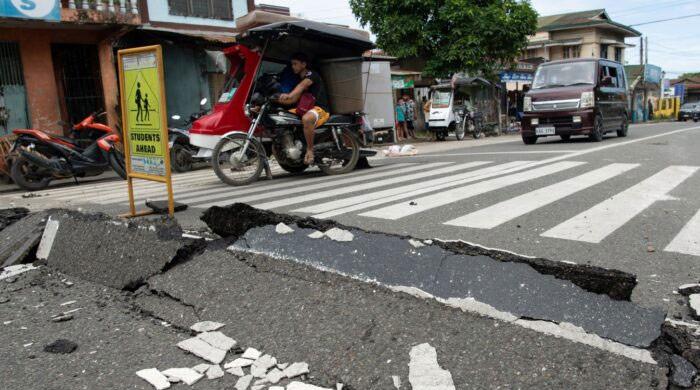
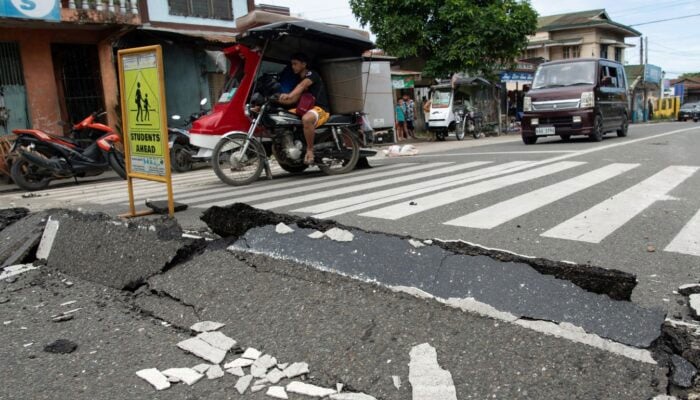
- More than 150 injured in quake, say officials.
- No tsunami threat, multiple aftershocks recorded.
- President Marcos Jr expresses condolences.
The death toll from a powerful earthquake in the central Philippines has climbed to over 60 on Wednesday, with injured patients overwhelming hospitals on the island of Cebu as workers carried dozens of body bags away in the chaotic aftermath.
The shallow magnitude 6.9 quake struck at 9:59pm (1359 GMT) Tuesday off the island’s northern end near Bogo, a city of 90,000 people, according to the US Geological Survey (USGS).
Injured children cried and adults screamed while receiving treatment on beds laid out beneath blue tents on the driveway of the Cebu Provincial Hospital in Bogo.
They had been wheeled out of the building amid fears of further harm as hundreds of aftershocks rocked the region overnight.
Nearby, hospital workers carried black body bags on stretchers into vans that will take them to local mortuaries, AFP journalists saw.
Up to 60 people are reported killed so far, Office of Civil Defence deputy administrator Rafaelito Alejandro said.
“We are receiving additional numbers of reported casualties so this thing is very fluid,” he told reporters in Manila.
The National Disaster Risk Reduction and Management Council earlier listed 147 injured across the central islands, where 22 buildings were damaged.
Rescuer Teddy Fontillas, 56, told AFP he had not slept a wink, adding some patients had to be moved to other hospitals because the one in Bogo was already overflowing.
“We are already overwhelmed, so we have to bring them to the city,” he said, referring to the provincial capital Cebu, some 100 kilometres (60 miles) to the south.
“I’m already struggling, but what we are doing is necessary to help our patients,” he added.
“Because of the high volume of patients with serious injuries, the medical staff tended to some of them outside the hospital,” Cebu provincial governor Pamela Baricuatro posted on her official Facebook page.
Dramatic footage filmed by residents and widely shared on social media showed an old Catholic church on Bantayan island near Cebu adorned with a string of light bulbs swaying wildly shortly before its belfry tumbled into the courtyard.
“I heard a loud booming noise from the direction of the church then I saw rocks falling from the structure. Luckily, no one got hurt,” Martham Pacilan, 25, who was nearby when the belfry collapsed, told AFP.
Local television showed riders being forced to dismount from their motorcycles and hold onto the railings for dear life as a Cebu bridge violently rocked.
‘The mall started shaking’
Buildings were damaged as far as Cebu city, where online shoe merchant Jayford Maranga, 21, hid under a restaurant table to avoid being struck by the collapsing metal ceiling of a shopping mall.
“My friend and I ate at the food court near closing time, and then, bang! It was as if the Earth stopped spinning. And then the mall started shaking,” Maranga told AFP, adding his friend was slightly injured.
The Cebu provincial government has put out a call on its official Facebook page for medical volunteers to assist in the aftermath of the quake.
“There could be people trapped beneath collapsed buildings,” provincial rescue official Wilson Ramos told AFP.
Overnight recovery efforts were hampered by the dark as well as aftershocks, he added.
The rescue effort proceeded all night, even as the Philippine Institute of Volcanology and Seismology said the region was being rocked by 379 aftershocks.
The quake caused power lines to trip, leading to outages across Cebu and nearby central islands, though power was restored shortly after midnight in Cebu and four other major central islands, the National Grid Corp. of the Philippines said in an updated advisory.
The Cebu provincial government reported a commercial building and a school in Bantayan had collapsed, while a fast food restaurant in Bogo was heavily damaged.
Agnes Merza, 65, a carer based in Bantayan, said her kitchen tiles had cracked.
“It felt as though we would all fall down. It’s the first time I have experienced it. The neighbours all ran out of their homes. My two teenage assistants hid under a table because that´s what they were taught in the Boy Scouts,” she told AFP.
A number of village roads also sustained damage. In Tabogon town, the road was riddled with five-centimetre (two-inch) cracks, AFP journalists saw.
The USGS had reported a magnitude reading of 7.0 before revising it down, while the Pacific Tsunami Warning Centre said there was no tsunami threat from the earthquake.
Quakes are a near-daily occurrence in the Philippines, which is situated on the Pacific “Ring of Fire”, an arc of intense seismic activity stretching from Japan through Southeast Asia and across the Pacific basin.
Most are too weak to be felt by humans, but strong and destructive ones come at random, with no technology available to predict when and where they might strike.
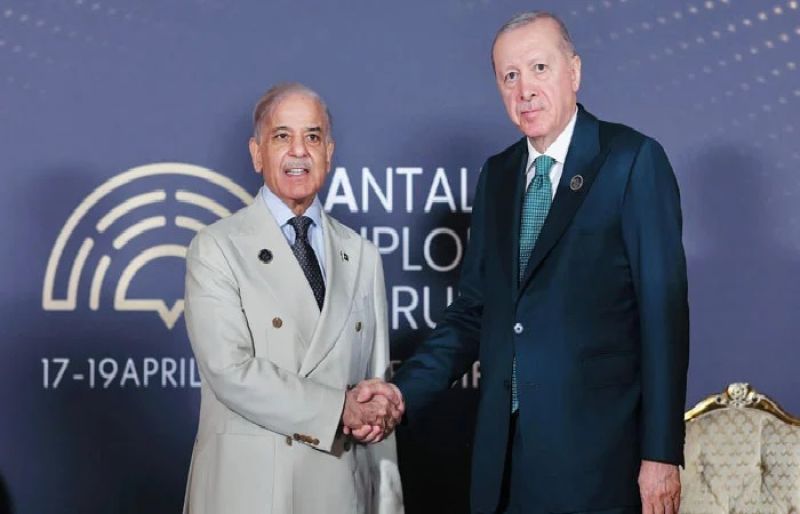
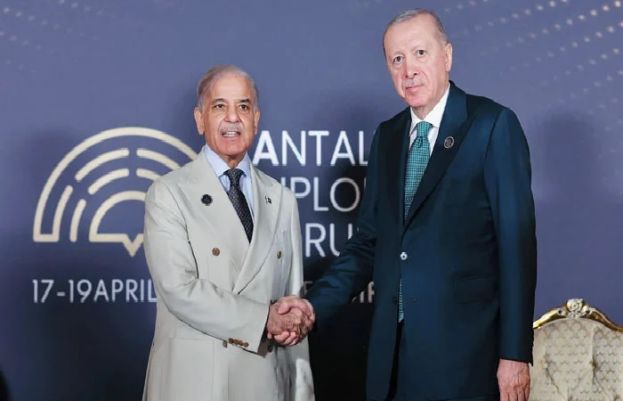
Prime Minister Shehbaz Sharif on Friday held a bilateral meeting with Turkish President Recep Tayyip Erdogan on the sidelines of the 5th Antalya Diplomacy Forum.
According to a statement released by the Prime Minister’s Office, during the warm and cordial meeting, President Erdogan welcomed PM Shehbaz to Turkiye and thanked him for attending the Antalya Diplomacy Forum.
The meeting comes a day after the premier reached Turkiye on the third leg of his tri-nation tour after concluding visits to Saudi Arabia and Qatar.
During his visit to Riyadh and Doha, PM Shehbaz held meetings with Saudi Crown Prince Mohammed bin Salman and Qatar’s Emir Sheikh Tamim bin Hamad Al Thani.
The Turkish president, during the meeting with PM Shehbaz on the sidelines of the diplomacy forum earlier today, praised the prime minister’s peace efforts and said Turkiye would continue to support Pakistan’s diplomatic initiative to bring peace to the region.
The prime minister thanked President Erdogan for his warm invitation and traditional Turkish hospitality extended to him and his delegation during his stay in Antalya.
He congratulated the Turkish president on the success of the Antalya Diplomacy Forum, which he said had transformed into an important global event.
The two leaders exchanged views on recent regional developments, particularly the evolving situation in the Middle East. PM Shehbaz thanked Erdogan for his strong support and encouragement of Pakistan’s peace efforts and shared with him the updates on how to extend the ceasefire and resume talks so that a peace agreement could be reached.
The two leaders also emphasised the importance of effectively utilising the current window of opportunity to advance a durable and lasting regional peace.
While reaffirming the deep-rooted, historic, and brotherly ties between Pakistan and Turkiye, both leaders expressed satisfaction at the positive trajectory of bilateral relations. They agreed to convene the 8th High-Level Strategic Cooperation Council (HLSCC) meeting in Ankara later this year.
The two leaders emphasised the importance of expediting the implementation of ongoing initiatives and exploring new opportunities to further deepen economic engagement.
The meeting concluded with both leaders reaffirming their resolve to further strengthen the strategic partnership between Pakistan and Türkiye, building on fraternal ties and a shared vision for peace and prosperity.
The meeting was attended by Deputy Prime Minister and Foreign Minister Ishaq Dar, Minister for Information Ataullah Tarar and other senior officials.
Turkish Foreign Minister Hakan Fidan and other senior Turkish officials were also present.
PM meets world leaders on sidelines of diplomacy forum
Prime Minister Shehbaz Sharif held a series of meetings with world leaders on the sidelines of the Antalya Diplomacy Forum.
During the interactions, the prime minister met Qatar’s Emir Sheikh Tamim bin Hamad Al Thani, Kazakhstan’s President Kassym-Jomart Tokayev, Azerbaijan’s President Ilham Aliyev, and Syria’s President Ahmed al-Sharaa.
He also held meetings with Qatar’s Prime Minister and Foreign Minister Sheikh Mohammed bin Abdulrahman bin Jassim Al Thani, as well as former Kosovo president Vjosa Osmani.
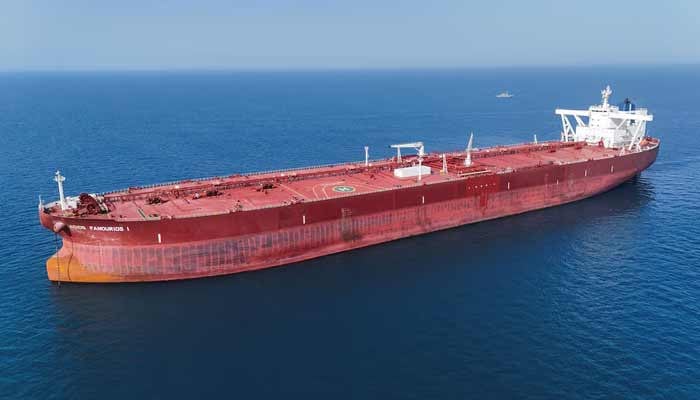
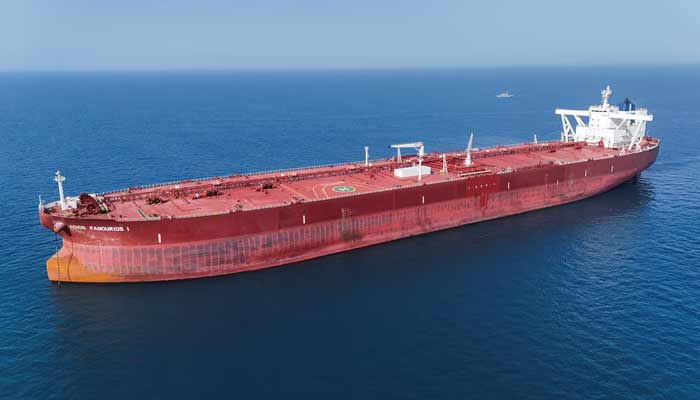
The world has lost over $50 billion worth of crude oil that has not been produced since the Iran war began nearly 50 days ago and the aftershock of the crisis will be felt for months and even years to come, according to analysts and Reuters calculations.
Iranian Foreign Minister Abbas Araghchi said on Friday the Strait of Hormuz was open following a ceasefire accord agreed in Lebanon, while US President Donald Trump said he believed a deal to end the Iran war would come “soon”, though the timing remains unclear.
Since the crisis began at the end of February, more than 500 million barrels of crude and condensate have been knocked out of the global market, according to Kpler data — the largest energy supply disruption in modern history.
Put differently, 500 million barrels of oil lost to the market is equivalent to:
Curtailing aviation demand globally for 10 weeks; no road travel by any vehicle globally for 11 days; or no oil for the global economy for five days, said Iain Mowat, principal analyst at Wood Mackenzie.
Nearly a month of oil demand in the United States, or more than a month of oil for all of Europe, according to Reuters estimates.
Roughly six years of fuel consumption for the US military, based on annual usage of about 80 million barrels from fiscal year 2021.
Enough fuel to run the world’s international shipping industry for around four months.
Key facts:
Gulf Arab countries lost about 8 million barrels per day of crude production in March, nearly equivalent to the combined production of Exxon Mobil and Chevron, two of the biggest oil companies in the world.
Jet fuel exports from Saudi Arabia, Qatar, the United Arab Emirates, Kuwait, Bahrain and Oman fell from about 19.6 million barrels in February, to just 4.1 million barrels for March and April so far combined, according to Kpler data.
The loss in exports would have been enough for around 20,000 round-trip flights between New York’s JFK airport and London Heathrow, according to Reuters estimates.
With crude prices averaging around $100 a barrel since the conflict began, those missing volumes represent roughly $50 billion in lost revenues, said Johannes Rauball, a senior crude analyst at Kpler. That equates to a 1% cut in Germany’s annual gross domestic product, or roughly the entire GDP of smaller countries such as Latvia or Estonia.
Full restoration could take years
Even as Iranian Foreign Minister Araghchi said the Strait of Hormuz was open, recovery of output and flows is expected to be slow.
Global onshore crude inventories have fallen by about 45 million barrels so far in April, according to Kpler. Since late March, production outages have reached roughly 12 million bpd.
Heavier crude fields in Kuwait and Iraq could take four to five months to return to normal operating levels, extending stock draws through the summer, Rauball said. Damage to refining capacity and Qatar’s Ras Laffan LNG complex means full restoration of regional energy infrastructure could take years.
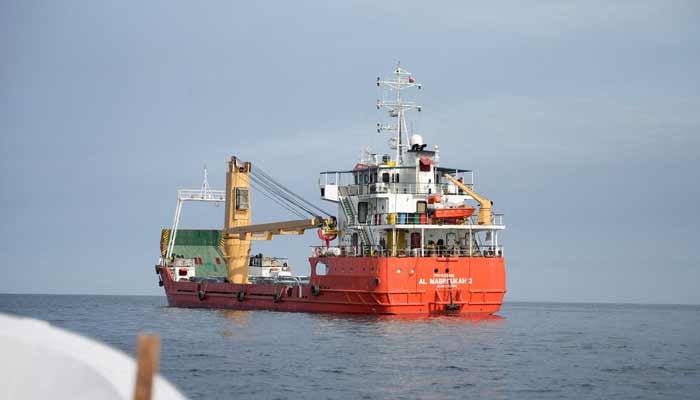
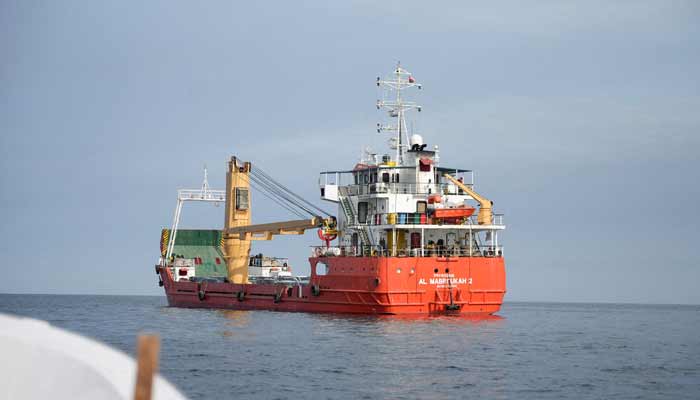
Shipping industry figures gave a cautious welcome on Friday to Iran’s announcement that it was reopening the crucial Strait of Hormuz trade route to commercial freight after nearly seven weeks closed.
Iranian forces’ closure of the strait has trapped hundreds of ships in the Gulf and driven up the costs of shipping goods, with captains avoiding the region for fear of attacks or mines.
A spokesman for German transportation giant Hapag-Lloyd, which has ships stuck in the Gulf, told AFP by phone that the reopening was “in general… good news”.
But he cautioned that shippers still needed details of what route vessels could take and in what order, citing fears of sea mines.
“One thousand ships cannot just go now to the entrance of the strait, that will be chaos. They (the Iranians) need to give clear orders,” said the spokesman, Nils Haupt.
“We would be ready to go very soon if some of these open questions can be solved within the weekend.”
Bloomberg data indicated there were about 770 vessels used for carrying commodities sending transponder signals inside the Gulf on Thursday, of which about 360 were oil and gas carriers.
Before the war, average daily crossings of the strait overall numbered about 120, according to industry journal Lloyd’s List.
‘Inaccurate’
Afer Iran’s announcement on Friday, US President Donald Trump said the Islamic republic had declared the waterway “fully open and ready for full passage”.
Jakob Larsen, chief security officer of major shipping association Bimco, said in a statement emailed to AFP that this claim was “inaccurate”.
“The status of mine threats in (Iran’s maritime) traffic separation scheme is unclear, and Bimco believes shipping companies should consider avoiding the area,” he said.
The secretary general of leading industry lobby the International Chamber of Shipping, Thomas Kazakos, said the announcement was “a positive step (but) there is still much uncertainty around what it means in practice”.
In a statement sent to AFP, he said it offered “a cautious measure of reassurance to” shippers and the thousands of seafarers stuck in the Gulf by the Middle East war for nearly seven weeks.
“It is essential that it marks the beginning of a broader and more durable return, beyond the current ceasefire, to freedom of navigation in one of the world’s most critical maritime corridors,” he said.


Nathalie Baye, low-key legend of French cinema, dies aged 77

Transfer rumors, news: Liverpool eye Wharton amid Man United, Real Madrid interest

The Best Movies to Stream This Month

-

 Politics1 week ago
Indian airlines hit hardest after Dubai limits foreign flights until May 31
-

 Entertainment5 days ago
Palace left in shock as Prince William cancels grand ceremony
-

 Sports5 days ago
The case for Man United’s Fernandes as Premier League’s best
-

 Politics1 week ago
Chinese, Taiwanese will unite, Xi tells Taiwan opposition leader
-

 Sports1 week ago
Documents: NC State trainer initiated ‘unwelcome,’ ‘sexual’ contact
-

 Entertainment1 week ago
Dua Lipa hits major career high ahead of wedding with Callum Turner
-
 Business5 days ago
UK could adopt EU single market rules under new legislation
-
 Business1 week ago
He paid $248 in illegal tariffs for this coat. Will he ever get it back?